Stablecoin Crime Wave? $141B In Illicit Activity Reported This Year

bitcoinistPublished on 2026-02-20Last updated on 2026-02-20

Abstract

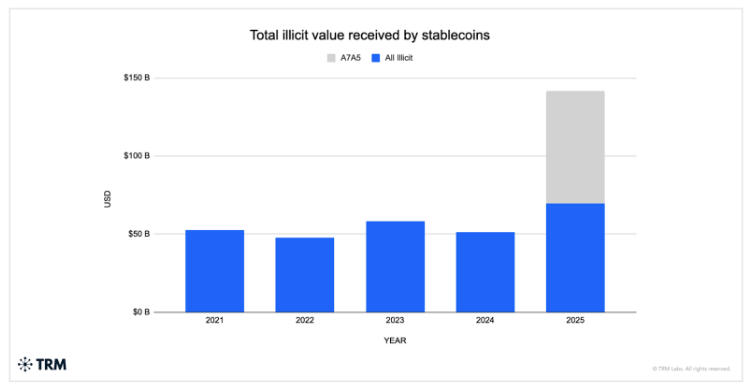
In 2025, approximately $141 billion in stablecoins was reportedly acquired by illicit actors, largely due to their predictable value and fast transaction speeds. Sanctions-related networks accounted for about 86% of these illicit flows, with $72 billion tied to a Russian ruble-pegged token. These networks also showed connections to China, Iran, North Korea, and Venezuela. Stablecoins were heavily used in guarantee marketplaces and human trafficking operations, where payment certainty and liquidity were prioritized. While scams and ransomware often start in Bitcoin or Ether, funds are frequently converted to stablecoins during laundering. The stablecoin market capitalization exceeded $270 billion in early 2026, dominated by Tether’s USDT ($180B) and Circle’s USDC ($70B), which together control over 90% of the market.

In 2025, about $141 billion in stablecoins reportedly ended up in the hands of illicit actors. Much of this activity was funneled through a few networks that favored stablecoins for their predictable value and quick transfers.

Much of that movement is tied to a small number of networks that use stablecoins for their speed and price stability. That does not mean widespread criminal use across all stablecoins. It points to concentrated channels where these tokens meet a specific need: moving value reliably outside regular banking rails.

Sanctions Linked Networks Drive The Bulk Of Flows

According To TRM Labs, sanctions-related flows made up roughly 86% of detected illicit crypto transfers last year. Around $72 billion of the stablecoin total traced back to a ruble-pegged token linked to Russian networks.

These networks are not isolated. Reports note overlaps with entities tied to China, Iran, North Korea, and Venezuela, which shows how stablecoins can act as bridges between different sanctioned systems.

The mechanics are simple: price stability matters when you need predictable settlement and low volatility risk. Stablecoins offer that.
Guarantee Marketplaces And Human Trafficking Rely On Stablecoins

Volume on certain marketplaces surged, mostly in stablecoins. Some escrow and guarantee sites — which act like middlemen for high-value transfers — saw tens of billions of dollars flow through their systems.

Reports note these venues are almost totally stablecoin-denominated, which raises red flags about their role in moving funds tied to illicit trade. Chainalysis and others have also pointed to sharp increases in flows to networks connected to human trafficking and escort services, and those operations leaned heavily on stablecoins for payments.

In these cases, payment certainty and liquidity matter more to the buyers and sellers than the chance of gains.
Different Types Of Crime Use Different Paths

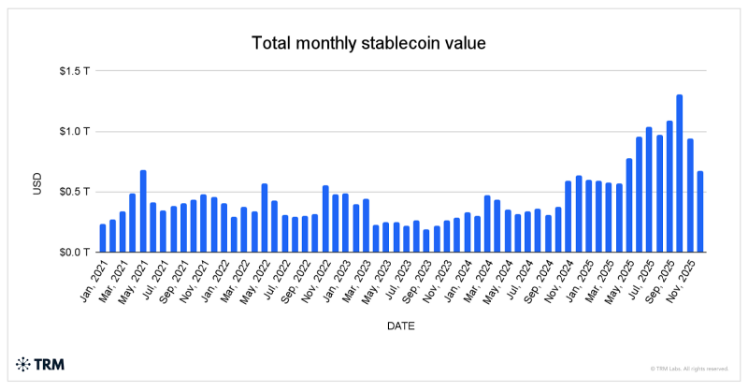
Scams, ransomware, and thefts often start in Bitcoin or Ether and then shift into stablecoins later in the laundering chain. That pattern is common because attackers want an asset that holds value while they move it through fewer hands.

BTCUSD now trading at $67,833. Chart: TradingView

Market Cap

Meanwhile, the global stablecoin market has grown into a multi‐hundred‐billion‐dollar sector, with total market capitalization topping roughly $270 billion in early 2026.

According to data tracking site Stablecoin.com, the combined value of all major stablecoins consistently sits above the mid‐hundreds of billions mark, with fiat‐backed coins accounting for most of that total.

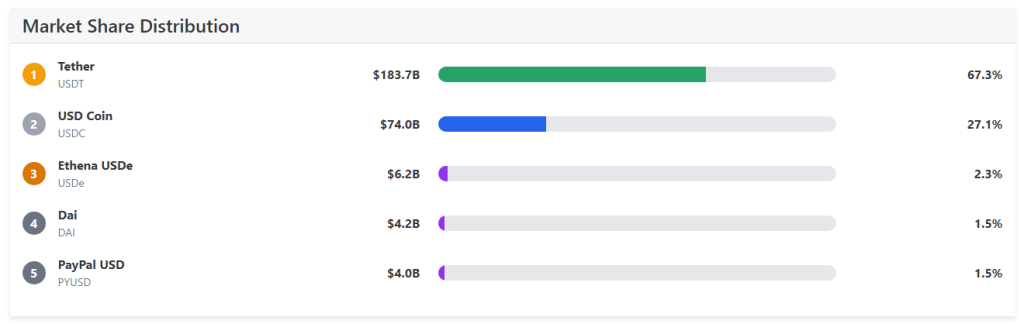
Two issuers dominate the sector. Tether’s USDT leads by a wide margin, with a market cap often reported at around $180 billion or more, and representing more than two‐thirds of the total stablecoin market.
Source: Stablecoin.com

Circle’s USD Coin (USDC) sits in second place with a market cap often above $70 billion, jointly holding over 90% of stablecoin capitalization when combined with USDT.

Smaller stablecoins like Ethena USDe, DAI, and PayPal USD make up a much smaller portion of the market but signal ongoing diversification among providers, the data tracker said.

Featured image from Unsplash, chart from TradingView

Related Questions

QHow much in stablecoins reportedly ended up in the hands of illicit actors in 2025?

AAbout $141 billion in stablecoins reportedly ended up in the hands of illicit actors in 2025.

QWhat percentage of detected illicit crypto transfers last year were sanctions-related, according to TRM Labs?

ASanctions-related flows made up roughly 86% of detected illicit crypto transfers last year.

QWhich two stablecoin issuers dominate the market and what is their combined market share?

ATether's USDT and Circle's USD Coin (USDC) dominate the market, jointly holding over 90% of the stablecoin market capitalization.

QWhat is a key reason illicit actors use stablecoins for transactions, according to the article?

AIllicit actors use stablecoins for their predictable value, quick transfers, and price stability, which provides reliable settlement with low volatility risk.

QBesides sanctions evasion, what other types of illicit activities are increasingly using stablecoins for payments?

AStablecoins are also heavily used for payments in illicit activities such as operations on guarantee marketplaces, human trafficking, and escort services.

Related Reads

20 Billion Valuation, Alibaba and Tencent Competing to Invest, Whose Money Will Liang Wenfeng Take?

DeepSeek, an AI startup founded by Liang Wenfeng, is reportedly in talks with Alibaba and Tencent for an external funding round that could value the company at over $20 billion. This marks a significant shift, as DeepSeek had previously relied solely on funding from its parent company,幻方量化 (Huanfang Quantitative), and had resisted external investment. The potential valuation would place DeepSeek among the top-tier AI model companies in China, comparable to competitors like MoonDark (valued at ~$18 billion) and ahead of recently listed firms like MiniMax and Zhipu. The funding—which could range from $600 million (for a 3% stake) to $2 billion (for 10%)—is seen as a move to secure resources for model development, retain talent, and support infrastructure needs, particularly as competition in inference models and AI agents intensifies. Both Alibaba and Tencent are eager to invest, not only for financial returns but also to integrate DeepSeek into their broader AI ecosystems. However, DeepSeek’s leadership is cautious about maintaining independence and may prefer financial investors over strategic ones to avoid being locked into a specific tech ecosystem. Alternative options, such as state-backed funds, offer longer-term capital and policy support but may come with slower decision-making and potential constraints on global expansion. With competing AI firms accelerating their IPO plans, DeepSeek’s window for securing optimal terms may be narrowing. The final decision will reflect a trade-off between capital, resources, and strategic independence.

marsbit1h ago

20 Billion Valuation, Alibaba and Tencent Competing to Invest, Whose Money Will Liang Wenfeng Take?

marsbit1h ago

After Losing 97% of Its Market Value, iQiyi Attempts to Use AI to Forcefully Extend Its Lifespan

After losing 97% of its market value since its 2018 peak, iQiyi is aggressively pivoting to AI in a desperate attempt to survive. At its 2026 World Conference, CEO Gong Yu announced an "AI Artist Library" with over 100 virtual performers and a new AIGC platform, "NaDou Pro," promising faster production and lower costs. This shift comes as the company faces severe financial distress: its market cap sits near delisting thresholds at $1.36 billion, with significant losses, declining membership revenue, and depleted cash flow. The AI strategy has sparked controversy. Top actors have issued legal threats against unauthorized digital replicas, while in Hengdian, over 134,000 background actors are seeing their already scarce job opportunities vanish as AI replaces them for background roles. iQiyi's move represents a fundamental shift from being a high-cost content buyer to a landlord" to becoming a "platform capitalist" that transfers production risk to creators. This contrasts with competitors like Douyin (TikTok's Chinese counterpart), which is investing heavily in *real* actor-led short dramas, betting that authentic human connection retains users better than AI-generated content. The article draws a parallel to the 1920s transition to "talkies," which made cinema musicians obsolete but ultimately enriched the art form. In contrast, iQiyi's AI drive is framed not as an artistic evolution but as a cost-cutting measure that could degrade storytelling, replacing genuine human emotion with algorithmically calculated stimulation and potentially numbing audiences' capacity for empathy. The core question remains: can a company focused solely on financial survival preserve the art of storytelling?

marsbit1h ago

After Losing 97% of Its Market Value, iQiyi Attempts to Use AI to Forcefully Extend Its Lifespan

marsbit1h ago

Trading

Spot
Futures
活动图片





