Spot volumes drop 66% in ‘lulls’ that often precede next cycle leg: Bitfinex

cointelegraphPublished on 2025-12-13Last updated on 2025-12-13

Abstract

Bitfinex reports a 66% decline in crypto spot trading volumes this quarter, dropping from over $500 billion in early November to around $250 billion. The exchange notes this mirrors historical market lulls that often precede the next cycle upswing. Analysts observe Bitcoin's tightening price structure near key levels of $89,000–$92,000, suggesting a breakout toward $100,000 is possible if resistance is broken. Despite a recent Fed rate cut and a large institutional purchase, momentum faded as the move was already priced in, leaving markets subdued amid softer ETF inflows and macroeconomic uncertainty.

Bitfinex says crypto spot trading activity has fallen sharply this quarter, with volumes down 66% from January’s peak as traders step back amid softer ETF inflows and an uncertain macro backdrop.

In a Sunday post on X, the exchange noted that the slowdown mirrors periods seen in earlier market cycles, where extended lulls often “precede the next leg in the cycle.”

According to data from CoinMarketCap, 30-day crypto spot volumes have slipped from over $500 billion in early November to roughly $250 billion this week.

Trading activity struggled to stay above the $300–$350 billion range throughout late November and early December, with several sessions sliding toward $200 billion, levels not seen in months. The decline followed a brief spike in mid-November, when volumes exceeded $550 billion before retreating quickly, data shows.
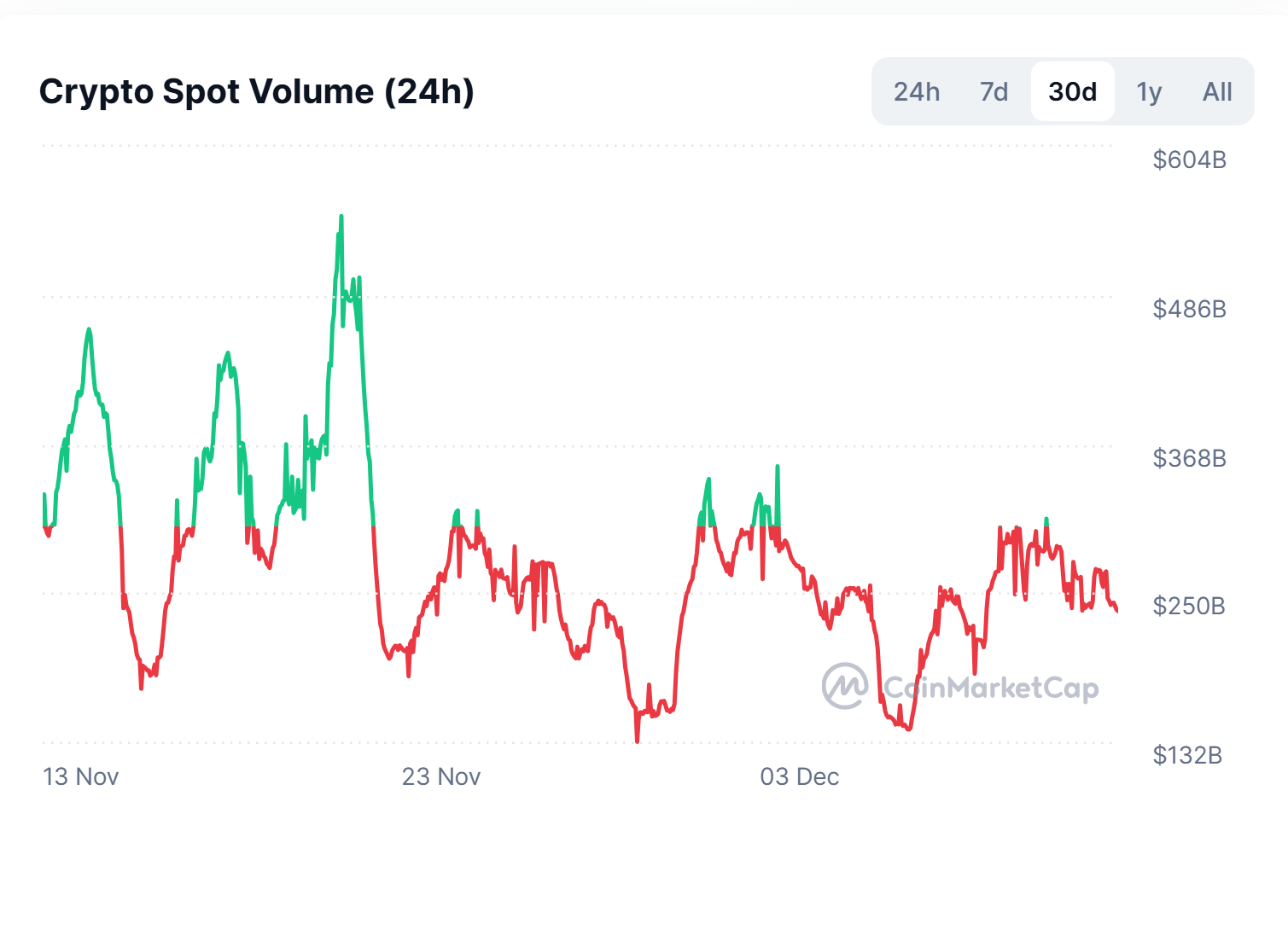
Spot crypto volumes continue to drop. Source: CoinMarketCap

Related: Brazil’s largest private bank advises investors to allocate 3% to Bitcoin in 2026

Bitcoin nearing breakout as key levels tighten

Meanwhile, market analysts say the current environment resembles previous pre-breakout periods. In a recent post on X, Michaël van de Poppe noted a tightening price structure in Bitcoin (BTC), saying that major macro events in the coming week could drive a surge in volatility.

“Bitcoin holds above this crucial level, but I'm sure we'll start to see volatility pick up significantly over the course of the next days,” the analyst said.

He pointed to key levels at $89,000 and $92,000, arguing that a break above resistance could accelerate a move toward $100,000 before 2026, while losing support risks another retest of lower ranges.

Related: Bitcoin rallies fail at $94K despite Fed policy shift: Here's why

Crypto slips despite fed cut

As Cointelegraph reported, Bitcoin briefly climbed to $94,330 early in the week, lifted by Strategy’s $962 million purchase, its largest Bitcoin investment since mid-2025.

However, the momentum faded quickly as traders awaited the final Federal Open Market Committee meeting of the year. The Federal Reserve delivered a widely expected 25-basis-point rate cut on Wednesday, giving markets a short-lived boost before sentiment cooled again. According to CoinEx analyst Jeff Ko, the move offered little upside because it was “already priced in.”

Magazine: 2026 is the year of pragmatic privacy in crypto — Canton, Zcash and more

Related Questions

QAccording to Bitfinex, by what percentage have crypto spot trading volumes dropped from January's peak?

ACrypto spot trading volumes have dropped by 66% from January's peak.

QWhat does Bitfinex suggest that the current market slowdown often precedes, based on historical cycles?

ABitfinex suggests that extended lulls in the market often precede the next leg in the cycle.

QWhat are the two key Bitcoin price levels mentioned by analyst Michaël van de Poppe that could determine the next major price move?

AThe two key Bitcoin price levels are $89,000 and $92,000.

QDespite a Fed rate cut, why did the crypto market see little upside according to CoinEx analyst Jeff Ko?

AThe market saw little upside because the rate cut was already priced in by investors.

QWhat event in mid-November 2025 caused a brief spike in crypto trading volumes before they retreated?

AA brief spike in mid-November was caused by volumes exceeding $550 billion, though the article does not specify the exact event that triggered it.

Related Reads

U.S. Tax Service Details New Cryptocurrency Fraud Scheme

The U.S. Internal Revenue Service (IRS) has warned of a new cryptocurrency fraud scheme. Scammers are sending paper letters impersonating official U.S. Department of the Treasury and IRS correspondence. These letters urge Americans to urgently register on a non-existent platform called the "Digital Asset Compliance Portal." The fraudulent letters contain QR codes linking to a phishing website disguised as the official IRS site. Victims are prompted to disclose their cryptocurrency exchange or wallet provider (examples given include Coinbase, Kraken, and Ledger) and the amount of crypto assets they hold. Jarod Koopman, Chief of the IRS Criminal Investigation Division, stated that criminals are exploiting public trust in government institutions by creating convincing fake websites and official-looking correspondence. According to the investigation, the infrastructure for this scam was set up just days before the mailing campaign began, using a domain registered through a Hong Kong-based registrar. The IRS assured taxpayers that it does not require them to provide wallet information via third-party sites or to click links from suspicious messages. The agency advised Americans to verify the authenticity of any notifications through official channels, such as making a phone call. This alert follows a recent FBI warning about a separate fraudulent scheme targeting cryptocurrency wallet holders on the Tron network.

cryptonews.ru8m ago

U.S. Tax Service Details New Cryptocurrency Fraud Scheme

cryptonews.ru8m ago

Has Bitcoin Bottomed, or Is a 'Shakeout' Approaching? What's the Situation with XRP?

Cryptocurrency analytics platform Santiment shared key insights on Bitcoin and altcoin markets, highlighting significant signals from on-chain data. Analysis shows Bitcoin's 365-day MVRV ratio has fallen to -26%, indicating substantial losses for long-term holders, a level historically associated with market bottom formations and long-term buying opportunities. While short-term MVRV is near breakeven, suggesting no clear directional signal, the annual perspective points to a bottom before bullish cycles. On-chain data reveals divergent behavior: large wallets (10-10,000 BTC) have been accumulating, adding ~18,500 BTC in 10 days, while smaller retail investors continue buying dips. Analysts caution that high retail demand can sometimes create a risk of a final market shakeout or correction. The altcoin market shows a mixed picture. Ethereum's 365-day MVRV is around -33%, but recent monthly gains combined with overly optimistic social sentiment pose a short-term correction risk. XRP is in oversold territory with 30-day and 365-day MVRVs at -57.5% and -45.5% respectively, signaling potential for a strong mid-to-long term rebound. Social activity and optimism are rising for Solana, while investor sentiment remains calmer towards Cardano. Future direction for Bitcoin and altcoins depends not only on on-chain metrics but also on macroeconomic and regulatory developments. The Federal Reserve's interest rate decision and upcoming policy rulings are increasing market volatility expectations, while uncertainty around the U.S. Congressional clarity process continues to pressure pricing. *This is not investment advice.

cryptonews.ru1h ago

Has Bitcoin Bottomed, or Is a 'Shakeout' Approaching? What's the Situation with XRP?

cryptonews.ru1h ago

Trading

Spot
活动图片





