Space Announces Public Sale of Its Native Token $SPACE

深潮Published on 2025-12-17Last updated on 2025-12-17

Abstract

Space announces the public sale of its native token $SPACE. Built on Solana, Space is a leveraged prediction market offering 10x leverage on real-world outcomes across crypto, politics, sports, and more. The project, created by the team behind the UFO project, features a central limit orderbook (CLOB) with no maker fees and a token flywheel where 50% of revenue is used to buy back and burn $SPACE. The public sale begins December 17, 2025, at 18:00 UTC with a $2.5M target. The FDV starts at $50M and can rise linearly to a $99M cap. It features a variable token allocation model to ensure a fair, single clearing price for all participants. Contributions are accepted in USDC, USDT, or SOL with no minimum or maximum limits. Early participants can achieve higher tiers for bonus airdrops, lifetime referral rewards, trading fee discounts, and积分 multipliers. The total token supply is 1 billion. The platform is set to launch in January 2026.

Space is the first leveraged trading market on Solana offering 10x leverage, allowing users to trade real-world outcomes in crypto, politics, sports, tech, culture, and more, with rewards. Today, they announced the public sale of their native token $SPACE.

The company employs a token flywheel mechanism, with 50% of revenue used to buy back and burn $SPACE.

Space is built by the UFO team, UFO was a top 100 project on CoinMarketCap in 2021 with a market cap exceeding $1.5 billion and a massive on-chain community. This success came from distribution and community, not insiders. The same ethos drives Space.

Core Features

  • Central Limit Order Book (CLOB) with no maker fees for traders

  • Well-designed user acquisition and retention mechanisms

  • <极狐span style="font-family:Arial,Helvetica,sans-serif">50% of revenue used for buyback and burn

  • Gamified points, rankings, and seasonal airdrops

  • Liquidity and referral rewards

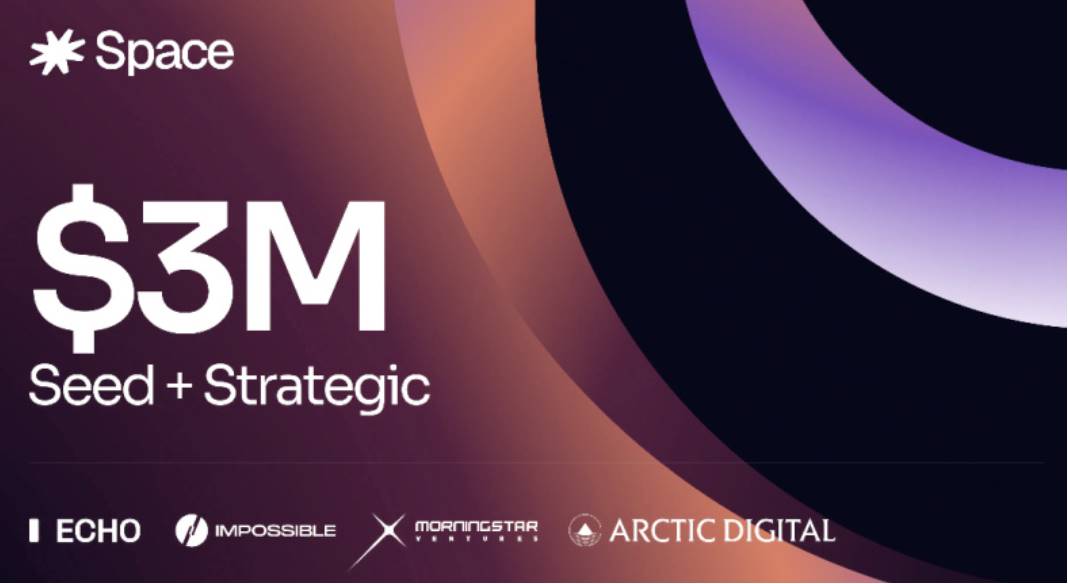
Space's $3 million seed and strategic rounds were led by Morningstar Ventures and Arctic Digital. Additionally, it set a record with 1360% oversubscription on Echo and received participation from Impossible Finance investors.
Now, they are opening up ownership to the community. The team believes that those who use, trade, build, and support Space should own a piece of it. The public sale places ownership in the hands of the community, ensuring everyone can participate at the same price. The public sale uses a variable token distribution model. The number of tokens allocated depends on the final market clearing price. This ensures fair and efficient price discovery while guaranteeing all participants get the same price.

Key Details

  • Chain: Solana

  • Start Time: December 17, 2025, 18:00 UTC

  • Target: $2.5 million

  • Minimum FDV: $50 million

  • Maximum FDV: $99 million

  • FDV Curve: Linear ($0.05 → $0.099)

  • Unlock: 100% at TGE

  • Accept: USDC, USDT, SOL

  • Minimum Contribution: None

  • Maximum Contribution: None

How It Works

After the countdown, sale.into.space will open for contributions. The sale starts at a floor valuation of $50 million FDV and maintains this level until the $2.5 million target is reached. After the target is met, the sale enters a price discovery phase where the FDV increases linearly up to the $99 million cap. At the end of the sale, all participants pay the same clearing price. If demand exceeds the tokens available at the final price, the team will manage allocations and refund any excess contributions to ensure fair participation for all contributors.

Tiers & Rewards

Tiers will change every 24 hours. Users who commit earlier achieve higher tiers, increasing their likelihood of allocation: unlocking larger bonus airdrops, lifetime privileges, and benefits on the Space platform.

Minimum contributions are used to unlock tiers and subsequent rewards. There is no minimum contribution requirement to participate in the public sale.
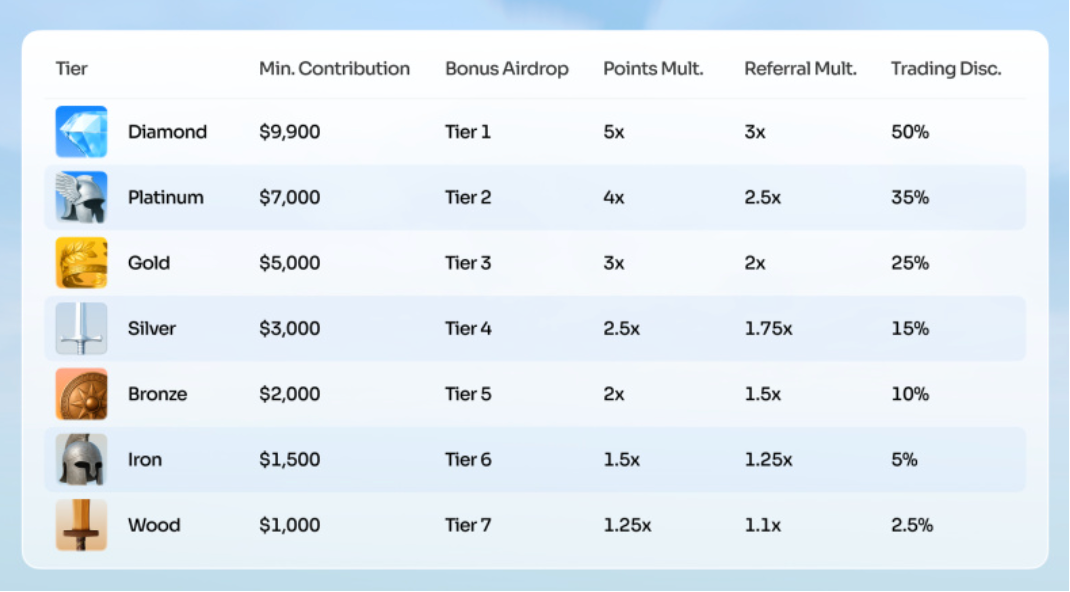
Reward Benefits

  • Reward Airdrops: Unlock additional bonus token airdrops

  • Points Multiplier: Earn points faster during Airdrop Seasons 1-4 (Q1-Q4 2026)

  • Referral Multiplier: Lifetime rewards from trading fees of referred users

  • Trading Fee Discounts: Reduced fees on user trades for 12 months

A user's total contribution is cumulative, but a tier is only achieved if the minimum contribution is met during that tier's active window. Once a user earns a tier, it is终身 associated with their Space profile with additional benefits.

Allocation & Refunds

In case of oversubscription, the team will manage allocations to ensure fairness. After the sale concludes, refunds will be processed for any excess contributions, with specific criteria disclosed post-sale.

Tokenomics

  • Total Supply: 1 billion

  • Flywheel Mechanism

    • All platform fees power a self-sustaining loop:

      • 50% of revenue → Buyback and burn $SPACE

      • 50% of revenue → Protocol treasury

Next Steps

  • Public Sale: December 17, 2025, 18:00 UTC

  • Refunds: Immediately after the sale

  • TGE: After the public sale

  • Platform Launch: January 2026

How to Participate

Users can:

  1. Visit sale.into.space

  2. Connect a self-custody wallet (Phantom recommended)

  3. For the best user experience, use a desktop device

  4. Select contribution amount in USDC, USDT, or SOL

  5. Sign and confirm the transaction

Important: Do not send from a centralized exchange (CEX). Use a self-custody wallet like Phantom.

About Space

Space is a leveraged trading market on Solana, created by the UFO team, UFO was a top 100 project with a market cap exceeding $1.5 billion. It combines a central limit order book, 10x leverage, and zero maker fees to address liquidity challenges common in prediction markets. Space integrates gamified rewards, referral incentives, and seasonal airdrop systems to enhance user engagement.

The protocol raised $3 million, including a round with 1360% oversubscription on Echo.xyz, backed by Echo, Impossible Finance, Morningstar Ventures, and Arctic Digital. By allocating 50% of platform revenue to a buyback and burn mechanism, Space aims to serve as a foundational layer for decentralized prediction markets, supporting traders, developers, and token holders.

Website: https://into.space/

Related Questions

QWhat is the main purpose of the $SPACE token public sale announced by Space?

AThe public sale aims to open ownership to the community, allowing users, traders, builders, and supporters to own a part of Space at the same price, ensuring fair participation.

QWhat is the unique token economic model adopted by Space?

ASpace uses a token flywheel mechanism where 50% of platform revenue is used to buy back and burn $SPACE tokens, while the other 50% goes to the protocol treasury.

QOn which blockchain is the Space platform built and when does the public sale start?

ASpace is built on the Solana blockchain, and the public sale starts on December 17, 2025, at 18:00 UTC.

QWhat are the key features of the Space platform as mentioned in the article?

AKey features include a central limit order book (CLOB) with no maker fees, 10x leverage, gamified points and rankings, seasonal airdrops, liquidity and referral rewards, and a user acquisition and retention mechanism.

QHow does the public sale ensure fair participation and allocation in case of oversubscription?

AThe sale uses a variable token distribution model where all participants pay the same clearing price. If oversubscribed, the team manages allocations and refunds any excess contributions to ensure fairness.

Related Reads

a16z: AI's 'Amnesia', Can Continuous Learning Cure It?

The article "a16z: AI's 'Amnesia' – Can Continual Learning Cure It?" explores the limitations of current large language models (LLMs), which, like the protagonist in the film *Memento*, are trapped in a perpetual present—unable to form new memories after training. While methods like in-context learning (ICL), retrieval-augmented generation (RAG), and external scaffolding (e.g., chat history, prompts) provide temporary solutions, they fail to enable true internalization of new knowledge. The authors argue that compression—the core of learning during training—is halted at deployment, preventing models from generalizing, discovering novel solutions (e.g., mathematical proofs), or handling adversarial scenarios. The piece introduces *continual learning* as a critical research direction to address this, categorizing approaches into three paths: 1. **Context**: Scaling external memory via longer context windows, multi-agent systems, and smarter retrieval. 2. **Modules**: Using pluggable adapters or external memory layers for specialization without full retraining. 3. **Weights**: Enabling parameter updates through sparse training, test-time training, meta-learning, distillation, and reinforcement learning from feedback. Challenges include catastrophic forgetting, safety risks, and auditability, but overcoming these could unlock models that learn iteratively from experience. The conclusion emphasizes that while context-based methods are effective, true breakthroughs require models to compress new information into weights post-deployment, moving from mere retrieval to genuine learning.

marsbit2h ago

a16z: AI's 'Amnesia', Can Continuous Learning Cure It?

marsbit2h ago

Can a Hair Dryer Earn $34,000? Deciphering the Reflexivity Paradox in Prediction Markets

An individual manipulated a weather sensor at Paris Charles de Gaulle Airport with a portable heat source, causing a Polymarket weather market to settle at 22°C and earning $34,000. This incident highlights a fundamental issue in prediction markets: when a market aims to reflect reality, it also incentivizes participants to influence that reality. Prediction markets operate on two layers: platform rules (what outcome counts as a win) and data sources (what actually happened). While most focus on rules, the real vulnerability lies in the data source. If reality is recorded through a specific source, influencing that source directly affects market settlement. The article categorizes markets by their vulnerability: 1. **Single-point physical data sources** (e.g., weather stations): Easily manipulated through physical interference. 2. **Insider information markets** (e.g., MrBeast video details): Insiders like team members use non-public information to trade. Kalshi fined a剪辑师 $20,000 for insider trading. 3. **Actor-manipulated markets** (e.g., Andrew Tate’s tweet counts): The subject of the market can control the outcome. Evidence suggests Tate’sociated accounts coordinated to profit. 4. **Individual-action markets** (e.g., WNBA disruptions): A single person can execute an event to profit from their pre-placed bets. Kalshi and Polymarket handle these issues differently. Kalshi enforces strict KYC, publicly penalizes insider trading, and reports to regulators. Polymarket, with its anonymous wallet-based system, has historically been more permissive, arguing that insider information improves market accuracy. However, it cooperated with authorities in the "Van Dyke case," where a user traded on classified government information. The core paradox is reflexivity: prediction markets are designed to discover truth, but their financial incentives can distort reality. The more valuable a prediction becomes, the more likely participants are to influence the event itself. The market ceases to be a mirror of reality and instead shapes it.

marsbit3h ago

Can a Hair Dryer Earn $34,000? Deciphering the Reflexivity Paradox in Prediction Markets

marsbit3h ago

Trading

Spot
Futures

Hot Articles

Discussions

Welcome to the HTX Community. Here, you can stay informed about the latest platform developments and gain access to professional market insights. Users' opinions on the price of SOL (SOL) are presented below.

活动图片