South Korean Stocks Plunge, Global Funds Liquidate: Has the Semiconductor Fundamentals Really Changed?

marsbitPublished on 2026-06-08Last updated on 2026-06-08

Abstract

South Korean stocks experienced their sharpest decline of the year, with the KOSPI index plunging nearly 9% on Monday, triggering a market circuit breaker. Leading semiconductor firms Samsung Electronics and SK Hynix were heavily sold off, raising questions about whether the AI-driven bull market has reached an inflection point. This sell-off was largely triggered by a significant drop in the U.S. semiconductor sector late last week. Concurrently, NVIDIA CEO Jensen Huang visited Seoul over the weekend, meeting with top executives from SK Group, Samsung, LG, and NAVER. He announced a new multi-year partnership with SK Hynix to co-develop next-generation memory products for AI data centers. Huang emphasized that AI infrastructure build-out remains in its early stages, creating a stark contrast between market panic and ongoing, strengthened industry collaboration. The article argues that South Korea has become one of the most sensitive markets for global AI-related capital flows, functioning like a large AI memory ETF due to the heavy weighting of its chipmakers. The current market turmoil reflects a shift in investor focus: from simply betting on overall AI growth to scrutinizing which companies will actually capture the profits from that growth. This "profit pool reassessment" phase is causing high volatility based on supply chain news and earnings guidance. Ultimately, the direction of the Korean market will be determined by external factors—NVIDIA's orders, HBM supply-dem...

TL;DR

The South Korean stock market just experienced its sharpest drop this year.

After opening on Monday, the KOSPI fell nearly 9% intraday, triggering a circuit breaker. Both Samsung Electronics and SK Hynix plunged heavily, and the market began discussing whether the AI bull market has reached an inflection point.

But while the market panicked and sold off, another event was unfolding in Seoul.

Jensen Huang began his visit to South Korea over the weekend, not only meeting with SK Group Chairman Chey Tae-won but also announcing a new multi-year cooperation agreement between NVIDIA and SK Hynix to jointly develop next-generation memory products for AI data centers. Simultaneously, he held intensive meetings with South Korean tech giants like Samsung Electronics, LG, and NAVER, reiterating that AI infrastructure construction is still in its early stages.

Thus, a rather contrasting picture emerged in the market.

On one side, South Korea's AI leaders faced concentrated selling pressure; on the other, the most core customer in the AI supply chain was moving to strengthen its ties with Korean suppliers.

If AI demand was truly collapsing, Jensen Huang wouldn't have needed to fly to Seoul specifically to reinforce cooperation.

This is also why a new debate is emerging in the market today.

Is the Korean market preemptively signaling the peak of the AI cycle, or is it experiencing a typical high-leverage deleveraging event?

South Korea Becomes One of the Most Sensitive Markets for Global AI Trading

Although this decline occurred in South Korea, the trigger did not originate there.

Last Friday, the U.S. semiconductor sector faced a sharp sell-off. The Philadelphia Semiconductor Index recorded one of its worst single-day declines in recent years, with AI infrastructure-related companies like Broadcom and Micron also correcting. Subsequently, the market began to reassess the risk exposure of high-valuation tech stocks.

South Korea became the most directly affected market.

Over the past year, the core driver of the South Korean stock market's rise has not been its domestic economy, but rather AI data center construction, HBM demand growth, and the expansion of the NVIDIA supply chain.

Samsung Electronics and SK Hynix together account for an extremely high weighting in the Korean market. When global funds want to bet on AI infrastructure, South Korea is one of the most convenient entry points; and when funds begin to reduce their AI exposure, South Korea naturally becomes one of the easiest markets to sell.

As a result, the decline in the Korean market far exceeded that in the U.S. market itself.
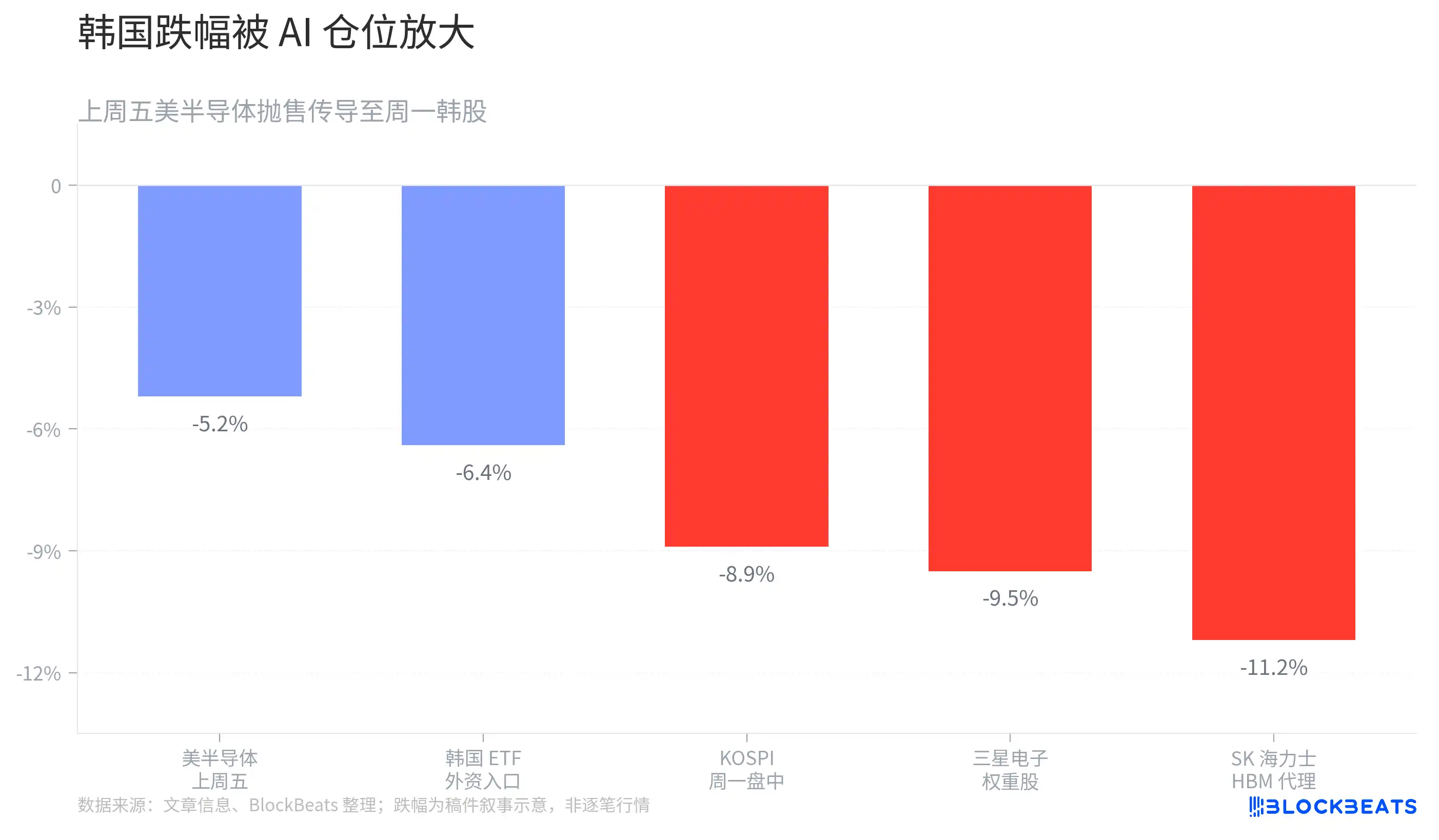
In a sense, South Korea is no longer just a national index, but more like a large AI memory ETF.

Jensen Huang's Visit to South Korea Presents a Stark Contrast to Market Panic

If market panic stems from valuations, then the biggest positive news over the weekend came from the supply chain itself.

The core objective of Jensen Huang's visit to South Korea was very clear: to further strengthen the cooperative relationship between NVIDIA and the Korean AI supply chain. The most notable development was the announcement of a new multi-year cooperation agreement between NVIDIA and SK Hynix. Over the past two years, HBM has become one of the most critical components in AI servers, and SK Hynix is one of the biggest beneficiaries of this trend.

This is also why the market highly anticipated this cooperation.

In recent months, as the scale of AI infrastructure construction continues to expand, the market began to worry about whether HBM demand growth would gradually peak. However, Jensen Huang's visit to South Korea at this time actually sends the opposite signal. If NVIDIA believed that AI data center construction was nearing its end, it wouldn't need to reinforce long-term cooperative relationships with suppliers at this point.
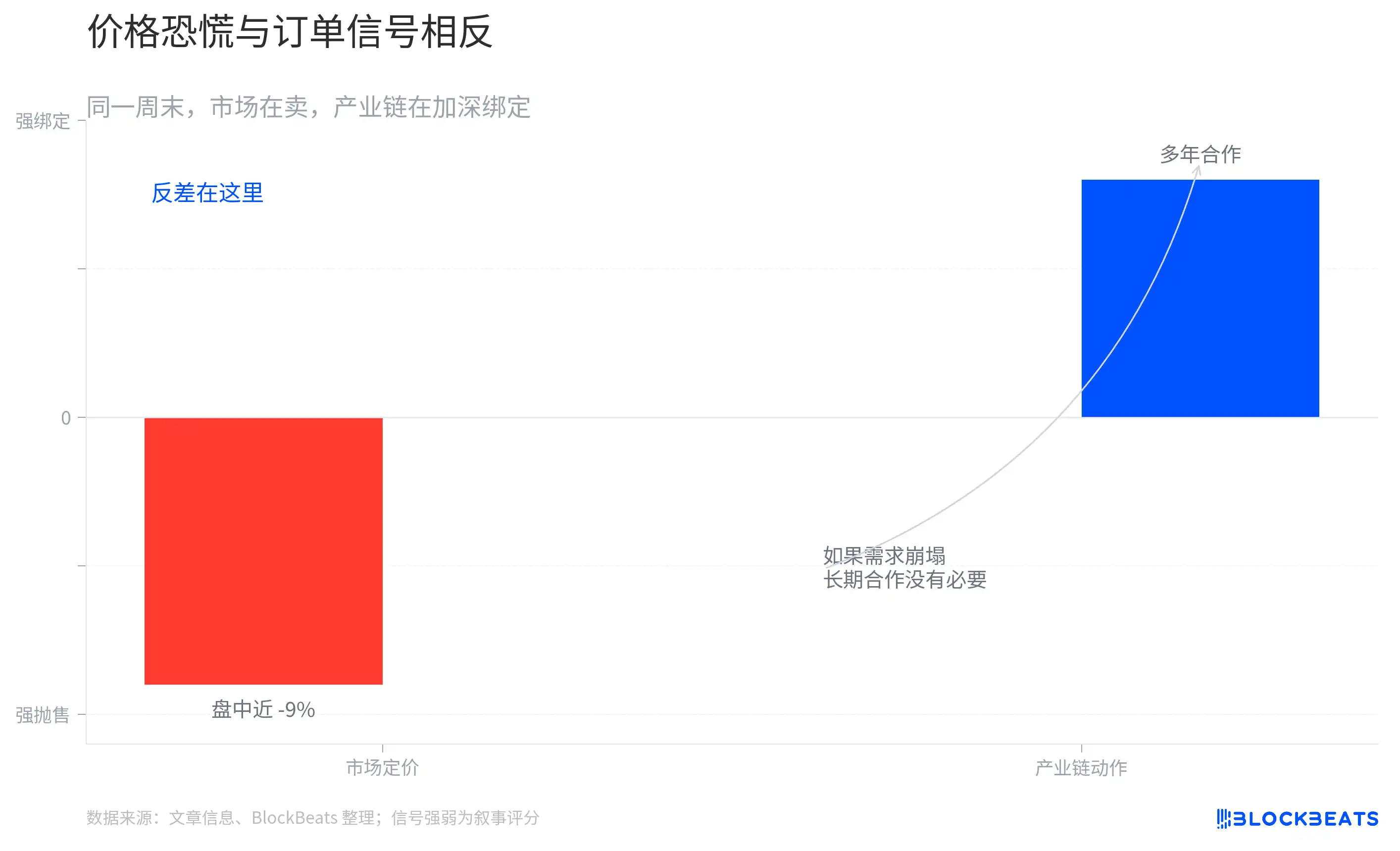
From a supply chain perspective, there is no evidence yet of a sudden disappearance of AI demand.

The most interesting part of the past two days lies right here. The capital market is using stock prices to express concerns about AI sector valuations, while the core enterprises in the supply chain are still discussing expansion and cooperation plans for the coming years. A significant temperature gap remains between the price signaled by the market and the signal released by the industry.

The AI Bull Market Begins Entering the Profit Pool Reassessment Stage

This is also the core of the current major divergence.

Over the past year, the market traded a very simple logic: AI demand growth. Therefore, NVIDIA rose, Micron rose, SK Hynix rose, Samsung Electronics rose—almost any company related to AI received a valuation boost.

But as the sector's gains continued to expand, the market has entered a second stage.

Investors are no longer satisfied with the story of 'AI will grow,' and have begun to ask another question: Who will ultimately capture the profits created by AI growth? In recent months, from the Rubin rack system memory adjustments, to the market reaction following Broadcom's earnings, to this Korean market crash, they all essentially reflect the same thing—the market is beginning to deconstruct the AI profit pool.

SK Hynix benefits from HBM, Samsung Electronics positions itself across HBM, DRAM, and advanced packaging, while Micron benefits more from the overall AI server memory upgrade. Although they all belong to the AI supply chain, their respective profit sources and pricing power are not the same.
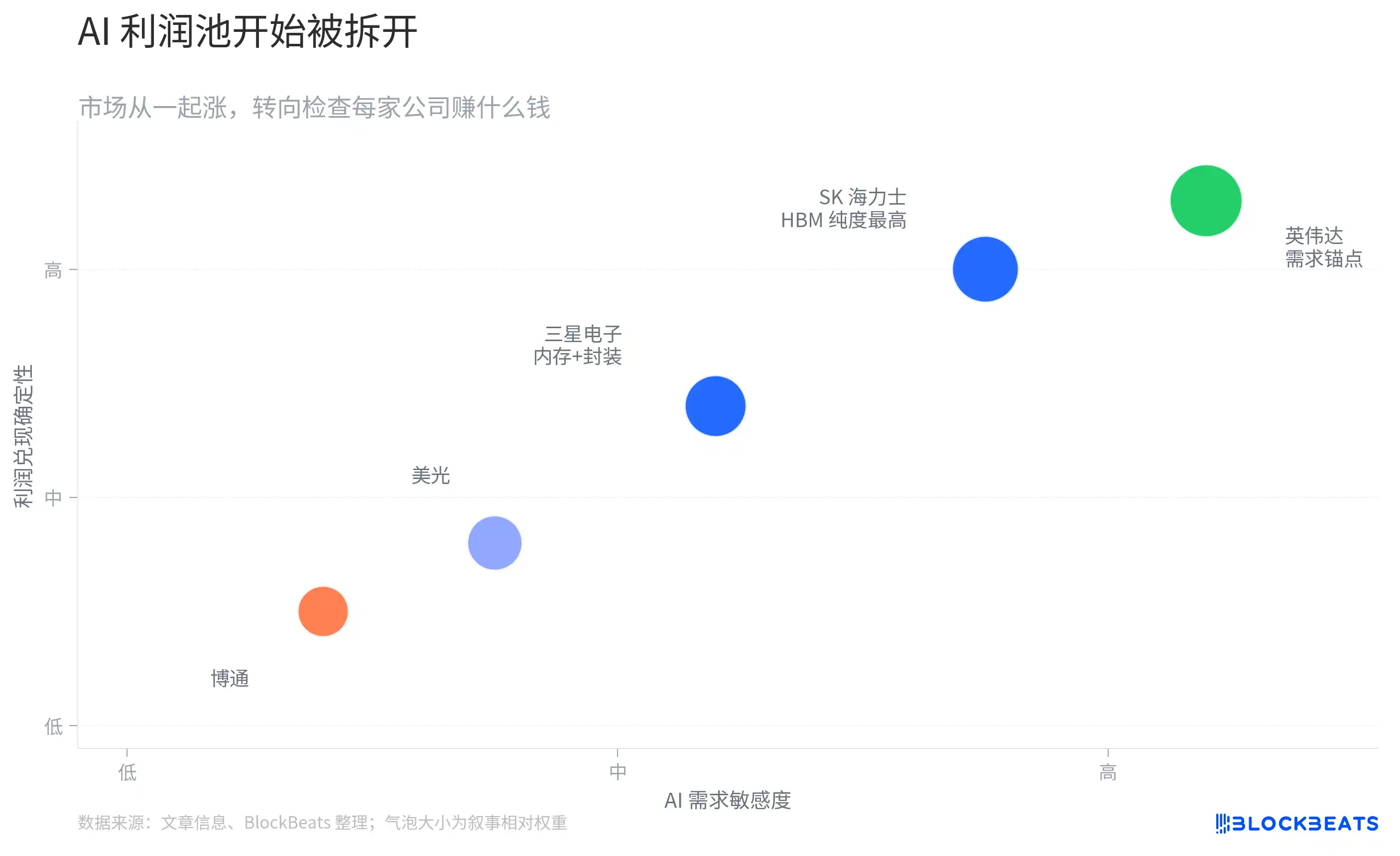
Previously, the market was willing to collectively expand valuations for the entire sector. Now, capital is beginning to examine, one by one, whether these profits can truly be realized.

This is also why a supply chain update, an earnings guidance, or even a capital expenditure adjustment can trigger significant volatility across the entire sector. The focus of market trading has shifted: rather than whether AI will continue to grow, investors are more concerned about whose financial statements the growth will ultimately land on.

What Decides South Korean Stocks is Not South Korea

In the coming weeks, what will truly determine the direction of the South Korean market remains NVIDIA's orders, HBM supply and demand, and capital expenditures from cloud service providers.
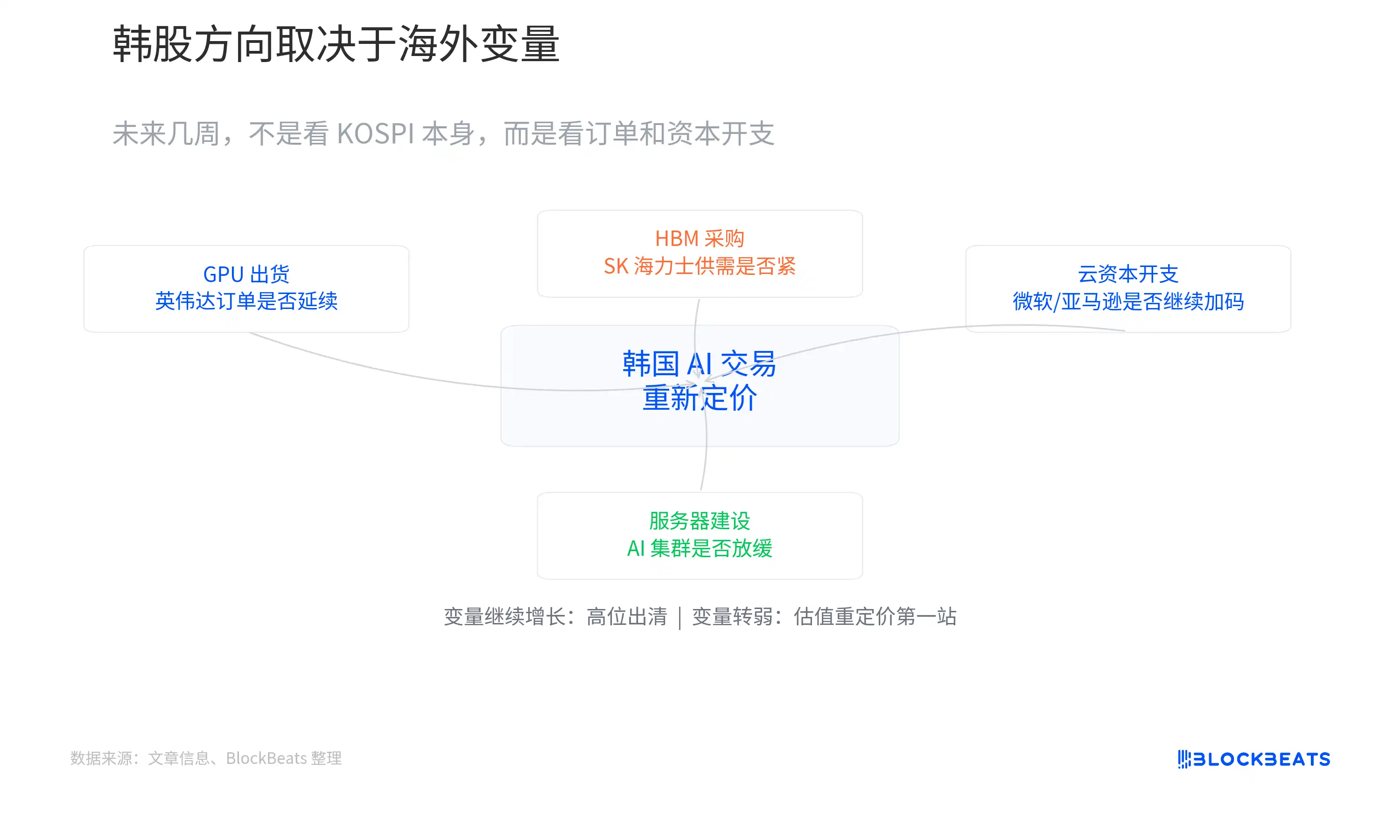
If this data begins to weaken, then this crash may be just the beginning of a larger-scale valuation adjustment.

But if data center construction, GPU shipments, and HBM procurement continue to maintain high growth, then Monday's circuit breaker looks more like a concentrated liquidation of a crowded trade.

At least from the current vantage point, the price signaled by the market and the signal released by the industry are not entirely aligned.

On one side, South Korea's AI leaders are facing the most severe selling pressure in years; on the other, Jensen Huang is in Seoul discussing the next generation of AI infrastructure with supply chain partners.

Whose judgment is closer to reality? Perhaps we will have an answer soon.

Related Questions

QAccording to the article, what event triggered the sharp decline in the South Korean stock market (KOSPI), and which two companies were most affected?

AThe sharp decline in the South Korean stock market was triggered by a significant sell-off in the U.S. semiconductor sector on the previous Friday. The two most affected companies were Samsung Electronics and SK Hynix, both of which are major players in the AI supply chain and carry high weightings in the Korean market index.

QDespite the market panic, what significant business activity did Jensen Huang's recent visit to Seoul indicate about the AI industry's future?

AJensen Huang's visit to Seoul involved strengthening partnerships with key South Korean AI suppliers. The highlight was the announcement of a new multi-year cooperation agreement between NVIDIA and SK Hynix to jointly develop next-generation memory products for AI data centers. This activity indicates that core players in the AI infrastructure chain remain committed to long-term collaboration and expansion, suggesting they believe AI demand is still in its early stages and not collapsing.

QHow does the article describe the current main focus of investors in the AI sector, shifting from the initial investment phase?

AThe article states that the market has entered a second stage where the main focus of investors has shifted. Initially, investors broadly valued any company related to AI growth. Now, they are scrutinizing the 'profit pool,' asking which specific companies will actually capture and realize the profits generated by AI growth, leading to a re-evaluation based on individual profit sources and pricing power rather than sector-wide optimism.

QWhat key factors does the article identify as ultimately determining the future direction of the South Korean stock market?

AThe article identifies that the future direction of the South Korean stock market will be determined by external, global factors related to AI infrastructure demand, not domestic Korean issues. The key factors are: NVIDIA's orders, the supply and demand dynamics for HBM (High Bandwidth Memory), and the capital expenditure plans of major cloud service providers.

QWhat contrasting views does the article present regarding the nature of the South Korean market crash?

AThe article presents two contrasting interpretations of the market crash. One view is that it signals an early peak in the AI cycle, reflecting a fundamental change in demand prospects. The other view is that it represents a typical 'high-leverage unwinding' or a concentrated sell-off in a crowded trade, driven more by valuation concerns and position adjustments than by a sudden disappearance of underlying AI demand.

Related Reads

Wang Chuan: After Investing in Storage Stocks and Seeing a Thirty-Fold Return, How to Remain Unanxious (Part 7) - A Quarter-Century Cycle

Wang Chuan: Reflections on Investment Anxiety and Market Cycles After Observing a 30x Gain in a Storage Stock (Part 7) – A Quarter-Century Cycle This article examines the cyclical nature and inherent risks in technology hardware investments, using the storage and semiconductor sectors as examples. It criticizes the misleading practice of "annualized" Net Dollar Retention (NDR) rates, where short-term growth is extrapolated unrealistically. A key concept explored is "reflexivity" – demand driven by panic, exploration, and liquidity during market booms, which can vanish just as quickly when conditions reverse. This reflexivity exists both in product demand and among speculative stock buyers, creating powerful feedback loops that inflate prices during upturns and exacerbate crashes during downturns. The author highlights a major risk for hardware sectors: unlike assets with defined cycles (e.g., Bitcoin's halving), there's no guarantee of a swift recovery post-crash. Companies like Micron, Intel, and Cisco took roughly a quarter-century to surpass their 2000 highs, enduring drawdowns exceeding 80%. This is attributed to the "bullwhip effect" in supply chains, where demand collapses instantly but过剩产能 persists, and a migration of narrative-driven capital. High-valuation stories吸引 speculative funds during growth phases, but these funds quickly depart for the next hot narrative once growth slows, leaving behind stronger companies with much lower valuations. The piece warns of dangerous mental models formed during bull markets: 1) equating current strong demand with perpetual high growth, and 2) believing that making fast, large profits is easy. Citing巴菲特, the author notes that easy money undermines rationality, likening speculators to Cinderella at a ball with a clock that has no hands. The current phase presents an asymmetric risk-reward scenario: potential for further gains exists, but the downside risk is an 80%+ drawdown and a multi-decade wait for breakeven, which reflexive speculators cannot tolerate. The hypothetical investor "老王" (Lao Wang), who achieved a 30x return, is used to illustrate potential pitfalls. Leverage could lead to a wipeout during a sharp correction. Even without leverage, ingrained beliefs in easy money would likely lead him to double down after losses, expecting a quick rebound. Instead, he might face a protracted decline, depleting his resources through frantic trading as the high-growth narrative fades. The conclusion references Schopenhauer, comparing those who have seen multiple market cycles to an audience seeing the same magic trick repeatedly—once the illusion is understood, its power is gone.

marsbit6m ago

Wang Chuan: After Investing in Storage Stocks and Seeing a Thirty-Fold Return, How to Remain Unanxious (Part 7) - A Quarter-Century Cycle

marsbit6m ago

US Stocks Too Expensive? This Top CIO Scoured the Globe and Found 5 Stocks More Attractive Than NVIDIA

Summary: Main Street Research CIO James Demmert maintains his bullish 8,100 target for the S&P 500 but argues that greater opportunities now lie overseas. He identifies five international stocks with superior valuations poised to benefit from the AI revolution, suggesting international markets will outperform the US for years. Key Recommendations: 1. **ASML (Netherlands):** A foundational chip manufacturing technology provider, offering crucial AI exposure and geographic diversification. Demmert's top long-term pick. 2. **HSBC (UK/Asia):** A global bank with a 9x P/E ratio, better growth prospects than US peers like JPMorgan, and strong Asian presence. 3. **Siemens Energy (Germany):** A direct play on global power grid expansion driven by AI, crypto, and EV electricity demand. 4. **BHP Group (Australia):** A "hidden AI play" and "second derivative" of the trend due to massive copper demand for data centers. Trades at a 16x P/E. 5. **AstraZeneca (UK):** An undervalued healthcare stock with a strong pipeline (18x P/E, >20% growth), expected to benefit from AI's impact on medicine. Core Thesis: International outperformance is driven by both attractive valuations and a major policy shift. While the US tightens fiscal policy, Europe and Japan are launching unprecedented stimulus, reigniting growth. Demmert recommends allocating 45% of a portfolio internationally, citing excessive US investor conservatism as a key mistake.

marsbit11m ago

US Stocks Too Expensive? This Top CIO Scoured the Globe and Found 5 Stocks More Attractive Than NVIDIA

marsbit11m ago

a16z Partner: Three Paths for Crypto Projects to Find PMF

Author: Jason Rosenthal. Compiler: Shenchao TechFlow. Finding Product-Market Fit (PMF) is the most critical variable for a company's survival. In the crypto space, misaligned growth hacking and airdrops often mask the absence of true PMF. However, leading teams are now finding PMF faster. Here are three proven paths for crypto projects to achieve PMF: 1. **Co-build with Anchor Clients:** Partner with the most sophisticated potential clients in your field and develop the product based on their specific needs. Their adoption serves as the strongest validation, more valuable than media coverage or TVL metrics. This approach is shaping current product roadmaps, as seen in collaborations between crypto startups and traditional finance. 2. **Position Ahead of an Exponential Curve:** Identify and position yourself ahead of a major emerging trend before the market fully realizes it. The most evident current curve is the rise of AI Agents as autonomous economic actors. Projects like AgentCash by Merit Systems, which enables AI Agents to pay for API access with crypto, are building foundational payment rails for the impending Agent economy. 3. **Be Your Own First and Best Customer:** The most enduring infrastructure companies don't wait for external validation. They first build and prove their technology by using it to power their own applications at scale before offering it to others. Matter Labs exemplifies this by anchoring its ZKsync technology in a concrete application, Cari Network, which enables U.S. regional banks to conduct real-time, on-chain interbank transfers of tokenized deposits. The underlying logic is consistent: the fastest path to PMF involves choosing the right battlefield and executing with conviction—by co-building with clients whose validation compounds, positioning ahead of the curve before consensus forms, or becoming your own best case study.

marsbit12m ago

a16z Partner: Three Paths for Crypto Projects to Find PMF

marsbit12m ago

Wang Chuan: How to Avoid Anxiety When the Neighbor, Lao Wang, Made Thirty Times His Investment in Storage Stocks (7) - A Quarter-Century Cycle

Wang Chuan: Reflections on a Quarter-Century Cycle – How to Stay Calm After a 30x Gain on Storage Stocks (Part 7) This article continues the discussion on investment pitfalls. It highlights the deceptive use of metrics like the "Annualized Net Dollar Retention Rate" by some companies to inflate growth projections. The core analysis focuses on the "reflexivity" present in both product demand and financial markets during boom periods. In a bubble, speculative and fear-driven demand in the real economy interacts with speculative, leveraged buying in financial markets, creating a powerful upward feedback loop. This dynamic reverses sharply when faced with physical or liquidity constraints, leading to a cascading downturn. The hardware and semiconductor sectors face unique risks. Unlike assets with defined cycles, there's no guarantee of a swift recovery post-crash. Historical examples like Micron, Intel, and Cisco show it can take decades to surpass previous peaks after severe drawdowns (80-95%). This is due to the "bullwhip effect" in supply chains—demand vanishes quickly while过剩产能 persists—and the migration of speculative capital and growth narratives to new sectors once momentum slows. Companies may have stronger fundamentals years later, but the speculative "soul" of extreme valuations is long gone. The author warns of psychological traps for new investors: mistaking temporary, intense demand for permanent growth, and believing that making quick, large profits is easy. Citing Buffett, the piece cautions that easy money erodes rationality. The current phase presents an asymmetric risk-reward scenario: potential for further gains versus the risk of an 80%+ drawdown and a multi-decade recovery wait—an outcome reflexive speculators cannot endure. The hypothetical "Lao Wang" who made 30x may be wiped out by leverage or, driven by the "get-rich-quick" mindset, may repeatedly try to recover losses until exhausted, failing to recognize that the high-growth narrative has ended. The piece concludes with Schopenhauer's analogy: those who've seen multiple cycles are like an audience watching the same magic trick repeatedly—the illusion no longer works.

链捕手21m ago

Wang Chuan: How to Avoid Anxiety When the Neighbor, Lao Wang, Made Thirty Times His Investment in Storage Stocks (7) - A Quarter-Century Cycle

链捕手21m ago

Trading

Spot
Futures
活动图片