Someone Predicts South Korean Stock Market with Hyperliquid, Achieving 74% Accuracy?

Foresight NewsPublished on 2026-06-10Last updated on 2026-06-10

Abstract

A study analyzed whether weekend price movements of four Korean stock perpetual futures contracts (Samsung Electronics, SK Hynix, Hyundai Motor, and EWY) on Hyperliquid could predict their Monday opening directions on their respective primary exchanges (KRX, NYSE). Over 62 weekend observations across the four assets, Hyperliquid correctly predicted the Monday opening direction 45 times (73.8% accuracy). However, performance varied significantly. Samsung Electronics showed the strongest and statistically significant signal, with Hyperliquid's weekend close correctly predicting its KRX Monday open in 15 out of 16 cases (94% accuracy, p-value < 0.001). This signal remained strong (75% accuracy) even when using Saturday's close instead of Sunday's, suggesting genuine price discovery beyond last-minute convergence. Hyundai Motor also showed high accuracy (81%, 13/16 correct), but this was not statistically significant after accounting for a baseline downward bias in its Monday opens. SK Hynix performed marginally better than a coin flip (63%, 10/16). EWY performed the worst (54%, 7/13), underperforming a simple strategy of always predicting a Monday rise. The stark difference between Samsung and EWY is largely attributed to market timing. KRX opens shortly after Hyperliquid's Sunday close, while NYSE opens ~14 hours later, allowing new information to flow in. The results suggest that for assets like Samsung Electronics, where weekend trading on Hyperliquid precedes the primary...


Written by: Ponyo(@ponyo_fp), Four Pillars Researcher & Hyperliquid Core Contributor

Compiled by: AididiaoJP, Foresight News


In February, TradeXYZ launched perpetual futures contracts for Samsung Electronics, SK Hynix, Hyundai Motor, and EWY on Hyperliquid, allowing investors to gain exposure to South Korean stocks on weekends for the first time.


I reviewed the weekend price movements of these stock contracts since their launch, covering a total of 62 observation samples across the 4 assets. I compared each contract's movement from Friday close to Sunday close with the direction of the underlying asset's Monday opening auction. For South Korean stocks, I used the KRX opening price at 9:00 AM (KST); for EWY, I used the NYSE opening price at 9:30 AM (ET).


Hyperliquid correctly predicted the opening direction in 45 out of the 62 cases, an accuracy rate of 73.8%. This number sounds good, but the aggregate data masks highly uneven performance across different assets.
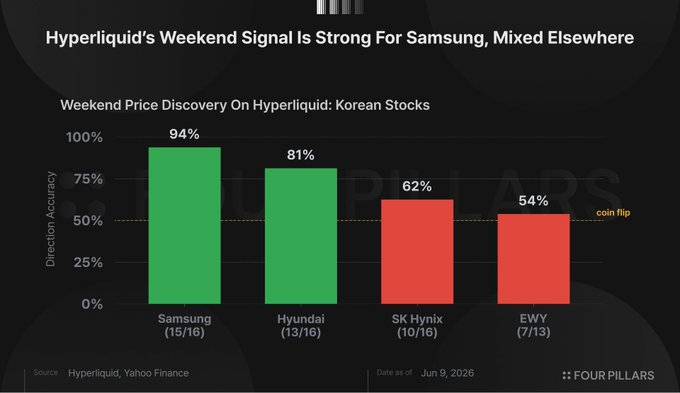


Samsung Electronics shows a clear outlier. Hyperliquid correctly predicted the direction 15 out of 16 weekends. Since Samsung's Monday openings were evenly distributed between up and down, there's no inherent directional bias inflating the hit rate. The binomial test (against a 50% benchmark) yields a p-value of 0.0003, meaning the probability of such a strong result occurring by random chance is only 0.03%. Although the sample size is still small, a result of 15 correct out of 16 is hard to ignore.


Hyundai Motor also performed well, with 13 correct predictions out of 16, an 81% accuracy rate. However, after accounting for the stock's slight downward bias on Mondays, this result did not reach statistical significance. During the sample period, Hyundai Motor opened lower on Mondays 62% of the time, meaning a simple strategy of always predicting "down" would have had a high baseline win rate.


SK Hynix is less convincing. It was correct only 10 out of 16 times, barely better than a coin flip. Some misses were significant. On the weekend of June 5-7, the Hyperliquid contract closed up 0.11%, while SK Hynix gapped down 10.34% at the Monday KRX open.


EWY had the worst results. It was correct only 7 out of 13 weekends, even underperforming the benchmark. Out of those 13 Mondays, EWY opened higher 10 times, accounting for 77%. A simple weekly prediction of "up" would have outperformed Hyperliquid's signal. Meanwhile, the Hyperliquid weekend contract closed down in 9 out of the 13 cases, repeatedly pointing traders in the wrong direction.


The discrepancy between Samsung Electronics and EWY can largely be explained by market time differences. The KRX opens at 9:00 KST, which is 00:00 UTC, almost exactly coinciding with Hyperliquid's daily candle reset time. Therefore, the time gap between Hyperliquid's last weekend trade and the KRX opening auction is only a few minutes.


In contrast, EWY trading on the NYSE doesn't start until 9:30 AM ET, about 14 hours after Hyperliquid's Sunday candle close. By then, the entire Monday trading session on the KRX is complete, European markets are open, and US pre-market trading has incorporated a new round of information. The information set determining EWY's Monday open simply didn't exist when Hyperliquid's weekend candle closed.


A reasonable critique is that even Samsung's results might reflect last-moment convergence rather than genuine price discovery. Informed traders might adjust positions on Hyperliquid just before the KRX opens, making this "prediction" almost tautological.


To test this, I repeated the analysis using Saturday's close instead of Sunday's, creating a lead time of about 24 hours instead of just minutes. The results show that the Saturday signal still predicted Samsung's Monday opening direction with 75% accuracy (against a 50% benchmark). Sunday trading improved the result but didn't create the signal from scratch.


In comparison, Samsung's own Friday price movement predicted Monday's direction with only 62% accuracy. This suggests Hyperliquid's weekend market provides information beyond a simple continuation of the previous KRX trading session.


Among the four assets tested, only Samsung Electronics produced a statistically significant directional signal. The sample size remains small, and the results have not been validated out-of-sample. Nevertheless, this might still be valuable information for anyone trading Samsung Electronics or the broader KOSPI market.


Despite an average weekend trading volume of only about $12,000, Hyperliquid correctly predicted the Monday opening direction for a company with a market cap of roughly $300 billion with 94% accuracy and a p-value below 0.001. For anyone trading Samsung Electronics on the KRX, checking Hyperliquid's weekend closing price before Monday's opening auction appears to be a very worthwhile practice.


Related Questions

QWhat is the main finding of the analysis regarding Hyperliquid's weekend contracts for predicting Korean stock market opens?

AThe analysis found that Hyperliquid's weekend contracts, specifically for Samsung Electronics, predicted the direction of Monday's KRX opening auction with 94% accuracy (15 out of 16 times), a result highly unlikely to be due to random chance (p-value

QWhy was the performance of the EWY contract on Hyperliquid significantly worse than for Samsung Electronics?

AThe EWY contract performed poorly because NYSE opens approximately 14 hours after Hyperliquid's Sunday close. By that time, new information from a full day of KRX trading, European markets, and US pre-market activity becomes available, which was not reflected in the Hyperliquid weekend price.

QWhat was the author's method to test if the Samsung result was due to last-minute convergence or genuine price discovery?

ATo test this, the author repeated the analysis using Saturday's closing price on Hyperliquid instead of Sunday's, creating a 24-hour lead time. The result showed a 75% accuracy rate, indicating the signal existed beyond just last-minute convergence before KRX open.

QHow did the author account for potential bias from a stock's inherent Monday opening direction when evaluating the results?

AThe author noted that for stocks like Hyundai Motor, which had a 62% probability of opening down on Mondays, a high accuracy rate needed to be considered against this baseline. They also mentioned that Samsung's Monday openings were evenly distributed, so a high accuracy was not due to a directional bias.

QWhat is a key limitation of the study's findings mentioned by the author?

AA key limitation is the small sample size (only 16 weekends for Samsung Electronics) and the fact that the results have not yet been validated out-of-sample.

Related Reads

Bitcoin Withdrawals Continue: 8 Years of Storage in a Coldcard Cold Wallet Ended in Zero

Coldcard Hardware Wallet Hacked: Losses Mount Due to Vulnerable Seed Generation A critical vulnerability in Coldcard hardware wallets has led to a continued wave of fund thefts. According to Galaxy Research, the total stolen has reached 1,367.05 BTC (approx. $88.6 million) from 4,585 addresses, a significant increase from the initial 594.5 BTC reported on July 30, 2026. Most of the stolen funds remain on the attackers' addresses. The issue is not with the current firmware, which Coinkite has updated, but with seed phrases generated on vulnerable devices between March 2021 and the release of fixed firmware versions. Due to a programmer error, devices switched from using a hardware random number generator to the software-based Yasmarang generator, which was initialized with publicly accessible data like the chip's serial number. This made the seed phrases predictable through offline brute-force attacks, meaning wallets remain at risk until funds are moved to a new wallet generated with the patched firmware. Affected devices include Mk2/Mk3 with firmware 4.0.1–4.1.9 (and up to 5.0.3), Mk4/Mk5 up to version 5.6.0, and Q models up to 1.5.0Q. The only exceptions are seeds created with a high-entropy method like at least 50 independent dice rolls or a strong unique BIP-39 passphrase. All other owners must generate a new seed on the fixed firmware and transfer their assets. A case highlighting the human impact involves a 39-year-old long-term investor who lost 2 BTC (approx. $130,000) in minutes. He had accumulated the Bitcoin over eight years through physical labor, viewing it as a financial lifeline and a retirement plan in a country suffering from hyperinflation. His story underscores that even conservative "buy and hold in cold storage" strategies can be compromised by such underlying technical flaws. From a technical perspective, this incident echoes historical failures where weak random number generators undermined cryptographic security, challenging the assumption that offline storage is automatically foolproof.

cryptonews.ru2h ago

Bitcoin Withdrawals Continue: 8 Years of Storage in a Coldcard Cold Wallet Ended in Zero

cryptonews.ru2h ago

Trading

Spot
活动图片




