Solana sees capital repositioning on-chain – Is a new cycle forming?

ambcryptoPublished on 2026-03-20Last updated on 2026-03-20

Abstract

Solana's market structure shows a significant shift from futures-driven trading to spot-led accumulation, indicating a potential transition in market cycles. Futures momentum weakened through 2026, with sell dominance returning, suggesting late-cycle fatigue and reduced leveraged conviction. Meanwhile, spot demand increased, with whale activity expanding between $80–$100, reflecting strategic accumulation rather than speculation. Stablecoin supply on Solana reached a new all-time high exceeding $17 billion, indicating that capital is repositioning within the ecosystem rather than exiting, strengthening its role as a settlement layer. Exchange balances continued declining, falling from over 40 million SOL in late 2024 to nearly 27 million by March 2026, signaling strong holding behavior and reduced sell pressure. This absorption of supply, combined with growing on-chain liquidity, points to a structural market reset. Leverage is exiting while stronger hands rebuild positions, setting the stage for a more stable base and potential sustained upside.

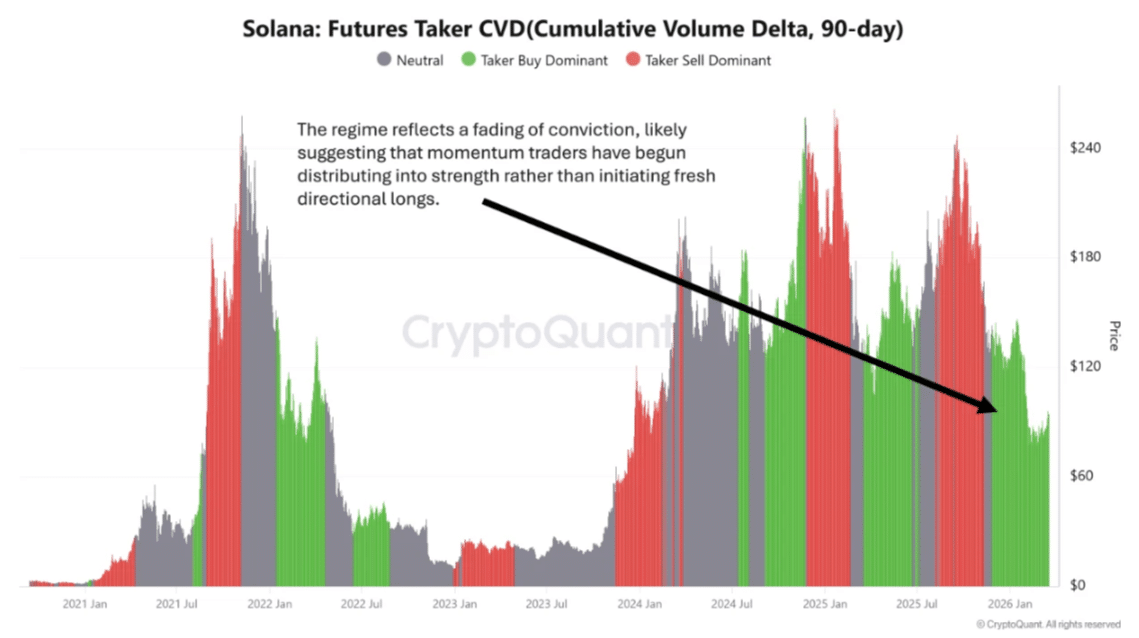
Solana’s [SOL] market structure revealed a clear shift in participant behavior, with Futures momentum weakening as Spot demand built quietly. In fact, the Futures Taker CVD showed that after strong sell dominance in 2024, activity transitioned into mixed phases through 2025.

However, in 2026, buy pressure faded while sell clusters returned – A sign that momentum traders may be distributing their strength rather than committing fresh capital. This may be evidence of late-cycle fatigue, where leveraged conviction usually declines.
Source: CryptoQuant

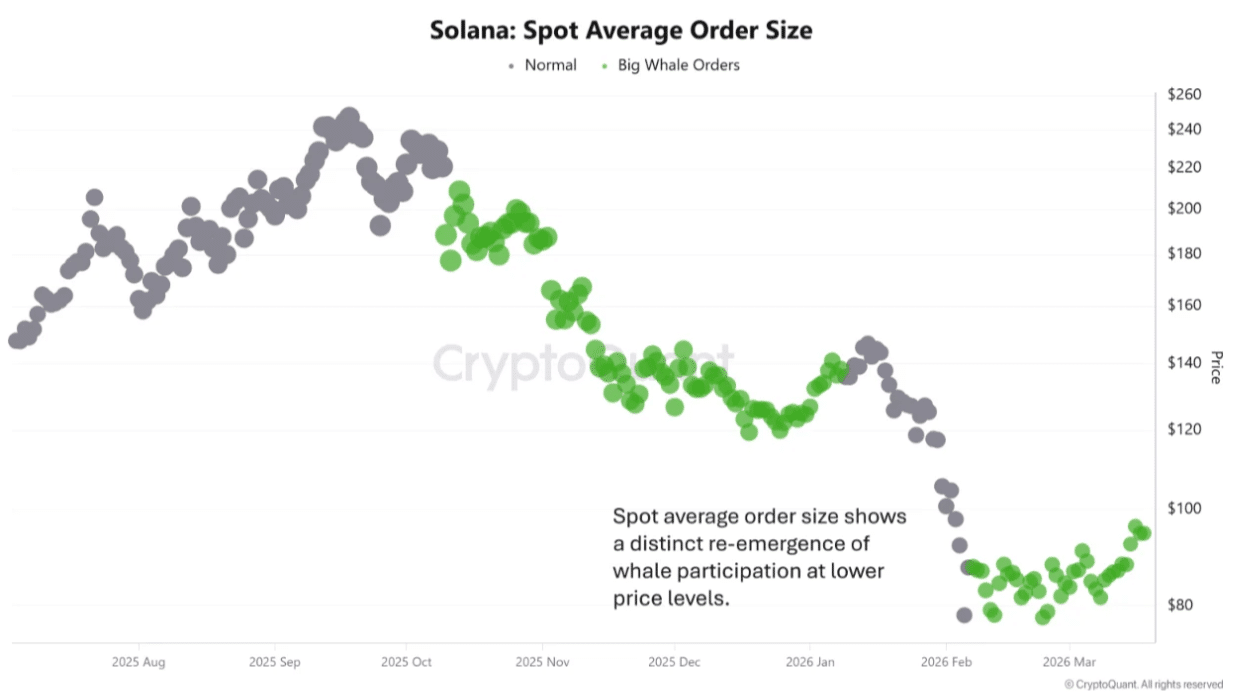
Meanwhile, Spot order sizes expanded between $80 and $100, marking the return of whale participation at lower levels.

As larger players accumulate into weakness, they absorb supply without chasing price, signaling strategic positioning rather than speculation. Such behavior usually implies confidence in long-term value while avoiding short-term volatility.
Source: CryptoQuant

On the contrary, this divergence highlighted a structural reset, one where leverage exits and stronger hands rebuild positions. This might set the stage for a more stable base before any sustained upside.

That same shift from Futures exhaustion towards Spot-driven demand began to reflect more clearly in Solana’s liquidity layer.

Stablecoin supply extended past $17 billion, marking a new all-time high as growth accelerated into early 2026. As capital flows into the network, such an expansion would mean that liquidity is not exiting but repositioning for deployment.
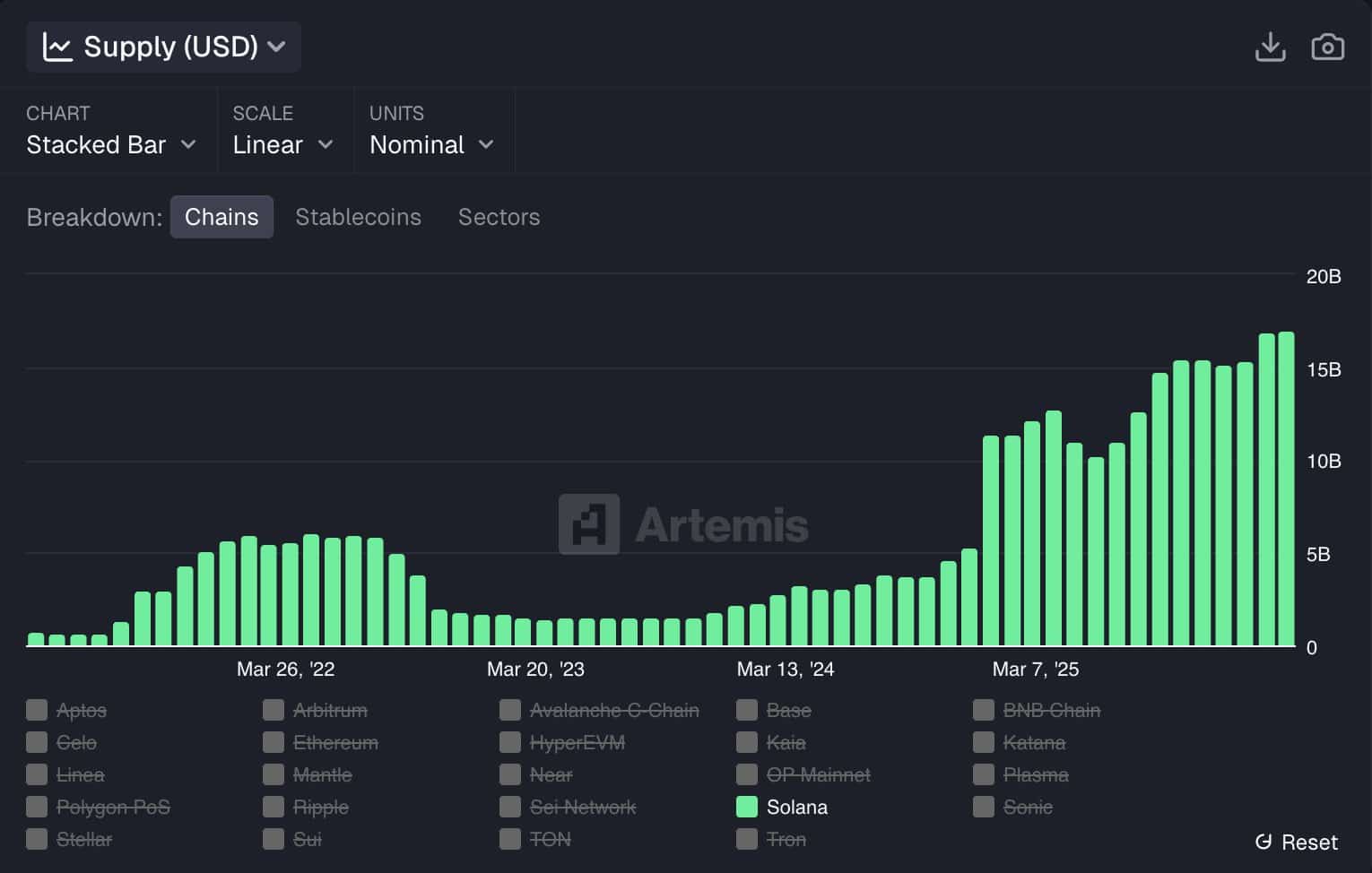
Source: Artemis

As supply pushes beyond previous ceilings, Solana strengthens its role as a settlement layer. As a result, users and institutions increasingly route capital through the network.

This shift may be evidence that participants are preparing to deploy funds across DeFi and real-world asset activity. Rather than holding idle positions, capital moves with clearer intent.

As liquidity deepens, the ecosystem gains stronger support for sustained activity. In turn, this reinforces the broader transition, where spot demand gradually replaces fading derivatives-driven momentum.

Solana supply tightens under the surface

Finally, this absorption dynamic becomes clearer when viewed through Exchange Balances. They have continued to trend lower, despite recent inflows.

in fact, balances fell from above 40 million SOL in late 2024 to nearly 27 million by March 2026. Even as intermittent spikes pointed to short-term deposits.
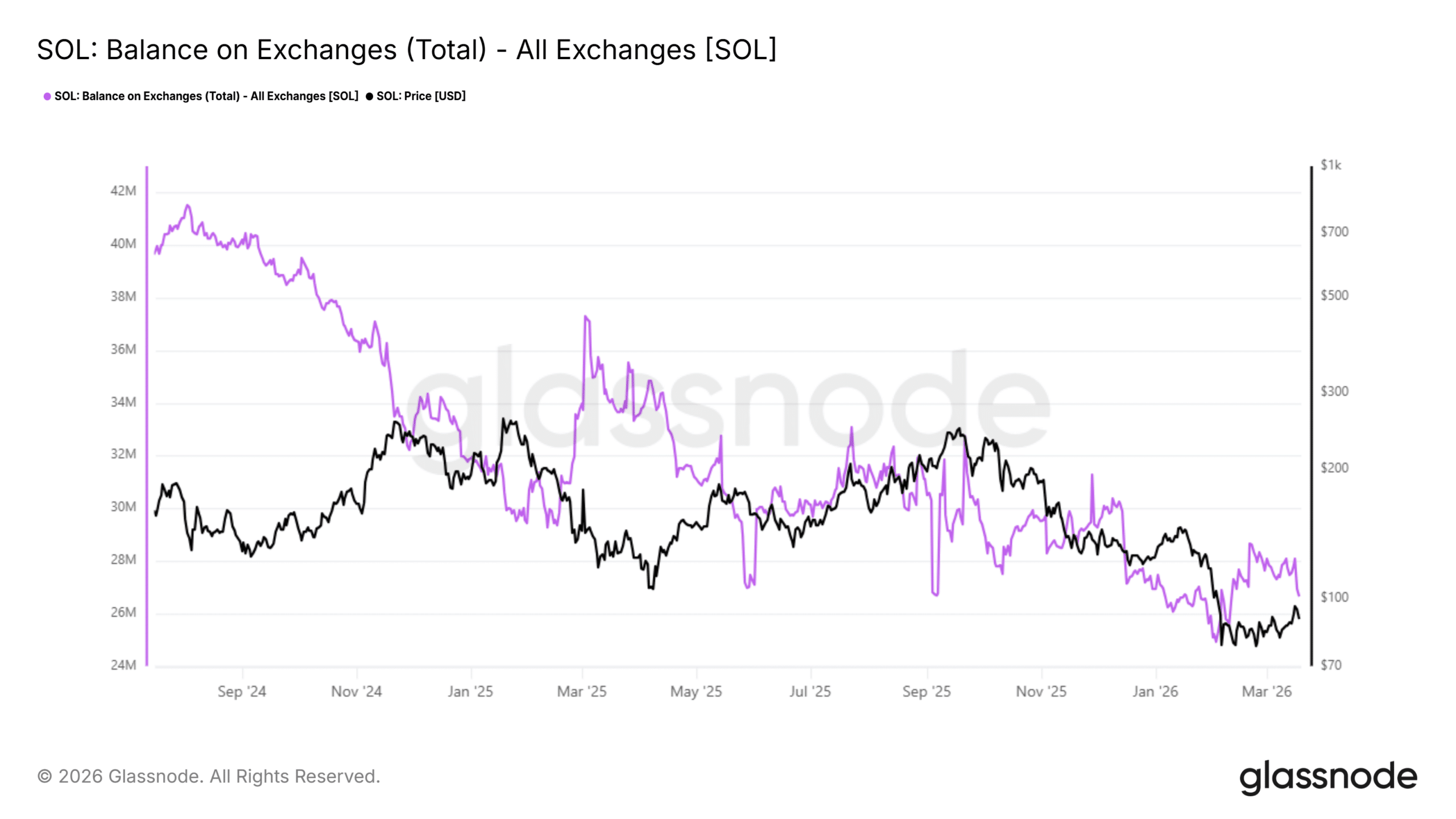
Source: Glassnode

As these inflows fail to reverse the broader downtrend, it means incoming supply is being quickly absorbed rather than redistributed.

As liquid balances compress, the amount of readily tradable SOL shrinks, limiting sustained sell pressure. Such a shift occurs as participants move tokens into private custody or staking, signaling stronger holding behavior.

As supply tightens beneath the surface while demand absorbs available liquidity, the market structure will strengthen, reinforcing a transition towards a more stable and controlled environment.


Final Summary

  • Solana [SOL] is transitioning from Futures-driven momentum to Spot-led accumulation, as whales absorb supply and stablecoin liquidity exceeds $17 billion.
  • Solana saw tightening exchange supply alongside rising on-chain liquidity, signaling reduced sell pressure and positioning the market for sustained expansion.

Related Questions

QWhat shift in participant behavior did Solana's market structure reveal according to the article?

ASolana's market structure revealed a shift from Futures-driven momentum to Spot-led accumulation, with Futures momentum weakening as Spot demand built quietly.

QWhat does the expansion of Spot order sizes between $80 and $100 indicate about whale participation?

AThe expansion of Spot order sizes between $80 and $100 marks the return of whale participation at lower levels, signaling strategic positioning rather than speculation as larger players accumulate into weakness.

QHow did stablecoin supply on Solana change by early 2026, and what does it imply?

AStablecoin supply on Solana extended past $17 billion by early 2026, marking a new all-time high, which implies that liquidity is not exiting but repositioning for deployment across DeFi and real-world asset activity.

QWhat trend was observed in Solana's Exchange Balances from late 2024 to March 2026?

AExchange Balances for Solana fell from above 40 million SOL in late 2024 to nearly 27 million by March 2026, indicating that incoming supply is being quickly absorbed rather than redistributed.

QHow does the article describe the overall market structure transition for Solana?

AThe article describes Solana's market structure as transitioning towards a more stable and controlled environment, with spot demand gradually replacing fading derivatives-driven momentum, supply tightening beneath the surface, and demand absorbing available liquidity.

Related Reads

How Many Tokens Away Is Yang Zhilin from the 'Moon Chasing the Light'?

The article explores the intense competition between two leading Chinese AI companies, DeepSeek and Kimi (Moon Dark Side), and the mounting pressure on Yang Zhilin, the founder of Kimi. While DeepSeek re-emerged after 15 months of silence with its powerful V4 model—boasting 1.6 trillion parameters and low-cost, long-context capabilities—Kimi has been focusing on long-context processing and multi-agent systems with its K2.6 model. Yang faces a threefold challenge: technological rivalry, commercialization pressure, and investor expectations. Despite Kimi’s high valuation (reaching $18 billion), its revenue heavily relies on a single product with low paid conversion rates, while DeepSeek’s strategic silence and open-source influence have strengthened its market position and valuation prospects, now targeting over $20 billion. Both companies reflect broader trends in China’s AI ecosystem: Kimi aims for global influence through open-source contributions and agent-based advancements, while DeepSeek prioritizes foundational innovation and hardware independence, notably shifting to Huawei’s chips. Their competition is seen as vital for China’s AI progress, with the gap between top Chinese and U.S. models narrowing to just 2.7% on the Elo rating scale. Ultimately, the article argues that this rivalry, though anxiety-inducing for leaders like Zhilin, is essential for driving innovation and solidifying China’s role in the global AI landscape.

marsbit46m ago

How Many Tokens Away Is Yang Zhilin from the 'Moon Chasing the Light'?

marsbit46m ago

TechFlow Intelligence Bureau: ChatGPT Helps Amateur Mathematician Crack 60-Year-Old Problem, CFTC Sues New York Regulator Over Coinbase and Gemini

An amateur mathematician, with the assistance of ChatGPT, has solved a combinatorial mathematics puzzle originally proposed by Hungarian mathematician Paul Erdős in the 1960s. This marks another milestone in AI-aided mathematical research, demonstrating the evolving capabilities of large language models in formal reasoning. In other AI developments, OpenAI introduced a new privacy filter tool for enterprise API usage, automatically screening sensitive data. Meanwhile, the Qwen3.6-27B model achieved 100 tokens per second on a single RTX 5090 GPU using quantization, significantly lowering the cost barrier for local AI deployment. In crypto and Web3, the U.S. CFTC sued New York’s financial regulator, challenging its oversight of Coinbase and Gemini—a first-of-its-kind federal-state regulatory clash. Following a vulnerability, KelpDAO and major DeFi protocols established a recovery fund. Tether froze $344 million in assets linked to Iran’s central bank upon U.S. Treasury request, highlighting the centralized control risks in stablecoins. Separately, Litecoin underwent a 3-hour chain reorganization to undo a privacy-layer exploit. In the U.S., former President Trump invoked the Defense Production Act to address power grid bottlenecks affecting AI data centers and dismissed the entire National Science Board, raising concerns over research independence. A retail trader gained 250% on a $600k Intel options bet amid AI-related speculation. Xiaomi announced its first performance electric vehicle, targeting rivals like Tesla. Meanwhile, iPhone users reported devices automatically reinstalling a hidden app daily, suspected to be MDM-related. A Chinese securities report noted that A-share institutional crowding has reached its second-longest streak since 2007, signaling high valuations and potential style rotation. The day’s developments reflect a dual narrative: AI is enabling unprecedented individual breakthroughs, while centralized power structures—whether governmental or corporate—are becoming more assertive, underscoring that decentralization is as much a political-economic challenge as a technical one.

marsbit1h ago

TechFlow Intelligence Bureau: ChatGPT Helps Amateur Mathematician Crack 60-Year-Old Problem, CFTC Sues New York Regulator Over Coinbase and Gemini

marsbit1h ago

Trading

Spot
Futures

Hot Articles

Discussions

Welcome to the HTX Community. Here, you can stay informed about the latest platform developments and gain access to professional market insights. Users' opinions on the price of SOL (SOL) are presented below.

活动图片