Solana On-Chain Liquidity Leadership Widens As DEX Volume Stays Robust Across The Network

bitcoinistPublished on 2026-01-09Last updated on 2026-01-09

Abstract

Despite a volatile market with sideways price movements, the Solana network continues to demonstrate robust on-chain activity and performance. It has solidified its leadership in on-chain liquidity, processing a dominant $6.7 billion in DEX volume, which surpasses all other layer 1 and layer 2 solutions. This reflects strong trading environment, deep liquidity pools, and sustained user engagement. Further signaling strength, Solana's derivatives market is expanding, with open interest reaching $3.35 billion, indicating significant new capital inflows and trader activity. The network closed 2025 with record on-chain performance, showing growth in real economic activity, applications, and users. Key developments fueling this growth include a massive $900 million+ spike in stablecoin supply within 24 hours, driven by Jupiter's new stablecoin launch, and Morgan Stanley's filing for a Spot Solana ETF, pointing to a resurgence in institutional crypto flows.

The Solana network is still demonstrating notable activity and performance in a volatile market state, with its price facing sideways movements. With a recent uptick in user participation and demand, the SOL network remains a dominant force in the blockchain sector, ramping up substantial DEX volume over the past few weeks.

Resilient DEX Volume Keeps Solana At The Top

As the cryptocurrency market cools, the Solana network is showing signs of strength. This strength is seen in the network’s on-chain liquidity, which appears to be leading the charge across the dynamic blockchain sector. Solana Daily’s post reveals that Solana’s position at the forefront of on-chain liquidity keeps growing, with Decentralized Exchange (DEX) activity on the network exhibiting notable resilience despite broader market conditions fluctuating.

The chart from Solana Daily shows that the network is processing $6.7 billion in DEX volume. Interestingly, this figure surpasses that of all other layer 1 and layer 2 solutions, reflecting SOL’s strong trading volumes, deep liquidity pools, and sustained user engagement.
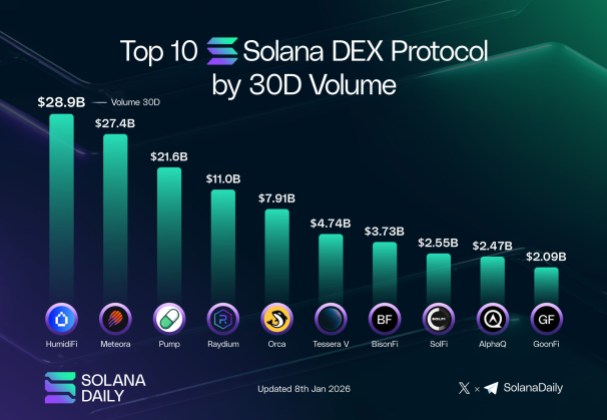
Source: Chart from Solana Daily on X

As SOL improves in these areas, it expands its lead over competing layer 1 and layer 2 ecosystems. With active market makers, robust DeFi protocols, and high transaction throughput, the network’s liquidity infrastructure seems to be maturing rather than withering after previous spikes in activity.

Another notable development highlighted by Solana Daily is the rise in SOL’s derivatives market as open interest broadens. At the time of the report, the altcoin’s open interest had reached a staggering $3.35 billion, indicating a fresh wave of trader engagement and risk-taking around the asset.

Increasing open interest usually indicates a new capital inflow into futures and perpetual markets, and in SOL’s case, it coincides with growing on-chain activity and a resurgence of speculative activity.

A Milestone In On-Chain Performance Into 2026

In another X post, Solana Daily reported that the SOL network closed 2025 with record on-chain performance, reflecting steady growth in real economic activity across applications, liquidity, and users. Traders, developers, and capital are not just testing Solana. They seem to be committing to the network, cementing its position as one of the most active centers in the cryptocurrency field.

This rise in on-chain performance underscores strong revenue metrics, increasing stablecoin supply, and growing institutional participation, which outline an evolving ecosystem heading into the next cycle. As the network further advances into 2026, narratives about Real World Assets (RWAs), payments, AI-native finance, and privacy infrastructure are beginning to emerge throughout the robust ecosystem.

SOL is slowly becoming an on-chain finance prodigy, which is indicated by the surge in stablecoin supply on the network. The Kobeissi Letter has outlined SOL’s stablecoin growth following a supply spike of over +$900 million in 24 hours.

According to the leading commentary, this is a result of Jupiter, the world’s largest on-chain platform, launching its on-chain focused stablecoin. During the period, Morgan Stanley also filed for a Spot Solana Exchange-Traded Fund (ETF). These moves point to a resurgence in crypto flows.

SOL trading at $139 on the 1D chart | Source: SOLUSDT on Tradingview.com

Related Questions

QWhat is the current DEX volume being processed by the Solana network, and how does it compare to other blockchain solutions?

AThe Solana network is processing $6.7 billion in DEX volume, which surpasses that of all other layer 1 and layer 2 solutions.

QWhat does the significant increase in Solana's open interest indicate about market activity?

ASolana's open interest reaching $3.35 billion indicates a fresh wave of trader engagement, risk-taking, and new capital inflow into futures and perpetual markets.

QWhat two major events contributed to the surge in stablecoin supply on the Solana network?

AThe surge was primarily due to Jupiter, the world's largest on-chain platform, launching its on-chain focused stablecoin, and Morgan Stanley filing for a Spot Solana Exchange-Traded Fund (ETF).

QHow did Solana's on-chain performance fare at the end of 2025, and what does this signify?

ASolana closed 2025 with record on-chain performance, reflecting steady growth in real economic activity and signifying that traders, developers are committing to the network, cementing its position as a highly active center in crypto.

QWhat emerging narratives are beginning to take shape within the Solana ecosystem as it advances into 2026?

ANarratives about Real World Assets (RWAs), payments, AI-native finance, and privacy infrastructure are beginning to emerge throughout the robust Solana ecosystem.

Related Reads

The Storage Magnate Who Conquered a Trillion-Dollar Kingdom, Yet Ultimately Could Not Become the Richest

**Summary:** "The Memory Magnate Who Built a Trillion-Dollar Empire, Yet Never Became the Richest" explores the journey of Zhu Yiming, founder of GigaDevice (603986) and co-founder of the soon-to-IPO ChangXin Memory Technologies (CXMT). The article positions GigaDevice, a fabless chip designer now valued at ~¥340 billion, as a prequel to the massive IDM (Integrated Device Manufacturer) venture, CXMT. Starting in 2005 with minimal capital, Zhu strategically "picked up the pieces" by focusing on niche markets like NOR Flash and microcontrollers (MCUs), areas major players were exiting. This allowed GigaDevice to grow into a diversified semiconductor company, maintaining robust profitability even during industry downturns by controlling costs. However, the piece argues that in the highly cyclical and capital-intensive memory chip industry, the fabless model has limits. True resilience and scale require the ability for "counter-cyclical expansion" – investing heavily during downturns – a tactic only possible for IDMs like Samsung or SK Hynix. This insight led Zhu to partner with the Hefei city government in 2016 to establish CXMT, an IDM focused on DRAM. Zhu's symbolic moves, like forfeiting salary and diluting his equity, were crucial in securing the massive state and bank funding needed. CXMT's equipment base is now valued even higher than that of BYD's vast auto manufacturing empire. Despite the potential for CXMT to reach a market cap of ¥1-2 trillion upon its IPO, Zhu's indirect stake in both companies is estimated below 3%, placing his personal wealth far below that of China's top billionaires. The article concludes that his strategic vision built a trillion-yuan memory landscape, but the capital structure necessary to achieve it precluded a personal fortune of similar scale.

marsbit2m ago

The Storage Magnate Who Conquered a Trillion-Dollar Kingdom, Yet Ultimately Could Not Become the Richest

marsbit2m ago

XRP Ledger Daily Fees Drop Below $400 As Network Activity Question Returns

The XRP Ledger is drawing attention as daily network fees have fallen below $400. While low fees align with XRPL's design for affordable transactions and are often seen as a strength, the metric can also serve as an indicator of network demand and paid transaction volume. This data point of around $3,100 in weekly fee burn highlights the stark contrast with higher-fee chains like Ethereum and Bitcoin. The development fuels an ongoing debate. Proponents view low fees as a sign of efficiency and accessibility, while critics may question if the network is generating sufficient high-value activity relative to its market cap and payments-focused narrative. The article cautions against overstating the finding, noting a single low-fee day does not signify network failure. It instead adds context to discussions about XRPL's usage, especially alongside Ripple's broader initiatives in stablecoins (RLUSD), AI payments, and enterprise infrastructure. The report recommends monitoring for a fee rebound, checking transaction counts for a fuller picture, and confirming the trend via native explorers like Bithomp. It frames the story within a larger market shift where on-chain data, protocol updates, and infrastructure developments are becoming crucial alongside price action. The editorial stance is to present the verified data, explain its significance for assessing network activity, and avoid hype, positioning it as part of the daily crypto conversation.

bitcoinist4h ago

XRP Ledger Daily Fees Drop Below $400 As Network Activity Question Returns

bitcoinist4h ago

Trading

Spot
Futures

Hot Articles

Discussions

Welcome to the HTX Community. Here, you can stay informed about the latest platform developments and gain access to professional market insights. Users' opinions on the price of SOL (SOL) are presented below.

活动图片