Solana Gets A Big Infra Signal As Alibaba Demos High-Performance RPCs

bitcoinistPublished on 2026-02-11Last updated on 2026-02-11

Abstract

Alibaba Cloud demonstrated high-performance Solana RPC connectivity during a keynote, showcasing a significant infrastructure development for the blockchain. The demo highlighted a migration of a Solana archive node to Alibaba's in-house database, completed in just two days with the aid of AI-assisted coding. Key improvements included a reduction in RPC call latency; a "get slot" call dropped from 25ms to 10ms, while a "get block" call for a 4MB payload saw latency fall to under 200ms. This was achieved by routing traffic through Alibaba's private backbone network instead of the public internet, emphasizing stability and suitability for low-latency, trading-heavy applications. The company also highlighted its global data center footprint as a perfect match for Solana's needs. Although not a formal product announcement, the public benchmarking by a major cloud provider is a notable vote of confidence for the Solana ecosystem.

Solana picked up an infrastructure vote of confidence on Wednesday after Alibaba Cloud used a Hong Kong keynote to demo “high-performance” Solana RPC connectivity, framing the work as part of its broader push to fuse AI tooling with Web3 developer workflows.

In a clip shared by Solana’s official X account, the demo came during an Accelerate APAC 2026 keynote titled “Fueling Web3 Innovation with AI on Cloud,” delivered by Zhao Qingyuan of Alibaba Cloud Intelligence Group. The pitch was straightforward: reduce latency and operational overhead for builders who rely on fast, reliable RPC access, especially in trading-heavy use cases where milliseconds can matter.

Alibaba Flexes Solana RPC Throughput

Zhao framed the talk as a practical example of how large language models can compress development cycles. In the keynote, he said he recently migrated a archive node away from a Google Bigtable setup to an Alibaba Cloud in-house database implementation over a weekend, leaning on AI-assisted coding despite limited prior familiarity with Solana’s usual developer stack.

“Just this weekend, I spent two days — I migrated the Solana archive node from a Google Bigtable implementation to Alibaba Cloud’s in-house database implementation,” Zhao said. “I haven’t even learned Rust before, and I just used web coding to do this in two days. And it will download the data from Hugging Face for the historical slots, and it will synchronize the data with the mainnet, and it can provide the RPC service.”

The remarks landed alongside Alibaba Cloud’s broader messaging around its Qwen family of models, positioned by the company as a general-purpose LLM stack that can be used for coding, assistants, and multimodal workflows.

The more market-relevant part of the demo was the latency claim. Zhao described a setup where users connect to RPC nodes through Alibaba Cloud’s backbone network rather than via general public internet routes.

In a table shown during the talk, he said a “get slot” RPC call latency was reduced from roughly 25 milliseconds to about 10 milliseconds under the backbone-network approach, calling it “a huge reduction.” For “get block,” described as a 4MB block payload, he said latency fell from “more than 200 milliseconds” to “less than 200 milliseconds,” while emphasizing stability and suitability for low-latency workloads.

Alibaba Cloud also leaned into geography. Zhao pointed to the firm’s global footprint, highlighting regions such as Frankfurt, the US, and multiple Asia-Pacific hubs including Tokyo, Singapore, and Hong Kong, as a “perfect match” for Solana’s builder base and latency-sensitive applications.

While the clip stops short of announcing a formal partnership or a productized Solana RPC offering with pricing or SLAs, the optics are notable: a major cloud provider using a Solana ecosystem stage to publicly benchmark RPC latency improvements, and explicitly tying that to trading and “co-location for the high frequency calls.”

At press time, SOL traded at $81.
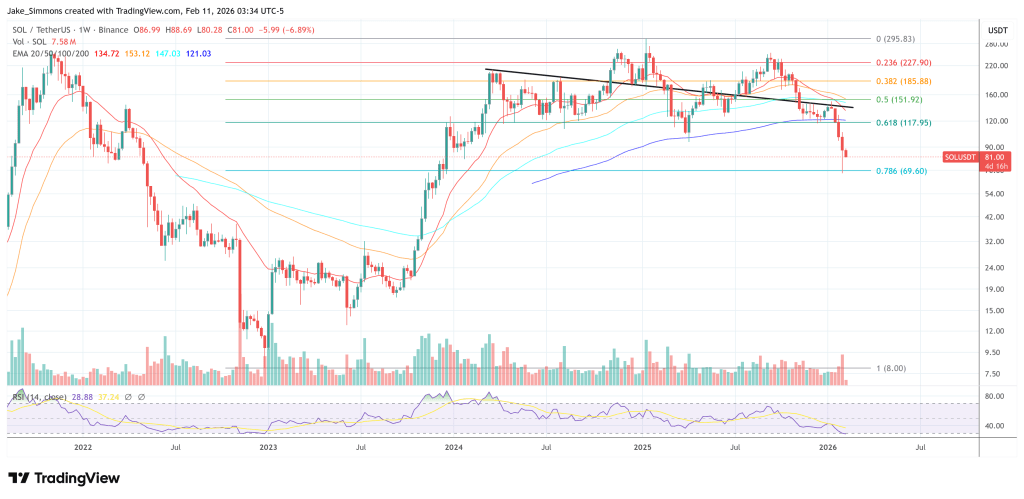
SOL stays above the 0.786 Fib, 1-week chart | Source: SOLUSDT on TradingView.com

Related Questions

QWhat did Alibaba Cloud demonstrate regarding Solana at the Accelerate APAC 2026 keynote?

AAlibaba Cloud demonstrated 'high-performance' Solana RPC connectivity, showcasing reduced latency and operational overhead for developers, particularly in trading-heavy use cases.

QHow did Zhao Qingyuan from Alibaba Cloud migrate the Solana archive node, and what was notable about his approach?

AZhao Qingyuan migrated a Solana archive node from a Google Bigtable implementation to Alibaba Cloud's in-house database over a weekend using AI-assisted coding, despite having limited prior familiarity with Rust or Solana's developer stack.

QWhat latency improvements did Alibaba Cloud claim for Solana RPC calls using their backbone network?

AFor a 'get slot' RPC call, latency was reduced from roughly 25 milliseconds to about 10 milliseconds. For a 'get block' call with a 4MB payload, latency fell from 'more than 200 milliseconds' to 'less than 200 milliseconds'.

QHow did Alibaba Cloud position its Qwen family of models in relation to this demonstration?

AAlibaba Cloud positioned its Qwen family of models as a general-purpose LLM stack that can be used for coding, assistants, and multimodal workflows, using the demo as a practical example of how AI can compress development cycles.

QWhat was the market context for SOL at the time of the article's publication?

AAt press time, SOL was trading at $81.

Related Reads

From Survival to Accelerated Growth: The Journey of Zcash's Three-Year Rise as Told by the Founder of ZODL

**From Survival to Accelerated Growth: Zcash Founder Details the 3-Year Rise** Three years ago, Zcash (ZEC) was a struggling pioneer in privacy technology, with a price near $30, low shielded supply (11%), and a community mired in governance disputes. Today, ZEC trades around $600, with over 31% of its supply (~$3B) in user-controlled shielded pools. This transformation resulted from breaking key constraints. First, **governance shackles were removed**. The old model guaranteed funding to two entities (ECC and ZF) regardless of performance, creating a monopoly. In 2024, ECC rejected further direct funding, forcing a change. The NU6 upgrade ended direct funding, allocating 8% to community grants and 12% to a protocol-controlled treasury for retroactive rewards, expiring in 2028 unless renewed by overwhelming consensus. The entities also relinquished their trademark-based veto power, freeing community governance. Second, the **product focus shifted** from pure cryptography to user growth. Previously, engineering excelled at privacy tech but failed to attract users. In early 2024, the team (later ZODL) pivoted to building products users wanted, like the Zodl wallet (default privacy, hardware support, cross-asset swaps). This drove shielded supply to grow over 400% in ZEC terms, with 86.5% of recent transactions being shielded, representing real user adoption. Third, the **narrative evolved** from the limiting "privacy coin" label to "unstoppable private money." This clarified Zcash's value proposition: a Bitcoin-like monetary policy with verifiable private payments via advanced cryptography. This structural narrative—protocol (Zcash), asset (ZEC), gateway (Zodl)—enabled broader exchange listings, institutional interest, and ETF filings. Finally, **organizational constraints were broken**. In early 2026, the ECC team left its non-profit structure after disputes over control, forming Zcash Open Development Lab (ZODL). ZODL raised $25M from top VCs (Paradigm, a16z, etc.), gaining the capital and agility of a startup to scale consumer products. Current metrics show strong momentum: social discussion volume for ZEC surged 15,245% in a year, with 81% positive sentiment. The focus is now on enhancing user experience (Zodl wallet), scalability (Tachyon project targeting Visa-level throughput with 25-second blocks), and post-quantum security (quantum-recoverable wallets coming soon). Zcash is positioned to become faster, more usable, scalable, and quantum-resistant.

marsbit6m ago

From Survival to Accelerated Growth: The Journey of Zcash's Three-Year Rise as Told by the Founder of ZODL

marsbit6m ago

Five Counterparty Risk Architectures: A Settlement-Layer Methodology for Classifying TradFi Models in Crypto Exchanges

**Summary:** This companion piece reframes the five TradFi-on-crypto exchange architectures, previously classified by "architectural fingerprint," through the lens of counterparty risk. The core question is: whose balance sheet bears the loss first in a stress scenario, and has it historically done so? Each of the five models corresponds to a distinct risk holder with its own documented failure modes. * **Model 1 (Stablecoin-Settled CEX Perpetuals):** Risk is held by the stablecoin issuer (e.g., reserve composition, bank connectivity) and the CEX's own book. History includes Tether's banking disconnections (2017) and reserve misrepresentations (CFTC 2021 Order). * **Model 2 (CFD Brokers):** Risk resides on the broker's balance sheet (B-book model). Regulatory differences (e.g., ESMA's mandatory negative balance protection vs. Mauritius FSC's lack thereof) define loss allocation rules, as seen in the 2015 SNB event (Alpari UK insolvency). * **Model 3 (Off-Chain Custody & Transfer Agent Chain):** Risk lies with the off-chain custodian/platform. User asset recovery depends on Terms of Use and corporate structure, exemplified by the Celsius bankruptcy ruling (2023) where Earn Account assets were deemed property of the estate. * **Model 4 (DEX Perpetual Protocols):** No single balance sheet bears risk. Loss absorption relies on a protocol's insurance fund and Auto-Deleveraging (ADL) mechanism, as demonstrated in the GMX V1 (2022) and dYdX v3 YFI (2023) incidents. * **Model 5 (Regulated CCP - DCM-DCO-FCM):** The most institutionalized model concentrates risk in the Central Counterparty (CCP). However, history shows CCPs can employ non-standard tools under extreme stress, such as mass trade cancellation (LME Nickel, 2022) or enabling negative price settlements (CME WTI, 2020). The report argues that regulatory choices and counterparty risk structures are co-extensive, not in an upstream-downstream relationship. It concludes with five separate observation checklists (not predictions) for monitoring the structural vulnerabilities of each risk model.

marsbit24m ago

Five Counterparty Risk Architectures: A Settlement-Layer Methodology for Classifying TradFi Models in Crypto Exchanges

marsbit24m ago

Trading

Spot
Futures

Hot Articles

Discussions

Welcome to the HTX Community. Here, you can stay informed about the latest platform developments and gain access to professional market insights. Users' opinions on the price of SOL (SOL) are presented below.

活动图片