Solana ETF Volume Explodes: Anomaly Or New Normal?

bitcoinistPublished on 2026-01-08Last updated on 2026-01-08

Abstract

Solana spot ETFs experienced a significant surge in trading volume, reaching $220 million on January 6, 2026, surpassing the previous record of $122 million set during their October 2025 launch. This spike coincides with a price rally and a filing by Morgan Stanley for its first Solana and Bitcoin ETFs. While Bitcoin ETF data shows volume surges can indicate either sustained support or local reversals, it's unclear if Solana's recent activity is an anomaly or the beginning of a new trend due to its relatively short history. At the time of writing, Solana's price was around $138, up over 9% in the past week.

Solana spot exchange-traded funds (ETFs) have witnessed a $220 million spike in trading volume. Here’s what this could mean for the asset.

Solana Spot ETF Volume Has Shot Up

In a new insight post on its website, on-chain analytics firm Santiment has discussed what spikes in the spot ETF trading volume mean for Bitcoin and Solana. Spot ETFs refer to investment vehicles that allow traders to gain indirect exposure to an underlying asset. In the context of cryptocurrencies, they allow investors an off-chain route into digital assets that doesn’t require them to deal with exchanges and wallets; the fund buys and custodies the tokens on their behalf.

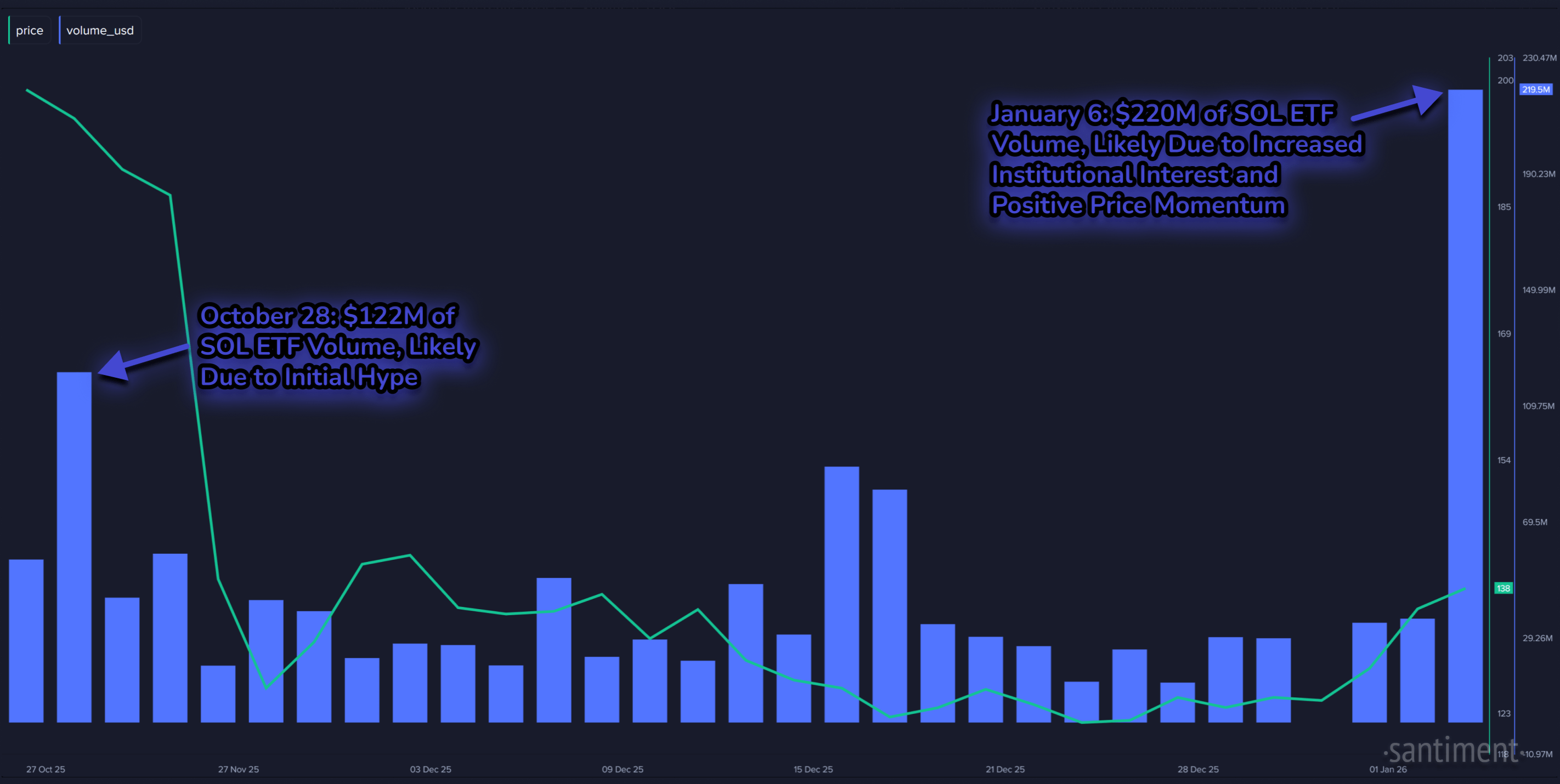
The US Securities and Exchange Commission (SEC) approved the first Bitcoin spot ETFs back in January 2024. Ethereum funds got the green light in July of that year, while Solana obtained its approval in October 2025. Thus, while BTC and ETH spot ETFs have been around for some time now, SOL products are relatively new. As the chart shared by Santiment shows, SOL spot ETFs observed a burst of trading volume during the initial launch hype.
The data for the SOL ETF USD volume | Source: Santiment

Solana spot ETF volume rose to a high of $122 million on October 28th, but excitement was quick to run out as the metric fell to a much lower level soon after. This record wasn’t broken for the rest of the year, but six days into 2026, SOL ETFs finally saw activity surpassing that of the launch period.

From the chart, it’s visible that SOL volume hit $220 million on January 6th, significantly higher than the October 28th spike. The uptick in the cryptocurrency’s investment vehicles has come as its price has enjoyed a rally, and Morgan Stanley has filed for its first Solana and Bitcoin ETFs.

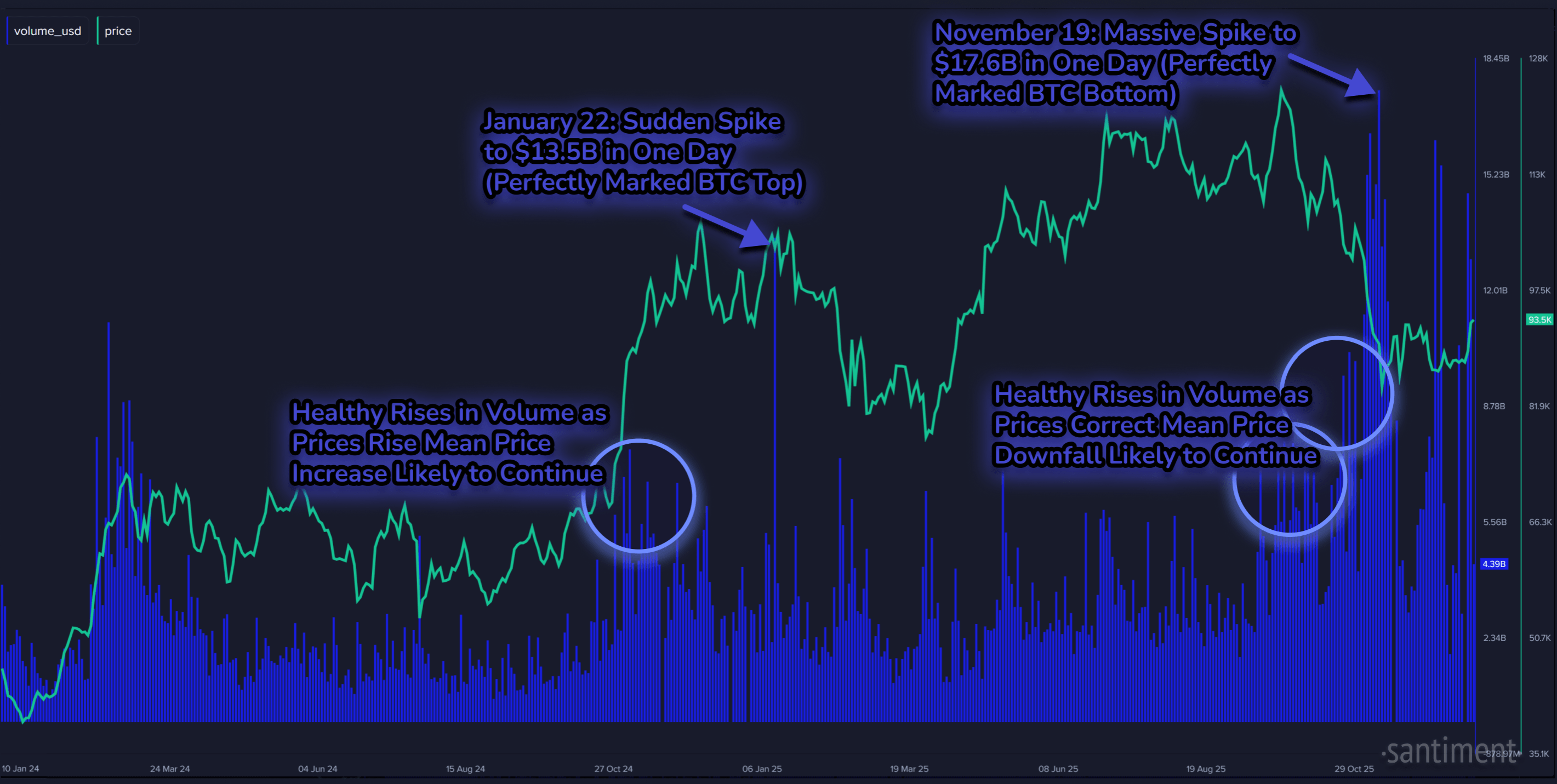
As for what the volume surge could mean for the asset, it’s hard to say from the data of SOL ETFs alone, as they are still quite young. Bitcoin ETFs, on the other hand, have been around for two years now, so some interpretations can be made from their data.
How the volume associated with BTC ETFs has changed over their history | Source: Santiment

As the analytics firm has highlighted in the chart, Bitcoin has seen two types of surges in the ETF volume: a healthy, sustained rise that supports price moves, and sudden spikes that mark local reversals.

Solana’s latest spike could be of the latter type, but since its spot ETFs still have a small sample size, the pattern with them is yet uncertain. The sharp surge could be an anomaly, or it could just be the start of a new normal (which, if so, would put the spike in the former category).

SOL Price

At the time of writing, Solana is trading around $138, up more than 9% over the last week.

Looks like the price of the coin has been going up recently | Source: SOLUSDT on TradingView


Related Questions

QWhat was the recent spike in trading volume for Solana spot ETFs, and how does it compare to the initial launch period?

AThe recent spike in trading volume for Solana spot ETFs reached $220 million on January 6th, 2026. This is significantly higher than the initial launch hype spike of $122 million recorded on October 28th, 2025.

QAccording to the article, what are the two types of volume surges observed in Bitcoin ETFs, and what do they signify?

AAccording to the on-chain analytics firm Santiment, Bitcoin ETFs have shown two types of volume surges: a healthy, sustained rise that supports price moves, and sudden spikes that mark local price reversals.

QWhat recent corporate filing is mentioned as a factor to the increased activity in Solana ETFs?

AThe article mentions that the uptick in Solana's investment vehicles coincided with Morgan Stanley filing for its first Solana and Bitcoin ETFs.

QWhy is it difficult to definitively interpret the meaning of the volume surge for Solana specifically?

AIt is difficult to interpret the surge because Solana spot ETFs are still quite new and have a small sample size of data, making any pattern or trend uncertain at this early stage.

QWhat was Solana's price and weekly performance at the time the article was written?

AAt the time of writing, Solana was trading around $138, reflecting a gain of more than 9% over the previous week.

Related Reads

From Theft to Re-entry: How Was $292 Million "Laundered"?

A sophisticated crypto laundering operation was executed following the $292 million hack of Kelp DAO on April 18. The attack, attributed to the North Korean Lazarus group, began with anonymous infrastructure preparation using Tornado Cash to fund wallets untraceably. The hacker exploited a vulnerability in Kelp’s cross-chain bridge, stealing 116,500 rsETH. To avoid crashing the market, the attacker used Aave and Compound as laundering tools—depositing the stolen rsETH as collateral to borrow $190 million in clean, liquid ETH. This move triggered a bank run on Aave, causing an $8 billion drop in TVL. After consolidating funds, the attacker fragmented them across hundreds of wallets to evade detection. A major breakpoint was THORChain, where over $460 million in volume—30 times its usual activity—was processed in 24 hours, converting ETH into Bitcoin. This shift to Bitcoin’s UTXO model exponentially increased tracing complexity by shattering funds into countless untraceable fragments. The final destination was Tron-based USDT, the primary channel for illicit crypto flows. From there, funds were cashed out via OTC brokers in China and Southeast Asia, using unlicensed underground banks and UnionPay networks outside Western sanctions scope. Ultimately, the laundered money supports North Korea’s weapons programs, which rely heavily on crypto hacking for foreign currency. The incident underscores structural challenges in DeFi: its openness, composability, and lack of central control make such laundering not just possible, but inherently difficult to prevent.

marsbit28m ago

From Theft to Re-entry: How Was $292 Million "Laundered"?

marsbit28m ago

Google and Amazon Simultaneously Invest Heavily in a Competitor: The Most Absurd Business Logic of the AI Era Is Becoming Reality

In a span of four days, Amazon announced an additional $25 billion investment, and Google pledged up to $40 billion—both direct competitors pouring over $65 billion into the same AI startup, Anthropic. Rather than a typical venture capital move, this signals the latest escalation in the cloud wars. The core of the deal is not equity but compute pre-orders: Anthropic must spend the majority of these funds on AWS and Google Cloud services and chips, effectively locking in massive future compute consumption. This reflects a shift in cloud market dynamics—enterprises now choose cloud providers based on which hosts the best AI models, not just price or stability. With OpenAI deeply tied to Microsoft, Anthropic’s Claude has become the only viable strategic asset for Google and Amazon to remain competitive. Anthropic’s annualized revenue has surged to $30 billion, and it is expanding into verticals like biotech, positioning itself as a cross-industry AI infrastructure layer. However, this funding comes with constraints: Anthropic’s independence is challenged as it balances two rival investors, its safety-first narrative faces pressure from regulatory scrutiny, and its path to IPO introduces new financial pressures. Globally, this accelerates a "tri-polar" closed-loop structure in AI infrastructure, with Microsoft-OpenAI, Google-Anthropic, and Amazon-Anthropic forming exclusive model-cloud alliances. In contrast, China’s landscape differs—investments like Alibaba and Tencent backing open-source model firm DeepSeek reflect a more decoupled approach, though closed-source models from major cloud providers still dominate. The $65 billion bet is ultimately about securing a seat at the table in an AI-defined future—where missing the model layer means losing the cloud war.

marsbit6h ago

Google and Amazon Simultaneously Invest Heavily in a Competitor: The Most Absurd Business Logic of the AI Era Is Becoming Reality

marsbit6h ago

Trading

Spot
Futures

Hot Articles

Discussions

Welcome to the HTX Community. Here, you can stay informed about the latest platform developments and gain access to professional market insights. Users' opinions on the price of SOL (SOL) are presented below.

活动图片