Solana ETF Draws $39 Million Inflow in Single Week, Highest Since February, Futures Open Interest Surges 30%, Traders Target $120

marsbitPublished on 2026-05-12Last updated on 2026-05-12

Abstract

Solana ETF sees its strongest weekly inflow since February, attracting $39.23 million with Bitwise's BSOL ETF accounting for 92% of the total. This marks a potential reversal of a six-month downtrend in monthly inflows. Simultaneously, SOL futures open interest surged 29.5% in the first half of May, reaching $6.4 billion, indicating significant new capital entering the derivatives market. Spot buying pressure also increased, with the Cumulative Volume Difference (CVD) rising sharply. On the fundamental side, Solana's largest-ever consensus upgrade, Alpenglow, has launched on a community testnet, aiming to drastically reduce transaction finality times. Mainnet deployment could occur next quarter. Analysts note that after a four-month consolidation period, short-term traders have largely exited, leaving conviction holders in control of the supply. This shift in holder structure means any renewed trading volume is more likely to push prices upward. A technical Adam & Eve bottom pattern suggests a price target of $120. However, short-term momentum has shown signs of cooling near the $95-$96 resistance level. Risks remain, including potential pressure from exchange sell orders if ETF inflows weaken again and the threat of cascading liquidations from highly leveraged positions.

Author: Claude, Deep Tide TechFlow

Deep Tide Introduction: Solana spot ETFs recorded a net inflow of $39.23 million last week, their strongest weekly performance since February, with Bitwise's BSOL capturing 92% of the share. Futures open interest surged 29.5% in the first two weeks of May to $6.4 billion, with spot and derivatives buying activity amplifying simultaneously.

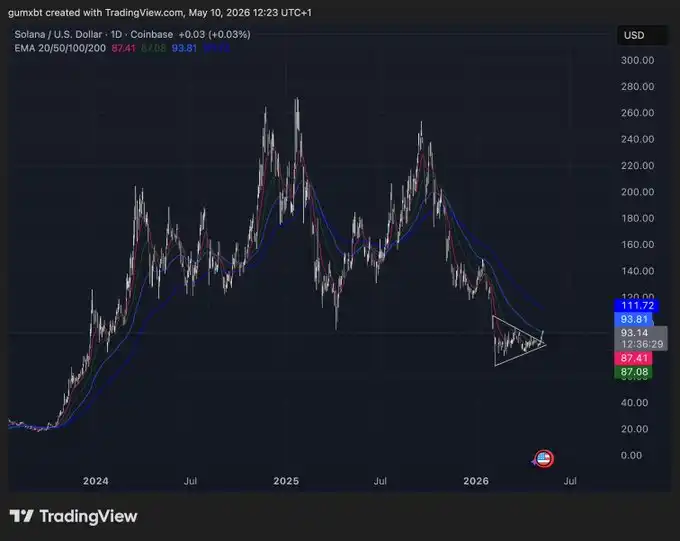
Technically, an Adam & Eve bottom pattern has emerged, pointing to a target of $120. Concurrently, Solana's largest-ever consensus upgrade, Alpenglow, went live on the community testnet on May 11, with co-founder Yakovenko indicating mainnet deployment could happen as early as next quarter. Capital flows, derivatives, and on-chain fundamentals are all emitting bullish signals simultaneously.

SOL is experiencing a multi-dimensional signal convergence.

According to a Cointelegraph report on May 11, Solana spot ETFs recorded a net inflow of $39.23 million last week, their strongest weekly performance since February. During the same period, the SOL price rose about 15% in seven days to around $97, while futures open interest grew by nearly $1.5 billion in half a month.

The on-chain holder structure is also quietly shifting: traders and hot money gradually exited during the four-month consolidation, and strong holders have regained control of the token supply. Any increase in volume after the sharp contraction will tend to push prices upward.

Signals from multiple independent data sources are lighting up simultaneously.

ETF Fund Flows Reverse Six-Month Downtrend, Bitwise BSOL Captures Over 80% Share

According to SoSoValue data, Solana spot ETFs saw a net inflow of $39.23 million last week, with Bitwise's staking ETF BSOL contributing $36 million, accounting for approximately 92%; Fidelity's FSOL saw an inflow of about $1.8 million. Since its launch, BSOL has accumulated approximately $861 million, representing 81% of the total cumulative inflow (approximately $1.06 billion) into all SOL spot ETFs.
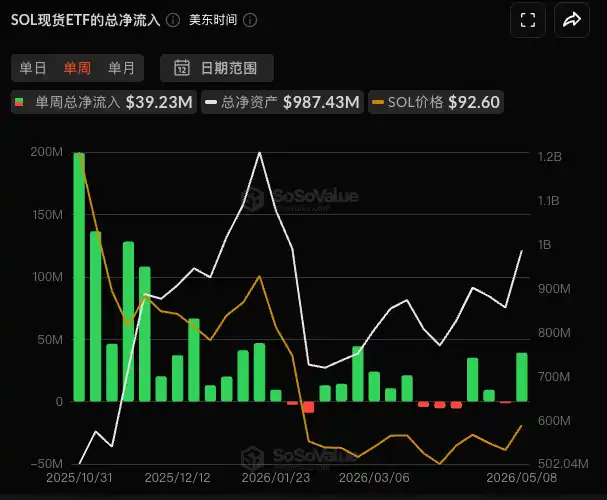
The significance of this figure needs to be understood within a longer timeline. Citing SoSoValue data, BeInCrypto reported that monthly inflows into Solana ETFs have declined for six consecutive months after hitting a peak of $419 million last November: $148 million in December, $105 million in January, $63 million in February, $45.44 million in March, and only $39.93 million in April, the lowest monthly performance since the products launched. The weekly inflow in the first two weeks of May has already approached April's full-month level. If the current pace continues, it will mark the first reversal of the six-month downtrend.

As of publication, the total net asset value of all SOL spot ETFs is approximately $938 million, with SOL accounting for about 1.82% of ETF net assets, and historical cumulative net inflows exceeding $1 billion.

Futures Open Interest Surges 30% in Half a Month to $6.4 Billion, Spot Buying Volume Also Expands

The signal from the derivatives market is equally clear.

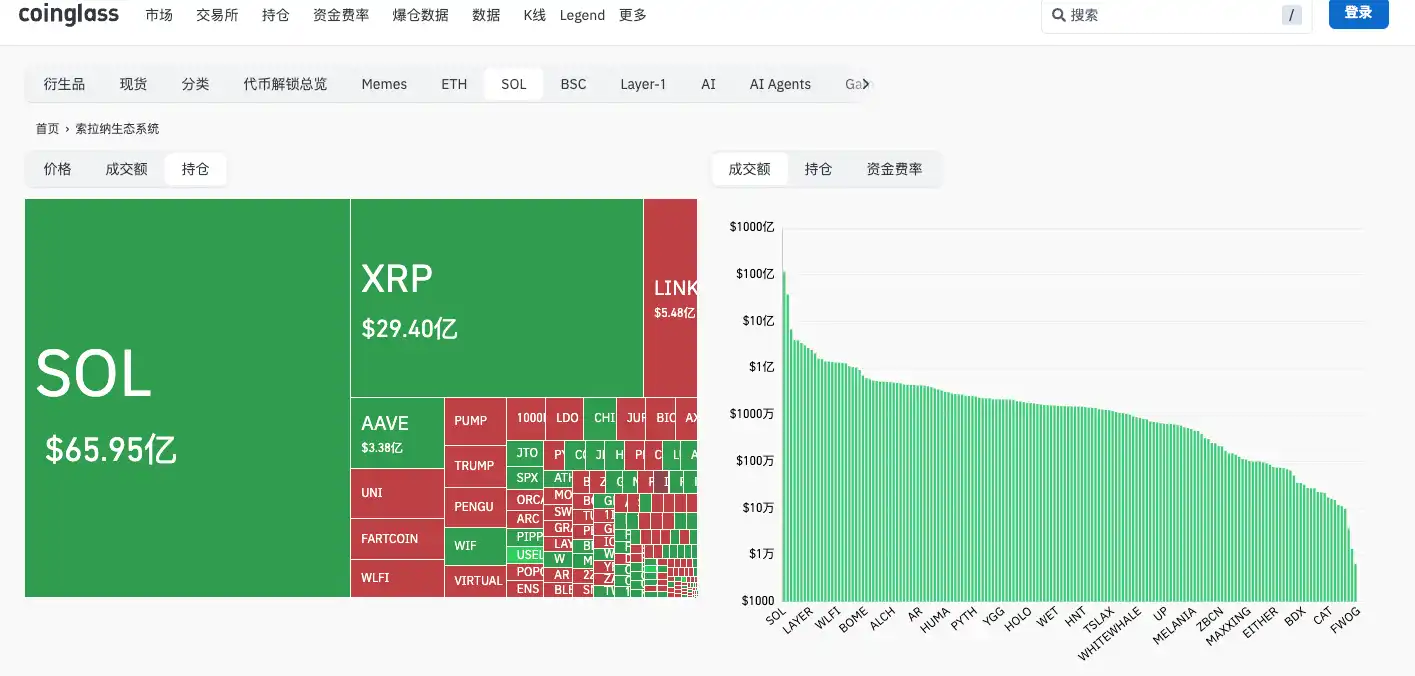
According to Coinglass data, SOL futures open interest climbed from $4.94 billion on May 1st to $6.4 billion, a 29.5% increase within half a month, representing an increment of approximately $1.5 billion. This is not merely increased leverage from existing players, but direct evidence of new capital entering the market.

Spot market buying activity is also cooperating. According to velo.chart data, the spot Cumulative Volume Delta (CVD, measuring the net difference between active buying and selling in the market) rose from $163 million to nearly $250 million over five days; futures CVD has been rising steadily since May 5th, expanding to approximately $594 million. Buyers are absorbing selling liquidity in both the spot and futures markets simultaneously.

The funding rate remains around 0.065%, indicating that longs are still paying to maintain their positions, but it hasn't reached overheated levels. However, after SOL reached the $95 to $96 range, the spot and futures CVD have started to flatten, suggesting short-term momentum has cooled somewhat.
Alpenglow Launches on Testnet, Solana's Largest-Ever Consensus Upgrade Enters Countdown

Beyond capital flows and technicals, fundamentals are also providing a catalyst.

According to a CoinDesk report on May 11, Solana's core development team Anza announced that the network's largest-ever consensus upgrade, Alpenglow, has gone live on a community test cluster. This upgrade will replace the current Proof-of-History and TowerBFT systems with the new Votor and Rotor protocols, aiming to compress transaction finality time from the current ~12.8 seconds to around 150 milliseconds—a speedup of nearly 100 times.

In a community vote last September, 98.27% of stakers voted in favor of the proposal, with a participation rate of 52%. Solana co-founder Anatoly Yakovenko stated at the Consensus conference in Miami last week that if testing goes smoothly, Alpenglow could launch on the mainnet as early as next quarter.

Silent Shift in Holder Structure, Healthier Token Distribution After 'Tourists Depart'

Crypto KOL gum pointed out on platform X that SOL is breaking out from a four-month consolidation period, but the underlying reason for this breakout is not just technical. He believes SOL is breaking out now, rather than a month ago, because it acts as a barometer for the entire crypto market's risk appetite, and its current price action is pricing in a 'return of risk'.

More crucially, it's about the token distribution structure. gum notes that during the four-month consolidation, short-term traders and hot money have abandoned SOL and exited, leading to a sharp decline in trading volume. Strong holders (conviction holders) have regained control of the token distribution. With this distribution structure, any reasonable recovery in trading volume will tend to push momentum in an upward direction.
Reference: KOL Perspective: Why SOL is Poised for a Rise at This Price Point?

Risk Warning: Short-term Momentum Shows Signs of Cooling

It's important to note that buying intensity for SOL in the $95 to $96 range has already begun to weaken, with spot and futures CVD flattening over the past 24 hours. The Adam & Eve pattern still requires daily close confirmation; failure to hold above $95 could lead to a pullback towards the $89 to $91 support zone.

Furthermore, a previous BeInCrypto analysis pointed out that if ETF inflows in May fail to stabilize or even continue to decline, SOL could face selling pressure from exchanges. The rapid buildup of high-leverage positions also means that any price retracement could amplify volatility through cascading liquidations. The liquidity vacuum left after meme-coin-driven retail frenzy subsides is another recurring risk pattern historically.

Multiple signals from capital flows, derivatives, and technicals are all pointing in the same direction, but the market is never short of precedents for moving in the opposite direction when 'signals align'. The $120 technical target is clearly visible, but every step from $95 to $120 will require real buying volume to materialize.


Related Questions

QWhat was the net inflow for Solana spot ETFs in the recent week, and why is this figure significant?

ASolana spot ETFs recorded a net inflow of $39.23 million in the recent week. This is significant because it represents the strongest weekly performance since February, potentially marking a reversal of a six-month consecutive decline in monthly inflows.

QAccording to the article, how much did Solana futures open interest increase in the first two weeks of May, and what does this signify?

ASolana futures open interest increased by 29.5% in the first two weeks of May, reaching $6.4 billion, with an increase of approximately $1.5 billion. This signifies that new capital, not just leverage from existing players, is entering the market.

QWhat is the Alpenglow upgrade for Solana, and what is its primary goal?

AAlpenglow is Solana's largest-ever consensus upgrade. It aims to replace the current Proof-of-History and TowerBFT systems with new Votor and Rotor protocols, with the primary goal of reducing transaction finality time from about 12.8 seconds to roughly 150 milliseconds.

QHow has the holder structure of SOL changed during its four-month consolidation, according to the KOL gum?

AAccording to KOL gum, during the four-month consolidation, short-term traders and 'tourist capital' gradually exited SOL. This led to a sharp decline in trading volume, allowing 'conviction holders' or strong holders to regain control of the token distribution.

QWhat are some of the key risk factors mentioned for SOL's price in the near term?

AKey near-term risk factors include: buying pressure weakening in the $95-$96 range; the need for the Adam & Eve technical pattern to be confirmed with a daily close above $95; potential for a pullback to the $89-$91 support zone if that fails; pressure from exchange sell-offs if ETF inflows don't stabilize; and the risk of cascading liquidations due to rapid high-leverage accumulation.

Related Reads

Why Did Zhipu Surge Nearly 30% in a Single Day?

"Global AI Model Unicorn" Zhipu's stock surged nearly 30% in a single day, reaching a new market cap high. The catalyst was the launch of its GLM-5.1-highspeed API, boasting a generation speed of **400 tokens per second**, setting a new global benchmark. This speed, roughly 3-5 times faster than industry leaders like OpenAI's GPT-4o and Anthropic's Claude, is achieved **without compromising the full-scale model's capabilities**. In the era of AI Agents requiring dozens of self-calls, such latency reduction is critical, transforming speed from a system metric into a determinant of intelligence limits. The breakthrough stems from a three-layer technical overhaul: 1. **TileRT Inference Engine**: Compiles the entire model into a continuous, always-on computation pipeline using "Warp Specialization," minimizing GPU idle time by having different processor groups handle data loading, computation, and communication in parallel. 2. **Heterogeneous Parallelism for MLA**: To efficiently run the GLM-5.1 model using the MLA attention mechanism, TileRT employs a heterogeneous strategy. One GPU handles sparse indexing/routing, while the others perform dense computation, optimizing for MLA's unique workflow. 3. **ZCube Network Architecture**: Replaces the standard Spine-Leaf (ROFT) network topology with a flat, dual-group interconnect. This design creates a single optimal path between any two GPUs, eliminating network congestion at scale and reducing latency. The business impact is significant: a 15% increase in cluster throughput (free extra capacity), a 40.6% reduction in tail latency (improved stability), and a one-third cut in networking hardware costs. Long-term, this innovation challenges the dominance of NVIDIA's integrated hardware-software stack (GPU+NVLink+InfiniBand), potentially benefiting manufacturers of high-density Leaf switches and optical modules while lowering the software barrier for domestic AI chips like Huawei's Ascend. The innovation proves that more can be achieved with the same compute, reshaping the infrastructure beyond just GPUs.

marsbit33m ago

Why Did Zhipu Surge Nearly 30% in a Single Day?

marsbit33m ago

Bidding Farewell to the 'Gray Gambling Game'! Polymarket Charges into the Compliance Track—How Will This Impact the Entire Crypto Industry?

From Gray to Regulated: How Polymarket’s Compliance Journey Reshapes Crypto The evolution of Polymarket, a decentralized prediction market platform, illustrates a critical trend in crypto: innovative, high-value sectors ultimately integrate into regulatory frameworks. Founded in 2020, Polymarket quickly gained traction by leveraging low-cost Layer 2 blockchain technology for event-based trading, notably during the 2024 US presidential election where its markets outperformed traditional polls. However, its "build first, comply later" approach led to a 2022 CFTC enforcement action, resulting in a $1.4 million fine and a ban from the US market. A pivotal shift occurred in 2025 under a new US administration. Polymarket strategically acquired CFTC-licensed derivatives exchange QCX for $112 million, securing a regulated pathway back into the US. This move coincided with a regulatory reversal, as the CFTC withdrew a prior proposal to ban political event contracts. The platform’s successful "regulatory acquisition" strategy, avoiding a lengthy independent licensing process, highlights a viable compliance path for crypto-native projects. Its journey from regulatory target to a CFTC-recognized entity—bolstered by a major data partnership and investment from Intercontinental Exchange (ICE)—signals the maturation of prediction markets from a "crypto novelty" into acknowledged financial infrastructure. The story underscores that genuine utility provides negotiating power with regulators and that embracing compliance does not necessarily mean sacrificing core technological advantages.

marsbit51m ago

Bidding Farewell to the 'Gray Gambling Game'! Polymarket Charges into the Compliance Track—How Will This Impact the Entire Crypto Industry?

marsbit51m ago

Trading

Spot
Futures

Hot Articles

Discussions

Welcome to the HTX Community. Here, you can stay informed about the latest platform developments and gain access to professional market insights. Users' opinions on the price of SOL (SOL) are presented below.

活动图片














