Six Years Since DeFi Summer, How Will the Decentralized Financial Revolution Continue?

marsbitPublished on 2026-04-21Last updated on 2026-04-21

Abstract

In 2026, the DeFi sector faces a severe trust crisis following a series of high-profile security breaches, including a $292 million theft from KelpDAO’s rsETH, a $2.85 million exploit at Drift Protocol due to permission vulnerabilities, and a $14.9 million lending failure at Venus Protocol. These incidents triggered a withdrawal of approximately $10 billion from DeFi over a single weekend, highlighting systemic risks beyond smart contract flaws—such as governance, cross-chain complexity, and operational weaknesses. Despite these challenges, on-chain finance continues to grow, with capital shifting toward safer, regulated products. Stablecoins like USDT ($185B) and USDC ($78B) have reached a combined market cap of $263 billion, while tokenized U.S. Treasuries surged to $10.93 billion. Visa’s growing USDC settlement volume, now annualized at $3.5 billion, signals increasing institutional adoption of compliant blockchain-based financial infrastructure. The competition for the future of on-chain finance is intensifying. While native DeFi struggles with trust and capital outflows, regulated products—stablecoins, tokenized assets, and ETFs—are gaining dominance by offering programmable, 24/7 settlement without high DeFi risks. Over 80 crypto projects shut down in Q1 2026, reflecting dwindling patience for speculative ventures. The core challenge for open DeFi is to rebuild trust and demonstrate irreplaceable value—or risk ceding its role as the primary entry point to on-chain fin...

Written by: Liam 'Akiba' Wright

Compiled by: Saoirse, Foresight News

The theft of $292 million worth of rsETH from KelpDAO occurred at an extremely inopportune time for the DeFi industry. Prior to this, the Drift Protocol security breach on April 1st and the Venus lending protocol debacle in March had already severely damaged market confidence. Following this incident, approximately $10 billion in funds fled the entire DeFi sector over the weekend.

The叠加 of multiple crises has made the困境 facing DeFi increasingly difficult to ignore. Although the open-source decentralized financial system still exists, it is gradually losing its core status as the default on-chain financial entry point. Stablecoins, tokenized treasuries, and compliant settlement channels continue to expand rapidly, while permissionless native protocols持续承受 a market trust discount.

A list of theft incidents for 2026 circulating on social platform X直观反映了 the current industry's悲观情绪.
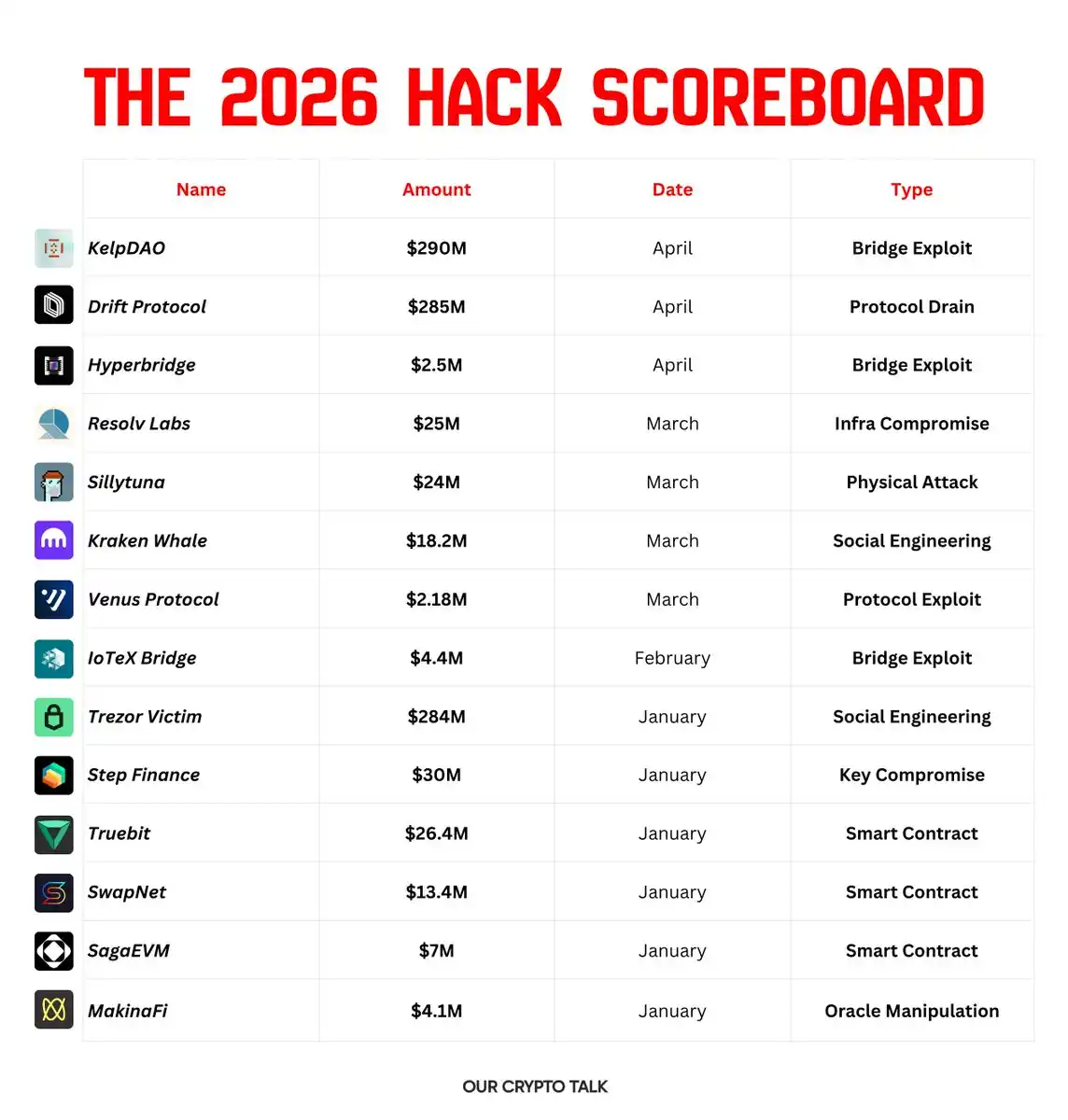
2026 Hacker Leaderboard (Source: Our Crypto Talk)

Some security incidents have been fully reviewed, some risks are still发酵, and many events blur the lines between protocol vulnerabilities, cross-chain bridge failures, and user asset theft. This article focuses on the confirmed security incidents of 2026 and the industry landscape changes暴露 by these events.

The current industry situation is vastly different from the peak of DeFi Summer in 2020 and the bull market of 2021; that glory now exists only in memory. Back then, DeFi told the market a narrative of open, efficient, and composable finance; by 2026, these traits still exist but no longer carry their own halo and market faith.

Every major coin theft event increases the trust cost for users to participate in DeFi. And currently, the fastest-growing and most secure areas of on-chain finance are becoming payment networks, tokenized treasuries, and compliant token products,不再是 the complex token ecosystems of native DeFi.

The real test for the industry now is: can open-source DeFi quickly rebuild market trust and maintain its position as the mainstream on-chain entry point? Currently, it appears the entire sector is not heading towards extinction, but rather处于空间被挤压的处境.

DeFi's Security Risks Extend Far Beyond Smart Contract Vulnerabilities

A common misconception after a major hack is to attribute all incidents to smart contract code vulnerabilities. The Drift protocol loss of approximately $285 million恰恰证明 this perception is outdated.

On-chain data analysis firm Chainalysis disclosed that the attack stemmed from permission abuse, admin pre-signature operation vulnerabilities, and fake collateral assets, not simple code statement defects. The market thus realized: a significant portion of DeFi's risks today lie in governance permissions, signature mechanisms, operational architecture, and other layers.

This fundamental change alters the underlying objects users need to trust. Code audits and market-proven contracts are still important, but they can no longer cover the complete risk chain: signature nodes, cross-chain bridges, oracles, and market parameter configurations all harbor potential risks. When protocols span multiple public chains, management committees, liquidity platforms, and collateral derivatives, the attack surface expands much faster than the update speed of the decentralization narrative.

The post-mortem of the Venus protocol also exposed similar issues, albeit in a different risk form. The attacker borrowed approximately $14.9 million in assets through overvalued asset抵押借贷, leaving the protocol with over $2 million in bad debt. Although the cause differed from Drift's, the conclusion was the same: leading DeFi lending platforms remain vulnerable to asset crises under conditions of weak liquidity and structural edge anomalies.

Then came the sudden implosion of KelpDAO. According to CryptoSlate statistics, this漏洞 directly triggered a挤兑出逃 of approximately $10 billion from the entire DeFi market, forcing all rsETH-related markets to freeze. Even though market sentiment later eased and the capital outflow data was revised, the signal remained clear: when faced with cross-chain complexity, collateral uncertainty, and systemic contagion risk, users' first choice is to withdraw funds.

This trend also aligns with the 2026 security report released by security agency TRM: the vast majority of stolen losses in the industry in 2025 came from infrastructure attacks, already surpassing单纯 smart contract vulnerabilities.

DeFi's trust crisis is becoming increasingly difficult to isolate because the industry needs to defend no longer just the code itself, but the entire complex operating system built on top of it.

On-Chain Finance is Still Growing, But Funds are Flowing to Safer Products

The overall capital landscape does not support the notion of a "complete collapse of DeFi." CryptoSlate data from April shows:

  • USDT market capitalization has reached $185 billion, USDC market cap has reached $78 billion;
  • Total stablecoin value on Tron chain is $86.958 billion, on Solana chain is $15.726 billion.

The Ethereum chain still retains the core存量资金 of native DeFi. The market is exhibiting more of a concentrated migration of funds rather than a complete exit.

The shift of funds towards low-volatility wealth management sectors is even more apparent. As of March 12, 2026, the scale of tokenized U.S. Treasury bonds reached $10.9 billion, held by over 55,000 people.

Users are still using blockchain for settlement and asset ownership confirmation, but are no longer willing to invest assets into structurally complex, high-risk native DeFi projects.

Market differentiation is very clear:

Trust Pressure and Capital Outflow Signals:

  • KelpDAO's $292 million theft triggered ~$10 billion outflow from the entire industry;
  • Drift's TVL halved due to permission vulnerabilities;
  • Venus exposed lending risks of weak liquidity and frequent bad debts.

On-Chain Growth Positive Signals:

  • Combined USDT+USDC total market cap ~$263 billion;
  • Tokenized U.S. Treasury scale reached $1.093 billion, held by over 55k;
  • Visa持续推进 USDC settlement,布局 institutional-grade stablecoin ecosystem.

Capital is clearly aggregating towards products with clear logic, sufficient collateral, and suitability for institutional entry.

Visa's 2026 stablecoin strategy report is worth special attention: its data shows that the total stablecoin supply increased by over 50% in 2025, growing from $186 billion at the beginning of the year to $274 billion at year-end; and proposes that 2026 will be the first year of正式布局 stablecoins by institutions, meaning the stablecoin track is moving towards mainstream standardization.

The same is true at the settlement level. Visa disclosed its annualized USDC monthly settlement volume has exceeded $3.5 billion.

The figure itself is not a large proportion of the entire stablecoin market, but its industry significance is profound: compliant traditional financial infrastructure is connecting to the on-chain network, no longer needing to rely on the entire ecosystem narrative of native DeFi.

Core Industry Competition: Who Will Master the Future On-Chain Infrastructure

CryptoSlate previously pointed out: compliant institutions are competing for an on-chain capital pool exceeding $330 billion, which includes approximately $317 billion in stablecoins and nearly $13 billion in tokenized treasuries.

These funds持续追求 the advantages of high speed, programmability, and 7x24 hour uninterrupted settlement. Market attention is also focused on top-tier assets and basic settlement networks, rather than various niche governance experiment projects.

The contrast with the 2021 bull cycle is particularly striking.

In past cycles, DeFi simultaneously handled both underlying infrastructure and end products: the birthplace of innovation, the source of high yields, and the blueprint for future finance were all concentrated here. By 2026, the future of on-chain finance is being stripped of the messy risks of native DeFi and repackaged.

Tokenized funds achieve 24/7 circulation and rapid清算; stablecoins undertake payment and treasury operations; institutions enjoy the advantages of blockchain while tightly controlling compliance, counterparty risk, and market structure.

CryptoSlate's project shutdown report shows: In Q1 2026, over 80 crypto projects have officially ceased operations or entered liquidation procedures. Although not limited to DeFi, it足以说明: capital's patience has run out for projects that cannot generate long-term value, stable returns, and real applications.

Crypto spot ETFs also fall within this major trend. Compliant products持续承接 market funds and attention, with users and institutions preferring infrastructure that can enjoy the advantages of blockchain without bearing the high trust risks of native DeFi.

This also leaves native DeFi with its own定位, albeit in a narrowed space: open composability and permissionless innovation still hold value, serving as a financial primitive innovation laboratory—exploring and testing new models before they are absorbed and popularized by compliant products.

The core industry矛盾 remains trust squeeze.

Native open-source DeFi is losing narrative dominance. If it cannot quickly rebuild trust, optimize operational architecture, and prove the irreplaceability of its complex design, it will gradually lose its position as the front-end entry point for on-chain finance.

The core博弈 of the industry is now clear: who will承接 the next wave of on-chain demand? And currently, it appears that safer, compliant on-chain packaged products are gaining the upper hand.


Related Questions

QWhat were the major DeFi security incidents mentioned in the article that contributed to a loss of market confidence?

AThe major incidents included the $292 million theft from KelpDAO's rsETH, the $285 million security breach at Drift Protocol due to permission abuse and admin pre-signing vulnerabilities, and the Venus lending protocol exploit in March where attackers used overvalued assets as collateral to extract approximately $14.9 million, leaving over $2 million in bad debt.

QAccording to the article, what is the current trend in capital flow within the on-chain finance sector?

ACapital is flowing away from complex, high-risk native DeFi projects and is instead migrating towards safer, more structured products. This is evidenced by the growth in stablecoins (USDT and USDC with a combined market cap of ~$263 billion), tokenized U.S. Treasuries (reaching $10.93 billion), and compliant settlement channels like Visa's USDC network.

QHow has the nature of DeFi security risks evolved beyond simple smart contract vulnerabilities?

ASecurity risks have expanded beyond smart contract code flaws to include vulnerabilities in governance permissions, signature mechanisms, operational architecture, cross-chain bridges, oracles, and market parameter configurations. The TRM 2026 security report indicated that most losses now come from infrastructure attacks rather than pure contract exploits.

QWhat key signal does the Visa 2026 stablecoin strategy report provide about the future of on-chain finance?

AVisa's report signals that 2026 is the year institutions will formally enter the stablecoin space, moving towards mainstream standardization. It highlighted that stablecoin total supply grew over 50% in 2025 and that Visa's own USDC settlement volume has reached an annualized rate of $3.5 billion per month, indicating traditional finance is building compliant on-chain infrastructure independent of native DeFi.

QWhat is the core challenge or 'squeeze' that native, open-source DeFi is currently facing according to the article?

AThe core challenge is a 'trust squeeze.' Native DeFi is losing narrative dominance and its position as the default on-chain financial front-end. It cannot quickly rebuild market trust, optimize its operational architecture, and prove the indispensable value of its complex designs, it risks ceding its role to safer, more compliant on-chain wrapped products.

Related Reads

Must-Watch Events Next Week|CLARITY Act Could Face Senate Vote; SpaceX, Circle to Report Earnings (8.3-8.9)

**Summary: Key Events and Developments to Watch (August 3-9)** The upcoming week is marked by significant financial disclosures, key legislative deadlines, and notable product updates. **Major Financial Events:** Several companies are scheduled to release their Q2 2026 earnings. American Bitcoin (ABTC) will report on August 3, followed by SpaceX and Hut 8 Mining Corp. on August 4, and Circle on August 5. Notably, a significant portion of SpaceX shares (up to 12% of total shares) will be unlocked on August 6 following their earnings release. **Key Legislative Deadline:** The U.S. Senate faces an August 7 deadline to secure 60 votes for the CLARITY Act, a bipartisan bill aiming to establish a federal regulatory framework for cryptocurrencies. The Senate may hold a full vote on the bill during the week. **Economic Data:** The U.S. July Non-Farm Payrolls report will be released on August 7, providing crucial labor market data. **Technology & Product Updates:** * **Shutdowns:** DeFi portfolio tracker Zapper and wallet app Ctrl Wallet will cease operations on August 3. * **Upgrades:** LayerZero will deprecate its v1 relayers on August 3. XRP Ledger's new version 3.3.0, featuring five new functions, is expected next week. * **AI:** Elon Musk announced that the advanced Grok 4.6 AI model is set for release around August 7. * **Bitcoin:** The BIP-110 forced signaling for a potential Bitcoin network change is scheduled to begin around August 8. **Other Notable Events:** Chinese robotics firm Unitree Tech has set its preliminary price inquiry for its IPO for August 5. South Korean exchange Upbit will delist AQT and AERGO tokens on August 3.

marsbit48m ago

Must-Watch Events Next Week|CLARITY Act Could Face Senate Vote; SpaceX, Circle to Report Earnings (8.3-8.9)

marsbit48m ago

Stocks Are Plummeting More Sharply Than Cryptocurrencies. Where Has the Money Gone?

Stock Markets Plunge Deeper Than Cryptocurrencies: Where Did the Money Go? In late July, Seoul's Kospi index triggered circuit breakers for two consecutive days, plummeting over 40% from its June high. The collapse was led by heavyweight stocks like SK Hynix, whose record profits still disappointed investors, and devastating leveraged ETFs, with one major product losing over 83% of its value. This signaled a global, forced deleveraging targeting the most crowded trades. Interestingly, while stocks exhibited extreme volatility akin to crypto markets, Bitcoin rose nearly 15% in July after a prior steep drop. Analysis shows the money fleeing equities did not flow into Bitcoin. Instead, Bitcoin had already absorbed its sell-off in May-June, when U.S. spot Bitcoin ETFs saw historic outflows. The true safe-haven beneficiary was gold, whose price rose over 20% year-on-year, highlighting a decoupling between Bitcoin and gold as "digital gold." The sell-off was a targeted unwinding of leveraged positions in tech and semiconductors, accelerated by broker-dealer risk management and shifts in the AI narrative, including new competition from Chinese memory chipmakers. The retreat path was clear: from high-valuation tech stocks to cash and U.S. Treasuries, then to gold. For Bitcoin to attract sustained institutional inflows, conditions like eased global liquidity pressure, a "soft-landing" Fed rate cut, and U.S. regulatory clarity via legislation like the stalled CLARITY Act are needed. Currently, Bitcoin is not a safe haven but an already-cleared asset. Its low correlation with tech stocks, however, makes it a potential diversification play for institutional portfolios once the storm passes. The money isn't here yet, but the positioning is underway.

marsbit48m ago

Stocks Are Plummeting More Sharply Than Cryptocurrencies. Where Has the Money Gone?

marsbit48m ago

In Conversation with Ray Dalio: We Are Currently in an AI Bubble, with 1% of My Portfolio in Bitcoin

Ray Dalio, founder of Bridgewater Associates, warns in an interview that the current AI boom shows classic bubble characteristics, which could lead to significant economic downturns as seen in past cycles like 1929 or 2000. He explains that speculative enthusiasm, fueled by debt and overvaluation, often precedes a crash when rising rates or taxation force asset sales, causing widespread losses and recession. Dalio also outlines his "Big Cycle" theory, describing an approximate 80-year pattern where widening wealth gaps, massive government deficits, and shifting geopolitical power (like China's rise) create internal conflict and global instability. He emphasizes that we are in a late-cycle, transitional phase where traditional powers like the US and UK face decline. For personal wealth protection, Dalio advises diversification beyond cash into assets like stocks, bonds, real estate, and particularly gold, which he prefers over Bitcoin. While he holds about 1% of his portfolio in Bitcoin as a non-printable hard asset, he views gold as more secure from technological or governmental threats. Regarding AI's impact, Dalio believes it will disproportionately benefit capital owners, worsening inequality by replacing both physical and cognitive labor. He suggests that human intuition and emotional intelligence, combined with AI, will be key for future workers. On taxation, Dalio argues that wealth taxes are impractical and risk triggering asset sell-offs, reducing productive investment. He points to the UK as a cautionary example of debt, low productivity, and political strife. Geopolitically, Dalio foresees a more regionalized world, with the US showing weakness in prolonged conflicts like with Iran, akin to past imperial declines. The ideal outcome, he suggests, is coexisting powerful blocs (e.g., Americas, China-Asia Pacific) without major war.

marsbit4h ago

In Conversation with Ray Dalio: We Are Currently in an AI Bubble, with 1% of My Portfolio in Bitcoin

marsbit4h ago

Daily 7.2 Trillion KRW: Foreign Capital's Record Net Buying on Friday! Wall Street Says Headwinds for Korean Stock Fund Flows Have Subsided

South Korean stock market sees a dramatic shift in fund flows. On July 31, foreign investors made a record net purchase of approximately KRW 7.2 trillion in KOSPI stocks, marking a fundamental reversal from the persistent large-scale net outflows seen in previous months. This contributed to a significant narrowing of foreign net selling in July to KRW 9.8 trillion, down sharply from KRW 48.4 trillion in June and KRW 44.5 trillion in May. Simultaneously, domestic institutional pressure eased. South Korean pension funds and asset managers turned to a net buying position in July, purchasing KRW 1.0 trillion worth of KOSPI shares, contrasting with net sales in May and June. Market volatility is expected to be dampened by new financial regulations. Effective July 31, the Financial Services Commission tightened access for retail investors to single-stock leveraged ETFs by raising the minimum cash deposit requirement. Trading volumes for these products subsequently dropped to about 50% of their monthly average. Citigroup Research maintains its year-end KOSPI target of 10,000 points. The firm cites several supportive factors: the substantial easing of headwinds from capital outflows, a robust fundamental outlook for the semiconductor sector, historically low market valuations, strong economic fundamentals, and the potential for policy support from financial authorities if needed.

marsbit4h ago

Daily 7.2 Trillion KRW: Foreign Capital's Record Net Buying on Friday! Wall Street Says Headwinds for Korean Stock Fund Flows Have Subsided

marsbit4h ago

Trading

Spot
活动图片




