Single Post with 150 Million Views: Dan Koe and His Super Individual Business

marsbitPublished on 2026-01-19Last updated on 2026-01-19

Abstract

Dan Koe, a prominent figure in the "one-person business" space, recently achieved 1.5 billion views on X with a post titled "How to fix your entire life in 1 day." Despite the massive reach, he earned only $4,495 from the platform in two weeks. His real income comes from his broader business: Koe made over $4 million in 2024 through paid newsletters, books, and digital products aimed at teaching people how to build personal brands and escape traditional employment. His success is built on years of content creation, a large following (750k on X, 1.2M YouTube subscribers), and a trusted brand. The viral post served as a top-of-funnel tool to attract potential customers into his paid ecosystem, rather than a direct revenue source. The "super individual" trend reflects a growing desire for self-directed work, but the market is increasingly crowded. While AI tools allow easy imitation of high-engagement content, established creators like Koe retain advantage through authenticity and timing. X's recent push for long-form content, including a $1M incentive program, benefits top creators most, reinforcing a cycle where platforms and influencers mutually profit—while most followers remain consumers, not successful creators.

Author: Curry, Deep Tide TechFlow

What was the hottest article on X last week?

"How to fix your entire life in 1 day." Fix your entire life in one day.

Author Dan Koe, an American, creates content about "super individuals," teaching people how to not work a 9-to-5 job and make a living by writing. A week after its release, this article had already reached 150 million views.
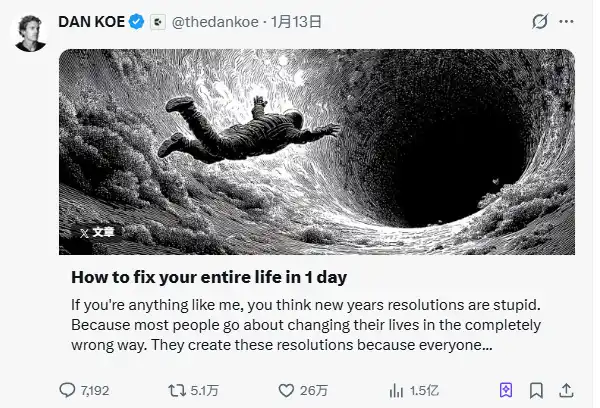
What does 150 million mean? X has just over 600 million monthly active users globally, meaning one in every four users has come across this article.

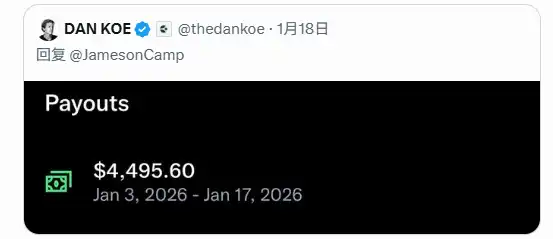
Some wondered how much money this could make. Dan Koe shared a screenshot of his earnings: in 14 days, X platform paid him $4,495.

150 million views, $4,495. But Dan Koe actually earned over $4 million last year.

The money clearly doesn't come from platform revenue sharing.
You must have seen the term "super individual."

It generally means you don't need to work a job or have a team; you just need to turn your ideas and creativity into content posted online to attract a group of people who resonate with you, and then sell courses to them. In the U.S., this is called a One-Person Business.

Dan Koe is a top player in this field. He has 750,000 X followers, 1.2 million YouTube subscribers, and an email list of 170,000 people.

His story is also standard. He studied design in college, worked as a freelancer after graduation, tried e-commerce, and lost money. He started writing on Twitter in 2019, but no one read it. He persisted for two years before gaining traction.

These experiences are part of the content itself. Failure, struggle, persistence, and triumph—you can see this narrative structure in any successful self-help blogger.

Li Xiaolai talked about it, Luo Zhenyu talked about it, Fan Deng talked about it.

Americans package it as Philosophy and Productivity; Chinese package it as "cognitive upgrade." The skeleton is the same.

How does Dan Koe make money?

Open his official website, and you'll see several types of products: paid newsletter subscriptions, two books ("The Art of Focus" and "Purpose & Profit"), and an AI tool he co-founded called Eden.
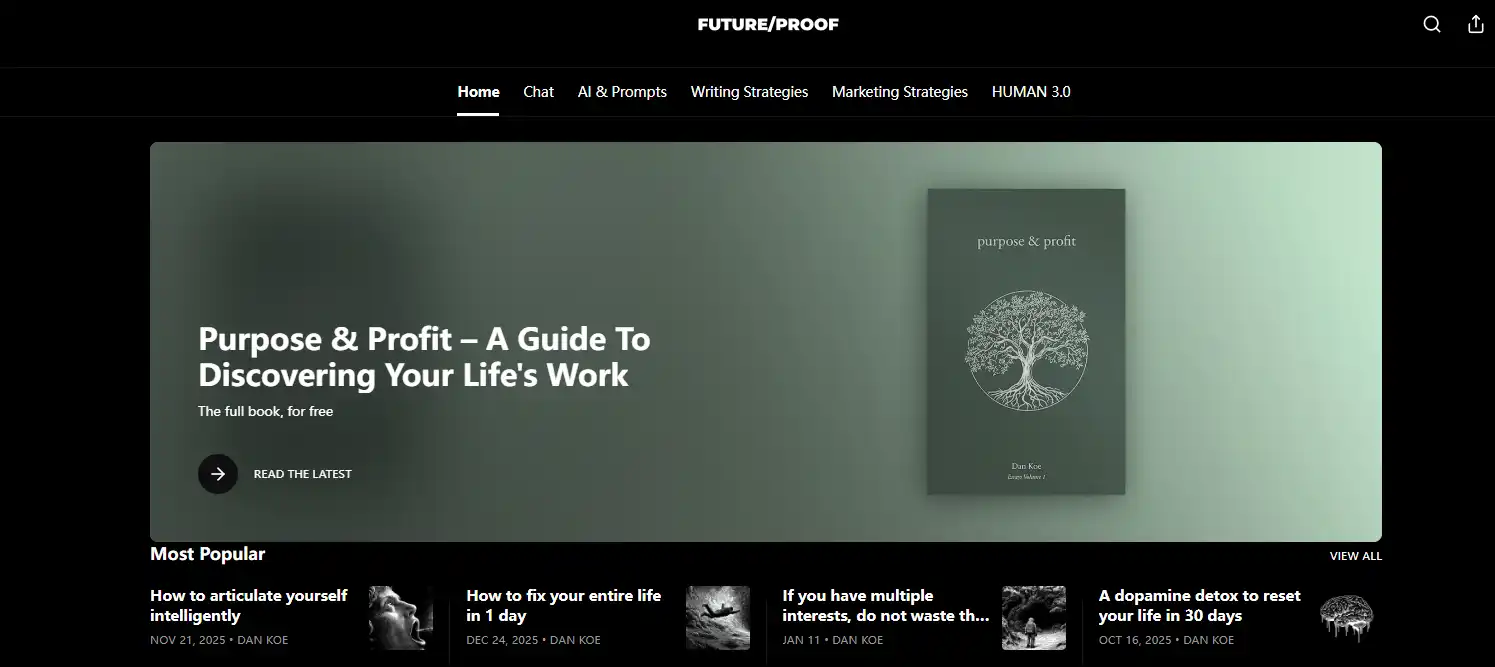
He used to sell writing courses and membership communities, but they are no longer visible on the official website. They might have been taken down or merged into the paid subscriptions.

I couldn't find official pricing data, but the logic of such products is generally similar:

Free content filters out those willing to pay; low-priced products filter out those willing to pay more.

How much does he earn? In 2023, he posted on Twitter that his income that year was $2.5 million. In a 2024 interview with the subscription software beehiiv, Dan also revealed that he earns over $4 million annually.

But given his follower size, it's not far-fetched. With nearly 200,000 email subscribers and millions of YouTube fans, assuming 5% have purchased paid products, that's nearly 50,000 paying users.

So what is the 150 million views to him?

A traffic entry point at the top of the funnel. The $4,495 platform share on X is pocket change; what's more important is increasing his brand recognition and reach. The real money comes from those willing to pay later.

You might ask, who is buying these things?

The answer is undoubtedly those who want to become the next Dan Koe.

The goal of such course participants is basically to "build a personal brand," "monetize self-media," and "escape the 9-to-5 grind." What they pay to learn is exactly what Dan Koe is doing.

For this model to work, there is one prerequisite: there are always new people wanting to join.

Just like gym memberships always surge at the beginning of the year, the "super individual"赛道 always has people who believe they can become the next top player. Dan Koe published that article on January 12, right when New Year's resolutions are strongest.

The title is "How to fix your entire life in 1 day." What do you think people clicking on it are thinking?

Meanwhile, X is also betting on it.

On January 16, a few days after Dan Koe's article went viral, X announced a new policy: the creator revenue pool doubled, long-form article权重 increased, and an additional $1 million reward for the best-performing original articles.
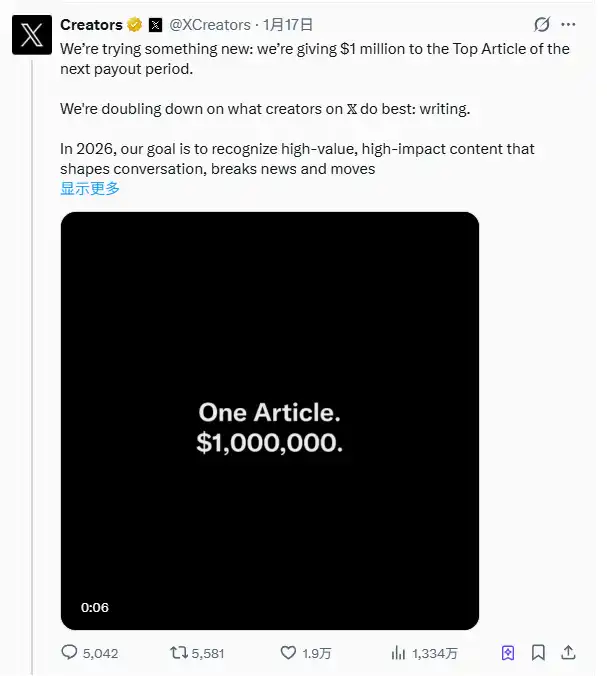
What Musk wants to do is obvious. TikTok has cut everyone's attention into 15-second碎片; X wants to go the opposite way, using long-form content to retain users. Dan Koe wrote a comment大意 saying that short videos are刷得太狠了, and now the internet has a chance to swing back.

X loves to hear that.

But what can $1 million buy?

Search on X, and you'll already find a lot of imitators. Various AI skill tutorials and inspirational articles are emerging, such as "How to change your life in 2026," "The one skill you need," "Why most people will never succeed"...

The structure is the same, the image style is the same as Dan's viral post, and even the "I'm here to tell you the truth" tone is the same.

This writing style has even become a meme,引得大家争相模仿和尝试.

It's not surprising. Dan Koe himself said he uses AI to assist写作, by having AI interview himself, extract ideas, and then format them into highly传播 content structures.

Anyone can learn this method. ChatGPT can generate a "life-changing" long article in ten minutes, with correct grammar, complete structure, and even automatically add a few psychological terms to appear profound.

But it's Dan Koe who went viral, not the imitators.

Why?

One explanation is that trust takes time. Dan Koe has been writing for six years, has real failure experiences, and has a traceable growth trajectory. AI can imitate his sentence structure, but it can't replicate these.

Another explanation is that the super individual赛道 is too crowded.

When everyone is teaching "how to become a super individual," whether it's about AI tools, guide to success, life fixes, or business insights, attention concentrates at the top. Those who enter early eat the meat, those who come later drink the soup, and those even later get nothing.

Another explanation is luck. Dan Koe hit the window of X's algorithm adjustment, the New Year emotional cycle, and the policy tailwind of Musk pushing long-form content. Three things叠加 together, and 150 million views happened.

Change the person, change the timing, the same quality article might only get 1.5 million views.

An interesting point is that Dan Koe's article was published a few days too early and is not eligible for X's $1 million content reward selection.

But he doesn't care. His business model doesn't rely on platform revenue sharing. The 150 million views have already fulfilled their mission:让更多人知道 Dan Koe 这个名字,让漏斗顶端灌进去更多的人.

So who will X's $1 million eventually go to? According to the rules, it must be original long-form articles, at least 1000 words, calculated based on the首页展示量 of paying users.

Translation: you not only have to write well, but you also need to already have a large number of fans.

So most likely, the top players will take it.

This is the structure of the game. The platform needs top creators to prove that "long-form content has a future"; top creators need platform traffic to feed their funnel; AI allows everyone to mass-produce "life-changing" content, but only a very few can actually make money from it.

What is the role of most people?

Readers.

After reading a "How to fix your entire life in 1 day," feeling inspired to become a super individual, then sharing, liking, bookmarking it, and continuing to scroll to the next one.


Related Questions

QWhat was the title of Dan Koe's viral article on X and how many views did it achieve?

AThe title was 'How to fix your entire life in 1 day' and it achieved 150 million views.

QHow much revenue did Dan Koe generate from X platform's ad share for that viral article, and what was his actual annual income in 2024?

AHe earned $4,495 from X's ad share for the article, but his actual annual income in 2024 was over $4 million.

QWhat is the core business model of a 'super individual' or 'one-person business' as described in the article?

AThe core model involves creating content to build a personal brand, attracting an audience, and monetizing through selling courses, subscriptions, books, or tools to followers who want to achieve similar success.

QHow did X platform's policy change shortly after Dan Koe's article went viral, and what was its goal?

AX announced a new policy that doubled the creator earnings pool, increased the weight of long-form articles, and allocated an additional $1 million to reward the best-performing original articles, aiming to promote long-content and retain users.

QWhy did Dan Koe's article succeed despite many AI-generated imitations, according to the analysis?

AHis success is attributed to six years of building trust through authentic experiences and a track record, timing with X's algorithm changes and New Year resolutions, and the 'winner-takes-most' effect in the crowded super-individual niche.

Related Reads

20 Billion Valuation, Alibaba and Tencent Competing to Invest, Whose Money Will Liang Wenfeng Take?

DeepSeek, an AI startup founded by Liang Wenfeng, is reportedly in talks with Alibaba and Tencent for an external funding round that could value the company at over $20 billion. This marks a significant shift, as DeepSeek had previously relied solely on funding from its parent company,幻方量化 (Huanfang Quantitative), and had resisted external investment. The potential valuation would place DeepSeek among the top-tier AI model companies in China, comparable to competitors like MoonDark (valued at ~$18 billion) and ahead of recently listed firms like MiniMax and Zhipu. The funding—which could range from $600 million (for a 3% stake) to $2 billion (for 10%)—is seen as a move to secure resources for model development, retain talent, and support infrastructure needs, particularly as competition in inference models and AI agents intensifies. Both Alibaba and Tencent are eager to invest, not only for financial returns but also to integrate DeepSeek into their broader AI ecosystems. However, DeepSeek’s leadership is cautious about maintaining independence and may prefer financial investors over strategic ones to avoid being locked into a specific tech ecosystem. Alternative options, such as state-backed funds, offer longer-term capital and policy support but may come with slower decision-making and potential constraints on global expansion. With competing AI firms accelerating their IPO plans, DeepSeek’s window for securing optimal terms may be narrowing. The final decision will reflect a trade-off between capital, resources, and strategic independence.

marsbit40m ago

20 Billion Valuation, Alibaba and Tencent Competing to Invest, Whose Money Will Liang Wenfeng Take?

marsbit40m ago

After Losing 97% of Its Market Value, iQiyi Attempts to Use AI to Forcefully Extend Its Lifespan

After losing 97% of its market value since its 2018 peak, iQiyi is aggressively pivoting to AI in a desperate attempt to survive. At its 2026 World Conference, CEO Gong Yu announced an "AI Artist Library" with over 100 virtual performers and a new AIGC platform, "NaDou Pro," promising faster production and lower costs. This shift comes as the company faces severe financial distress: its market cap sits near delisting thresholds at $1.36 billion, with significant losses, declining membership revenue, and depleted cash flow. The AI strategy has sparked controversy. Top actors have issued legal threats against unauthorized digital replicas, while in Hengdian, over 134,000 background actors are seeing their already scarce job opportunities vanish as AI replaces them for background roles. iQiyi's move represents a fundamental shift from being a high-cost content buyer to a landlord" to becoming a "platform capitalist" that transfers production risk to creators. This contrasts with competitors like Douyin (TikTok's Chinese counterpart), which is investing heavily in *real* actor-led short dramas, betting that authentic human connection retains users better than AI-generated content. The article draws a parallel to the 1920s transition to "talkies," which made cinema musicians obsolete but ultimately enriched the art form. In contrast, iQiyi's AI drive is framed not as an artistic evolution but as a cost-cutting measure that could degrade storytelling, replacing genuine human emotion with algorithmically calculated stimulation and potentially numbing audiences' capacity for empathy. The core question remains: can a company focused solely on financial survival preserve the art of storytelling?

marsbit43m ago

After Losing 97% of Its Market Value, iQiyi Attempts to Use AI to Forcefully Extend Its Lifespan

marsbit43m ago

Only a 50% Chance of Passing This Year, Can the CLARITY Bill Succeed Before the Midterm Elections?

The CLARITY Act, which passed the House in July 2025 with strong bipartisan support (294-134), faces a critical juncture in the Senate. The Senate Banking Committee is expected to hold a markup soon, but key issues remain unresolved, including stablecoin yield provisions, DeFi regulations, and securing full Republican committee support. Other contentious points involve the Blockchain Regulatory Certainty Act (BRCA), ethics amendments for government officials, and SEC-related matters. The legislative calendar is tight, with limited time before the midterm elections. If the committee markup is delayed beyond mid-May, the chances of passage in 2026 drop significantly. Senator Cynthia Lummis has warned that failure this year could delay comprehensive crypto market structure legislation until 2030 or later. Galaxy estimates the probability of the CLARITY Act becoming law in 2026 is only about 50%. The bill provides crucial regulatory clarity by defining jurisdictional boundaries between the SEC and CFTC, establishing a path for decentralization, and bringing digital commodity intermediaries under federal regulation. Its passage is seen as vital before potential power shifts in the next Congress, which could bring less favorable leadership to key committees. The timeline is compressed, and the bill must compete for floor time with other priorities like Iran authorization and DHS appropriations. Key hurdles include finalizing the stablecoin yield compromise text, addressing law enforcement concerns about BRCA, and navigating political dynamics around SEC nominations. The outcome of the Banking Committee markup and the level of bipartisan support will be critical indicators of its future success.

marsbit1h ago

Only a 50% Chance of Passing This Year, Can the CLARITY Bill Succeed Before the Midterm Elections?

marsbit1h ago

Trading

Spot
Futures
活动图片