Silver Faces a 'Delivery Failure' Crisis? March May Be a 'Critical Moment' for Precious Metals

marsbitPublished on 2026-01-29Last updated on 2026-01-29

Abstract

A potential delivery crisis is looming in the silver market, with veteran analyst Bill Holter warning that COMEX could face a physical silver default as early as March 2026. Such an event would destroy the credibility of the current pricing mechanism and trigger a chain reaction spreading to gold and credit markets, potentially causing a systemic financial collapse. Unusually high delivery demand has already emerged, with over 40 million ounces of silver requested for delivery in January—a traditionally non-delivery month—compared to the usual 1-2 million ounces. As the key March delivery month approaches, demand could reach 70-80 million ounces, potentially exhausting COMEX's registered inventory of 110-120 million ounces. This warning comes amid an unprecedented rally, with silver prices surging 154% year-to-date and 40% in January alone. If COMEX fails to deliver, contract values could collapse, undermining trust in paper contracts and triggering a liquidity crisis reminiscent of the 1980 Silver Thursday event. Despite prices exceeding $100/ounce, analysts believe the market remains in early stages, with predictions of $300/ounce or even extreme valuations based on monetary recalibration. Strong industrial demand from solar, EV, and electronics sectors, combined with investment demand as an inflation hedge, contrasts with constrained supply, setting the stage for continued volatility and potential long-term price appreciation.

Author:Bu Shuqing, Wall Street News

The precious metals market is facing a potential delivery crisis.

Veteran precious metals analyst Bill Holter recently warned that the New York Commodity Exchange (COMEX) could see a physical silver delivery default as early as March 2026. This would completely destroy the credibility of the existing pricing mechanism and trigger a chain reaction spreading to the gold and credit markets, potentially leading to the collapse of the entire financial system.

Abnormal delivery demand has already emerged. According to Holter, in January, traditionally a non-delivery month, COMEX has already seen over 40 million ounces of silver requested for delivery, whereas this figure is typically only 1 to 2 million ounces in previous years during the same period. As the main delivery month of March approaches, delivery demand could reach 70 to 80 million ounces, potentially depleting COMEX's current registered inventory of 110 to 120 million ounces.

This warning comes as the silver market is experiencing an unprecedented rally. Silver prices have surged 154% year-to-date in 2025, rising about 40% in January alone, far outpacing the stock market's performance over the same period. UBS strategists have already alerted clients this week, stating that the gains in precious and industrial metals have been "out of control" recently.
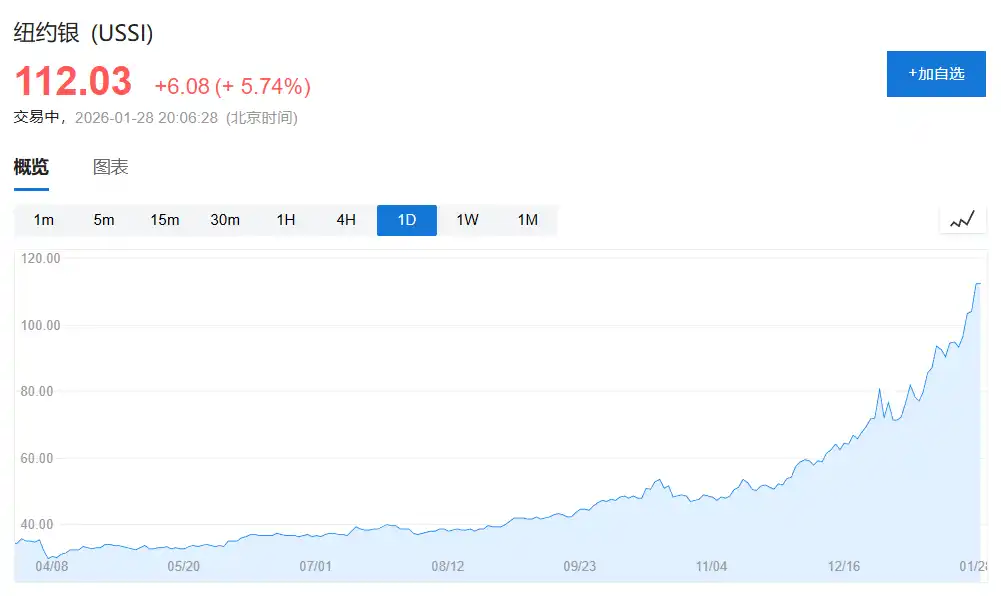
If Delivery Fails, Is the Financial System at Risk of Collapse?

The COMEX silver market is facing unprecedented physical delivery pressure. Holter pointed out that the appearance of 40 million ounces of delivery requests in January, a non-delivery month, is an extremely abnormal phenomenon, signaling the potential for a larger-scale run in the main delivery month of March.

"If COMEX cannot fulfill its delivery obligations, the contract value will go to zero," Holter stated. He emphasized that a delivery default would completely negate COMEX's pricing authority, as contracts that cannot be honored hold no value.

More seriously, a silver delivery failure would immediately transmit to the gold market. Holter warned that since gold is essentially an "anti-dollar" or "anti-U.S. Treasury" asset, a default in the gold market would directly impact the credit market, thereby threatening the stability of the entire financial system.

Currently, COMEX's registered deliverable silver inventory is approximately 110 to 120 million ounces, but the market questions whether this inventory might be subject to re-hypothecation or other encumbrances. If March delivery demand exceeds available inventory, the market will face the most severe liquidity crisis since the Silver Thursday event of 1980.

Holter painted a grim picture of the consequences of a delivery default. He predicted that if a delivery failure occurs in March 2026, it would trigger currency devaluation and the collapse of the entire financial system.

"The real economy runs on credit. Everything you touch, everything you do, involves the participation of credit," Holter said. If credit becomes unavailable, the real economy would completely stall.

This warning is not alarmist. The pricing mechanism of the precious metals market has long relied on paper contracts, with physical delivery being extremely low. Once trust in paper contracts collapses, investors will flock to demand physical delivery, and exchange inventories are far from sufficient to meet the delivery demands of all contracts.

Considering the U.S.'s total debt and commitment scale of $200 trillion, the financial system's reliance on credit has reached a historical extreme. A crisis of confidence in any key market could trigger a chain reaction, and the precious metals market is precisely the final anchor of trust for the entire monetary system.

Price Predictions "Ridiculously Underestimated"

Although the silver price has broken through $100 per ounce, Holter believes the market is still in the early stages of the rally. He stated that all current price predictions—including the $600 per ounce target proposed years ago—will ultimately prove to be "ridiculously underestimated."

Well-known silver analyst Peter Krauth is also optimistic, expecting silver prices to potentially hit $300 per ounce in the upcoming "mania phase." Krauth believes that $50 per ounce has become the new price floor, and a sharp adjustment in the gold-to-silver ratio will be the core driver pushing silver prices higher.

Holter provided an even more extreme valuation framework from a monetary perspective. He pointed out that if calculated based on the U.S. federal government's $38 trillion debt, supported by 8,000 tons of gold reserves, the gold price should reach $200,000 per ounce. This logic also applies to the repricing of silver.

Some large traders and banks that are short precious metals have already fallen into financial difficulties. Holter indicated that the persistently rising metal prices—especially silver prices—are putting severe pressure on these institutions, which could exacerbate market instability.

Silver's strong performance is rooted in a deep fundamental imbalance. As a metal with both monetary and industrial properties, silver is being squeezed by multiple sources of demand.

Industrial demand remains strong, particularly in areas such as solar energy, electric vehicles, and electronics. At the same time, investment demand is also surging, with investors viewing silver as a hedge against inflation and currency devaluation.

The supply side faces structural constraints. Silver is primarily a by-product of base metal mining like copper, lead, and zinc, making its production difficult to quickly respond to price signals. This supply rigidity can easily trigger sharp price fluctuations when demand surges.

Krauth emphasized that all the elements needed to sustain the rally for "quite some time" are already in place. Although there is a risk of a short-term pullback, the medium to long-term trend is already established.


Related Questions

QWhat potential crisis is the COMEX silver market facing according to analyst Bill Holter?

ABill Holter warns that the COMEX may face a physical silver delivery default as early as March 2026, which could destroy the credibility of the existing pricing mechanism and trigger a chain reaction leading to the collapse of the entire financial system.

QWhat unusual demand pattern has been observed in the COMEX silver market recently?

AIn January, a traditionally non-delivery month, there were over 40 million ounces of silver requested for delivery, compared to the usual 1-2 million ounces in previous years.

QWhat is the estimated size of the COMEX's registered silver inventory, and why is it a concern?

AThe COMEX's registered deliverable silver inventory is approximately 110-120 million ounces. There is concern that this may be insufficient if delivery demands reach 70-80 million ounces in the key March delivery month, potentially leading to a liquidity crisis.

QWhat are some of the extreme price targets mentioned for silver by the analysts in the article?

AAnalyst Peter Krauth expects silver could reach $300 per ounce in an upcoming 'mania phase,' while Bill Holter suggests that even a target of $600 per ounce would be a 'laughable underestimate' from a monetary valuation perspective.

QBeyond investment demand, what other factors are contributing to the strong fundamentals for silver?

ASilver is experiencing strong industrial demand from sectors like solar energy, electric vehicles, and electronics. Additionally, its supply is structurally constrained as it is largely a byproduct of base metal mining (like copper, lead, zinc), making it difficult to quickly increase production in response to price signals.

Related Reads

Lowering Expectations for BTC's Next Bull Market

The author, Alex Xu, explains his decision to significantly reduce his Bitcoin holdings (from full to ~30% of his portfolio) during the current bull cycle, citing a lowered long-term outlook for BTC's price appreciation in the next cycle. He outlines six key reasons for this reduced expectation: 1. **Diminished Growth Drivers:** The narrative of exponential user adoption has largely played out with institutional ETF adoption. The next major growth phase—adoption by sovereign national reserves or central banks—seems unlikely in the near future. 2. **Personal Opportunity Cost:** More attractive investment opportunities have emerged in other assets, such as undervalued companies. 3. **Industry-Wide Contraction:** The broader crypto industry is struggling, with most Web3 business models (SocialFi, GameFi, DePIN) failing. This overall萧条 (depression) reduces the fundamental demand and consensus for Bitcoin. 4. **Strain on Major Buyer:** MicroStrategy, a major corporate buyer of BTC, faces rising financing expenses for its debt, which could slow its purchasing rate and create significant marginal pressure on the market. 5. **Increased Competition from Gold:** The emergence of "tokenized gold" has closed the functional gap (portability, divisibility) between physical gold and Bitcoin, offering a strong competitor in the non-sovereign store-of-value space. 6. **Security Budget Concerns:** The block reward halving continues to exacerbate the long-standing issue of funding Bitcoin's network security, with new fee source explorations like Ordinals and L2s largely failing. The author's decision to hold a significant (though reduced) position reflects a cautious, not bearish, outlook. He remains open to increasing his exposure if the fundamental reasons for his skepticism change or if new positive catalysts emerge.

marsbit38m ago

Lowering Expectations for BTC's Next Bull Market

marsbit38m ago

Can Iran 'Control' the Strait of Hormuz?

Iran has announced a comprehensive plan to assert control over the strategic Strait of Hormuz, a critical global oil shipping chokepoint. The proposed measures include requiring all vessels to obtain Iranian permission for passage, imposing fees for security, environmental protection, and navigation management—preferably paid in Iranian rials—and absolutely banning Israeli ships. Vessels from countries deemed hostile by Iran’s top security bodies may also be barred. Analysts suggest Iran’s motives are multifaceted: increasing pressure on the U.S. and Israel by leveraging control over oil transit to influence global prices and inflation; creating a new revenue stream, potentially exceeding $7.7 billion annually, to counter Western sanctions and support postwar reconstruction; and using transit permissions as bargaining chips in future negotiations, notably with the U.S. However, the plan faces significant practical and diplomatic challenges. Enforcing comprehensive interception and fee collection in the busy waterway, patrolled by international military forces, would be difficult. The U.S. has already countering with a blockade of Iranian ports and threats to intercept any ship paying fees, potentially strangling Iran’s oil exports and fee revenue. Broad international opposition, led by European and Gulf states, and legal controversies further complicate implementation. The proposal may ultimately serve more as a negotiating tactic than a feasible policy, with its execution remaining highly uncertain.

marsbit1h ago

Can Iran 'Control' the Strait of Hormuz?

marsbit1h ago

Trading

Spot
Futures
活动图片




