Silicon Bull, Carbon Bear: The Wealth Code of 2026 is Only 'Chips' and 'Light'

marsbitPublished on 2026-05-21Last updated on 2026-05-21

Abstract

The article, titled "Silicon Bull, Carbon Bear: In 2026, the Wealth Code Lies Only in 'Chips' and 'Optics'", discusses the extreme market divergence in 2026 driven by the AI investment frenzy. Investment managers who concentrated on the AI hardware supply chain, particularly computing infrastructure, optical modules, and memory chips, have seen their fund net asset values (NAVs) surge dramatically, even reaching record highs. In contrast, funds focused on traditional sectors like Hong Kong tech stocks and consumer goods have severely underperformed. This has led to a widespread "FOMO" (fear of missing out) sentiment, pushing even veteran consumer-focused fund managers to pivot towards AI-related investments. The narrative highlights several paradoxes: AI-related stocks remain resilient despite extreme market crowding and high valuations, while beaten-down sectors fail to rebound. The author dubs this split market "Silicon Bull, Carbon Bear," suggesting a bull market only for those invested in silicon-based tech (AI hardware) and a bear market for carbon-based traditional economy sectors. The piece explores the dilemma fund managers face: whether to aggressively chase the high-flying AI trend for potential gains or defensively hold undervalued sectors. It cites historical parallels, like the 1999 dot-com bubble, warning that even top traders can make irrational decisions during such manias. Some skeptical investors argue the current AI炒作 (speculation) in A-shares lacks the ...

Author: Yuanchuan Investment Review

When an investment chat group grows quiet, tossing in a chart of Wu Yuefeng's net worth curve can instantly liven up the atmosphere.

This time, the net asset value (NAV) of Jia Yue Yuefeng Investment's Genesis Fund has not only resurfaced but also hit a new all-time high. Last year, Wu Yuefeng managed to bring the NAV back above water from below 0.3, thinking he had climbed out of the abyss, only for it to soon fall back below 0.5. It wasn't until May 8th this year, with the NAV surging nearly 167.54% in the past month, that Wu Yuefeng made his comeback.

Judging from the fund's portfolio report, the total equity position is maxed out at 100%, with 35% in AI computing infrastructure and 20% in memory chips, constituting the main drivers behind the NAV surge. A/H share optical modules and PCBs make up 5%. Wu Yuefeng has almost entirely bet on the AI computing industry chain [1].

Over the past year, just a slight shift in mindset to chase optical communication and memory stocks, rather than defending in baijiu, could fill any hole, no matter how deep or poorly dug earlier. Standing in the light, staying close to the chips, has been the biggest wealth code this year.

Yuanlesheng, Shiva, Qushi—subjective strategy funds that were infinitely glorious from 2020-2021—have seen their representative products' NAVs skyrocket over the past year, breaking through historical highs. Mr. Fu at Ruijing has quietly doubled his fund's NAV in the past year, setting a new record. A private fund named Zhun Jin Zhi Zhan No.1 is even more exaggerated, multiplying fivefold this year and fiftyfold in under five years since inception.
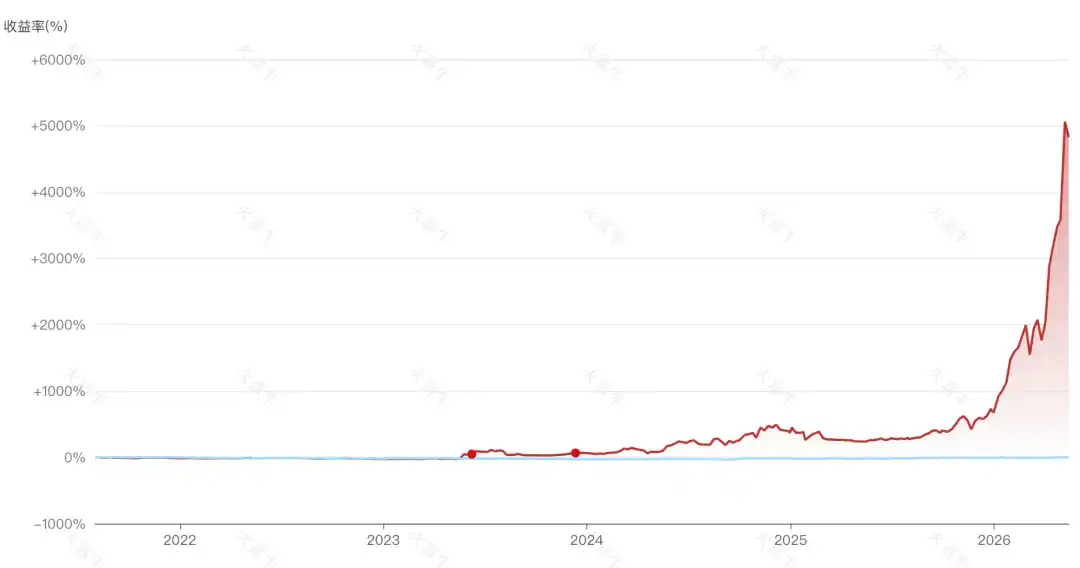
What is a Thunderous NAV

Then there are rumors of Yao Jinghe's private fund making astronomical profits from memory and CPO (Co-Packaged Optics), the former OpenAI employee Leopold whose hedge fund grew from $225 million to $5.5 billion in a year, and the Hefei state-owned capital, poised to be crowned "the most legendary VC" again with Changxin's impending IPO. It seems everywhere you look, people are counting money standing on "Chips, Light, and Lithium," while those without can only watch the relentless rise, gazing at various thunderous NAVs until their prefrontal cortexes are damaged by anxiety.

At this moment, those standing in Hang Seng Tech and value stocks can't help but wonder: Even Shanghai KTV hostesses have made 18 million, why hasn't the market rotated from high-flyers to laggards?

Silicon Bull, Carbon Bear

This market cycle has a peculiar aspect: no matter how crowded the AI industry chain gets, it just won't fall.

In Q1 this year, active equity funds allocated 31.5% to AI hardware, with an overweight position of 17.7%. Compared to historical core sectors, while not surpassing the peak of the "Mao Index" era, it has already exceeded the peak of the "Ning Portfolio" [2].

Guangfa's Liu Chenming also pointed out that fund holdings in TMT exceeded 40% last year, with electronics holdings consistently above 20% for over a year. From a trading crowdedness perspective, the turnover ratio of A-share TMT has long broken through the 40% threshold of the last industry cycle.

Despite such crowding, since April, the Philadelphia Semiconductor Index has risen 54%, and the STAR Semiconductor Index has risen 60%. Not to mention Mr. Fu who heavily bought into Zhongji Innolight in Q1, even 18 fixed-income-plus funds that raised semiconductor holdings above 10% have pulled off thunderous NAV surges.

Another peculiar aspect of this cycle is that no matter how much Hang Seng Tech falls, it just can't get up.

Two months have passed since Xia Junjie said "Hang Seng Tech may have fallen too much," yet it remains lifeless, like a dead fish lying flat-eyed on ice at a seafood stall.

The persistent weakness of Hang Seng Tech has its reasons. As Juming's Liu Xiaolong explained why he cleared Hong Kong tech stocks: 1) Potential impact of AI on internet business models; 2) Hong Kong stocks are more affected by marginal tightening of overseas liquidity; 3) Large IPO fundraising volumes in 2025, consuming capital.

In essence, the current large model landscape remains one of winner-takes-all and long-tail homogenized competition. Hongshang Asset believes that the "free" and "low-cost" cutthroat tactics in the C-end have led to a valuation dilemma for Chinese AI companies:

When monetization capability is heavily questioned, even the AI businesses of Tencent and Alibaba struggle to gain market recognition. Although models like Alibaba's Qianwen have started trying closed-source, paid models, the results aren't great. This is also why the market has gradually lost patience with Tencent and Alibaba's AI stories recently, and the core reason for their lack of valuation expansion momentum.

The most bizarre aspect of this cycle is that consumer fund managers are starting to transform and chase the light.

A while back, thinking of bottom-fishing in consumer funds, "Bosera Women's Consumption Theme" seemed appealing by name. But opening its top ten holdings revealed Crystal Optech and Zhongji Innolight staring back.

Well-known consumer veterans Tong Xun and Xiao Nan are also gradually blending with the light. After shifting their mindset, Mr. Tong's NAV saw a V-shaped reversal since April; after Q3 last year, the "light content" in Xiao Nan's managed Yifangda Ruiheng gradually increased, widening the performance gap with his peer Zhang Kun, who remains mired in baijiu.

These bizarre phenomena remind one of the peak of the last subjective long-only cycle in 2020-2021.

Only back then, the protagonists were 60s-generation fund managers with muscle memory for "monopoly barriers + perpetual operation," overweighting Kweichow Moutai and Alibaba relative to the market. This cycle's protagonists are 85s-generation managers with extreme faith in hard tech, overweighting Zhongji Innolight and Cambricon relative to the market, most experiencing the 4200-point level for the first time since managing money.

If not for AI, subjective long-only managers, suppressed by quant for years, haven't felt this proud in a long time. Over the past year, 12 public offering subjective long-only products have yielded over 300%; in the past three months, the Huofuniu Private Subjective Long-Only Selected Index has overtaken the CSI 500 Index Enhancement Selected Index to become the strongest strategy index.
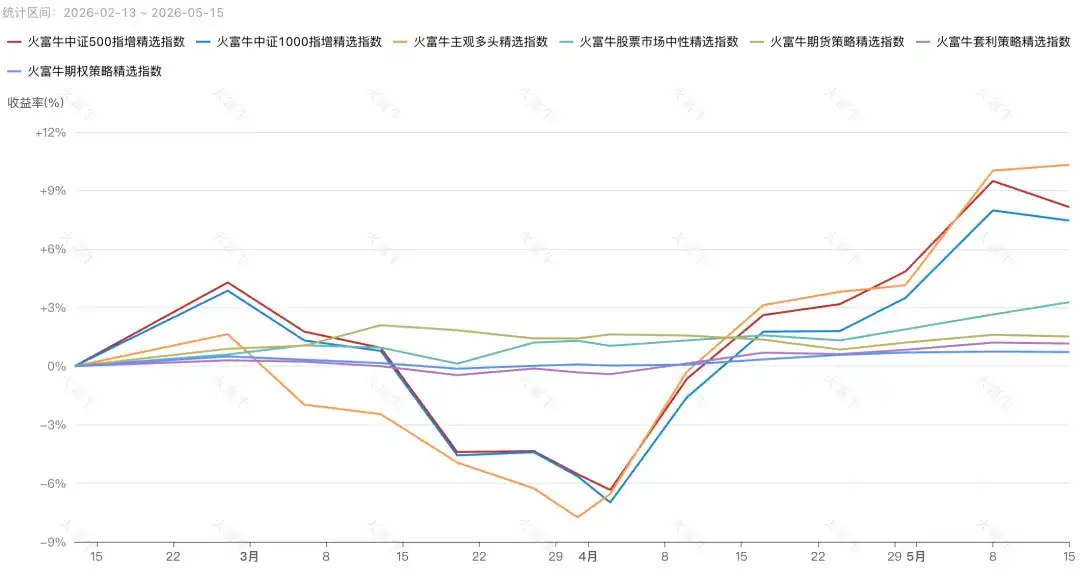
Ren Zeping says this is a once-in-a-decade bull market, a confidence bull formed by the叠加 of policy bull + tech bull + liquidity bull. I think a more accurate expression is: it's a bull market for those confident in silicon, and a bear market for those trying to bottom-fish in carbon.

Attack or Defend

For many fund managers, the current situation is like Hansi Flick leading this impoverished Barcelona—there seems to be no other choice.

Flick's tactic is to defend through attack, using high-pressuring to keep the ball in the opponent's half, reducing the chance of them facing his own goal. Once they fall back and bunker, relying on Barcelona's weak defense, they'd only lose worse. Similarly, even defending in Hang Seng Tech and consumer stocks, they'll still fall when the bull market ends, but at least attacking by buying AI can accumulate profit cushions.

Moreover, under extreme FOMO sentiment, managing liability-side emotions is getting harder. After all, clients can easily make money chasing the light themselves in stocks. Seeing friends' subjective funds all pulling thunderous NAVs, why spend time and management fees listening to you preach value investing, only to miss one of life's few era-defining trains?

Since it's a fast-moving train of the times, should those not on board chase? Should those on board get off? These are questions all managers must face directly. Just like how the capital expenditures of the US tech giants have been revised up all the way to $720 billion, no one wants to be left behind by the times.

Wang Zhongyuan, founder of Ziruixing Investment who entered the industry in 1993, lived through the 1995 "327" Treasury Bond incident and witnessed the 1999 internet bubble. He told Yuanchuan a true story:

Stanley Druckenmiller shorted tech stocks in the first half of 1999, went heavily long by year-end, and liquidated at the top in January 2000. But by March 2000, when tech soared again, he couldn't hold back and went all-in, losing 18% in a month and a half.

"What does this story illustrate? Even the world's公认 top trader can make irrational decisions when facing FOMO. So, how many of today's fund managers chasing the light do you think are more厉害 than Druckenmiller?"

Interestingly, Zeyuan Investment posted a chart on their public account—"Semiconductors Rank First in Global Trading for May."
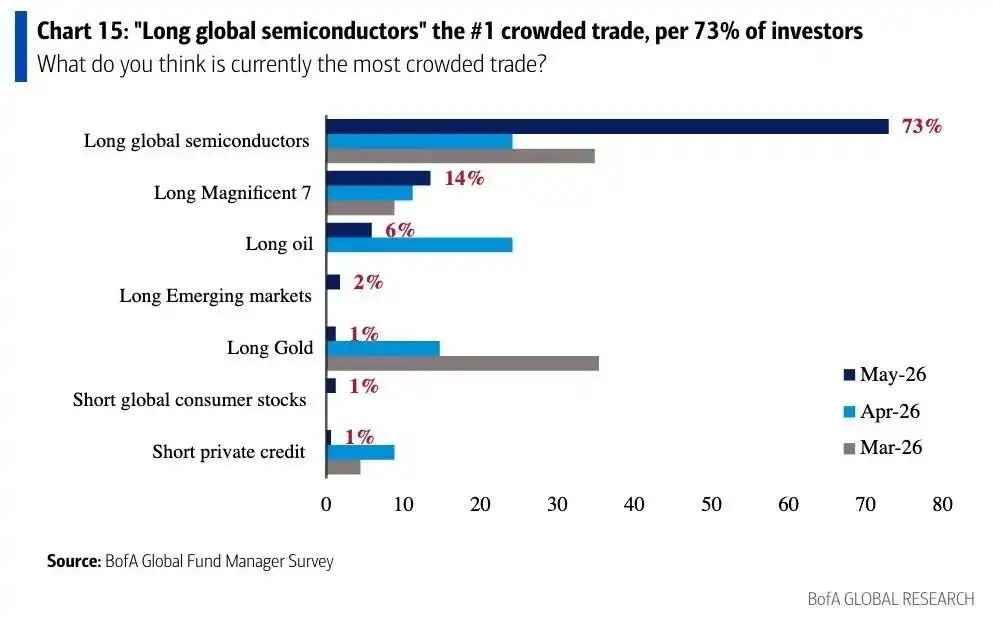
They advised investors to lower expectations for Zeyuan. The current situation resembles the peak of the dot-com bubble. They would never abandon traditional value investing to chase the dot-com bubble, even if it boils over, "never surrendering." They quoted a line, "The stock market is where dreams and money are exchanged. Those who sell their套取金钱, while those who付出金钱大多套牢守望梦想."

Compared to Ziruixing and Zeyuan, Jingyi Investment expressed it more bluntly—the underlying large models of this AI revolution, and the most core infrastructure and hardware, are overwhelmingly in the hands of those美股头部科技巨头 across the ocean. The fundamental支撑 of the current A-share AI speculation is far weaker than that of new energy back then.

"In 2021, most光伏 and lithium battery companies were伴随着实打实的业绩爆发 and rapid渗透率提升. But many of today's so-called 'AI companies' in A-shares,炒作到市值几千亿, don't even have that momentary profit爆发 of the new energy era."

It's undeniable that some subjective私募 aren't gambling. They withstood the short-selling打击 of Michael Burry's $379付费文章 last year and captured that the core主线 of AI investment is AI hardware. But as the speculation扩散 from optical modules to memory, CPU, electronic fabric,光纤等细分环节, the room for rotation within the板块不断收窄, and the potential代价 of making mistakes is also抬升.

Coupled with the 30-year US Treasury yield breaking 5%, chasing AI now versus when Michael Burry called the bubble last year happens under different macro situations.

It's like Flick's Barcelona, sailing smoothly this season, occasionally刷出雷霆比分. Until the Champions League quarter-finals against counter-attacking specialist Atletico Madrid, they stubbornly persisted with high attacking, leading defenders to frequently追回, receiving two red cards,彻底葬送了比赛.

Epilogue

When people still believed in carbon, thunderous NAVs weren't unheard of either.

In the last baijiu bull market, from 2020 to June 2021, Lin Yuan's performance rose 150%, only to fluctuate and decline for the next five years, now只剩下20%多的收益. Zhengyuan and Chongji, which集中押注光伏新能源 back then, are even more memories wealth managers不愿回首.

Then there's Shifeng Asset, which previously pulled off thunderous NAVs and peaked at 30 billion AUM.尝试转型量化也未能扭转颓势, its规模萎缩到20-50亿, recently learned to have moved from the prime Lujiazui Century Financial Plaza to the cheaper Yuanshen Financial Tower.

These may seem somewhat distant, but at the beginning of the year when gold prices stood at highs, that gold私募 that yelled "sit tight and hold on" three times probably isn't so easily forgotten.

I sometimes ask渠道人士 why they看好某家私募. The answers不外乎三点: Entrepreneurs who left big firms, strategies still effective at small scale, and the most core one—the NAV curve颜值好.

Behind thunderous NAVs often lie收益放大 from集中持仓乃至加杠杆. Buying solely based on业绩锐度 likely gets you a平庸的产品, merely buying into the过去强势的市场风格. The教训 of buying based on charts has repeated一遍又一遍.

Qinyuan's Wu Dingwen once shared: "Allocation requires认同底层逻辑, meaning认同交易,认同价值,认同团队, not just认同赚钱."仅认同赚钱大概率逃离不了什么火买什么,买什么什么跌,什么跌死在哪的循环.


Related Questions

QWhat is the main investment thesis or 'wealth code' proposed in the article for 2026?

AThe article proposes that the primary 'wealth code' or investment opportunity for 2026 is concentrated in the semiconductor ('chip') and optical communication ('light') sectors, particularly those related to AI computing power infrastructure. This is summarized as 'Silicon Bull, Carbon Bear,' meaning investing in silicon-based tech (AI, chips) is bullish, while traditional carbon-based sectors are bearish.

QWhat example does the article use to illustrate the potential risks of chasing high-flying market trends driven by FOMO (Fear Of Missing Out)?

AThe article cites the story of legendary trader Stanley Druckenmiller during the dot-com bubble. He famously shorted tech stocks, then bought back in, sold near the top in early 2000, but succumbed to FOMO and bought back in heavily in March 2000, just before the crash, losing 18% in six weeks. This illustrates that even top professionals can make irrational decisions under FOMO pressure.

QAccording to the article, why are some traditional value investment firms like Zeyuan Investment and Jingyi Investment skeptical of the current AI stock rally in A-shares?

AFirms like Zeyuan and Jingyi are skeptical because they view the current A-share AI rally as lacking fundamental support compared to past booms like new energy. They argue that the core AI infrastructure (large models, key hardware) is controlled by US tech giants, and many highly valued A-share 'AI companies' lack the genuine, explosive profit growth seen in companies during the solar or lithium battery booms. They see it as a speculative bubble and refuse to abandon traditional value investing principles to chase it.

QHow does the article describe the shift in the dominant players in the current market compared to the 2020-2021 peak?

AThe article notes a generational shift. During the 2020-2021 peak, the dominant players were 60s-born fund managers with a 'muscle memory' for monopolistic barriers and perpetual growth, heavily overweighting stocks like Kweichow Moutai and Alibaba. In the current market, the protagonists are 85s-born managers with an extreme faith in hard technology, who are heavily overweighting AI hardware stocks like Zhongji Innolight and Cambricon. Most are experiencing a market above 4200 points for the first time in their careers.

QWhat caution does the article raise about investing based solely on a fund's 'sharp net value curve' or past high returns?

AThe article warns that 'thunderous net value' curves are often the result of concentrated positions or even leverage, which magnifies returns. Simply using past high performance (curve 'beauty') as a buying criterion likely leads to purchasing a mediocre product that merely benefited from a past strong market style. It cautions against the cycle of chasing whatever is hot, buying at the top, and suffering losses when the trend reverses, a pattern that has repeated throughout history.

Related Reads

Why Haven't Forex Stablecoins Taken Off?

Why FX Stablecoins Never Took Off: A Path Forward via Synthetic FX Despite the explosive growth of stablecoin-powered digital banking, which has seen ~$6B in VC investment and a 24x surge in crypto card spending in under a year, a major limitation persists: these banks are essentially dollar-only accounts. This leaves 95-99% of global accounts, which are denominated in non-USD currencies, underserved. Attempts to create native foreign currency (FX) stablecoins (like EURC) have largely failed, with total FX stablecoin TVL at ~$600M compared to $400B for USD stablecoins—a 700x gap. These FX tokens face critical challenges: fragile pegs due to low liquidity, limited exchange/FinTech acceptance, poor on/off-ramps, complex regional compliance, and a chicken-and-egg adoption problem. The article argues that the solution lies not in competing with entrenched USD stablecoin networks (USDT/USDC), but in adopting a synthetic FX model inspired by traditional finance. Specifically, it advocates for Mark-to-Market Non-Deliverable Forwards (NDFs)—cash-settled FX derivatives that allow users to maintain underlying USD stablecoin holdings while having their account balance and P&L denominated in a foreign currency. This approach offers key advantages: strong oracle-based pegs, retention of deep USD stablecoin liquidity and yield, superior on/off-ramps, scalability to any currency with a reliable feed, and capital efficiency. It mirrors how modern institutional FX markets operate. Primary use cases for on-chain NDFs include: 1. **Digital Banks/Wallets:** Enabling multi-currency accounts for international users without leaving the USD stablecoin ecosystem, boosting deposits and retention. 2. **FX Carry Trade Vaults:** Offering access to sovereign interest rate differentials (e.g., earning yield on BRL) in a more stable and scalable format than crypto-native products like Ethena. 3. **Global Enterprise Payments:** Allowing merchants to receive payments in local currency equivalents while settling in USD stablecoins, similar to services offered by Stripe for fiat. The conclusion is that synthetic FX, not native FX stablecoins, is the viable path to integrating foreign exchange into the growing stablecoin digital banking landscape, potentially unlocking the next phase of institutional DeFi and multi-trillion-dollar global adoption.

链捕手34m ago

Why Haven't Forex Stablecoins Taken Off?

链捕手34m ago

IOSG Founder: Web3 Is 'Losing Blood,' How Can Practitioners Survive Better?

IOSG Founder: Web3 Is "Bleeding Out" – How Can Practitioners Survive Better? In a candid reflection, the founder of IOSG Ventures voices deep concerns about the current state of Web3, describing an ecosystem experiencing severe "blood loss." Despite the recent MuShanghai event showcasing a successful pivot towards a more diverse, global community, a somber reality persists: many crypto-native attendees were there exploring exits or new labels in biotech, AI, and robotics. The core issue is identified as a breakdown in the ecosystem's positive feedback loop. Alarmingly, underestimated "low-probability bad events" are occurring simultaneously: a significant brain drain of Chinese developers to AI, a lack of breakout applications despite massive funding, and a widening credibility gap for practitioners globally, often stigmatized as scam artists. This has created a dire接班人 (successor) problem, with the next generation seeing little professional prestige or financial upside in crypto compared to fields like AI. A significant portion of the critique focuses on Ethereum and Vitalik Buterin. While not pessimistic about Ethereum's technology, the founder worries that critical development windows were missed by focusing on niche technical narratives like ZK and L2 instead of mass-market applications. A more urgent concern is that Vitalik may be isolated in an "information bubble," shielded from the grassroots community's hardships by layers of intermediaries, preventing crucial feedback from reaching him. The call is for Vitalik to return to a founder's mindset, re-engage directly with the community, and rally efforts for the next decade. The divergence between U.S. and Chinese OG (Original Gangster) ecosystems is stark. While many U.S. builders reinvest their wealth into the ecosystem, the Chinese scene suffers from a severe lack of "造血能力" (blood-making ability), with most market-driven funds struggling and many early success stories cashing out entirely. This threatens the entire Asian Web3 ecosystem's survival. For individual practitioners, survival advice is pragmatic: find your core "why," maintain life balance beyond token prices, continuously learn new skills (like AI), form small, trusted alliances for mutual support, and practice self-compassion. The industry's greatest need is not money or tech, but lighthouses—individuals at all levels who offer mentorship, grants, referrals, and honest reflection to guide others. The piece concludes with a direct appeal: OGs must pay forward the opportunities the industry gave them; founders must not struggle alone; and builders must continue their work, ensuring it remains a viable profession. The survival of Web3's "cathedral" depends not on any single leader but on the collective responsibility of everyone who remains.

marsbit1h ago

IOSG Founder: Web3 Is 'Losing Blood,' How Can Practitioners Survive Better?

marsbit1h ago

Deficits, Inflation, and the New Fed: The Deep Logic Behind US Bond Yields Breaking 5% and the Market Reset

In the week of May 15-19, 2026, U.S. long-term Treasury yields surged to multi-year highs, with the 30-year yield hitting 5.2%, a level unseen since 2007, and the 10-year yield climbing to 4.687%. Equity markets declined in response. Four primary factors are driving the rise in yields. First, stubborn inflation persists, with April wholesale prices rising 6% year-over-year, fueling expectations of potential future Fed rate hikes instead of cuts. Second, newly confirmed Fed Chair Kevin Warsh inherits a complex inflation battle, with markets closely awaiting his first FOMC meeting. Third, deteriorating U.S. fiscal health, marked by large deficits and rising debt servicing costs, is eroding the traditional "safe-haven" premium for Treasuries. Fourth, the "One Big Beautiful Bill" tax cuts are projected to add trillions to the national debt, contributing to Moody's recent credit rating downgrade. Rising yields pressure stocks through several channels: a higher discount rate reduces the present value of future earnings (especially for growth stocks); rising risk-free rates compress equity risk premiums, making bonds relatively more attractive; higher borrowing costs impact consumers and corporations; and a stronger dollar affects multinational earnings. For investors, the environment favors value and financial stocks over long-duration growth stocks. Bond investors find attractive yields in short to intermediate maturities, while income investors see the best fixed-income opportunities in over a decade. Key developments to watch include Chair Warsh's first FOMC meeting, upcoming inflation data, Treasury auction demand, and whether the 30-year yield approaches 6%, a level that could trigger a more sustained equity valuation reset. The bond market's message is clear: the era of cheap government borrowing is over, posing a central challenge for markets in late 2026.

marsbit1h ago

Deficits, Inflation, and the New Fed: The Deep Logic Behind US Bond Yields Breaking 5% and the Market Reset

marsbit1h ago

Is MicroStrategy Selling Bitcoin Not a Bearish Signal? Deconstructing the 5 Financial Logics Behind Corporate Bitcoin Divestment

The article "Is Strategy Selling Bitcoin Not a Bearish Signal? Decoding 5 Financial Logics Behind Corporate Bitcoin Divestment" analyzes why companies might sell their bitcoin holdings, arguing it's not necessarily negative. It begins by noting the market's surprise at Strategy's potential sale, contrasting its previous "never sell" stance. The core argument is that corporate decisions prioritize shareholder value, and selling bitcoin can be a rational strategic choice. The article outlines five key financial reasons for such sales: 1. **Increase Bitcoin Holdings Per Share:** Companies can use proceeds from bitcoin sales to repurchase shares when the stock price is undervalued relative to its bitcoin assets. This reduces the outstanding share count, potentially increasing the bitcoin amount backing each remaining share. 2. **Optimize Capital Structure & Reduce Financing Costs:** Building cash reserves through bitcoin sales can improve credit ratings (as favored by agencies like S&P), leading to lower future borrowing costs. Repaying debt with sale proceeds also reduces financial leverage. 3. **Legitimate Tax Planning:** In the absence of wash-sale rules for bitcoin in the US, companies can sell to realize capital losses, then repurchase, lowering the tax basis of their holdings and creating tax offsets. 4. **Counter Negative Market Narratives:** A controlled, non-disruptive sale could demonstrate market resilience and disprove fears that corporate selling would crash the market, thereby normalizing bitcoin as a corporate treasury asset. 5. **Repurchase Preferred Stock at a Discount:** If a company's preferred stock trades significantly below its face value, using bitcoin sale proceeds to repurchase it can retire expensive liabilities at a profit, saving on future dividend payments. The conclusion emphasizes that bitcoin's monetary properties offer flexibility. Strategic sales can protect corporate and shareholder interests, making asset utilization more important than rigid "hold" mandates.

marsbit2h ago

Is MicroStrategy Selling Bitcoin Not a Bearish Signal? Deconstructing the 5 Financial Logics Behind Corporate Bitcoin Divestment

marsbit2h ago

Trading

Spot
Futures
活动图片