Shielded Labs Warns Zcash Must Act Now To Win Long-Term Investors

bitcoinistPublished on 2026-03-04Last updated on 2026-03-04

Shielded Labs is urging the Zcash community to move quickly on long-term sustainability changes, arguing that the network has a near-term opening to attract patient capital and should not wait for that window to close. The pitch is not just technical. In Shielded Labs’ telling, protocol-level clarity around future security and emissions could itself become an investment signal for ZEC.

The argument surfaced in a Zcash Community Forum discussion around the proposed Network Sustainability Mechanism, or NSM, where Shielded Labs pushed back on the idea that the work lacks short-term relevance.

“We believe there’s an opportunity right now to attract long-term investors. In conversations we’ve had over the past year, investors respond positively to the fact that we’re thinking about and actively addressing long-term sustainability. Broad consensus from the community and coinholders for implementing the NSM in the next network upgrade would send a clear signal that we have a credible path forward,” the group wrote.

Zcash Could Miss Its Moment Without Fast Action

That framing matters because the current debate is not simply about whether Zcash should strengthen its future security budget, but how. In a separate governance post, Shielded Labs said recent polling showed a split between support for the overall direction of the NSM and resistance to one of its more sensitive design choices, issuance smoothing.

According to the group, “There were two separate questions: one related to the NSM and issuance smoothing, and another focused on burning 60 percent of transaction fees to support network sustainability.” It added that the issuance-smoothing question won “broad support from panels but not from coinholders,” while the fee-burning component drew broad support from both panels and coinholders.

On that basis, Shielded Labs said it sees “clear support” for the elements that remove ZEC from circulation, including ZIP 233 and ZIP 235, and intends to push those parts toward the next network upgrade.

Shielded Labs also acknowledged that resistance from coinholders is not irrational. “For some coinholders, the existing emissions schedule is viewed as a defining part of Zcash’s monetary identity, similar in principle to the 21 million supply cap. That is a rational position,” the post said, adding that the team remains open to alternative designs that preserve the halving schedule while still improving sustainability.

Still, the core message from the newer forum exchange was unmistakably urgent. Shielded Labs argued that upcoming network developments could make the timing more consequential than it appears today.

“Tachyon could increase aggregate fees in the near term by allowing a much higher rate of transactions, which makes the timing especially important. NEAR Intents integrations and additional Maya DEX activity could also increase fee demand. If several of these developments gain traction at the same time, aggregate network usage could rise meaningfully. In that scenario, it would be better to already have the NSM in place rather than trying to introduce it later.”

The broader strategic claim is that Zcash can differentiate itself by confronting a question many proof-of-work networks still treat as a future problem. Shielded Labs explicitly tied the issue to the wider debate over Bitcoin’s long-term security budget, arguing that a mechanism “explicitly defined at the protocol level” could matter for how users and investors evaluate network durability.

Whether that case is enough to win over skeptical coinholders remains unresolved, but the direction of travel is clearer: Shielded Labs wants Zcash to present sustainability not as an abstract research topic, but as part of the asset’s investment thesis now.

At press time, ZEC traded at $216.59.
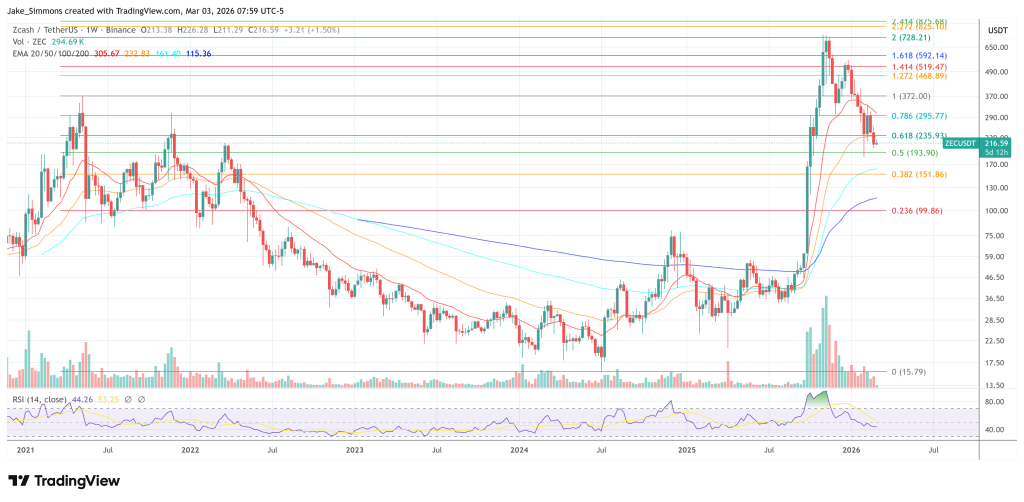
ZEC trades below the 0.618 Fib, 1-week chart | Source: ZECUSDT on TradingView.com

Related Reads

CPU Makes a Comeback to the Table, A $170 Billion "Power Seizure" Drama Begins

A new era is dawning for the server CPU (Central Processing Unit), driven by the shift from AI model training to large-scale reasoning and the rise of Agentic AI. This article explores how the CPU is reclaiming a central role in the AI data center. For years, the focus has been on the GPU (Graphics Processing Unit) for AI training. However, as AI moves to the inference and Agent phase—where tasks involve complex, multi-step reasoning, tool calls, and data management—the workload balance is flipping. Studies show CPUs now handle over 70% of the workload in Agentic AI, up from 10-30% in training. This is because Agent tasks generate massive intermediate data (KV Cache) that exceeds GPU memory, forcing it to be offloaded to the CPU's larger, more scalable memory pools. This increased importance is translating into market changes. Major players are taking note: NVIDIA launched its first standalone CPU line, Vera, based on ARM architecture and optimized for Agent performance. AMD doubled its server CPU market forecast to over $1200 billion by 2030. Analyst reports project the total server CPU market could reach $1700 billion by 2030, with AI-driven demand being a primary driver. Furthermore, the classic ratio of CPUs to GPUs in AI servers is rapidly changing, converging from 1:8 toward 1:1 for Agent deployments. This surge in demand has led to a rare industry-wide price increase of 10-15% for server CPUs from Intel and AMD, breaking a decade-long trend of "more performance for the same price." Demand is bifurcating into high-core-count CPUs for in-rack GPU support and moderate-core CPUs for standalone Agent task orchestration. In China, this global trend presents an opportunity for domestic CPU manufacturers like Hygon (海光信息) and Huawei Kunpeng, who are bolstered by both growing AI infrastructure needs and national policies promoting technological self-reliance ("xin chuang"). The maturity of their software ecosystems is also accelerating, evidenced by faster adaptation to new AI models. In conclusion, the narrative is shifting from a GPU-centric view to one where CPU-GPU synergy is critical. The CPU is no longer a peripheral component but a performance-defining bottleneck and a key growth driver in the AI hardware stack, opening a massive new market estimated in the hundreds of billions of dollars.

marsbit3h ago

CPU Makes a Comeback to the Table, A $170 Billion "Power Seizure" Drama Begins

marsbit3h ago

TechFlow Intelligence: AMD AI Director Publicly Criticizes Claude Code for "Becoming Dumber and Lazier", Trump Claims Full Ceasefire in Hormuz But Strait Still Has 80 Unexploded Mines

TechFlow Intelligence Report: This daily digest covers key developments in AI, crypto, hardware, and geopolitics. In AI, SK Telecom faces US export control scrutiny over its partnership with Anthropic, while a Gemini user reports being misled in a scam scenario, sparking safety debates. China's Z.AI launches the GLM-5.2 model, rivaling Claude Opus without NVIDIA chips. In crypto, Bithumb lists ReProtocol, and Upbit delists KernelDAO. On the hardware front, MIT researchers build a custom OS to study chips, ASML denies US claims its advanced lithography machines are in China, and Amazon considers selling its in-house AI chips. Apple's future A21 Pro chip may use TSMC's latest N2P process. Major tech issues include 10,000 GitHub repositories distributing malware and Apple patching a critical eavesdropping flaw in Beats earbuds. US stocks rise, led by semiconductors, with Intel surging 10.6%, while SpaceX falls 3.5%. Geopolitically, despite a US-Iran deal, the Strait of Hormuz remains risky with ~80 uncleared mines, stalling 80M barrels of oil on standby tankers. Iran postpones Switzerland talks, and Trump calls the agreement an "unconditional surrender." The report highlights a contrast: temporary geopolitical calm versus the ongoing, fundamental restructuring of tech supply chains and chip independence.

marsbit3h ago

TechFlow Intelligence: AMD AI Director Publicly Criticizes Claude Code for "Becoming Dumber and Lazier", Trump Claims Full Ceasefire in Hormuz But Strait Still Has 80 Unexploded Mines

marsbit3h ago

Trading

Spot
Futures
活动图片