ShapeShift founder denies $260mln whale accumulation – Here’s what we know!

ambcryptoPublished on 2026-03-23Last updated on 2026-03-23

Recent on-chain data suggests that large investors are quietly building strong positions in Ethereum.

Over the past two weeks, a major whale, reportedly linked to Erik Voorhees, Founder of ShapeShift, has deployed nearly $260 million in USDT to accumulate more than 120,000 ETH.

This buying pattern points to a steady accumulation strategy rather than a one-time trade. For instance, in the latest transaction, the whale spent $4.29 million to purchase ETH at $2,134.
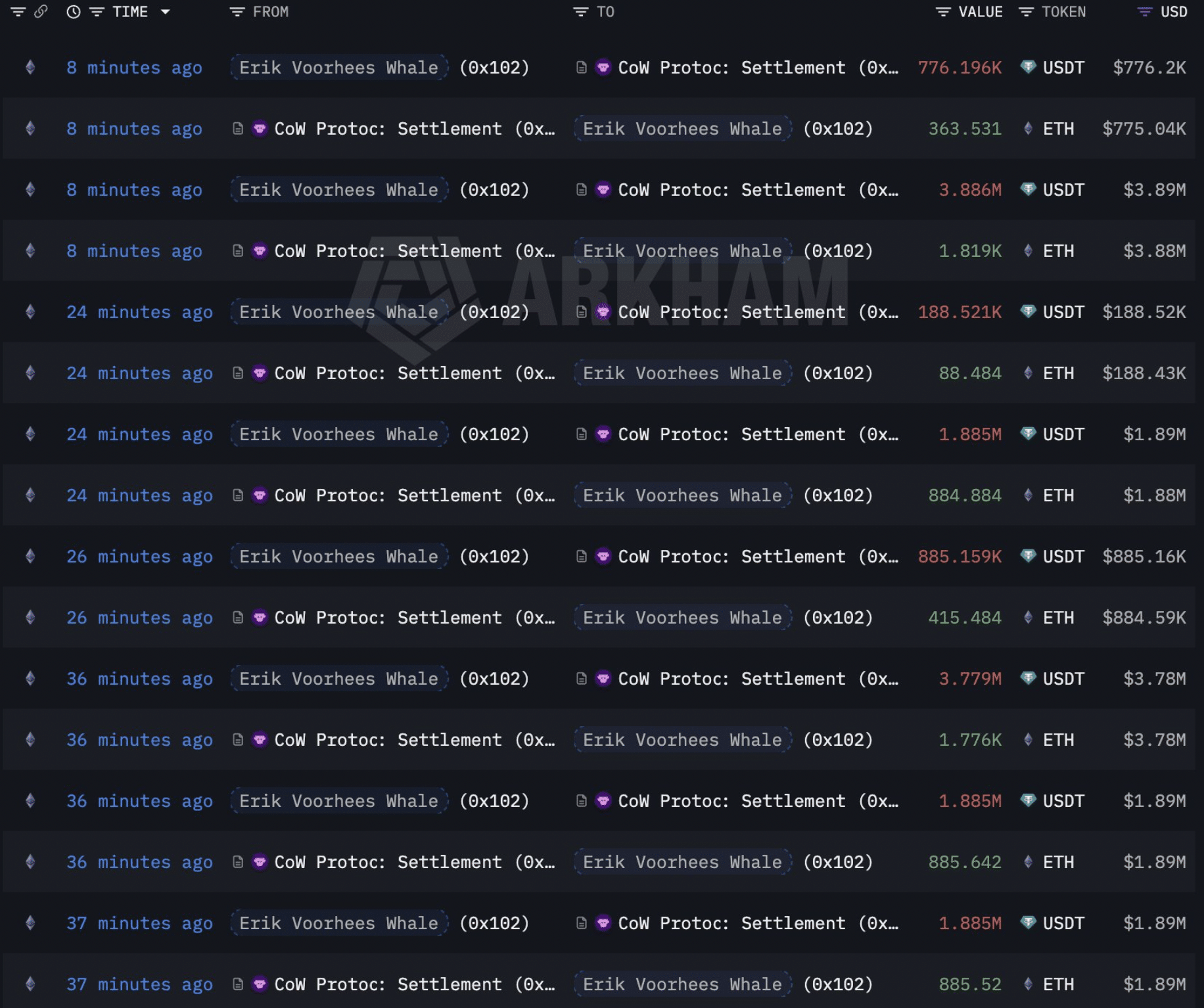
Source: Lookonchain/X

Overall, the average buying price stands at around $2,162, which now acts as a key support level for the market.

Such moves signal strong confidence that Ethereum may be nearing its bottom, with expectations of potential upside in the coming months.

Notably, this accumulation is happening even as ETH trades at $2,071.67, down over 3% in the last 24 hours. This paints a clear divergence between short-term price action and long-term investor sentiment.

Retail vs whale behavior

To understand this better, let’s analyse the Spot Retail Activity by CryptoQuant.

Historically, smaller investors tend to buy when prices are already high, driven by FOMO. This happened in past cycles like 2018, 2021, and even 2024.
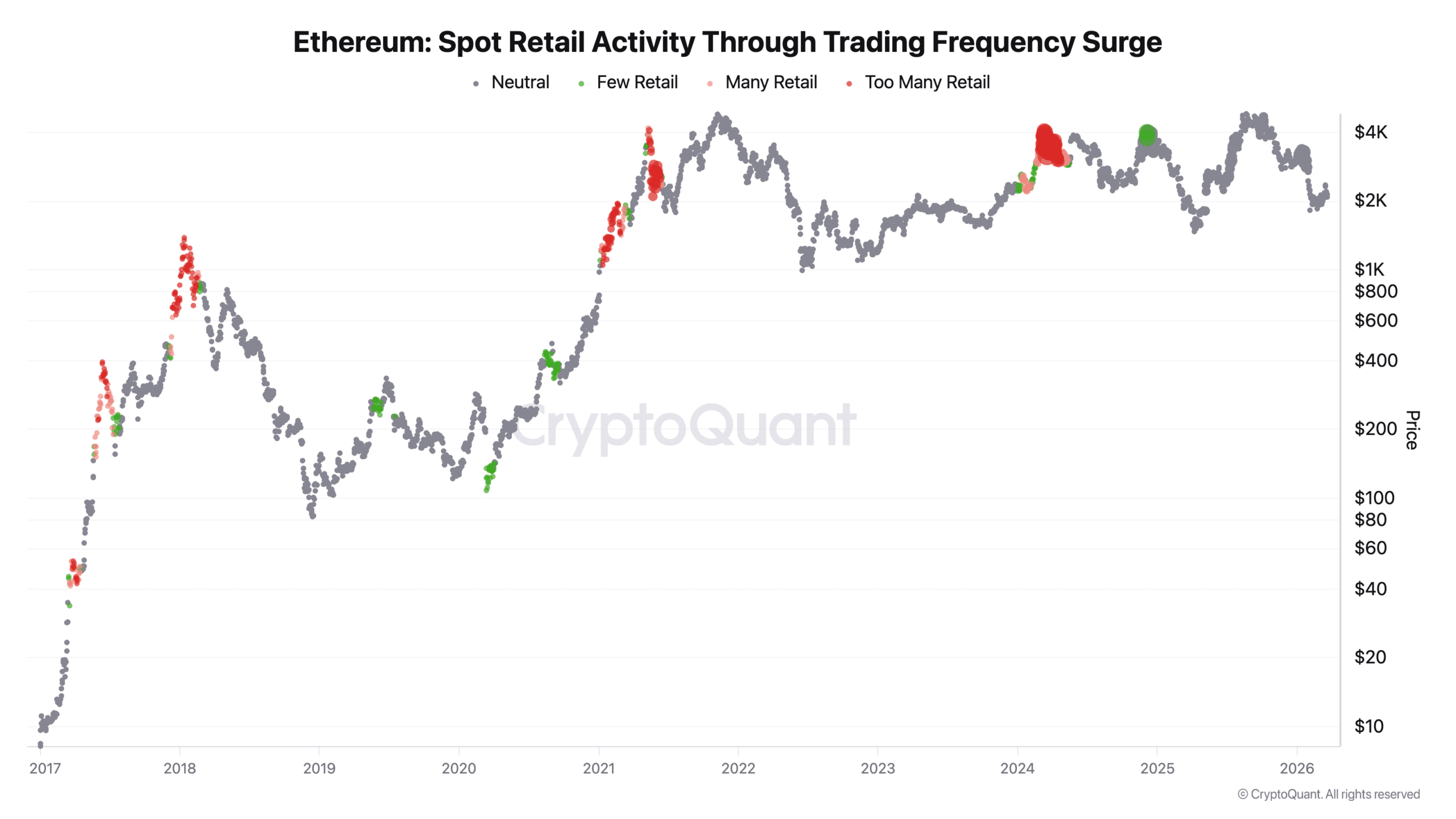
Source: CryptoQuant

Right now, retail activity is relatively low, which is actually a good sign. It means the market is in a quieter phase where large investors are accumulating, while the public is still on the sidelines.

Interestingly, while this whale has been aggressively buying Ethereum [ETH], ETFs have been seeing money flow out, which may seem negative at first.
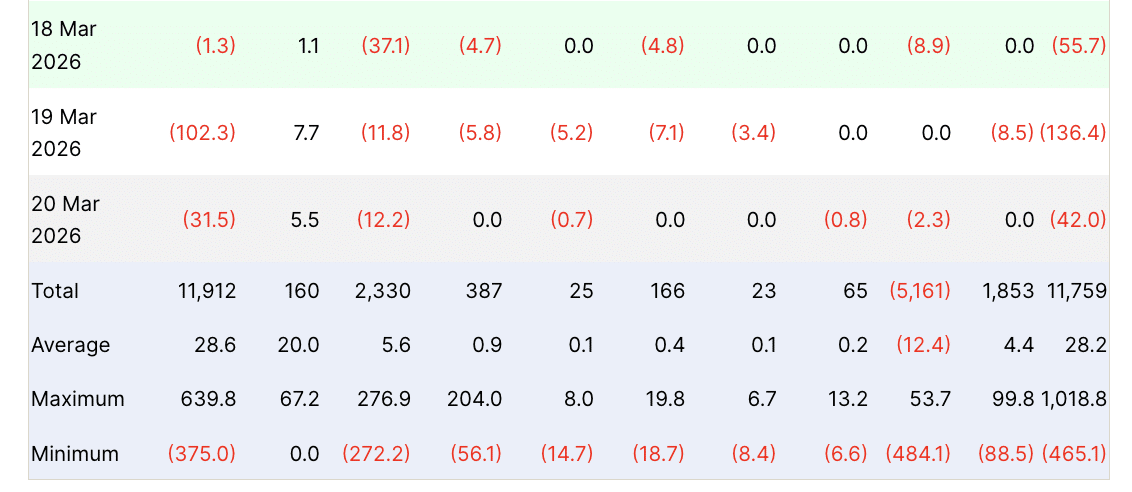
Source: Farside Investors

However, a closer look reveals that large whales are steadily increasing their holdings, while mid-sized investors seem to be selling or redistributing.

Meanwhile, retail investors remain inconsistent, often buying at higher levels and selling during dips.
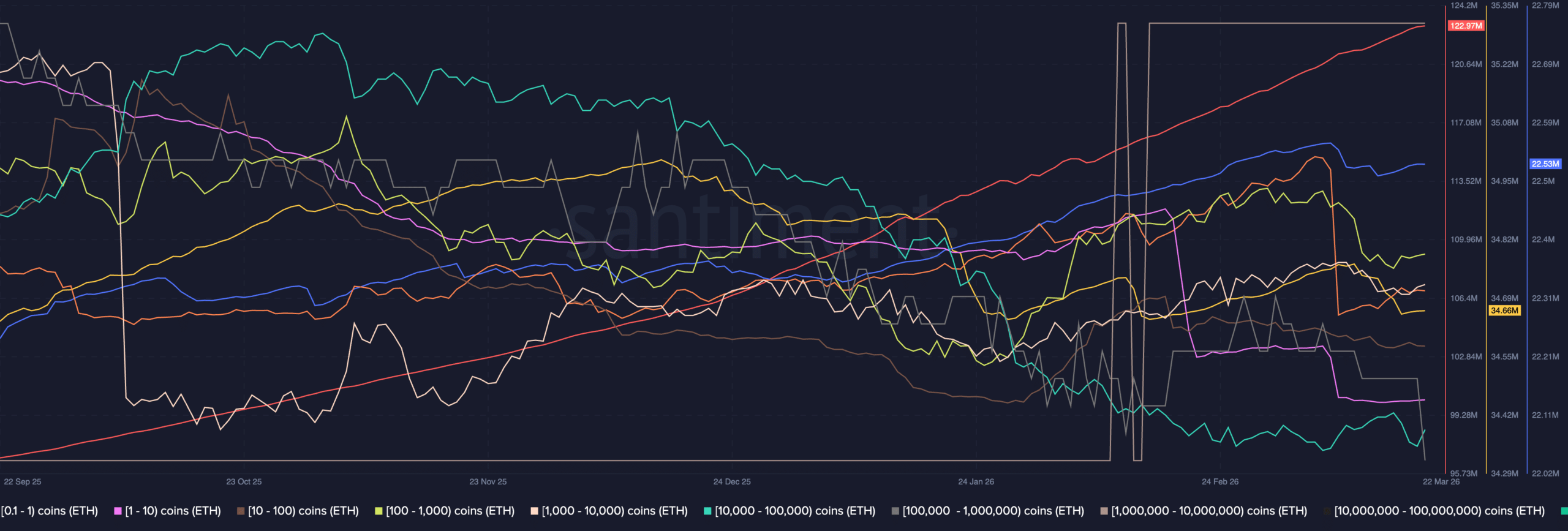
Source: Santiment

Overall, this indicates that Ethereum is gradually moving from weaker hands to stronger, long-term holders, which is typically a bullish sign for the market.

Voorhees’ past whale move and a crazy plot twist

For those unaware, this whale activity began on the 16th of March and intensified on the 20th of March, when the Voorhees-linked whale made another major move.
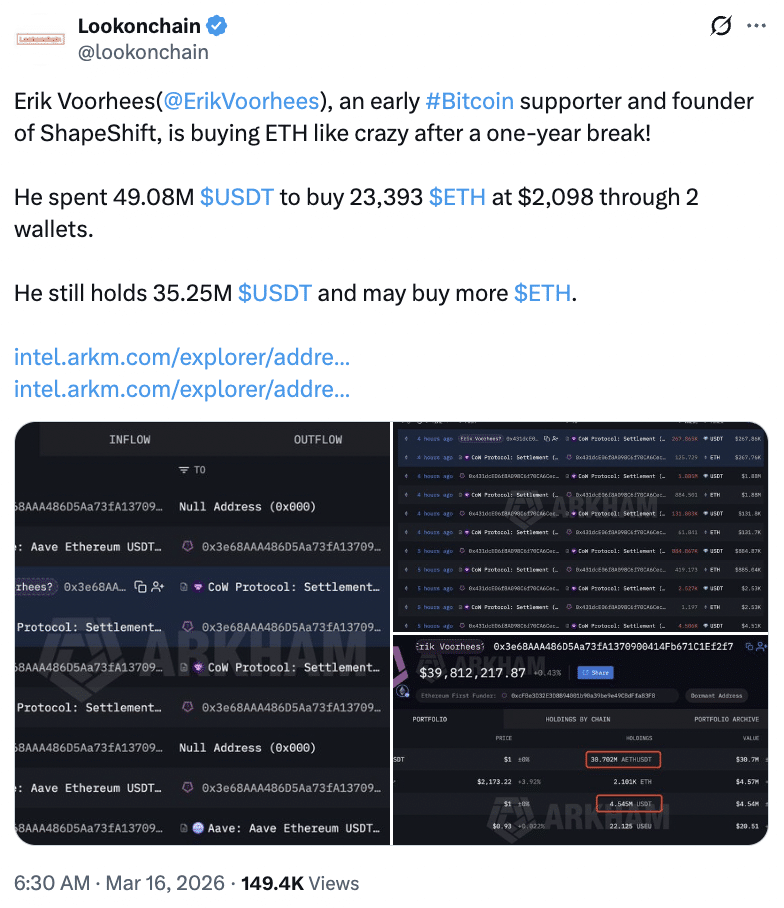
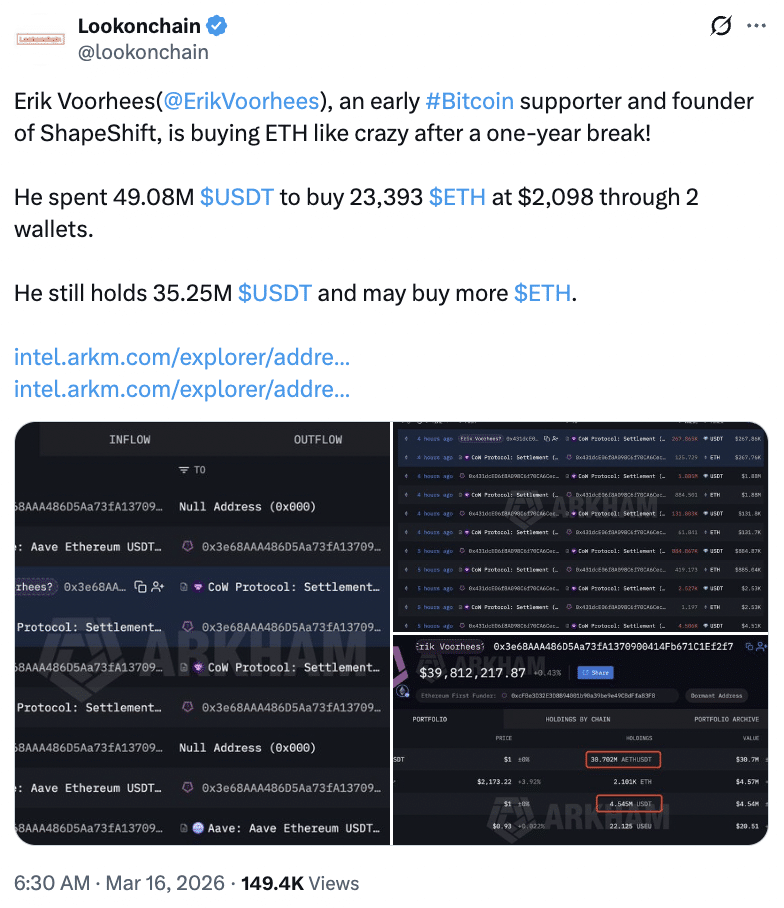
Source: Lookonchain/X

However, the narrative took a sharp turn when Voorhees publicly denied any involvement and said,

I did not buy any eth and those tracking sites are a scam.

Now, this throws darts at two opposite possibilities. In the first case, it could be a different investor with similar wallet activity, or simply a misidentification by tracking platforms.

However, another possibility is stealth accumulation, where large investors buy quietly to avoid moving the market.

Whatever the possibilities may be, such whale movements do impact how investors perceive and feel about the token’s future.


Final Summary

  • Price weakness is being used as an opportunity by large players, not a warning sign.
  • ETF outflows may look bearish, but on-chain data shows whales are steadily increasing holdings.

Related Questions

QWhat recent on-chain activity is linked to a major whale, and how much ETH was accumulated?

ARecent on-chain data suggests a major whale, reportedly linked to Erik Voorhees, deployed nearly $260 million in USDT to accumulate more than 120,000 ETH over the past two weeks.

QWhat is the average buying price for the whale's ETH accumulation, and why is it significant?

AThe average buying price for the whale's accumulation stands at around $2,162, which now acts as a key support level for the market.

QHow does the current retail activity for Ethereum compare to the behavior of large whales, according to the article?

ARetail activity is currently low, which is a sign the market is in a quieter phase where large investors are accumulating, while retail investors tend to buy at higher prices and sell during dips.

QWhat was Erik Voorhees's public response to the reports linking him to the whale activity?

AErik Voorhees publicly denied any involvement, stating, 'I did not buy any eth and those tracking sites are a scam.'

QWhat is one possible explanation given in the article for the whale's activity if it is not Voorhees?

AOne possibility is that it could be a different investor with similar wallet activity, or simply a misidentification by tracking platforms. Another possibility is stealth accumulation, where large investors buy quietly to avoid moving the market.

Related Reads

a16z: AI's 'Amnesia', Can Continuous Learning Cure It?

The article "a16z: AI's 'Amnesia' – Can Continual Learning Cure It?" explores the limitations of current large language models (LLMs), which, like the protagonist in the film *Memento*, are trapped in a perpetual present—unable to form new memories after training. While methods like in-context learning (ICL), retrieval-augmented generation (RAG), and external scaffolding (e.g., chat history, prompts) provide temporary solutions, they fail to enable true internalization of new knowledge. The authors argue that compression—the core of learning during training—is halted at deployment, preventing models from generalizing, discovering novel solutions (e.g., mathematical proofs), or handling adversarial scenarios. The piece introduces *continual learning* as a critical research direction to address this, categorizing approaches into three paths: 1. **Context**: Scaling external memory via longer context windows, multi-agent systems, and smarter retrieval. 2. **Modules**: Using pluggable adapters or external memory layers for specialization without full retraining. 3. **Weights**: Enabling parameter updates through sparse training, test-time training, meta-learning, distillation, and reinforcement learning from feedback. Challenges include catastrophic forgetting, safety risks, and auditability, but overcoming these could unlock models that learn iteratively from experience. The conclusion emphasizes that while context-based methods are effective, true breakthroughs require models to compress new information into weights post-deployment, moving from mere retrieval to genuine learning.

marsbit36m ago

a16z: AI's 'Amnesia', Can Continuous Learning Cure It?

marsbit36m ago

Can a Hair Dryer Earn $34,000? Deciphering the Reflexivity Paradox in Prediction Markets

An individual manipulated a weather sensor at Paris Charles de Gaulle Airport with a portable heat source, causing a Polymarket weather market to settle at 22°C and earning $34,000. This incident highlights a fundamental issue in prediction markets: when a market aims to reflect reality, it also incentivizes participants to influence that reality. Prediction markets operate on two layers: platform rules (what outcome counts as a win) and data sources (what actually happened). While most focus on rules, the real vulnerability lies in the data source. If reality is recorded through a specific source, influencing that source directly affects market settlement. The article categorizes markets by their vulnerability: 1. **Single-point physical data sources** (e.g., weather stations): Easily manipulated through physical interference. 2. **Insider information markets** (e.g., MrBeast video details): Insiders like team members use non-public information to trade. Kalshi fined a剪辑师 $20,000 for insider trading. 3. **Actor-manipulated markets** (e.g., Andrew Tate’s tweet counts): The subject of the market can control the outcome. Evidence suggests Tate’sociated accounts coordinated to profit. 4. **Individual-action markets** (e.g., WNBA disruptions): A single person can execute an event to profit from their pre-placed bets. Kalshi and Polymarket handle these issues differently. Kalshi enforces strict KYC, publicly penalizes insider trading, and reports to regulators. Polymarket, with its anonymous wallet-based system, has historically been more permissive, arguing that insider information improves market accuracy. However, it cooperated with authorities in the "Van Dyke case," where a user traded on classified government information. The core paradox is reflexivity: prediction markets are designed to discover truth, but their financial incentives can distort reality. The more valuable a prediction becomes, the more likely participants are to influence the event itself. The market ceases to be a mirror of reality and instead shapes it.

marsbit1h ago

Can a Hair Dryer Earn $34,000? Deciphering the Reflexivity Paradox in Prediction Markets

marsbit1h ago

Trading

Spot
Futures
活动图片





