Sentient: Why $51K long liquidations put SENT’s $0.015 at risk

ambcryptoPublished on 2026-03-28Last updated on 2026-03-28

Abstract

Sentient (SENT) dropped 14.3% to $0.01585 amid a 65% surge in trading volume, signaling strong sell-side pressure despite increased market activity. The price broke below the $0.01891 support level, indicating a continued bearish trend toward the $0.01106 demand zone. RSI fell to 29.06, confirming oversold conditions but suggesting persistent weakness rather than a short-term rebound. Open Interest declined by 16.30%, reflecting capital withdrawal and reduced participation from leveraged traders. Long liquidations dominated with $51K wiped out compared to only $96 in short liquidations, accelerating downward momentum. Current market structure, liquidations, and capital outflows align against recovery, indicating SENT may drift lower before stabilization attempts emerge.

Sentient [SENT] drops 14.3% to $0.01585 as volume surges 65% to $24.32 million at press time, reflecting aggressive sell-side activity despite rising market participation.

Sellers continue to dominate order flow, pushing price lower despite increased liquidity entering the market. Volume expansion under declining price conditions usually signals that participants are exiting positions rather than accumulating.

As a result, this structure shows clear sell-side control, where each attempt to stabilize gets absorbed quickly. The market reflects urgency from participants reducing exposure, which reinforces the ongoing SENT downside pressure.

SENT breakdown below support exposes

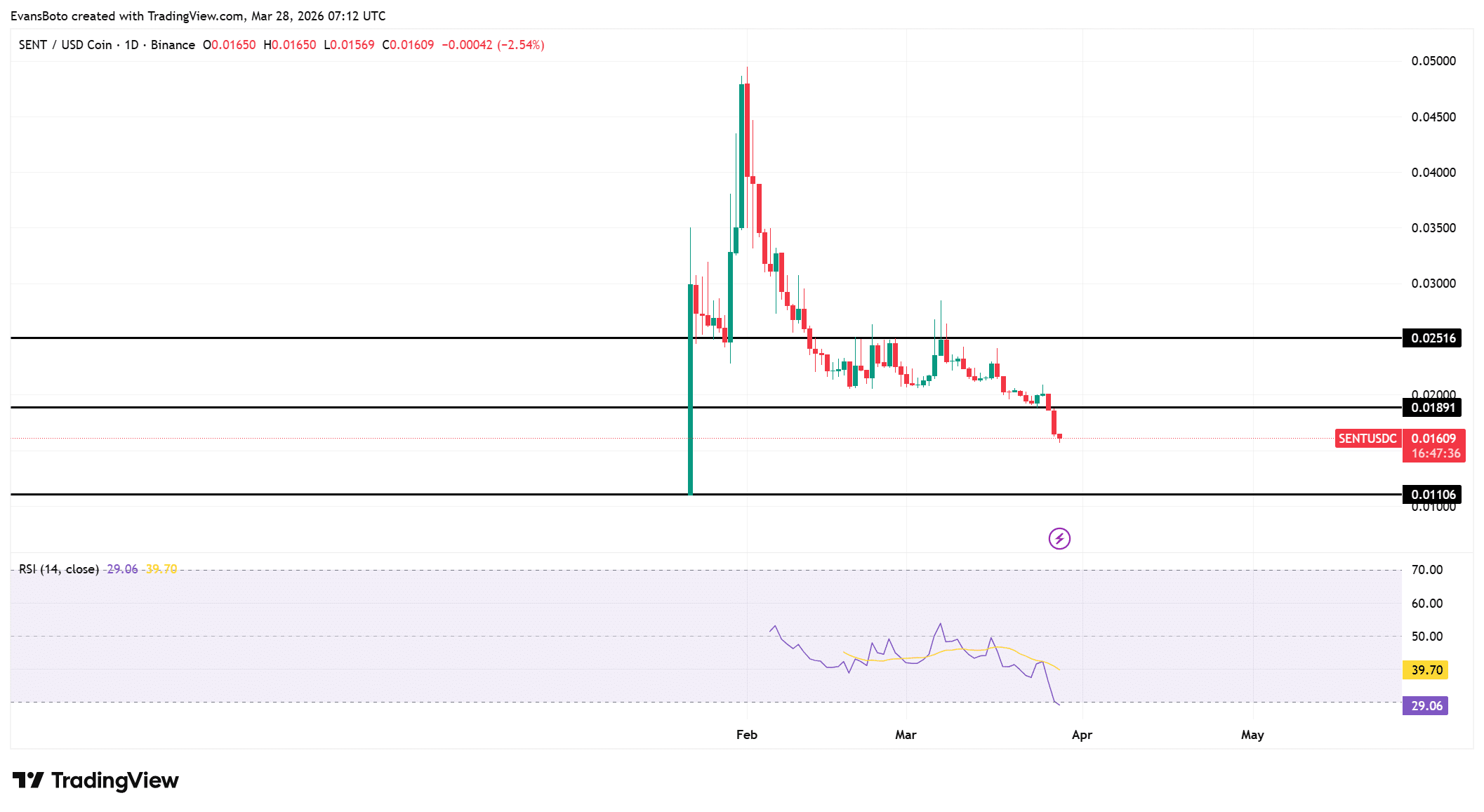
SENT price has broken below the $0.01891 support level and continues to extend lower toward the $0.01106 demand zone. This breakdown confirms that previous consolidation has failed to hold, shifting structure into a continuation phase.

Lower highs have remained intact across recent sessions, which reinforces bearish control over the trend. Attempts to reclaim the lost support have lacked follow-through, showing weak buyer commitment.

As price trades below key levels, market structure reflects continuation rather than reversal. This positioning suggests that sellers continue to dictate direction as the asset searches for a stronger demand base.

At press time, RSI dropped to 29.06, pushing Sentient into oversold territory and confirming the intensity of recent selling pressure. This reading reflects persistent downside strength rather than a temporary pullback.

While oversold conditions sometimes hint at short-term relief, the broader structure still aligns with continued weakness.
Source: TradingView

Falling OI signals capital withdrawal

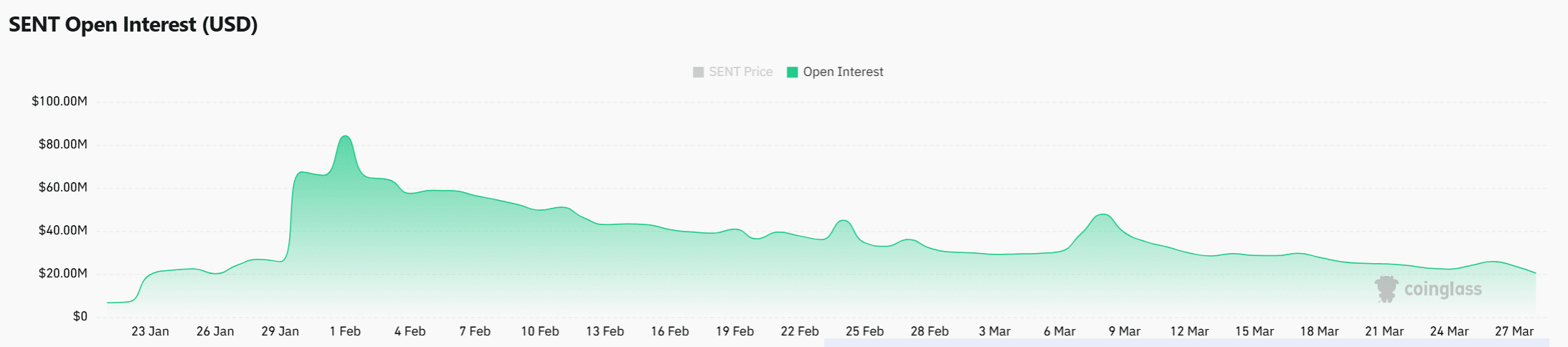
Open Interest (OI) has declined 16.30% to $19.76 million, indicating that leveraged traders are closing positions rather than opening new ones. This drop reflects a clear reduction in market participation from derivatives traders, especially those previously positioned on the long side.

As positions close, liquidity exits the market, which reduces the probability of immediate recovery. The decline in OI aligns closely with the price drop, confirming that traders are stepping away instead of defending positions. This behavior highlights a broader shift toward risk reduction across the market.
Source: CoinGlass

Long liquidations dominate across exchanges

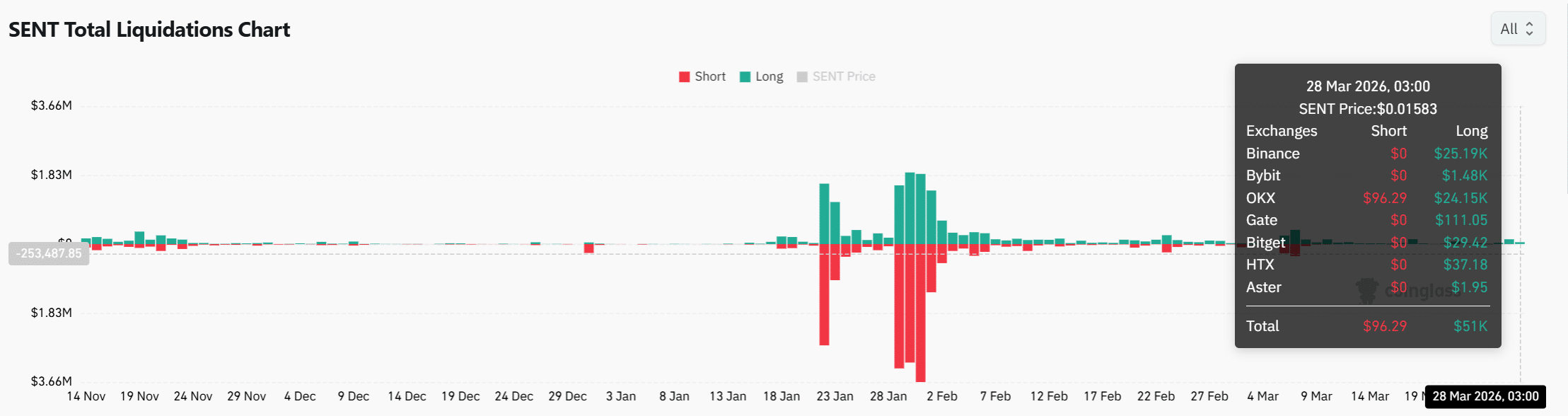
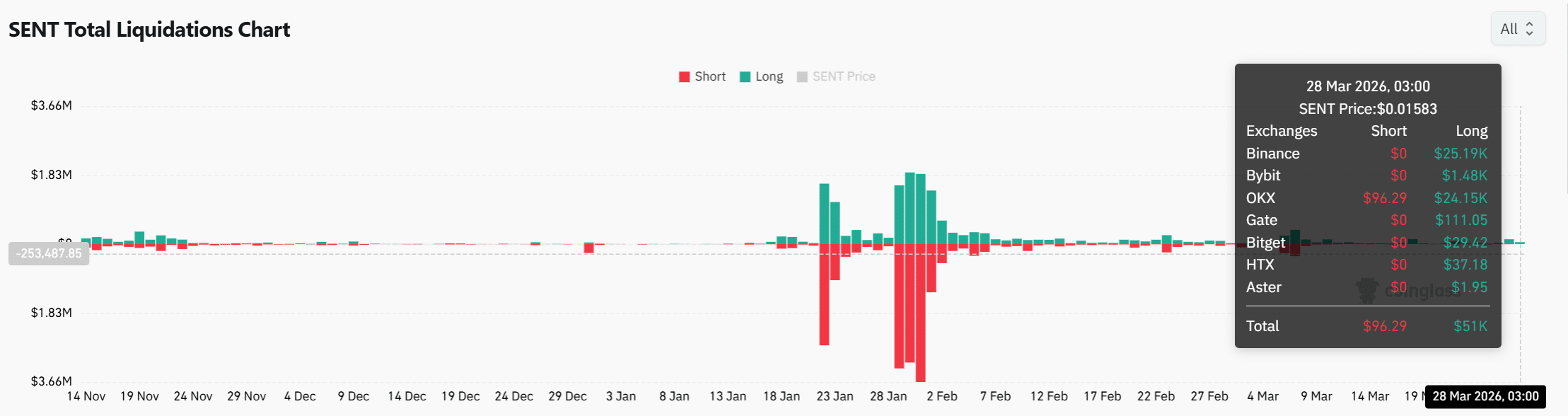
Liquidation data shows that long positions have faced heavy losses, with approximately $51K in longs wiped out compared to just $96 in short liquidations. This imbalance reflects aggressive forced exits, particularly across major exchanges like Binance and OKX.

When long positions get liquidated at this scale, they amplify downward pressure as positions close automatically. This cascade effect accelerates price declines and weakens bullish positioning further.

The dominance of long liquidations confirms that traders who expected upside continuation have exited under pressure, leaving the market tilted toward sellers.
Source: CoinGlass

Is SENT nearing stabilization or further downside?

SENT continues to face sustained downside pressure as structure, liquidations, and capital outflows align against recovery.

The breakdown below support, combined with the OI drop and dominant long liquidations, reflects a market still unwinding bullish exposure. Although RSI has entered oversold territory, current conditions do not support a stable rebound.

SENT would likely continue drifting lower toward the $0.01106 zone before any meaningful stabilization attempt emerges.


Final Summary

  • Sentient shows weakening structure as sellers maintain control and buyers fail to defend key levels effectively.
  • Market positioning reflects reduced confidence, suggesting price would continue drifting lower before any meaningful stabilization emerges.


Related Questions

QWhat is the current price of Sentient (SENT) and how much has it dropped?

ASentient (SENT) is currently priced at $0.01585, representing a drop of 14.3%.

QWhat key support level did SENT break below, and what is the next potential demand zone?

ASENT broke below the $0.01891 support level and is extending lower toward the $0.01106 demand zone.

QWhat does the 16.30% decline in Open Interest (OI) to $19.76 million indicate?

AThe decline in Open Interest indicates that leveraged traders are closing their positions rather than opening new ones, signaling a reduction in market participation and capital withdrawal.

QHow did long liquidations compare to short liquidations, and what does this imbalance reflect?

ALong liquidations dominated with approximately $51,000 wiped out, compared to only $96 in short liquidations. This reflects aggressive forced exits of bullish positions, amplifying downward price pressure.

QDespite the RSI reading of 29.06 indicating oversold conditions, why does the article suggest further downside is likely?

AThe article suggests further downside is likely because the broader market structure, capital outflows, and dominant sell-side control align against recovery. Oversold conditions alone are not enough to support a stable rebound without a change in these underlying factors.

Related Reads

Bitcoin Withdrawals Continue: 8 Years of Storage in a Coldcard Cold Wallet Ended in Zero

Coldcard Hardware Wallet Hacked: Losses Mount Due to Vulnerable Seed Generation A critical vulnerability in Coldcard hardware wallets has led to a continued wave of fund thefts. According to Galaxy Research, the total stolen has reached 1,367.05 BTC (approx. $88.6 million) from 4,585 addresses, a significant increase from the initial 594.5 BTC reported on July 30, 2026. Most of the stolen funds remain on the attackers' addresses. The issue is not with the current firmware, which Coinkite has updated, but with seed phrases generated on vulnerable devices between March 2021 and the release of fixed firmware versions. Due to a programmer error, devices switched from using a hardware random number generator to the software-based Yasmarang generator, which was initialized with publicly accessible data like the chip's serial number. This made the seed phrases predictable through offline brute-force attacks, meaning wallets remain at risk until funds are moved to a new wallet generated with the patched firmware. Affected devices include Mk2/Mk3 with firmware 4.0.1–4.1.9 (and up to 5.0.3), Mk4/Mk5 up to version 5.6.0, and Q models up to 1.5.0Q. The only exceptions are seeds created with a high-entropy method like at least 50 independent dice rolls or a strong unique BIP-39 passphrase. All other owners must generate a new seed on the fixed firmware and transfer their assets. A case highlighting the human impact involves a 39-year-old long-term investor who lost 2 BTC (approx. $130,000) in minutes. He had accumulated the Bitcoin over eight years through physical labor, viewing it as a financial lifeline and a retirement plan in a country suffering from hyperinflation. His story underscores that even conservative "buy and hold in cold storage" strategies can be compromised by such underlying technical flaws. From a technical perspective, this incident echoes historical failures where weak random number generators undermined cryptographic security, challenging the assumption that offline storage is automatically foolproof.

cryptonews.ru2h ago

Bitcoin Withdrawals Continue: 8 Years of Storage in a Coldcard Cold Wallet Ended in Zero

cryptonews.ru2h ago

Trading

Spot
活动图片




