Sentient Announces Token Economics, How Will the Market Price It?

marsbitPublished on 2026-01-16Last updated on 2026-01-16

Abstract

Sentient, an open-source AI platform focused on building an open, monetized, and verifiable Artificial General Intelligence (AGI) economy, has released the tokenomics for its native token SENT. The total supply is set at approximately 34.36 billion tokens (2³⁵), distributed across five categories: Community Initiatives & Airdrops (44%), Ecosystem & R&D (19.55%), Team (22%), Investors (12.45%), and Public Sale (2%). The SENT will be used for staking, model services, data-related functions, and payments within the platform's ecosystem, particularly for services powered by Artifacts. Unlock schedules vary: 30% of community and ecosystem allocations are unlocked at TGE, with the remainder linearly released over four years. Team and investor tokens are locked for one year post-TGE, then linearly vested over four and six years, respectively. The public sale portion is fully unlocked at TGE. Market expectations are high, with Polymarket prediction data indicating a 99% probability that Sentient’s fully diluted valuation (FDV) will exceed $200 million upon launch. Sentient aims to create a decentralized AGI economy where developers can monetize models, data, and innovations. Its core infrastructure, GRID (Global Research and Intelligence Directory), is a composable network of AI agents, models, and tools. The project has raised $85 million in seed funding from investors including Founders Fund, Pantera Capital, and Framework Ventures. Key advisors include Sandeep Nailwal (Polygon...

Original Title: 《Sentient Announces Token Economics, How Will the Market Price It?》

Original Author: ChandlerZ, Foresight News


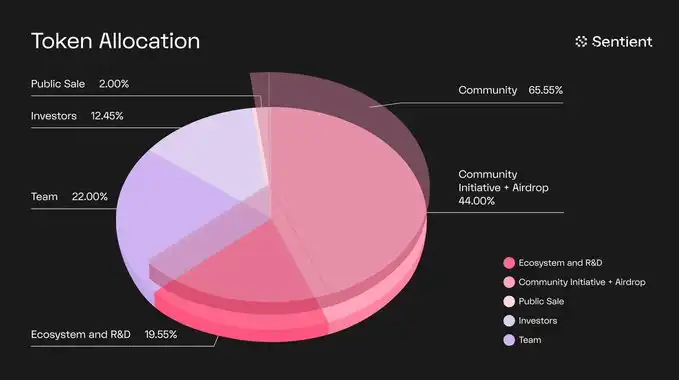
On January 16, the open-source AI platform Sentient announced the SENT token economics. The total supply of SENT tokens is approximately 34.3 billion, with 44% allocated to community incentives and airdrops, 19.55% to the ecosystem system and R&D, 2% to public sales, 22% allocated to the team, and 12.45% allocated to investors.
According to Polymarket data, the market's bet on the probability of Sentient's next-day FDV exceeding $200 million has risen to 99%, the probability of exceeding $400 million is 87%, and the probability of exceeding $600 million is 83%. The current trading volume of this prediction market is approximately $330,000.

Allocation Rules Details

Throughout the entire ecosystem, SENT is used for agents, models, data services, and other products driven by Artifacts. Artifacts can also use SENT for payments, thereby realizing composable on-chain value flows between services. The official set the total supply of SENT at 34,359,738,368, which is exactly 2³⁵. The official stated that the full story of how this number was chosen will be shared in the future; however, technically savvy readers might be able to deduce the reason.

SENT allocation is divided into five categories: Community Advocacy and Airdrops, Ecosystem System and R&D, Team, Investors, and Public Sale.

Community Activities and Airdrops ——44.00%

This portion of tokens accounts for 44% of the total supply and is specifically used for airdrops, community grants, bounties, and incentive programs to reward users and developers for their verifiable work on GRID. To ensure broad ownership, 30% of these tokens will be unlocked at TGE (approximately 13% of total supply), and the remaining 70% will be linearly unlocked over 4 years. According to the design, personnel who build, test, and share open-source intelligence and products will be eligible to receive the largest share of tokens. Airdrops will be fully unlocked at TGE.

Ecosystem System and R&D ——19.55%

This portion of tokens accounts for 19.55% of the total supply and will be used to promote ecosystem development, R&D, growth, infrastructure construction, and the operation of the Sentient Foundation. To ensure long-term stable supply, 30% will be unlocked at TGE (token issuance date), and the remaining 70% will be linearly unlocked over four years.

Team —— 22.00%

This funding pool accounts for 22% of the total supply and is exclusively for the team members of the Sentient Foundation and Sentient Labs, including employees, founders, and key contractors. At TGE, the team funding pool is locked for one year, after which the funds will be released linearly over 6 years, with a 1-year cliff period.

Investors ——12.45%

This portion of tokens accounts for 12.45% of the total supply and is allocated to investors who supported Sentient in private rounds. Investor tokens will be locked for one year and then linearly unlocked over four years. This structure aims to reward the confidence of early investors.

Public Sale ——2.00%

This public sale accounts for 2% of the total supply and aims to encourage broader participation from community members at the project's launch. This allocation will be fully unlocked at TGE. The specific public sale structure will be announced soon.

At the end of November 2025, Sentient opened airdrop registration for users, targeting four groups: community contributors, active Sentient Chat users, social platform Top Voices, and external open-source researchers.

The second season's activities will feature new roles based on contributions, clearer upgrade paths, and multiple reward mechanisms. Rewards will include SENT tokens, NFTs, and merchandise. Specific airdrop activity details have not yet been announced.

A New AI Star That Raised $85 Million

Sentient is an AI research organization dedicated to building an open artificial general intelligence (AGI) economy, developing a platform and protocol that allows open-source AI developers to monetize or tokenize their models, data, and other innovations. Here, developers can collaborate to build powerful AI agents and become key stakeholders in the new open AGI economy, driving AI transformation and prosperity.

Sentient proposed the "OML" (Open, Monetary, Loyal) model concept, hoping to promote the shared open AGI economy through the OML model, building a shared open AGI economic system involving millions of AI agents and billions of users, providing continuous momentum for the innovation and development of downstream applications.

At the product and architecture level, Sentient's main focus is its intelligent network called GRID (Global Research and Intelligence Directory). The official describes it as a collaborative system composed of specialized agents, models, data, tools, and computing power: when a user initiates a query, the task is decomposed, routed to suitable intelligences / tools / data sources, and then the multi-path results are aggregated into a consistent output.

For general users, Sentient Chat is positioned as the unified entry point and distribution channel into GRID, emphasizing that users can see which capabilities and sources are called during the interaction process; for developers and ecosystem partners, GRID provides channels to be used, distributed, and receive future回流 income, using the SENT token economy to incentivize contributors to connect various Artifacts to the network, directing incentives towards more valuable modules through signals like staking and usage volume.

To support this multi-agent collaboration capability, Sentient launched and open-sourced the ROMA (Recursive Open Meta-Agent) framework in 2025, abstracting complex tasks into a recursive hierarchical task tree: parent nodes are responsible for decomposing goals, sending context to child nodes, and completing aggregation after collecting results, making the context flow of medium-to-long chain tasks more transparent, traceable, and debuggable, and also facilitating the replacement of different models, tools, or manual verification steps at the node level. Sentient described ROMA in its product update as the skeleton for building high-performance multi-agent systems and synchronized it to GitHub as an open-source base for secondary community development.

Strong Alliance Between Academia and Crypto

In July 2024, Sentient announced the completion of an $85 million seed funding round, setting a record in the AI加密 field. This funding was co-led by Peter Thiel's Founders Fund, Pantera Capital, and Framework Ventures, with participation from Ethereal Ventures, Foresight Ventures, Robot Ventures, Symbolic Capital, Delphi Ventures, Hack VC, Arrington Capital, HashKey Capital, and Canonical Crypto.

One of Sentient's core contributors is Polygon's co-founder Sandeep Nailwal, and EigenLayer founder and CEO Sreeram Kannan is an advisor to the project.

In addition, in terms of team composition, Sentient Labs' public personnel page shows two other co-founders: Pramod Viswanath (Princeton University engineering professor) and Himanshu Tyagi (Indian Institute of Science engineering professor). Pramod Viswanath has long researched information theory and communication systems, leading Sentient's AI safety and theoretical foundation construction; Himanshu Tyagi is skilled in privacy protection and decentralized learning algorithms, providing academic support for model training and privacy collaboration.

The core engineering and development team consists of AI research lines led by university professors and researchers, as well as functions such as platform engineering, blockchain R&D, product, and operations, presenting a team structure that blends academic research, engineering implementation, and加密 economic mechanisms.

Ecosystem Cooperation and Landing Scenes

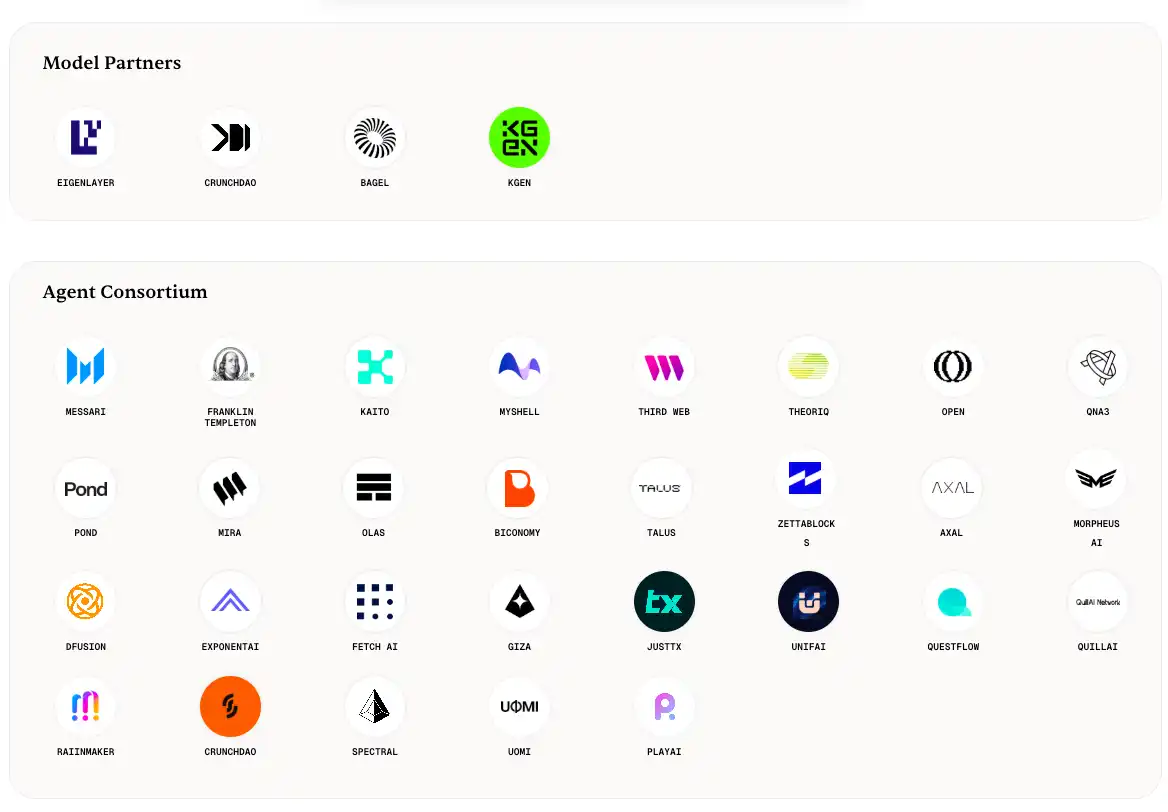
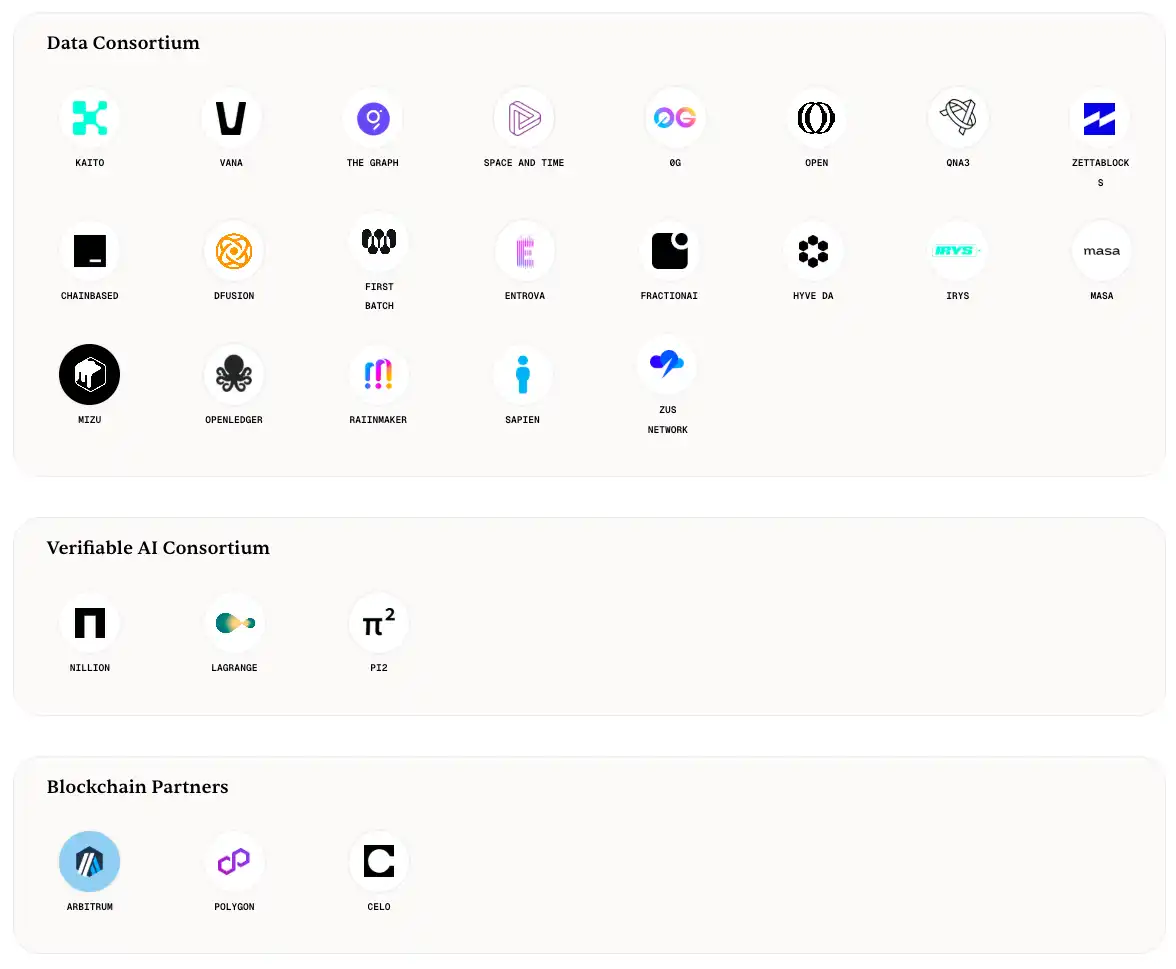
The official revealed that the ecosystem scale has reached 60+ partners / integrations, covering model cooperation partners, Agents, data providers, model and verifiable inference and other types.
Overall, Sentient's differentiation lies in defining the path to AGI as a composable open network, using SENT's incentives and staking mechanisms to try to solve the funding, distribution, and sustainability issues long faced by open-source AI. Its key variables are therefore more about systematic engineering and mechanism design rather than single-point model capabilities, including whether the quality of ecosystem接入 can持续 improve, whether incentives will导向 real usage value, and whether the multi-agent system can form a replicable model in terms of reliability and safety.


Related Questions

QWhat is the total supply of SENT tokens and what is the significance of the number?

AThe total supply of SENT tokens is 34,359,738,368, which is exactly 2³⁵. The official statement mentions that the full story of how this specific number was chosen will be shared in the future, but technically savvy readers might infer the reasoning behind it.

QAccording to the tokenomics, what are the five major allocation categories for SENT tokens and their percentages?

AThe five major allocation categories are: Community Initiatives and Airdrop (44.00%), Ecosystem System and R&D (19.55%), Team (22.00%), Investors (12.45%), and Public Sale (2.00%).

QWhat is the market's expectation for Sentient's Fully Diluted Valuation (FDV) at launch, based on Polymarket data?

AAccording to Polymarket data, the probability of Sentient's FDV exceeding $200 million at launch has risen to 99%, the probability of exceeding $400 million is 87%, and the probability of exceeding $600 million is 83%. The prediction market currently has a trading volume of approximately $330,000.

QWhat is the core product architecture that Sentient is building, as described in the article?

ASentient's core product architecture is a smart network called GRID (Global Research and Intelligence Directory). It is described as a collaborative system composed of specialized agents, models, data, tools, and computing power. When a user initiates a query, the task is decomposed and routed to suitable intelligent entities/tools/data sources, and the multi-path results are aggregated into a unified output.

QWho are the key investors and advisors behind Sentient's $85 million seed funding round?

AThe $85 million seed round was co-led by Peter Thiel's Founders Fund, Pantera Capital, and Framework Ventures. Other participants included Ethereal Ventures, Foresight Ventures, Robot Ventures, Symbolic Capital, Delphi Ventures, Hack VC, Arrington Capital, HashKey Capital, and Canonical Crypto. Key contributors include Sandeep Nailwal, co-founder of Polygon, and Sreeram Kannan, founder and CEO of EigenLayer, who serves as an advisor.

Related Reads

Xiaohongshu's Second Great Voyage, This Time Sailing Towards AI

Xiaohongshu's Second Voyage: Navigating Towards AI Since ChatGPT's emergence, Xiaohongshu's founder Mao Wenchao has been acutely aware of AI's potential threat, recognizing that the life advice people seek from chatbots overlaps directly with his platform's core business. Founded in 2013 as a PDF shopping guide for Chinese tourists, Xiaohongshu evolved into a massive community where millions share authentic, personal experiences—from product reviews to travel tips. This vast repository of "I've tried this" human judgment became its most valuable asset. However, the rise of AI, which delivers instant answers, challenges the very need for users to sift through numerous personal notes. Fearing its treasure trove of lived experience could become mere training data for others, Xiaohongshu is proactively adapting. In 2026, it established a dedicated AI division (Dots), launched RED Skill to turn user experiences into usable AI tools, and acquired the AI search product "Diandian." Its investments now extend to AI firms like MiniMax and hardware startups, moving upstream to address needs before they even become search queries. The platform's commercialization strategy is also evolving. With a newly acquired payment license and tools like the AIPS model to track consumer decision journeys, Xiaohongshu aims to seamlessly integrate recommendations with transactions, embedding commerce within AI-generated answers. Yet, a critical tension remains. While building smarter machines to organize and leverage its human experiences, Xiaohongshu must prevent AI from drowning out the authentic, flawed, and trustworthy "I've tried this" voices that built its community. Its core challenge is to harness AI's power without letting the map—the machine's perfect, synthesized answer—replace the territory of genuine human experience. This balance between technological advancement and preserving human trust defines its current journey and its future.

marsbit5m ago

Xiaohongshu's Second Great Voyage, This Time Sailing Towards AI

marsbit5m ago

SharpLink CEO: How to Understand Ethereum Developers Just Exceeded 1 Million?

SharpLink CEO reflects on the milestone of Ethereum surpassing 1 million historical developers, emphasizing that this figure represents the largest pool of technical talent ever assembled around an open, permissionless blockchain network. While approximately 232,000 developers remain active, the key question for the crypto industry is not which chain is fastest, but where the best builders choose to build long-term. Ethereum's advantage lies in a decade-long accumulation of infrastructure, standards, tools, liquidity, and a cohesive culture, making it the default operating system for programmable finance. This developer base is tackling complex challenges: the Glamsterdam upgrade aims to enhance scalability while preserving core principles; synchronous composability seeks to unify Rollup ecosystems; and significant efforts are underway for post-quantum security. Ethereum's deeper network effects stem from composability and shared standards (like the EVM and Solidity), creating a flywheel of more developers, tools, and liquidity. Three reinforcing strengths cement Ethereum's lead: credible neutrality (secured by ~900k validators), a modular architecture with interconnected Rollups, and a culture that attracts top researchers. The ecosystem is consolidating as the trusted coordination layer for internet-native finance, favored by large institutions valuing security and liquidity. The future of Ethereum is being built by this global community of founders and architects.

链捕手19m ago

SharpLink CEO: How to Understand Ethereum Developers Just Exceeded 1 Million?

链捕手19m ago

A Clod of Chinese Soil Chokes Two Japanese Giants

"Chinese Soil Chokes Japanese Giants" The production of a key electronic specialty gas, tungsten hexafluoride (WF6), vital for manufacturing AI chips, was halted by two leading Japanese producers—Kanto Denka and Central Glass. Their shutdown was not due to a technological failure but a sudden, critical shortage of a raw material they had long taken for granted: ultra-high-purity (6N-grade) tungsten powder, which is almost entirely sourced from China. Following a quiet Chinese export announcement in January 2026, tungsten powder shipments to Japan dropped to zero for months. Despite frantic efforts, Japanese companies found no viable alternative; imported powder was three times more expensive and lacked the required purity. Their existing stockpiles were exhausted by mid-2026. WF6 is essential for depositing tungsten into the microscopic contact holes of High Bandwidth Memory (HBM) chips, which are crucial for advanced processors like those from Nvidia. While Japanese firms had mastered producing ultra-pure WF6 gas, their entire supply chain relied on China's 6N tungsten powder—a dependency now revealed as a fatal vulnerability. China's dominance in this "soil" results from decades of painstaking R&D by companies like Xiamen Tungsten and China Tungsten & Hightech. They overcame immense technical hurdles, such as separating chemically similar molybdenum from tungsten, to achieve mass production of the world's purest tungsten powder. With their primary suppliers gone, Kanto Denka and Central Glass announced a permanent halt to WF6 production starting July 1, 2026. This immediately created a supply crisis for major semiconductor manufacturers like Samsung and SK Hynix, forcing them to urgently seek and certify new Chinese suppliers for WF6 itself. The reversal marks a dramatic shift: China has moved from exporting low-value raw materials to controlling the high-purity foundation of a critical global tech supply chain, upending a long-established industrial hierarchy.

marsbit51m ago

A Clod of Chinese Soil Chokes Two Japanese Giants

marsbit51m ago

Trading

Spot
Futures
活动图片