Author: Lauris
Compiled by: Deep Tide TechFlow
Original Title: Looking at Crypto Twitter, There's No More Money-Making Effect
Welcome to the "Post-Crypto Twitter" Era
The term "Crypto Twitter" (CT) here refers to Crypto Twitter as a market discovery and capital allocation engine, not the entire crypto community on Twitter in general.
"Post-Crypto Twitter" (Post-CT) does not mean the disappearance of discussion, but rather that Crypto Twitter, as a "mechanism for coordination through discourse," is gradually losing its ability to repeatedly create significant market events.
A single culture cannot sustain itself if it no longer produces enough significant winners to attract the next wave of new participants.
The "significant market events" mentioned are not situations like "a token's price tripling," but rather instances where the attention of most liquid market participants is focused on the same thing. Under this framework, Crypto Twitter was once a mechanism that transformed public narratives into coordinated flows around a dominant meta-narrative. The significance of the "Post-Crypto Twitter" era is that this transformation mechanism is no longer functioning reliably.
I am not trying to predict what will happen next. Frankly, I don't have a clear answer either. The focus of this article is to explain why the previous model worked, why it is declining, and what this means for how the crypto industry reorganizes itself.
Why Did Crypto Twitter Work Before?
Crypto Twitter (CT) was important because it compressed three market functions into one interface.
The first function of CT is narrative discovery. CT is a high-bandwidth salience mechanism. "Salience" is not just an academic term for "interesting," but a market term referring to how the graph converges on what is currently worth paying attention to.
In practice, CT created focal points. It compressed a huge hypothesis space into a small set of "actionable now" objects. This compression solved a coordination problem.
To put it more mechanistically: CT transformed dispersed, private attention into visible, public common knowledge. If you see ten credible traders discussing the same object, you not only know that the object exists, but you also know that others know it exists, and that others know that you know it exists. In liquid markets, this common knowledge is crucial.
As Herbert A. Simon said:
"A wealth of information creates a poverty of attention."
The second function of CT is to act as a trust router. In crypto markets, most assets do not have characteristics that provide strong intrinsic value anchors in the short term. Therefore, capital cannot be allocated based solely on fundamentals; instead, it flows through people, reputation, and continuous signals. A "trust router" is an informal infrastructure that determines whose claims are believed early enough to have an impact.
This is not a mysterious phenomenon but a rough reputation function continuously calculated by thousands of participants in public. People infer who the early entrants are, who has good foresight, who has access to resources, and whose behavior is associated with positive expected value (Positive EV). This reputation layer makes capital allocation possible without formal due diligence, as it acts as a simplified tool for selecting counterparties.
It is worth noting that CT's trust mechanism does not depend solely on "follower count." It is the combined result of follower count, who follows you, the quality of replies, whether credible people interact with you, and whether your predictions withstand real-world validation. CT makes these signals easy to observe at very low cost.
CT has public trust, and over time, some communities have also developed a tendency toward more private trust.
The third function of CT is to transform narratives into capital allocation through reflexivity. Reflexivity is key to this core loop: narratives drive prices, prices validate narratives, validation attracts more attention, attention brings more buyers, and this cycle reinforces itself until it collapses.
At this point, the market's microstructure comes into play. Narratives do not abstractly drive the "market"; they drive order flow. If a large group is convinced by a narrative that a certain object is "key," marginal participants will express this belief by buying.
When this cycle is strong enough, the market temporarily rewards behavior aligned with consensus more than the ability for deep analysis. In hindsight, CT was almost like a "low-IQ version of the Bloomberg Terminal": a single information stream integrating salience, trust, and capital allocation.
Why Was the "Monoculture" Era Possible?
The "monoculture" era was possible because it had a repeatable structure. Each cycle revolved around an object simple enough for a large-scale group to understand, yet broad enough to attract most of the ecosystem's attention and liquidity. I like to call these objects "toys."
Here, "toy" is not derogatory but a structural description. Think of it as a game—easy to explain, easy to participate in, and inherently social (almost like an expansion pack for a massively multiplayer online role-playing game). A "toy" has low barriers to entry and high narrative compressibility; you can explain it to a friend in one sentence.
The "meta-narrative" (Meta) is the manifestation when the "toy" becomes the shared game board. Meta refers to the dominant set of strategies and the dominant object around which most participants rally. The monoculture was powerful because this meta-narrative was not just "popular" but a shared game spanning users, developers, traders, and venture capital firms. Everyone was playing the same game, just at different levels of the stack.
@icobeast wrote a brilliant article on the cyclical and changing nature of "trending things," which I highly recommend reading.

https://x.com/icobeast/status/1993721136325005596
The market system we experienced required an "inefficiency window" that allowed people to quickly make "incredible wealth."
In the early stages of each cycle, the market is not fully efficient because the infrastructure for large-scale participation in the meta-narrative (Meta) is not yet fully built. Opportunities exist at this time, but the niche spaces of the market are not yet fully filled. This is very important because widespread wealth accumulation requires a window during which a large number of participants can enter the market, rather than facing a fully hostile environment from the start.
As George Akerlof said in "The Market for Lemons":
"Information asymmetry between buyers and sellers causes markets to move away from efficiency."
The key is that for this system to work, you need a highly efficient market for one group of people, while for another group, the market is a typical "lemons market" (i.e., full of information asymmetry and inefficiency).
The monoculture system also required large-scale shared context, which CT provided. Shared context is rare on the internet because attention is usually dispersed. However, when a monoculture forms, attention tends to concentrate. This concentration reduces coordination costs and amplifies the effects of reflexivity.
As F. A. Hayek said in "The Use of Knowledge in Society":
"The knowledge of the circumstances of which we must make use never exists in concentrated or integrated form but solely as the dispersed bits of incomplete and frequently contradictory knowledge which all the separate individuals possess."
In other words, the formation of shared context allows market participants to coordinate actions more efficiently, thereby driving the prosperity and development of the monoculture.
Why was the "single meta-narrative" once so credible? When fundamentals have weak constraints on the market, salience becomes a more important constraint than valuation. The primary question for the market is not "How much is it worth?" but "What are we all paying attention to? Is this trade already too crowded?"
A rough analogy is that mass culture once could concentrate attention on a few shared objects (like the same TV shows, chart-topping music, or celebrities). Nowadays, attention is dispersed into various niche areas and subcultures, and people no longer share the same reference set on a large scale. Similarly, CT, as a mechanism, is undergoing a similar transformation: shared context at the top is decreasing, while more localized contexts are emerging in smaller circles.
Why Is the "Post-Crypto Twitter" Era Arriving?
The "Post-Crypto Twitter" (Post-CT) era is emerging because the conditions that supported the "monoculture" are gradually failing.
The first failure is that "toys" are being cracked faster.
In previous cycles, the market learned the rules of the game and industrialized them. When the rules are industrialized, the inefficiency window closes faster and lasts for a shorter duration. As a result, the distribution of returns becomes more extreme: there are fewer winners and more structural losers.
Memecoins are a typical example of this dynamic. As an asset class, they work because of their low complexity and extremely high reflexivity. However, this very characteristic makes memecoins easy to mass-produce. Once the production pipeline matures, the meta-narrative becomes an assembly line.
As the market develops, the microstructure changes. The median participant is no longer trading with other ordinary people but is up against the system. They enter the market when information has already been widely disseminated, liquidity pools have been "pre-seeded," trading paths have been optimized, insiders have already positioned themselves, and even exit paths have been pre-calculated. In such an environment, the median participant's expected returns are compressed to extremely low levels.
In other words, most of the time, you are just someone else's "exit liquidity."
A useful mental model is: order flow in the early stages of a cycle is primarily dominated by naive retail investors, while order flow in the later stages becomes increasingly adversarial and mechanical. The same "toy" evolves into a completely different game at different stages.
A single culture cannot sustain itself if it cannot produce enough significant winners to attract the next wave of new participants.
The second failure is that value extraction overwhelms value creation.
Here, "extraction" refers to actors and mechanisms that capture the value of liquidity rather than create new liquidity.
In the early stages of a cycle, new participants can add net liquidity and benefit from it because the market environment expands faster than the harvesting speed of the value extraction layer. However, in the later stages of a cycle, new participants often become net contributors to the value extraction layer. When this perception becomes widely recognized, market participation begins to decline. The decline in participation weakens the strength of the reflexivity cycle.
This is also why market sentiment changes so consistently. If a market no longer provides broad, clear paths to victory, overall sentiment gradually deteriorates. In a market where the median participant's experience is "I'm just someone else's liquidity," cynicism is often rational.
To understand the current overall market sentiment of retail participants, refer to this post by @Chilearmy123.
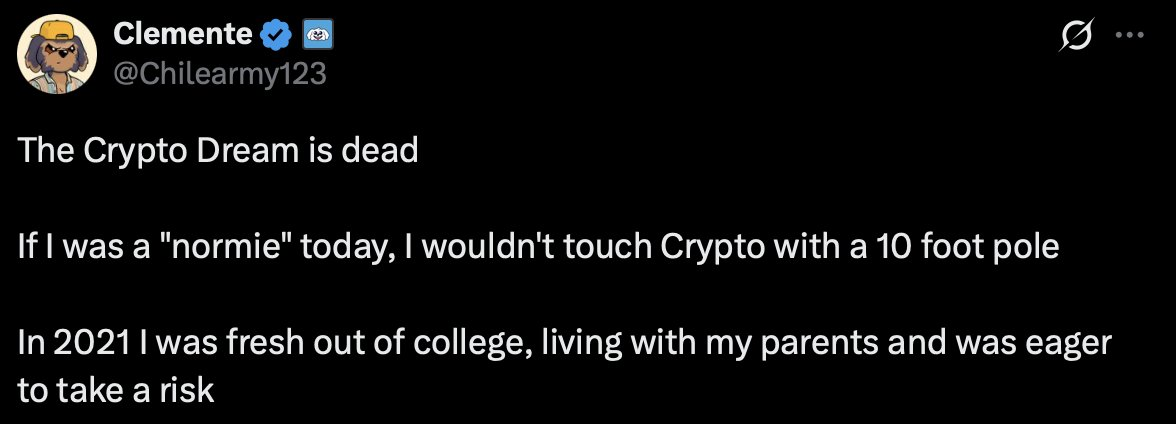
The third failure is the dispersion of attention. When no single object can attract the attention of the entire ecosystem, the market's "discovery layer" loses clear salience. Participants begin to diverge into narrower areas. This dispersion is not only cultural but also has significant market consequences: liquidity is dispersed into different segments, price signals become less intuitive, and the dynamic of "everyone is making the same trade" disappears.
Additionally, there is a factor that needs to be briefly mentioned: macroeconomic conditions affect the strength of the reflexivity cycle. The "monoculture" era coincided with a period of strong global risk appetite and liquidity environment, making speculative reflexivity seem like a "norm." But when the cost of capital rises and marginal buyers become more cautious, narrative-driven capital flows become harder to sustain over the long term.
What Does "Post-Crypto Twitter" Mean?
"Post-Crypto Twitter" (Post-CT) refers to a new market environment in which Crypto Twitter is no longer the primary coordination mechanism for capital allocation across the entire ecosystem, nor the core engine for the concentration of on-chain markets around a single meta-narrative.
In the "monoculture" era, CT repeatedly and massively linked narrative consensus with liquidity concentration. In the "Post-CT" era, this link becomes weaker and more intermittent. CT still has significance as a discovery platform and reputation indicator, but it is no longer the driving engine that reliably synchronizes the entire ecosystem around "one trade," "one toy," or "one shared context."
In other words, CT can still generate narratives, but only a few narratives can transform into "common knowledge" on a large scale, and even fewer "common knowledge" narratives can further transform into synchronized order flow. When this transformation mechanism fails, even if there is still a lot of activity in the market, the overall feeling will seem "quieter."
This is also why the subjective experience has changed. The market now seems slower and more professional because broad coordination has disappeared. The change in sentiment is mainly a reaction to the expected value (EV) conditions. The "quietness" of the market does not mean there is no activity, but rather a lack of narratives and synchronized actions that can resonate globally.
The Evolution of Crypto Twitter: From Engine to Interface
Crypto Twitter (CT) will not disappear, but its function is changing.
In the early market system, CT was upstream of capital flow, to some extent determining the market's direction. In the current market system, CT is closer to an "interface layer": it broadcasts reputation signals, surfaces narratives, and helps route trust, but actual capital allocation decisions increasingly occur in higher-trust "subgraphs."
These subgraphs are not mysterious. They are dense networks with higher information quality and frequent interactions among participants, such as small trading circles, domain-specific communities, private group chats, and institutional discussion spaces. In this system, CT is more like a superficial "facade," while real social and trading activities occur in the underlying social network layer.
This also explains a common misunderstanding: "Crypto Twitter is declining" often actually means "Crypto Twitter is no longer the main place for ordinary participants to make money." Wealth now accumulates more in places with higher information quality, restricted access, and more private trust mechanisms, rather than through public, noisy trust calculations.
That said, you can still achieve considerable returns by posting on CT and building a personal brand (some of my friends and nodes have done and are still doing this). But the real value accumulation comes from building your social graph, becoming a trustworthy participant, and gaining more access to the "backstage layer."
In other words, superficial brand building is still important, but the core competitiveness has shifted to the construction and participation in "backstage trust networks."
I Don't Know What Happens Next
I won't pretend to be able to accurately predict what the next "monoculture" will be. In fact, I am skeptical about whether the "monoculture" will form again in the same way, at least under current market conditions. The key is that the mechanisms that once nurtured the "monoculture" have degraded.
My intuition may be somewhat subjective and situational because it is based on what I am currently observing. However, the formation of these dynamics actually began to appear earlier this year.
There are indeed some active areas now, and it is not difficult to list the categories that attract attention. But I won't mention these areas because it doesn't substantively help the discussion. Overall, aside from pre-sales and some initial distributions, the trend we are seeing now is that the most overhyped categories are often "adjacent" to CT rather than directly driven by CT internally.
The Argument
We have entered the "Post-Crypto Twitter" (Post-CT) era.
This is not because CT is "dead," nor because discussion has lost its meaning, but because the structural conditions that supported the recurring systemic "monoculture" have been weakened. The game has become more efficient, value extraction mechanisms have matured, attention has become more dispersed, and the reflexivity cycle has gradually shifted from systemic to local.
The crypto industry continues, and CT still exists. My view is more narrow: the era in which CT could reliably coordinate the entire market into a shared meta-narrative and create broad, low-threshold nonlinear returns has, at least for now, ended. Moreover, I believe the likelihood of this phenomenon reappearing in the coming years is significantly reduced.
This does not mean you cannot make money, nor does it mean the crypto industry is coming to an end. This is neither a pessimistic view nor a cynical conclusion. In fact, I have never been more optimistic about the future of this industry. My point is that the distribution and salience mechanisms of future markets will be fundamentally different from the past few years.
Twitter:https://twitter.com/BitpushNewsCN
Bitpush TG Communication Group:https://t.me/BitPushCommunity
Bitpush TG Subscription: https://t.me/bitpush






