Saylor's Purchase of 1550 Bitcoin Is a Bad Trade

Foresight NewsPublished on 2026-06-09Last updated on 2026-06-09

Abstract

**Title: Saylor's Purchase of 1,550 Bitcoins Was a Bad Trade** The article critically analyzes Strategy's recent move of selling 32 bitcoins followed by a much larger purchase of 1,550 bitcoins. While appearing bullish, the author argues this trade is detrimental to MSTR shareholders. The core argument revolves around the concept of "breakeven modified Net Asset Value (mNAV)," a key metric for Strategy. To increase Bitcoin per share (BPS) for MSTR holders, Strategy must issue new shares at a premium high enough that the funds raised can buy more bitcoin than the bitcoin backing each existing share. Currently, this breakeven mNAV is estimated at 1.30. The recent trade failed on two counts: 1. The shares for the $181 million raise were issued at an mNAV *below* the 1.30 breakeven point. Selling "cheap" shares to buy bitcoin actually *reduces* BPS. 2. Only $101.3 million of the raised funds were used to buy bitcoin; the rest went to boost the company's dollar reserves. The breakeven mNAV calculation assumes *100%* of proceeds are used for bitcoin purchases. Diverting funds, even if mNAV were high, dilutes BPS. The result is an estimated 0.19% decrease in Bitcoin per share for MSTR holders. In exchange, Strategy merely extended its operational runway for its dollar reserves from ~6.3 months to 7 months. The author interprets this as Strategy prioritizing the survival and development of its STRC business over its stated core goal of increasing MSTR's BPS. This constitutes a...


Author: 100y

Translation: Chopper, Foresight News


Bitcoin treasury company Strategy first sold 32 bitcoins, and then immediately made a large purchase of 1550 bitcoins.
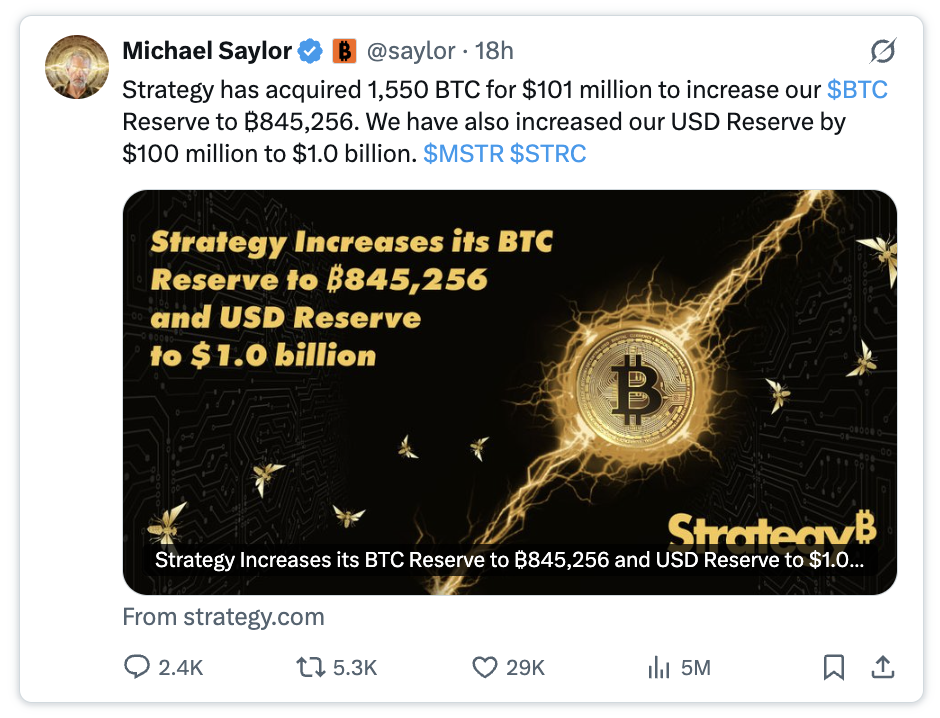


I do not wish for Strategy (MSTR) to decline, but some truths must be spoken. In my opinion, this is an extremely bad trade.


On the surface, this move appears brilliant. Strategy accumulated a significant number of bitcoins at relatively low prices, while also increasing its dollar reserves for paying preferred dividends from $900 million to $1 billion.


Does this mean Strategy is about to stage a reversal?


If you only see positives in this, it means you haven't truly understood the operational logic of this company.


First, Understand the Breakeven Adjusted Net Asset Value (mNAV)


Increasing the number of bitcoins per share (BPS) is a core goal for Strategy to create value for MSTR shareholders.


The logic to increase bitcoins per share is actually very clear: issue common stock at a premium above the market price, and use all the raised funds to buy bitcoin.


So, how high a premium does MSTR need to reach in order to genuinely increase the bitcoins per share through timely stock offerings?


According to information disclosed in the Q1 2026 earnings conference call, the adjusted net asset value (mNAV) must exceed 1.22, a figure also known as the breakeven adjusted net asset value in the industry.


The underlying logic of this standard is simple: the amount of bitcoin that can be purchased with the funds raised from selling 1 share of MSTR stock must be higher than the current bitcoin holdings corresponding to that single share. For the complete derivation process, you can refer to my previous publication. (https://research.4pillars.io/en/research/strategys-magic-number-122)


Ultimately, the calculation method for the breakeven mNAV is as follows:
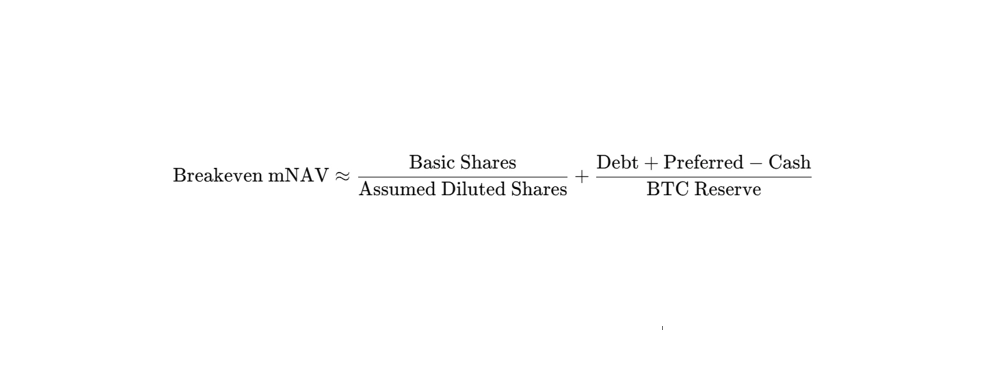


Let me add here that the breakeven adjusted net asset value is no longer 1.22. Before the execution of this purchase of 1550 bitcoins, calculations showed this value had already risen to 1.30.


Why This is a Bad Trade
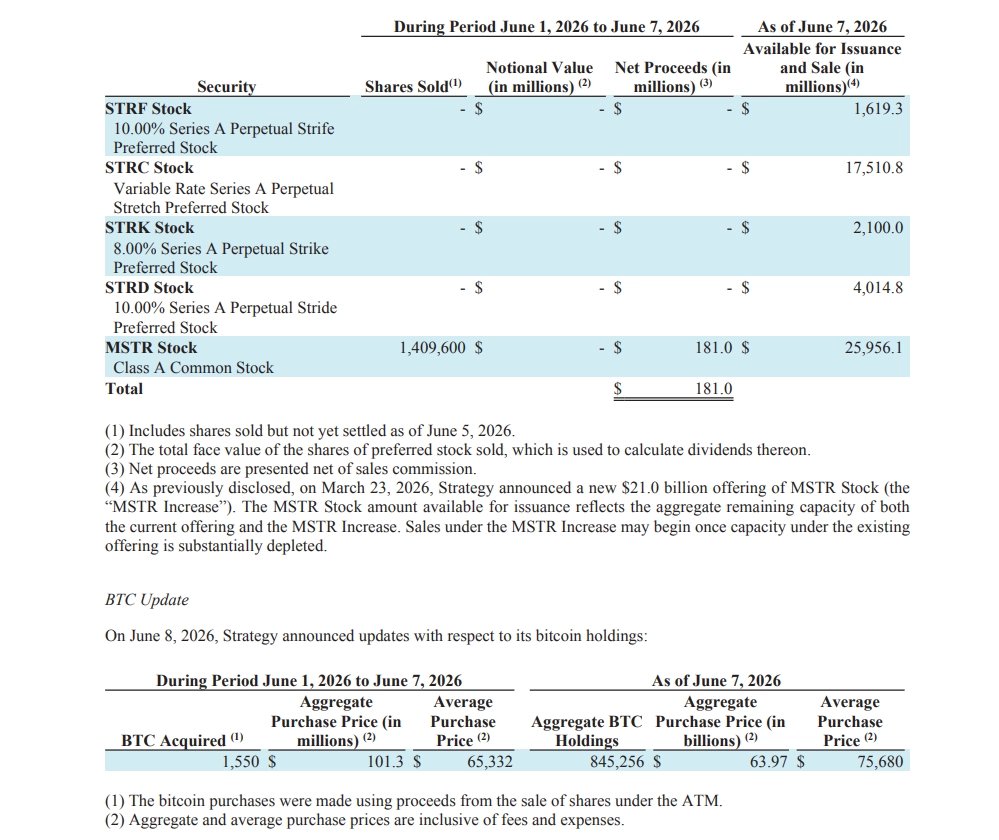


Let's look back at this acquisition of 1550 bitcoins.


Strategy raised a total of $181 million through MSTR's at-the-market (ATM) offering program, then used $101.3 million of it to purchase 1550 bitcoins. This operation has two core issues:


First, at the time of this MSTR stock ATM offering, the corresponding adjusted net asset value (mNAV) was below the 1.30 breakeven point. If stock is issued when mNAV is below the breakeven level and the raised funds are used to buy bitcoin, it not only fails to increase the bitcoins per share but actually causes this metric to decline.


Second, and more critically, the funds raised from this offering were not used 100% to purchase bitcoin. The calculation logic for the breakeven adjusted net asset value is based on the premise that all raised funds are used to buy bitcoin. Even if mNAV is at a high level, as long as only a portion of the funds are directed towards bitcoin, it will ultimately lower the bitcoins per share.


Reportedly, the remaining funds from this offering that were not used for buying bitcoin were allocated to the company's dollar reserves.


In other words, Strategy sacrificed the equity value and bitcoins per share of MSTR shareholders to ensure the normal operation of its STRC-related business.


Calculations show that after completing this transaction, the company's bitcoins per share decreased by approximately 0.19% compared to before. And what was gained in return? The runway for the company's dollar reserves to sustain operations only extended from about 6.3 months to 7 months.


A Big Gamble by Strategy


Michael Saylor stated in the Q1 2026 earnings conference call: "Our core goal is to increase the bitcoins per share, and we will use every means possible to achieve this goal."


However, as seen from this trade, for the development of STRC, Strategy chose to sacrifice MSTR's core metric of bitcoins per share. This is nothing short of a gamble.


If sacrificing MSTR leads to improved market sentiment, stabilization and recovery of STRC's price, and pushes the adjusted net asset value back to a reasonable range, then the company can continue to rely on the ATM offering channels of MSTR and STRC to raise funds, allowing the entire system to operate healthily.


But if market sentiment does not improve, the situation will deteriorate rapidly. Strategy would then likely be forced to continue sacrificing MSTR's interests to stay afloat.


The worst-case scenarios would follow one after another: the company might be forced to delay STRC dividend payments, or gradually decline amidst ongoing internal consumption.


Finally, I hope the prices of Bitcoin, MSTR, and STRC all recover.

Related Questions

QWhat is the core goal of Strategy (MSTR) company according to the article, and what specific metric is used to measure this goal?

AAccording to the article, the core goal of Strategy (MSTR) is to increase the amount of Bitcoin held per share for its shareholders. This is measured by the metric 'Bitcoins per Share' (BPS).

QWhat is 'Break-even Modified NAV (mNAV)' and why is it critical for Strategy's operations?

A'Break-even Modified NAV (mNAV)' is the premium-to-NAV ratio at which MSTR must sell its shares for its 'at-the-market' (ATM) equity offering. It is critical because Strategy must issue shares at an mNAV above this break-even point to ensure that the proceeds from selling one share can buy more Bitcoin than the current Bitcoin-per-share holding, thereby increasing shareholder value. As of the transaction discussed, this break-even point was 1.30.

QWhy does the author consider Strategy's recent purchase of 1,550 BTC a 'bad trade'?

AThe author considers it a bad trade for two main reasons: 1. The mNAV at the time of the share issuance was below the required break-even point of 1.30, meaning issuing shares diluted the Bitcoin-per-share metric. 2. Not all the funds raised from the share issuance were used to buy Bitcoin; a portion was allocated to the dollar reserve, which further contributed to the dilution of Bitcoin-per-share, sacrificing MSTR shareholder value to fund the STRC business.

QWhat trade-off did Strategy make by not using all the ATM offering proceeds to buy Bitcoin?

AStrategy made a trade-off between increasing the Bitcoin-per-share for MSTR shareholders and funding the operations of its STRC business. By allocating part of the proceeds to its dollar reserve instead of buying Bitcoin, it sacrificed a decrease in the Bitcoin-per-share metric (a 0.19% drop) in exchange for extending the operational runway of its dollar reserve from approximately 6.3 months to 7 months.

QWhat is the potential negative outcome or 'gamble' the author describes for Strategy if market sentiment does not improve?

AThe author describes a gamble where Strategy is sacrificing MSTR's core metric to support STRC. If market sentiment does not improve and STRC's price does not recover, the situation could deteriorate. Strategy might be forced to continue sacrificing MSTR's value (diluting Bitcoin-per-share) to stay afloat. The worst-case scenarios would be postponing STRC dividends or the company deteriorating through this internal consumption.

Related Reads

Dalio's Latest Warning: Don't Get Carried Away by AI, Real Returns on US Stocks in the Next 5-10 Years Could Be -5% to -10%

Ray Dalio, founder of Bridgewater Associates, warns investors against excessive concentration in AI stocks. He argues the current market, dominated by a few AI giants, mirrors historical patterns where revolutionary new technologies lead to high risk, volatility, and uncertainty. While acknowledging AI's transformative potential, Dalio emphasizes that most investors fail at this stage of the cycle by over-concentrating in a handful of leading companies. He cites inherent risks: companies cannot accurately forecast investment needs or external shocks (e.g., monetary policy, geopolitics, taxes), face potential disruption from future technologies and international competition (notably from China), and experience significant price swings. Dalio's core advice is diversification, calling it his "Holy Grail of Investing." He presents a mathematical case that a well-diversified portfolio of 15-20 uncorrelated, good bets offers a superior risk-adjusted return compared to a concentrated position. Dalio also offers a cautious outlook, suggesting U.S. stocks may deliver real returns of -5% to -10% over the next 5-10 years based on valuation and bubble indicators. He concludes that in the face of high uncertainty, the prudent strategy is not to avoid betting entirely, but to avoid large, concentrated bets where one lacks sufficient informational edge. Instead, investors should build a strategically balanced, diversified portfolio.

marsbit24m ago

Dalio's Latest Warning: Don't Get Carried Away by AI, Real Returns on US Stocks in the Next 5-10 Years Could Be -5% to -10%

marsbit24m ago

Rain Valuation Approaches $20 Billion: The Battle for U-Cards Extends to Rewards Systems

Rain, a stablecoin payments infrastructure company, is shifting the competitive focus for U Cards from simple issuance to user retention and repeated usage. On June 15, Rain launched "Rain Rewards," an embedded loyalty program capability within its card-issuing infrastructure. This allows partner businesses—like fintech platforms and neobanks—to configure branded loyalty points, earning rules, redemptions, and merchant promotions directly within their card products. The system, built from the 2025 acquisition of Uptop, ensures points are only issued upon final transaction settlement, preventing liabilities from refunds. Trials, such as with Avalanche Card, reportedly boosted spending by 25% among enrolled users. Founded by Farooq Malik and Charles Yoo-Naut, Rain evolved from a tool for managing Web3 company expenses into a full-stack enterprise platform. It is a Principal Member of Visa and Mastercard, enabling partners to issue stablecoin-backed cards and wallets while leveraging traditional payment networks. Notably, the popular U Card Plasma One is issued by Rain under Visa's authority. Rain also integrates with Visa's stablecoin settlement pilot, using USDC for network settlement. Rain's rapid funding reflects growing institutional interest in stablecoin payment infrastructure. It raised a $245 million Series A in March 2025, a $58 million Series B in August 2025, and a $250 million Series C in January of this year, reaching a $19.5 billion valuation. Annualized transaction volume exceeds $3 billion, serving over 200 partners including Western Union and Nuvei. Beyond cards, Rain is expanding into programmable payments. Its June 2026 "Agent Control Layer" allows businesses to set spending rules—like merchant categories, amounts, and frequency—for AI agents before transactions occur. This positions Rain not as a single product but as an operating system for stablecoin payments, handling everything from card issuance and wallet management to rewards, on/off-ramps, and automated compliance. The goal is to enable seamless, often invisible, real-world spending of on-chain assets.

Foresight News27m ago

Rain Valuation Approaches $20 Billion: The Battle for U-Cards Extends to Rewards Systems

Foresight News27m ago

Google TPU Shipments Revised Up by 50%

Recent industry research indicates a significant upward revision in the shipments of Google's TPU (Tensor Processing Unit) chips. Previous expectations for 2027 were set at around 10 million units, but new estimates now point to 15 million units, a 50% increase. This substantial boost directly translates to higher demand across the entire supporting supply chain. Google's TPU clusters utilize a standardized all-optical interconnect architecture. Consequently, key hardware components are deeply integrated and scaled in fixed ratios with the chips. The 15 million TPU target will drive corresponding demand increases for NPO optical engines (roughly a 1:1 match), 1.6T optical modules, OCS optical switches, high-end server power supplies, fiber optics & MPO connectors, and liquid cooling solutions. Among these, liquid cooling is highlighted as the sector experiencing the most significant transformation and offering the most stable potential for excess returns. As next-generation TPU chips reach power levels where traditional air cooling is insufficient, liquid cooling becomes essential. 2026 is forecasted as the first year of substantial adoption for Google's liquid cooling solutions. This shift, coupled with delivery and capacity bottlenecks faced by incumbent overseas manufacturers, is creating a prime window for domestic Chinese suppliers to enter and secure Google's core supply chain. The market size for Google-specific liquid cooling is projected to potentially triple from a baseline of hundreds of billions to around 300 billion units by 2028. The logic for the fiber optic sector is also being rewritten. Once considered a cyclical commodity tied to telecom operator procurement, fiber is now a strategic and scarce resource for AI Data Centers (AIDC). A severe supply-demand imbalance, driven by the long lead time for preform production (18-24 months) and surging demand from cloud giants, is supporting strong performance. Chinese fiber manufacturers are well-positioned to capture a significant share of global AIDC demand, with exports potentially reaching 200-300 million core kilometers in 2026. Overall, the investment focus within the AI computing industry is shifting from pure "chip performance speculation" towards the more certain incremental growth in computing infrastructure and its supporting ecosystem. The upward revision in Google TPU shipments, along with the potential for further doubling by 2028, is seen as solidifying performance visibility for the entire supporting supply chain over the next two years.

marsbit2h ago

Google TPU Shipments Revised Up by 50%

marsbit2h ago

What Wall Street Really Wants After the Crypto Story Recedes

The tide of speculative crypto narratives has receded, revealing Wall Street's true objective: building a controlled, yield-generating, and compliant financial pipeline on distributed ledgers. They are migrating core functions onto blockchains, not for decentralization, but for efficiency and new revenue streams. Key developments include BlackRock's BUIDL fund, a tokenized treasury fund acting as a foundational reserve asset, and the rise of Securitize, which is going public and partnering with the NYSE to build a 24/7 digital securities trading and settlement system. This signals a major shift of securities clearing to blockchain technology. To make volatile assets like Bitcoin palatable for institutional investors, firms like BlackRock and Goldman Sachs are creating "covered call" ETFs (e.g., BITA). These products systematically sell options on Bitcoin holdings, transforming price volatility into stable monthly income, effectively repackaging crypto as a yield-bearing asset. Stablecoins are being positioned not as speculative tools but as efficient payment rails. Companies like Stripe and Mastercard are integrating them for instant, low-cost merchant settlements and cross-border card payments, respectively. Critically, new legislation like the GENIUS Act shapes them as non-interest-bearing, heavily regulated extensions of the US dollar system. In summary, Wall Street is quietly constructing a parallel, blockchain-based financial infrastructure featuring tokenized traditional assets, structured crypto yields, and programmable dollar pipelines—all under its control and fully integrated with existing regulatory and credit frameworks.

marsbit2h ago

What Wall Street Really Wants After the Crypto Story Recedes

marsbit2h ago

Trading

Spot
Futures

Hot Articles

What is $BITCOIN

DIGITAL GOLD ($BITCOIN): A Comprehensive Analysis Introduction to DIGITAL GOLD ($BITCOIN) DIGITAL GOLD ($BITCOIN) is a blockchain-based project operating on the Solana network, which aims to combine the characteristics of traditional precious metals with the innovation of decentralized technologies. While it shares a name with Bitcoin, often referred to as “digital gold” due to its perception as a store of value, DIGITAL GOLD is a separate token designed to create a unique ecosystem within the Web3 landscape. Its goal is to position itself as a viable alternative digital asset, although specifics regarding its applications and functionalities are still developing. What is DIGITAL GOLD ($BITCOIN)? DIGITAL GOLD ($BITCOIN) is a cryptocurrency token explicitly designed for use on the Solana blockchain. In contrast to Bitcoin, which provides a widely recognized value storage role, this token appears to focus on broader applications and characteristics. Notable aspects include: Blockchain Infrastructure: The token is built on the Solana blockchain, known for its capacity to handle high-speed and low-cost transactions. Supply Dynamics: DIGITAL GOLD has a maximum supply capped at 100 quadrillion tokens (100P $BITCOIN), although details regarding its circulating supply are currently undisclosed. Utility: While precise functionalities are not explicitly outlined, there are indications that the token could be utilized for various applications, potentially involving decentralized applications (dApps) or asset tokenization strategies. Who is the Creator of DIGITAL GOLD ($BITCOIN)? At present, the identity of the creators and development team behind DIGITAL GOLD ($BITCOIN) remains unknown. This situation is typical among many innovative projects within the blockchain space, particularly those aligning with decentralized finance and meme coin phenomena. While such anonymity may foster a community-driven culture, it intensifies concerns about governance and accountability. Who are the Investors of DIGITAL GOLD ($BITCOIN)? The available information indicates that DIGITAL GOLD ($BITCOIN) does not have any known institutional backers or prominent venture capital investments. The project seems to operate on a peer-to-peer model focused on community support and adoption rather than traditional funding routes. Its activity and liquidity are primarily situated on decentralized exchanges (DEXs), such as PumpSwap, rather than established centralized trading platforms, further highlighting its grassroots approach. How DIGITAL GOLD ($BITCOIN) Works The operational mechanics of DIGITAL GOLD ($BITCOIN) can be elaborated on based on its blockchain design and network attributes: Consensus Mechanism: By leveraging Solana’s unique proof-of-history (PoH) combined with a proof-of-stake (PoS) model, the project ensures efficient transaction validation contributing to the network's high performance. Tokenomics: While specific deflationary mechanisms have not been extensively detailed, the vast maximum token supply implies that it may cater to microtransactions or niche use cases that are still to be defined. Interoperability: There exists the potential for integration with Solana’s broader ecosystem, including various decentralized finance (DeFi) platforms. However, the details regarding specific integrations remain unspecified. Timeline of Key Events Here is a timeline that highlights significant milestones concerning DIGITAL GOLD ($BITCOIN): 2023: The initial deployment of the token occurs on the Solana blockchain, marked by its contract address. 2024: DIGITAL GOLD gains visibility as it becomes available for trading on decentralized exchanges like PumpSwap, allowing users to trade it against SOL. 2025: The project witnesses sporadic trading activity and potential interest in community-led engagements, although no noteworthy partnerships or technical advancements have been documented as of yet. Critical Analysis Strengths Scalability: The underlying Solana infrastructure supports high transaction volumes, which could enhance the utility of $BITCOIN in various transaction scenarios. Accessibility: The potential low trading price per token could attract retail investors, facilitating wider participation due to fractional ownership opportunities. Risks Lack of Transparency: The absence of publicly known backers, developers, or an audit process may yield skepticism regarding the project's sustainability and trustworthiness. Market Volatility: The trading activity is heavily reliant on speculative behavior, which can result in significant price volatility and uncertainty for investors. Conclusion DIGITAL GOLD ($BITCOIN) emerges as an intriguing yet ambiguous project within the rapidly evolving Solana ecosystem. While it attempts to leverage the “digital gold” narrative, its departure from Bitcoin's established role as a store of value underscores the need for a clearer differentiation of its intended utility and governance structure. Future acceptance and adoption will likely depend on addressing the current opacity and defining its operational and economic strategies more explicitly. Note: This report encompasses synthesised information available as of October 2023, and developments may have transpired beyond the research period.

378 Total ViewsPublished 2025.05.13Updated 2025.05.13

What is $BITCOIN

Discussions

Welcome to the HTX Community. Here, you can stay informed about the latest platform developments and gain access to professional market insights. Users' opinions on the price of BTC (BTC) are presented below.

活动图片