Saylor Says Lost Bitcoin May Need To Be Frozen As Quantum Risk Rises

bitcoinistPublished on 2025-12-17Last updated on 2025-12-17

Abstract

Michael Saylor argues that the rise of quantum computing will ultimately strengthen Bitcoin by forcing a network upgrade to quantum-resistant cryptography. In this scenario, actively managed coins would migrate to new, secure outputs, while lost or abandoned coins would be permanently frozen, reducing the overall circulation and increasing scarcity. This proposal ignited a debate within the Bitcoin community. Proponents, like Jameson Lopp, view it as a necessary defense to prevent quantum theft and protect the currency's value. However, critics argue that nodes have no right to freeze another person's bitcoin and that distinguishing between lost and simply old coins is a social and political impossibility, risking a contentious chain split. The discussion highlights the immense technical and governance challenges ahead, far more than the current quantum threat itself.

Michael Saylor tossed a compact bit of Bitcoin game theory onto X on Tuesday and it set off the predictable kind of fight: technical details colliding with ideology.

“The Bitcoin Quantum Leap: Quantum computing won’t break Bitcoin—it will harden it,” Saylor wrote, adding: “The network upgrades, active coins migrate, lost coins stay frozen. Security goes up. Supply comes down. Bitcoin grows stronger.”

Short version: if quantum ever becomes real enough to threaten today’s signature schemes, Bitcoin can upgrade. Coins that are actively managed move to new, quantum-resistant output types. Coins that aren’t—because the keys are lost, the owner is gone, or the UTXOs are simply abandoned—should effectively get stuck.
Frozen.

Bitcoin Developers And Community React

That’s the part people latched onto, because it’s not just a technical question. It’s a social one. Who gets to decide which coins are “lost” versus “just old”? Jameson Lopp, one of the loudest voices pushing for practical quantum-readiness, basically said: yes, and welcome aboard. “I agree, lost coins should stay frozen. Glad to hear you’ll support my BIP!”

Then the counterpunch arrived fast. “We have no right to freeze another man’s bitcoin,” wrote Wicked (@w_s_bitcoin), arguing any attempt to lock legacy coins could spark a contentious chain split. He also floated a more narrative-friendly twist: what if Satoshi left early keys exposed as a “bounty” for quantum computers?

Lopp’s answer wasn’t sentimental. It was node-level realism. “On the flip side, every node runner has the right to refuse to accept coins they believe are most likely to have been stolen by a quantum attacker,” he wrote, framing it less as confiscation and more as a defensive filter to preserve the integrity of circulating supply. Later, he conceded the uncomfortable core: “Correct, the best you can do is come up with an extremely lengthy migration window.”

That “migration window” is doing a lot of work here. The draft proposal described by Lopp and co-authors (Christian Papathanasiou, Ian Smith, Joe Ross, Steve Vaile, Pierre-Luc Dallaire-Demers) sketches a three-phase path: first a soft fork that nudges (or forces) new sends into proposed quantum-resistant outputs, then a later rule change that makes legacy ECDSA/Schnorr spends invalid after a long deadline, and an optional third phase to recover unmigrated coins if the rightful owner can prove control through some new mechanism.

It sounds orderly on paper. It never is in practice. Because you can’t prove theft in Bitcoin’s older UTXOs. Wicked hammered that point: there’s “no way to prove whether older coins were stolen or just forgotten and then moved later by the rightful owner.” The fear, in his view, is basically supply paranoia dressed up as security.

Lopp didn’t deny the incentives. He leaned into them. “I can assure you that many entities in the industry care about supply shocks causing the value of their coins to plummet; businesses still use dollars as their unit of account.” And then, in a line that reads like a homework assignment for anyone who thinks this ends cleanly: “Your homework is to figure out the power dynamics...”

Outside the Bitcoin-only trench fight, other corners of crypto mostly reacted with a raised eyebrow. Nic Carter, a founding partner at Castle Island Ventures, demanded specifics: “Explain in detail how all of those things will happen [...] Which core devs has microstrategy funded to work on the multiple hard and soft forks that will be required for this plan? Which quantum researchers?”

BitMEX Research pushed back on the “hardfork” framing. “What makes you think we need a hardfork?” it asked, arguing the transition could be painful without literally being a hard fork. Another account summed up the mood: “You can freeze coins with a soft fork.”

Then again—soft fork or not—getting broad social consensus to lock unmoved coins is its own nightmare. “The idea that there would be social consensus over locking unmoved coins is crazy,” one user wrote. “In 1,000 realities that doesn’t happen once.”

And, quietly, a reminder from Willem Schroe (Botanix CEO): “Yes, there are quantum developments but nothing remotely close to a breakthrough. That said, our current cryptographic solutions are not even remotely close to ready or battletested so quantum resistance work is definitely worth it. Very small risk but would have a big impact.”

So overall, none of this is about quantum tomorrow. It’s about Bitcoin deciding what it is when faced with a threat that can’t be patched with vibes. The tech path is hard. The politics might be harder.

At press time, Bitcoin traded at $86,761.
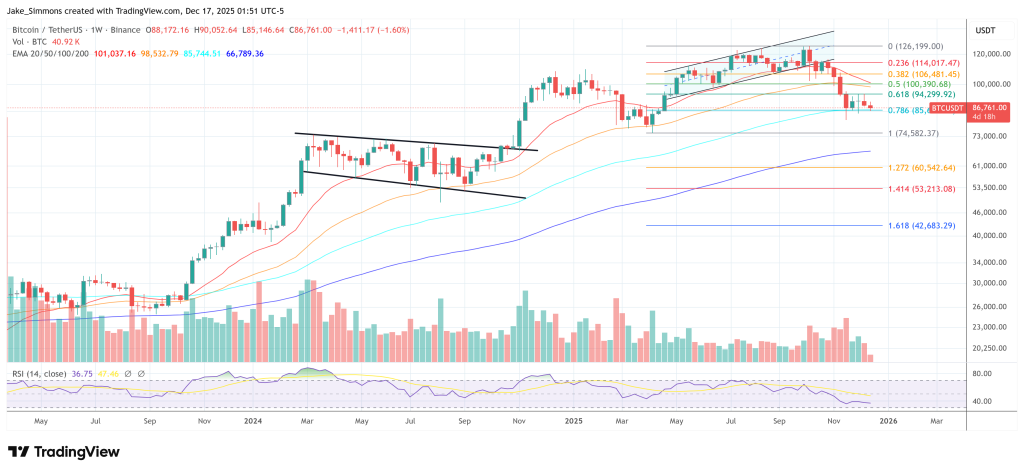
Bitcoin trades between the 0.618 and 0.786 Fib retracement, 1-week chart | Source: BTCUSDT on TradingView.com

Related Reads

Trading

Spot
Futures

Hot Articles

What is $BITCOIN

DIGITAL GOLD ($BITCOIN): A Comprehensive Analysis Introduction to DIGITAL GOLD ($BITCOIN) DIGITAL GOLD ($BITCOIN) is a blockchain-based project operating on the Solana network, which aims to combine the characteristics of traditional precious metals with the innovation of decentralized technologies. While it shares a name with Bitcoin, often referred to as “digital gold” due to its perception as a store of value, DIGITAL GOLD is a separate token designed to create a unique ecosystem within the Web3 landscape. Its goal is to position itself as a viable alternative digital asset, although specifics regarding its applications and functionalities are still developing. What is DIGITAL GOLD ($BITCOIN)? DIGITAL GOLD ($BITCOIN) is a cryptocurrency token explicitly designed for use on the Solana blockchain. In contrast to Bitcoin, which provides a widely recognized value storage role, this token appears to focus on broader applications and characteristics. Notable aspects include: Blockchain Infrastructure: The token is built on the Solana blockchain, known for its capacity to handle high-speed and low-cost transactions. Supply Dynamics: DIGITAL GOLD has a maximum supply capped at 100 quadrillion tokens (100P $BITCOIN), although details regarding its circulating supply are currently undisclosed. Utility: While precise functionalities are not explicitly outlined, there are indications that the token could be utilized for various applications, potentially involving decentralized applications (dApps) or asset tokenization strategies. Who is the Creator of DIGITAL GOLD ($BITCOIN)? At present, the identity of the creators and development team behind DIGITAL GOLD ($BITCOIN) remains unknown. This situation is typical among many innovative projects within the blockchain space, particularly those aligning with decentralized finance and meme coin phenomena. While such anonymity may foster a community-driven culture, it intensifies concerns about governance and accountability. Who are the Investors of DIGITAL GOLD ($BITCOIN)? The available information indicates that DIGITAL GOLD ($BITCOIN) does not have any known institutional backers or prominent venture capital investments. The project seems to operate on a peer-to-peer model focused on community support and adoption rather than traditional funding routes. Its activity and liquidity are primarily situated on decentralized exchanges (DEXs), such as PumpSwap, rather than established centralized trading platforms, further highlighting its grassroots approach. How DIGITAL GOLD ($BITCOIN) Works The operational mechanics of DIGITAL GOLD ($BITCOIN) can be elaborated on based on its blockchain design and network attributes: Consensus Mechanism: By leveraging Solana’s unique proof-of-history (PoH) combined with a proof-of-stake (PoS) model, the project ensures efficient transaction validation contributing to the network's high performance. Tokenomics: While specific deflationary mechanisms have not been extensively detailed, the vast maximum token supply implies that it may cater to microtransactions or niche use cases that are still to be defined. Interoperability: There exists the potential for integration with Solana’s broader ecosystem, including various decentralized finance (DeFi) platforms. However, the details regarding specific integrations remain unspecified. Timeline of Key Events Here is a timeline that highlights significant milestones concerning DIGITAL GOLD ($BITCOIN): 2023: The initial deployment of the token occurs on the Solana blockchain, marked by its contract address. 2024: DIGITAL GOLD gains visibility as it becomes available for trading on decentralized exchanges like PumpSwap, allowing users to trade it against SOL. 2025: The project witnesses sporadic trading activity and potential interest in community-led engagements, although no noteworthy partnerships or technical advancements have been documented as of yet. Critical Analysis Strengths Scalability: The underlying Solana infrastructure supports high transaction volumes, which could enhance the utility of $BITCOIN in various transaction scenarios. Accessibility: The potential low trading price per token could attract retail investors, facilitating wider participation due to fractional ownership opportunities. Risks Lack of Transparency: The absence of publicly known backers, developers, or an audit process may yield skepticism regarding the project's sustainability and trustworthiness. Market Volatility: The trading activity is heavily reliant on speculative behavior, which can result in significant price volatility and uncertainty for investors. Conclusion DIGITAL GOLD ($BITCOIN) emerges as an intriguing yet ambiguous project within the rapidly evolving Solana ecosystem. While it attempts to leverage the “digital gold” narrative, its departure from Bitcoin's established role as a store of value underscores the need for a clearer differentiation of its intended utility and governance structure. Future acceptance and adoption will likely depend on addressing the current opacity and defining its operational and economic strategies more explicitly. Note: This report encompasses synthesised information available as of October 2023, and developments may have transpired beyond the research period.

363 Total ViewsPublished 2025.05.13Updated 2025.05.13

What is $BITCOIN

Discussions

Welcome to the HTX Community. Here, you can stay informed about the latest platform developments and gain access to professional market insights. Users' opinions on the price of BTC (BTC) are presented below.

活动图片