SanDisk Sells $3 Billion More in Three Months, Price Speaks Louder Than Volume

marsbitPublished on 2026-08-06Last updated on 2026-08-06

Abstract

SanDisk's latest quarterly report (FY2026 Q4 ending July 3) shows revenue surged to $8.965 billion, a 51% increase quarter-over-quarter and a dramatic jump from $1.901 billion in the year-ago period. The sequential revenue gain of $3.015 billion alone exceeded the total revenue of FY2025 Q4. A key driver was profitability: the cost of sales increased by only about $95 million against the $3.015 billion revenue increase, leading to significantly expanded gross margins. While GAAP net profit was influenced by a $804 million gain on equity securities, the core business showed strong operational performance. Revenue growth was split, with approximately two-thirds attributed to higher selling prices and one-third to increased sales volume. Market segment analysis reveals that Data Center revenue doubled, becoming the growth narrative highlight. However, the Edge market segment contributed a slightly larger absolute dollar increase and remains the largest revenue base. Consumer segment revenue declined, indicating uneven demand across end markets. The report illustrates a multi-faceted story: Data Center provides high-growth visibility, Edge delivers the largest incremental sales, and favorable pricing dynamics convert new revenue into substantial profit expansion, moving beyond a simple AI-driven demand narrative.

The latest quarterly report card released by SanDisk features a top-line revenue of $8.965 billion for the single quarter. According to the company's announcement, this represents a 51% increase compared to the previous quarter.

This is not the "Q2" of the company's fiscal year. In SanDisk's books, it is called FY2026 Q4, with the reporting period ending on July 3rd, covering most of the second quarter of the calendar year and serving as the most recent snapshot of Q2 operations. The fiscal year naming adds a layer of complexity. What is easier to overlook when reading the financial report is the source of the growth.

The company notes in its 8-K filing attachment submitted to the U.S. Securities and Exchange Commission that the results are still preliminary before the fiscal year closing and audit process, and final 10-K figures may be adjusted. This article is based on this earnings announcement and does not treat management's next-quarter guidance as already realized revenue.

How Did Revenue Jump This Quarter?
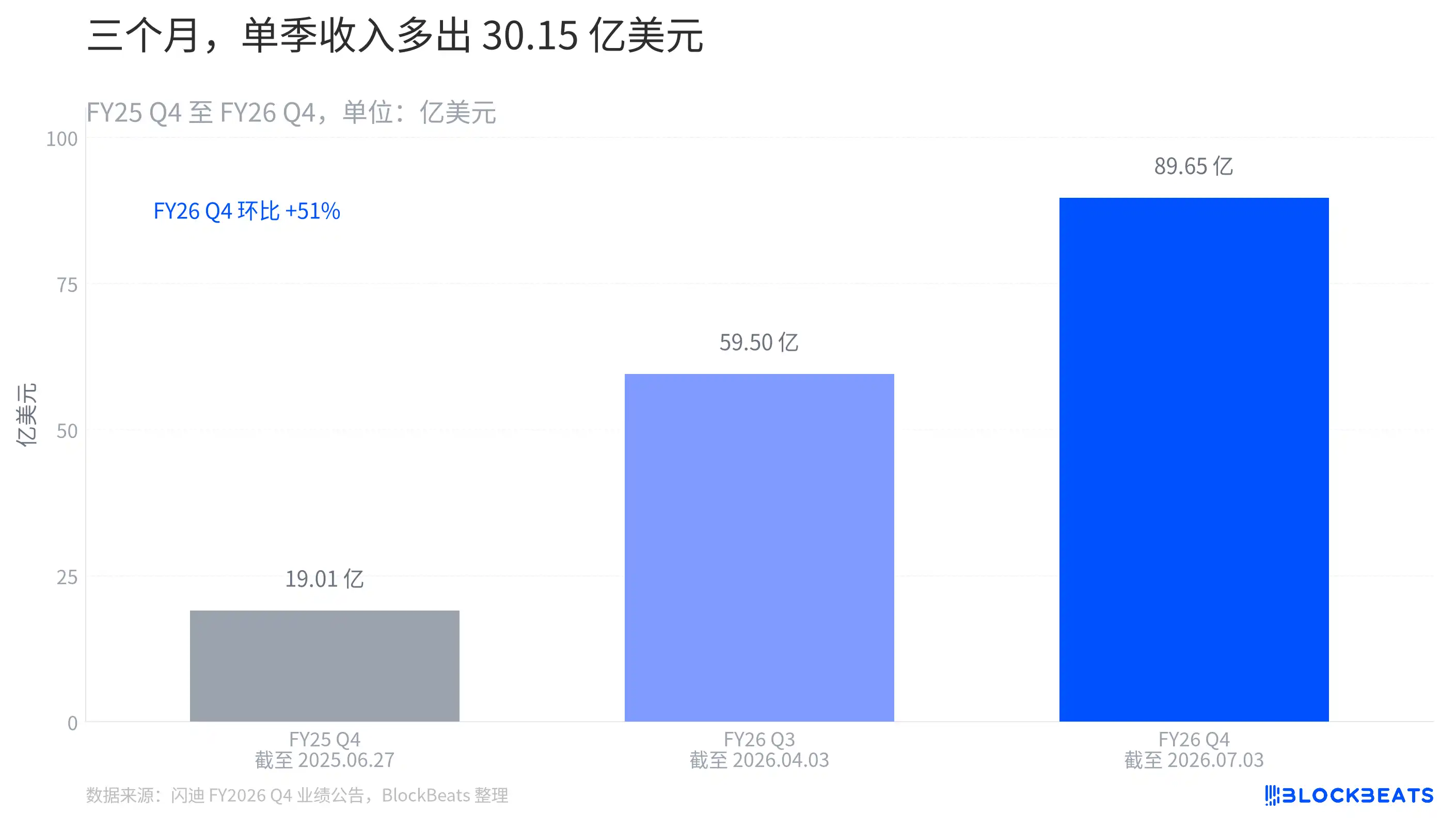
According to SanDisk's earnings announcement, revenue for FY2025 Q4 was still at $1.901 billion, while the latest quarter reached $8.965 billion. The step in the chart is steep, yet it more closely reflects the company's operational reality than "year-over-year growth."

The final column is particularly interesting. The additional revenue generated in the latest quarter compared to the previous quarter has already exceeded the total quarterly revenue of FY2025 Q4. It translates the 51% quarter-over-quarter increase into a more intuitive picture. SanDisk did not add a small segment to its original scale; rather, it essentially grew another version of its past self within three months.

The company's midpoint revenue guidance for the next quarter has already surpassed $10 billion. That is a dotted line, representing management's current assessment, not a fact confirmed in advance by this article.

Why Did Almost All the New Revenue Stay as Gross Profit?
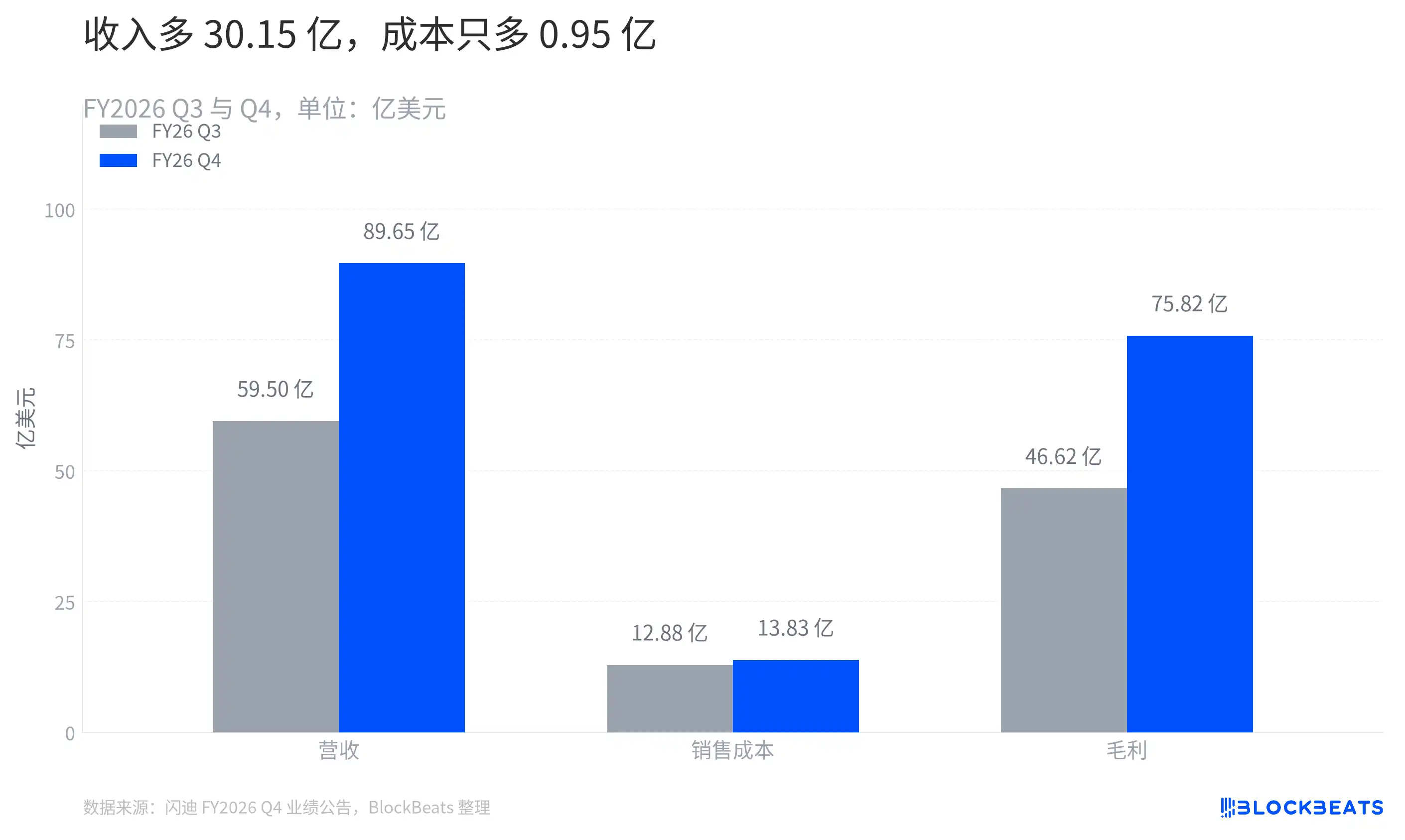
According to the company announcement, SanDisk sold $3.015 billion more in FY2026 Q4 compared to the previous quarter, while the cost of sales increased by only about $95 million. The chart shows a clear misalignment. The blue revenue bar stretches far, while the cost bar remains almost stationary.

This is a change that a NAND manufacturer must take seriously. The new revenue did not bring a proportionate increase in manufacturing expenses. Gross margin continued to rise above 80%. Translating this accounting change into plain language, the vast majority of every additional dollar of revenue stayed within the gross profit.

Significant profits still need to be examined closely. According to the company's reconciliation table, there is a difference of approximately $741 million between GAAP net income and Non-GAAP net income. The most noticeable item is $804 million in gains on equity securities, which the company excluded from its Non-GAAP metrics. Gains from valuation or disposal of such securities represent a different type of profit from selling more flash memory in the quarter, meaning not all the brightness in the GAAP income statement can be attributed to the core business.

Is Data Center the Only Protagonist?
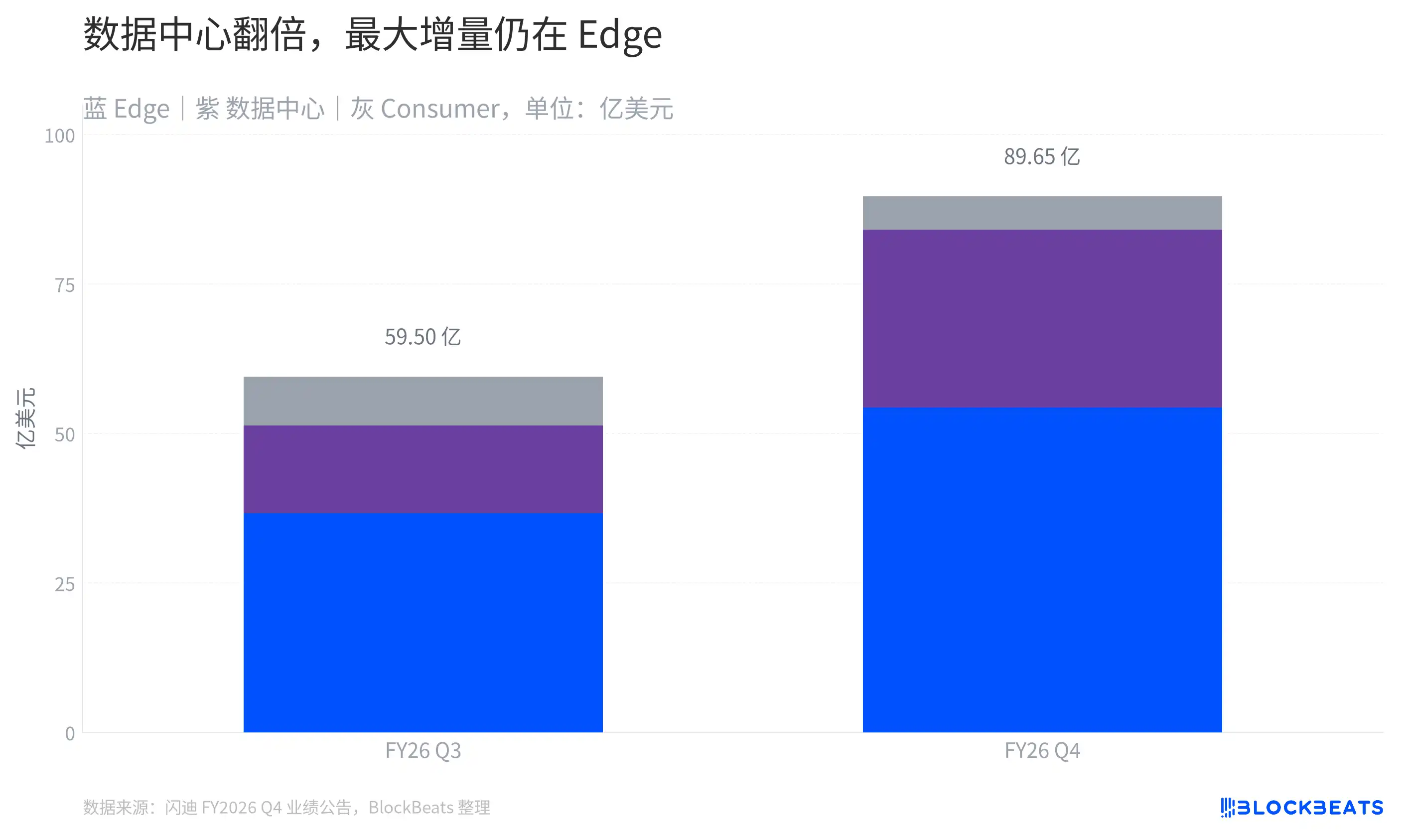
According to the company announcement, data center revenue doubled this quarter, naturally making it the star in the AI narrative. However, looking at the three markets stacked together, the blue Edge segment remains the largest foundation, and its incremental revenue for the quarter was slightly higher than that of the data center.

This distinction is crucial. The data center provided the fastest speed, while Edge provided the larger revenue increment. The top Consumer segment actually shrank, indicating this surge is not an across-the-board simultaneous uptick in all demand, but a reordering of different end markets with varying intensities.

Summarizing it as "AI driving flash memory" is not entirely wrong but misses the revenue structure. The data center makes the growth more noticeable, Edge continues to expand the scale, and the decline in Consumer reminds readers that SanDisk has not turned every product line into the same growth curve.

What Did Price Do?
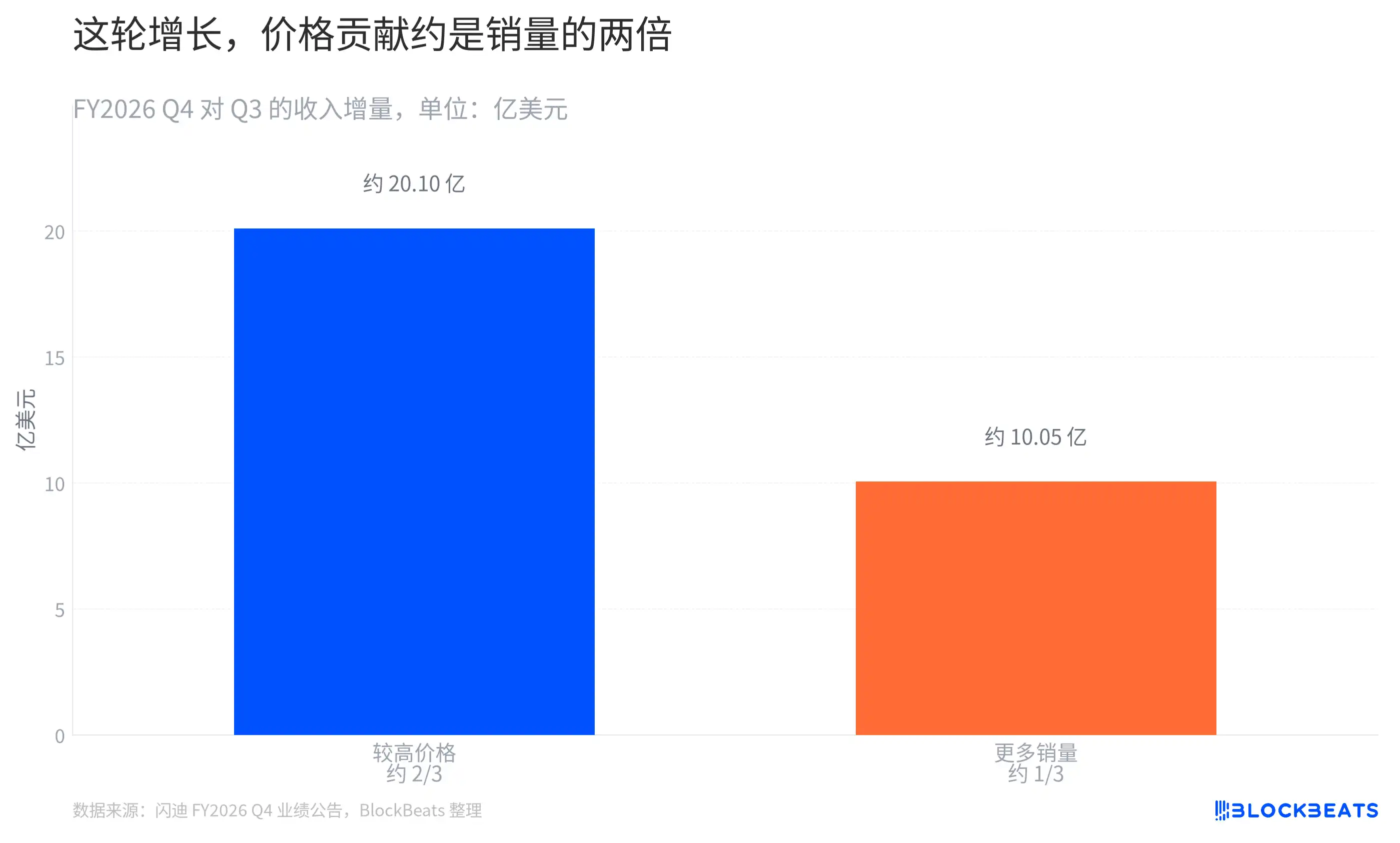
SanDisk provided a rare breakdown in its earnings announcement. Of the quarter-over-quarter revenue growth, approximately one-third came from higher volume, and approximately two-thirds came from higher prices. Based on the proportion provided by the company, the contribution from price was about twice that from volume.

The two bars in the chart are not separately disclosed, audited segments but rather a visual representation of "approximately two-thirds" and "approximately one-third" on the same scale. It at least shows that customers did not just buy more NAND; SanDisk also completed sales at higher average revenue per unit. Once both price and product mix move upward together, without manufacturing costs increasing proportionally, the income statement exhibits the kind of folding effect seen earlier.

SanDisk's latest Q2 financial report is not a single-threaded story reliant solely on AI. The data center amplified the narrative, Edge secured the largest increment, and price pushed the new revenue into thicker profits.


Related Questions

QAccording to Sandisk's latest quarterly results, what was the revenue and the quarter-over-quarter growth percentage?

ASandisk's revenue for FY2026 Q4 was $8.965 billion, representing a 51% increase compared to the previous quarter.

QWhat does the article highlight as a key reason for the large increase in gross margin despite the significant revenue growth?

AThe article highlights that the cost of sales only increased by approximately $95 million despite the revenue growing by over $3 billion. This means most of the new revenue was retained as gross profit, as higher selling prices and product mix allowed revenue to grow without a proportional increase in manufacturing costs.

QBased on the article's analysis, which market segment contributed the largest absolute revenue increase in Sandisk's latest quarter?

AAccording to the article, while the Data Center segment revenue doubled and gained the most attention, the Edge segment provided the largest absolute revenue increase for the quarter.

QHow did Sandisk explain the drivers behind its sequential revenue growth of roughly $3 billion in the quarter?

ASandisk attributed the revenue growth to a combination of higher volume and higher prices, with price increases contributing approximately two-thirds of the growth, which is about double the contribution from increased sales volume.

QWhat major non-operational item significantly impacted the GAAP net income, as mentioned in the article's analysis of Sandisk's profit?

AA significant item was an $804 million gain from equity securities, which was excluded from the Non-GAAP net income figure. This gain is related to valuation or disposal and is distinct from the profits generated by the core business of selling flash memory.

Related Reads

1.65 Billion Yuan: Sichuan Power Semiconductor Company Sells Itself

Sichuan-based power semiconductor company Jingyi Semiconductor is being acquired by its customer, Jiangsu-listed power semiconductor firm Suzhou Kaiweite Semiconductor Co., Ltd. ("Kaiweite"), for 1.65 billion yuan. Following the transaction, Jingyi Semiconductor will become a wholly-owned subsidiary of Kaiweite. Kaiweite will pay for the acquisition partly with new shares (approximately 901 million yuan worth) and partly in cash (approximately 749 million yuan). The deal is considered a major asset restructuring as Jingyi Semiconductor's assets and revenue in 2025 were 176.34% and 137.38% of Kaiweite's, respectively. Financially, Kaiweite has reported losses for 2024 and 2025. In contrast, Jingyi Semiconductor has remained profitable. The acquisition is expected to significantly improve Kaiweite's profitability. Jingyi Semiconductor's controlling shareholder and chairman, Yi Kun, along with employee持股 platforms, will hold a 13.28% stake in Kaiweite post-transaction. Founded in 2015 and listed on Shanghai's STAR Market in 2023, Kaiweite is a national-level "Little Giant" specializing in intelligent power semiconductor devices and power integrated chips. Established in 2019, Jingyi Semiconductor is a fabless power semiconductor company and a national-level专精特新重点"Little Giant." Its products, including Intelligent Power Modules (IPM), are supplied to major domestic appliance makers like Midea, Xiaomi, Gree, TCL, and Hisense-Hitachi. The company holds a leading 53.5% market share in China's IPM半桥 module segment for white goods. The strategic acquisition aims to repair Kaiweite's profitability and expand its power semiconductor product portfolio through integration in technology, products, and customer channels.

marsbit1h ago

1.65 Billion Yuan: Sichuan Power Semiconductor Company Sells Itself

marsbit1h ago

Launch Event Turned into a Make-up Ceremony? Why Hasn't Pools.trade Produced a High-Market-Cap Meme Coin Yet?

The article discusses the launch of Pools.trade, Uniswap's new token launch platform on Robinhood Chain, designed as a Meme coin launchpad. Despite generating high initial trading volumes (over $1.5 billion before the official frontend launch), the platform has yet to produce a high-market-cap Meme coin. The piece highlights two primary reasons for this. First, it outlines Pools.trade's features: it offers Instant and Crowd Launch modes, locks liquidity permanently in Uniswap v4 pools, and charges a low 0.25% transaction fee (compared to 1% on competitors like Pons and Flap), with most fees reinvested into liquidity. Second, it identifies a key problem: a lack of perceived fairness. The two most notable coins on the platform, FRONG (a "frog mascot" coin) and POOLS (a platform namesake), were both minted days before Uniswap's official countdown began. This "pre-minting" or "insider" controversy has dampened community FOMO (Fear Of Missing Out) and trust, causing their market caps to fall from peaks of $18 million and $4 million, respectively. The article argues that fairness is foundational for Meme coin success, and its absence has hindered viral growth. In conclusion, while Pools.trade benefits from Uniswap's existing user base and Robinhood Chain's popularity, its current lack of a fair-launch, high-engagement narrative has prevented a breakout hit. However, the author suggests that with its inherent traffic, such a success might not be far off.

Odaily星球日报2h ago

Launch Event Turned into a Make-up Ceremony? Why Hasn't Pools.trade Produced a High-Market-Cap Meme Coin Yet?

Odaily星球日报2h ago

Trading

Spot
活动图片