Original | Odaily Planet Daily (@OdailyChina)
Author | Ethan (@ethanzhang_web3)
RWA Sector Market Performance
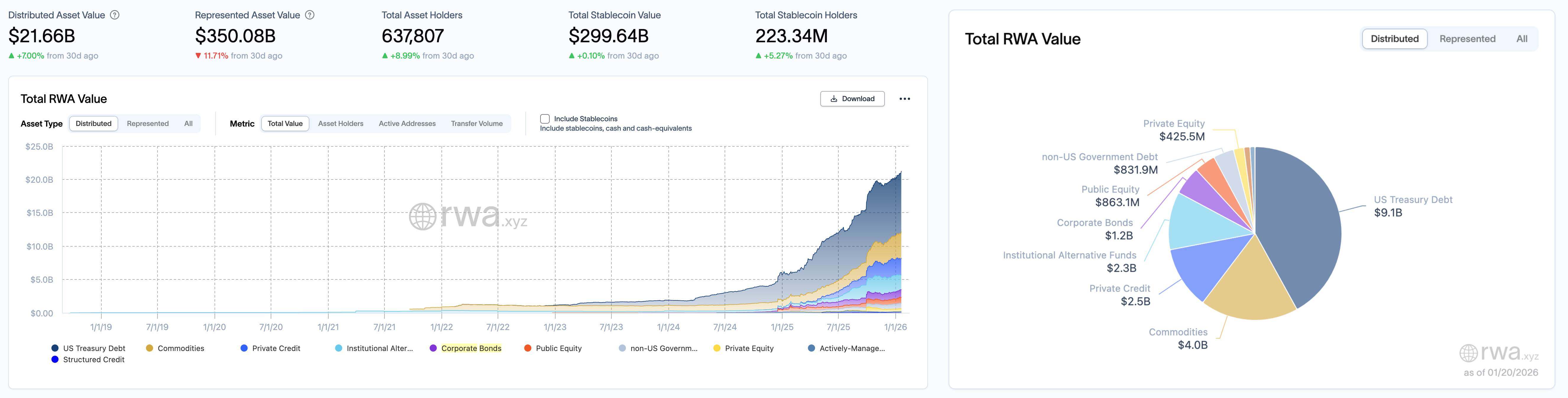
According to rwa.xyz data dashboard, as of January 20, 2026, the total on-chain value of RWA (Distributed Asset Value) continued its upward trend, growing from $208.1 billion on January 13 to $216.6 billion, a net increase of $8.5 billion for the week, a sequential growth of approximately 4.09%. The broad RWA market rebounded this period, rising from $282.68 billion last week to $350.08 billion, an increase of $67.4 billion, a growth of 23.84%. User activity on the asset side also surged significantly, with the total number of asset holders increasing from 620,073 to 637,807, a net weekly increase of over 17,700 people, an increase of 2.86%. Regarding stablecoins, the number of holders rose from 220.12 million to 223.34 million, an increase of 3.23 million, up 1.47%; the market cap slightly increased from $297.68 billion to $299.64 billion, adding $1.96 billion, a growth of 0.66%.
In terms of asset structure, the US Treasury sector maintained its absolute dominance, rising from $89 billion to $91 billion this period, a 2.25% increase. Commodity assets also continued their upward trend, rising from $3.7 billion to $4.0 billion, recording an increase of $300 million. Private credit rebounded to $2.5 billion after consecutive adjustments, a sign of recovery; while institutional alternative funds slightly contracted, dropping from $2.5 billion to $2.3 billion, a decrease of $200 million. Non-US government debt also saw a slight increase, rising from $8.098 billion to $8.319 billion, an increase of 2.73%. Public equities continued to strengthen, rising from $8.077 billion to $8.631 billion, a significant increase of 6.87%. Private equity also slightly increased from $420.5 million to $425.5 million, continuing its recovery momentum.
Trend Analysis (Compared to Last Week)
This period, the RWA market continued its structural expansion trend, with both user activity and overall market size recovering, showing significantly stronger performance compared to last week. From a capital flow perspective, capital previously concentrated in low-risk US Treasury assets is accelerating its diversion, gradually tilting towards medium-risk categories such as commodities, equities, and non-US debt. This shift in allocation intuitively signals a moderate rise in market risk appetite. Meanwhile, the stablecoin market cap and user base continue to grow steadily, laying a solid foundation for subsequent capital flows and asset injections into the market.
Market Keywords: On-chain Expansion, Diversified Allocation, Structural Evolution.
Key Event Review
US Senators Submit Over 130 Amendments, Stablecoin Yields and DeFi Become Focus
US Senators have submitted over 130 amendments for the upcoming review of the crypto market structure bill this week. The content covers stablecoin yield rules, DeFi provisions, restrictions on public officials' involvement in crypto interests, and adjustments to the definitions of digital asset mixers and tumblers, among others. The amendments were jointly proposed by senators from both the Democratic and Republican parties.
The Senate Banking Committee will hold a review meeting this Thursday to discuss the relevant amendments and vote on whether to include them in the bill text, followed by a vote on whether to advance the legislative process. Some amendments show bipartisan support, including proposed modifications to stablecoin yield provisions, such as deleting the phrase "solely for holding stablecoins" from the current text and strengthening yield disclosure and risk warning requirements.
New York Stock Exchange Plans to Launch Tokenized Securities Trading and On-Chain Settlement Platform
The New York Stock Exchange plans to launch a tokenized securities trading and on-chain settlement platform, intending to support 7x24 hour trading of US stocks and ETFs, fractional share trading, stablecoin-based fund settlement, and instant settlement, combining NYSE's existing matching engine with a blockchain settlement system. According to the plan, tokenized stocks will have the same dividends and governance rights as traditional securities. NYSE's parent company ICE is also collaborating with banks such as BNY Mellon and Citigroup to explore tokenized deposits and clearing infrastructure to support cross-time zone, round-the-clock fund and margin management.
(Recommended Reading:"NYSE Plans to Launch 7*24 Hour Tokenized Stock Trading, 'Competitors' Are Stunned","NYSE Launches 7*24 Crypto-Stock Trading, Which Crypto Businesses Will Directly Benefit or Suffer?")
Senate Crypto Bill Enters Critical Moment, Amendments Surge, Lobbying Intensifies
As the Senate Banking Committee hearing approaches, US crypto legislation enters a "sprint phase." The bill currently has over 70 amendments, and disagreements surrounding stablecoin yields and DeFi regulation are rapidly heating up, with the crypto industry, banking lobby groups, and consumer protection organizations fully involved.
The Senate will amend and vote on the bill on Thursday. The bill aims to clarify the regulatory boundaries between the US Securities and Exchange Commission (SEC) and the US Commodity Futures Trading Commission (CFTC), define the nature of digital assets, and introduce new disclosure requirements.
Committee Chairman Tim Scott released the 278-page bill text on Monday, followed by a large number of amendments submitted by senators from both parties. Some proposals involve granting the Treasury Department the power to impose sanctions on "distributed application layers," while other amendments focus on the issue of stablecoin yields, becoming the biggest point of contention currently.
Coinbase CEO Brian Armstrong stated that his initiative, Stand With Crypto, will score the amendment votes on Thursday, saying this will test whether senators "side with bank profits or consumer rewards." Industry insiders pointed out that although the bill still has momentum, its final outcome remains highly uncertain.
(Recommended Reading:"The Biggest Variable for the Future Crypto Market, Can the CLARITY Act Pass the Senate?","CLARITY Review Suddenly Postponed, Why Is the Industry So Divided?")
Hong Kong Securities and Futures Professionals Association: Hong Kong Has Completed Preliminary Virtual Asset Regulatory Infrastructure
The Hong Kong Securities and Futures Professionals Association stated that the Hong Kong government plans to announce the 2026/2027 "Budget" on February 25, focusing on virtual assets and investor protection, among other areas. Hong Kong has completed the preliminary regulatory infrastructure in the virtual asset field. The next step should focus on the commercialization and application landing, by unlocking secondary market liquidity for RWA, accelerating product approval, introducing international liquidity, and strengthening practitioner training. This will upgrade Hong Kong from a market with clear regulations to a global virtual asset center with ample liquidity and widespread applications, aligning with the national "15th Five-Year Plan's" financial opening and digital economy strategy.
Tokenized Assets May Grow to $400 Billion Scale in 2026, Banks and Asset Managers Accelerate Entry
As stablecoins validated product-market fit (PMF) in 2025, the crypto industry is pushing "on-chain dollars" to play a further role by tokenizing assets such as stocks, ETFs, money market funds, and gold as tradable on-chain financial building blocks. Multiple industry executives predict that the tokenized asset market size is expected to grow to approximately $400 billion in 2026.
Hashdex Chief Investment Officer Samir Kerbage stated that the current scale of tokenized assets is about $36 billion, and the next phase of growth will stem more from a structural reshaping of value transfer methods rather than pure speculative demand. He pointed out that as stablecoins mature as "on-chain cash," funds will naturally flow to investable assets, becoming a bridge between digital currency and the digital capital market.
The report pointed out that the scale of tokenized assets in 2025 was close to $20 billion, with traditional financial institutions such as BlackRock, JPMorgan Chase, and Bank of New York Mellon deeply involved. Tether CEO Paolo Ardoino believes that 2026 will be a critical year for banks to move from pilots to actual deployment, especially in emerging markets, where tokenization can help issuers bypass traditional infrastructure limitations.
Furthermore, Centrifuge COO Jürgen Blumberg predicts that by the end of 2026, the on-chain real-world asset (RWA) locked value may exceed $100 billion, and more than half of the world's top 20 asset management institutions will launch tokenized products. Securitize CEO Carlos Domingo pointed out that native tokenized stocks and ETFs will gradually replace the synthetic asset model and become high-quality collateral in DeFi.
Hong Kong Deputy Financial Secretary: Stablecoin Development Will "Seek Stability First Then Progress," Gold Central Clearing System Expected to Operate Within the Year
Hong Kong Deputy Financial Secretary Michael Wong, speaking at an event about digital assets and crypto assets, stated that Hong Kong will further promote the development of stablecoins in the future but emphasized "seeking stability first then progress," preventing the inflow of illegal funds and ensuring the stability of the financial system. Additionally, Wong pointed out that Hong Kong is actively expanding its gold storage facility capacity, aiming to increase the total capacity to 2,000 tons in the next three years. A gold central clearing system is currently being established, and the Shanghai Gold Exchange has been invited to participate, with the goal of putting it into operation within this year.
Bank of Thailand is Monitoring USDT "Grey Fund" Transactions
The Bank of Thailand stated that as part of its crackdown on so-called "grey funds," the agency has found that a significant portion of stablecoin activity on local platforms is related to foreigners. Bank of Thailand Governor Vitai Ratanakorn said that about 40% of USDT sellers operating on Thai platforms are foreigners, adding "they should not be trading in the country." Therefore, stablecoins, along with cash flows, gold transactions, and e-wallet fund flows, will be subject to stricter scrutiny.
South Korea Plans to Evaluate "One Exchange, One Bank" Restriction, May Relax Exchange-Bank Cooperation Rules
According to local media reports, South Korean financial regulators are evaluating whether to end the long-standing practice of "one exchange cooperating with only one bank" for crypto exchanges. The review is being coordinated by the Financial Services Commission (FSC) and the Fair Trade Commission, aiming to assess whether the current mechanism exacerbates market concentration. The report pointed out that "one exchange, one bank" is not written into law but gradually formed under anti-money laundering (AML) and customer due diligence requirements. Related research suggests that this model may restrict small and medium-sized exchanges from obtaining banking services, thereby consolidating the advantages of leading platforms.
This discussion is also related to South Korea's advancement of the second phase of legislation for the "Digital Asset Basic Act." The bill plans to allow the issuance of KRW stablecoins, but there are still disagreements on the regulatory framework and approval mechanism, and the submission time has been postponed to 2026.
Pakistan Signs MoU with WLFI to Explore USD1 Stablecoin for Cross-Border Payments
The Pakistan Virtual Asset Regulatory Authority (PVARA) announced that it has signed a Memorandum of Understanding (MoU) with SC Financial Technologies LLC, an affiliate of the Trump family's crypto project World Liberty Financial (WLFI), aiming to explore the use of the USD1 stablecoin for cross-border payments and digital settlement. The MoU focuses on technical cooperation, knowledge sharing, and regulatory dialogue and does not constitute a binding agreement to deploy USD1 within Pakistan's financial system at this stage. According to the terms of the MoU, SC Financial Technologies will collaborate with the State Bank of Pakistan and related institutions to study how stablecoins like USD1 can be integrated into the country's regulated payment ecosystem.
Coinbase Plans to Launch Custom Stablecoin, Allowing Enterprises to Issue Digital Dollars with 1:1 Backing
According to market news: Coinbase is launching a custom stablecoin, allowing enterprises to issue digital dollars with 1:1 backing.
Franklin Templeton to Transform Its Money Market Funds into Stablecoin Reserve Tools
Franklin Templeton announced that it is making two of its institutional money market funds compatible with blockchain finance, aiming to position for the growing market of tokenized assets and regulated stablecoins. This update applies to the Western Asset Institutional Treasury Obligations Fund (LUIXX) and the Western Asset Institutional Treasury Reserves Fund (DIGXX), both managed by its affiliate Western Asset Management. Franklin Templeton Head of Digital Assets Roger Bayston stated that traditional funds are beginning to go on-chain, so the focus is on making them more accessible. It is reported that the LUIXX fund has been modified to comply with the GENIUS Act, which sets reserve standards for regulated stablecoins. The fund currently holds only short-term US Treasuries with maturities of less than 93 days and can be used as a stablecoin reserve tool; the DIGXX fund has launched a digital institutional share class designed for distribution on blockchain platforms, allowing approved intermediaries to record and transfer fund share ownership on-chain.
Crypto Bank Anchorage Digital Seeks $200M to $400M Funding Before IPO
Crypto bank Anchorage Digital is seeking to raise $200 million to $400 million in new funding to prepare for a potential initial public offering. The company plans to conduct an IPO in 2026. As the first crypto bank to receive a federal charter in 2021, Anchorage Digital, following the passage of the GENIUS Act in July 2025, is committed to becoming a leading stablecoin issuer.
Anchorage Digital CEO Nathan McCauley stated that he plans to double the size of the stablecoin team within the next year. A company spokesperson said that 2025 was a year of scaling, solidifying its leading position in the institutional crypto space through a series of acquisitions and collaborations, including plans with Tether to launch the USAT token in the US. Additionally, Anchorage Digital also provides custody, trading, and staking services, and expanded its business in December 2025 by acquiring Securitize For Advisors and integrating Hedgey. It completed a $350 million funding round led by KKR & Co at the end of 2021, with a valuation of over $3 billion at that time.
Bank of America CEO: Interest-Bearing Stablecoins Could Lead to $6 Trillion in Bank Deposit Outflows
Bank of America CEO Brian Moynihan stated on a quarterly earnings call that interest-bearing stablecoins could lead to $6 trillion in outflows from the banking system and harm the credit capacity of small and medium-sized businesses. Brian Moynihan cited US Treasury report data, pointing out that the financial structure of stablecoins is similar to money market mutual funds, with reserves invested in low-risk securities like short-term Treasuries, rather than being converted into bank loans. He believes that the popularity of interest-bearing stablecoins will force banks to turn to more expensive wholesale funding, thereby pushing up overall borrowing costs. Currently, the draft crypto bill under discussion in the US Senate Banking Committee proposes to prohibit idle stablecoins from generating interest.
Coinbase CEO Brian Armstrong posted on platform X that due to provisions in the draft bill that restrict stablecoin rewards, substantially prohibit tokenized stocks, and limit DeFi, among others, Coinbase has formally withdrawn its support for the bill. Brian Armstrong accused the relevant amendments of aiming to eliminate competition faced by banks by canceling stablecoin rewards. Affected by this, the Senate Banking Committee has postponed the vote originally scheduled for January 15.
Hong Kong University of Science and Technology's Tang Bo: Gold Tokens Can Generate Interest On-Chain, Different from Traditional Gold ETFs
Tang Bo, Assistant Dean of the Hong Kong University of Science and Technology's Institute for Financial Studies, stated that gold tokenization is becoming the most promising track in real-world asset (RWA) tokenization. The value of gold as a safe-haven asset is returning, and tokenization technology will give this ancient asset全新的 financial attributes. Gold tokenization is different from traditional gold ETFs. Gold tokens are certificates corresponding 1:1 to physical gold, and holders can directly withdraw the physical metal from the vault, while ETFs are just asset certificates. More importantly, gold tokens can generate interest on the blockchain through methods like抵押借贷, further activating the financial attributes of gold.
Viewpoint: Passage of Crypto Market Structure Bill Would Be a Bullish Catalyst
Galaxy Research Head Alex Thorn posted on platform X that the US Senate Banking Committee is about to vote on the crypto market structure bill on January 15. The current Senate seat distribution is 53 to 47. Since bills typically require 60 votes to pass, Republicans still need to gain support from 7 to 10 Democratic senators.
Alex Thorn stated that the bill involves the classification of DeFi under anti-money laundering rules, the treatment of stablecoin reserve yields, the protection of non-custodial developers, and SEC authorization or restrictions on token issuance. If the bill is passed, it will be a major bullish catalyst for cryptocurrency adoption; if it fails to pass, although the overall impact on the industry's fundamentals is small, it may lead to negative market sentiment.
Hot Project Dynamics
MSX (STONKS)
One-Sentence Introduction:
MSX is a community-driven DeFi platform focused on tokenizing US stocks and other RWAs for on-chain trading. Through cooperation with Fidelity, the platform achieves 1:1 physical custody and token issuance. Users can use stablecoins like USDC, USDT, USD1 to mint stock tokens like AAPL.M, MSFT.M, and trade them 24/7 on the Base blockchain. All trading, minting, and redemption processes are executed by smart contracts, ensuring transparency, security, and auditability. MyStonks is committed to bridging the gap between TradFi and DeFi, providing users with a high-liquidity, low-threshold on-chain US stock investment portal, building the "Nasdaq of the crypto world".
Latest Developments:
On January 13, MSX announced that starting immediately, it is changing the RWA spot trading fee collection model. After the adjustment, this section changes from the original "two-way fee" to "one-way fee." The specific implementation standard is that the buy direction maintains a 0.3% handling fee, and the sell direction handling fee is reduced to 0. This means that when users complete a full trading cycle of "buy + sell," the comprehensive transaction cost will be substantially reduced by 50%. This fee policy is now effective across the entire MSX platform, covering all listed RWA spot trading pairs.
Previously, MSX published a 2025 review article "Anchoring the Era Window, Co-building a New On-Chain US Stock Ecosystem," reviewing the phased achievements of this year.
Ondo Finance (ONDO)

One-Sentence Introduction:
Ondo Finance is a decentralized finance protocol focused on structured financial products and the tokenization of real-world assets. Its goal is to provide users with fixed-income products, such as tokenized US Treasuries or other financial instruments, through blockchain technology. Ondo Finance allows users to invest in low-risk, high-liquidity assets while maintaining decentralized transparency and security. Its token, ONDO, is used for protocol governance and incentive mechanisms. The platform also supports cross-chain operations to expand its application scope in the DeFi ecosystem.
Previous Developments:
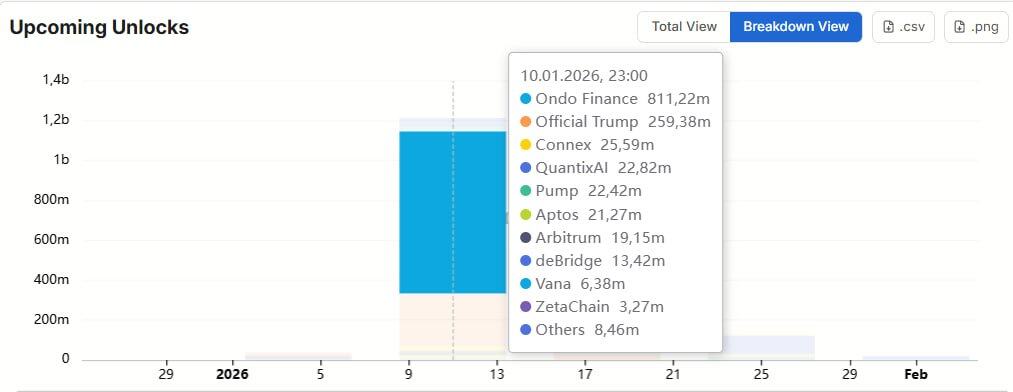
On January 4, according to onchainschool.pro monitoring, token unlocks worth over $1 billion are expected next week, including several well-known projects such as ONDO, TRUMP, PUMP, APTOS.
Previously, Ondo Finance announced on platform X that its tokenized stock and ETF platform will launch on the Solana blockchain in early 2026, aiming to bring Wall Street liquidity to the internet capital market.
Related Links
《RWA Weekly Report Series》
Sorting out the latest insights and market data of the RWA sector.
《When Big Money Gets Serious, RWA's Liquidity Problem Becomes Apparent》
Using actual data to point out where asset tokenization truly fails: the market structure supporting these assets has never been truly established.
《Why ENA is Becoming a Core Component of On-Chain Synthetic Dollars》
This article will explore the mechanism behind Ethena, its synthetic dollar USDe, and why the ENA token is becoming a foundational element of the on-chain economy. It explains how the Ethena system operates, its key relationship with the RWA narrative, and the opportunities and risks it brings.