Running for Three Years Only to Get a 'Witch Verdict'! Big Players Unite to Defend Rights, Backpack Rushes to 'Put Out the Fire'

marsbitPublished on 2026-03-24Last updated on 2026-03-24

Abstract

After three years of anticipation, Backpack Exchange finally conducted its TGE on March 23, but instead of rewards, many users—including long-term supporters and high-volume traders—were labeled as "sybils" and saw their points drastically reduced or zeroed out. The airdrop, which allocated 25% of the total token supply to the community, sparked widespread anger, especially among Chinese users, who reported heavy losses in time, fees, and trading volume. The lack of transparent sybil-detection criteria and retroactive enforcement led to a severe trust crisis. Even key community contributors and influencers were affected, with some losing referral networks due to collective penalties. In response, Backpack opened a manual appeal channel, promising to reinstate 50% of points for users with three or fewer accounts per device and to initiate a token buyback for compensation. Amid the controversy, Backpack is pursuing an IPO narrative, with plans to lock team tokens until after a potential public listing and to allow long-term stakers to convert tokens to equity. However, unclear details and the recent airdrop fallout have left community trust deeply damaged.

Author: Nancy, PANews

Running for three years, only to end up with a "witch verdict."

On March 23, the long-awaited trading platform Backpack finally launched its TGE. In the current deep bear market, Backpack did not bring any pleasant surprises. The token price plummeted upon listing, and as of now, the fully diluted market cap is less than $200 million. What shocked the community was the large-scale anti-sybil (anti-farming) actions. Key community members complained in group chats that both small-scale long-term interactive散户 and large players who dominated trading volumes were included in the sybil list. The rules were never disclosed, yet the judgment was unilaterally enforced. Backpack faced a severe trust crisis and had to urgently open an appeal channel on March 24.

"In a bull market, you're farming others' airdrops; in a bear market, you're farming the project's airdrops." Someone hit the nail on the head regarding the core issue. With consecutive airdrops from Opinion and Backpack leaving many farming communities empty-handed, it indirectly signaled the end of the airdrop farming track. Some veteran farmers even announced their retirement.

KOLs Also Fell Victim to Anti-Sybil Measures, Chinese Community Hit Hardest

The promise of a "pure community distribution" ultimately turned into a large-scale anti-sybil event.

Yesterday, Backpack finally opened the BP token claim channel. According to the previously announced rules, 25% of the total token supply (approximately 250 million BP) in this TGE would be allocated entirely to the community, with 24% going to points holders and 1% to Mad Lads NFT holders. The official emphasized that aside from this portion, which fully belonged to the community, no team or investor shares were involved in the initial circulation.
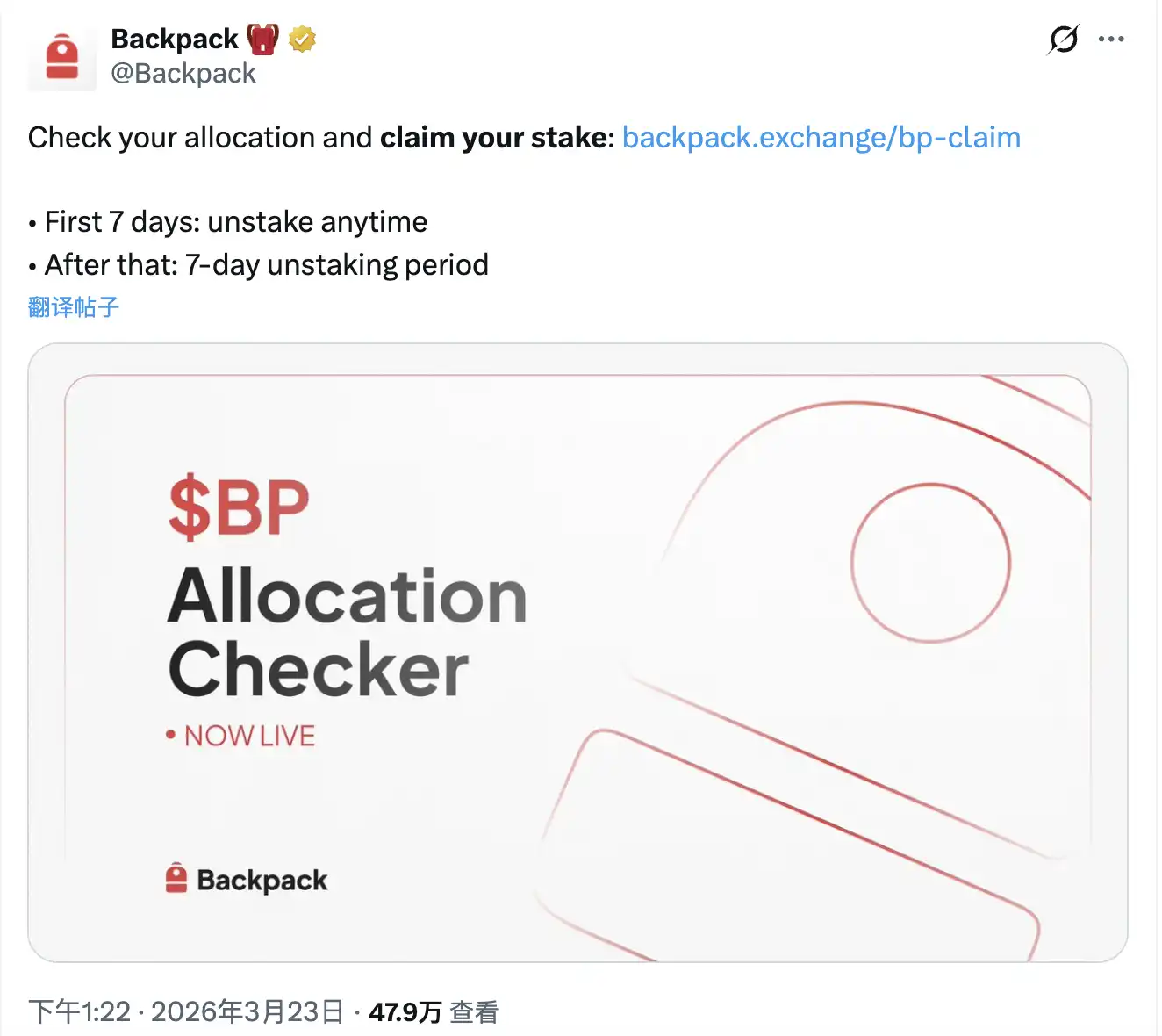
However, when the claim channel opened, it dealt a heavy blow to community users. A large number of users found their points drastically reduced or even reset to zero, ultimately receiving only a symbolic participation reward or nothing at all. What made users even more dissatisfied was that those affected were not marginal accounts but core participants, including long-term active single-wallet users, high-point farmers, and Mad Lads NFT holders.

Anger quickly spread throughout the community, especially among Chinese users, who became the hardest hit in this sybil cleanup. Complaints from major players and KOLs flooded the community: "$4 billion trading volume, 100% sybil rate," "Over $1.5 billion trading volume, 800+ hours spent, over $300,000 in fees, but airdrop halved," "330,000 points exchanged for 2,000 tokens," "Number one in global trading volume, 170,000 points only got 20,000 tokens"... Behind these numbers were real financial investments and time costs, but in the final distribution, they were uniformly classified as sybils and directly disqualified.

What amplified the dissatisfaction was not just the disparity in rewards but the negation of their contributions. Among these users, some had long maintained communication with the project team, some consistently produced content to endorse the project, and others actively participated in community growth and ecosystem expansion. However, these efforts were not factored into any weighting considerations and were instead erased.

Even more controversial was the collective punishment approach. Some community leaders responsible for growth, who recruited new users and expanded the ecosystem, were not only cleaned up but also saw their invited genuine users affected. This punishment mechanism turned the growth logic originally reliant on social裂变 into a source of risk.

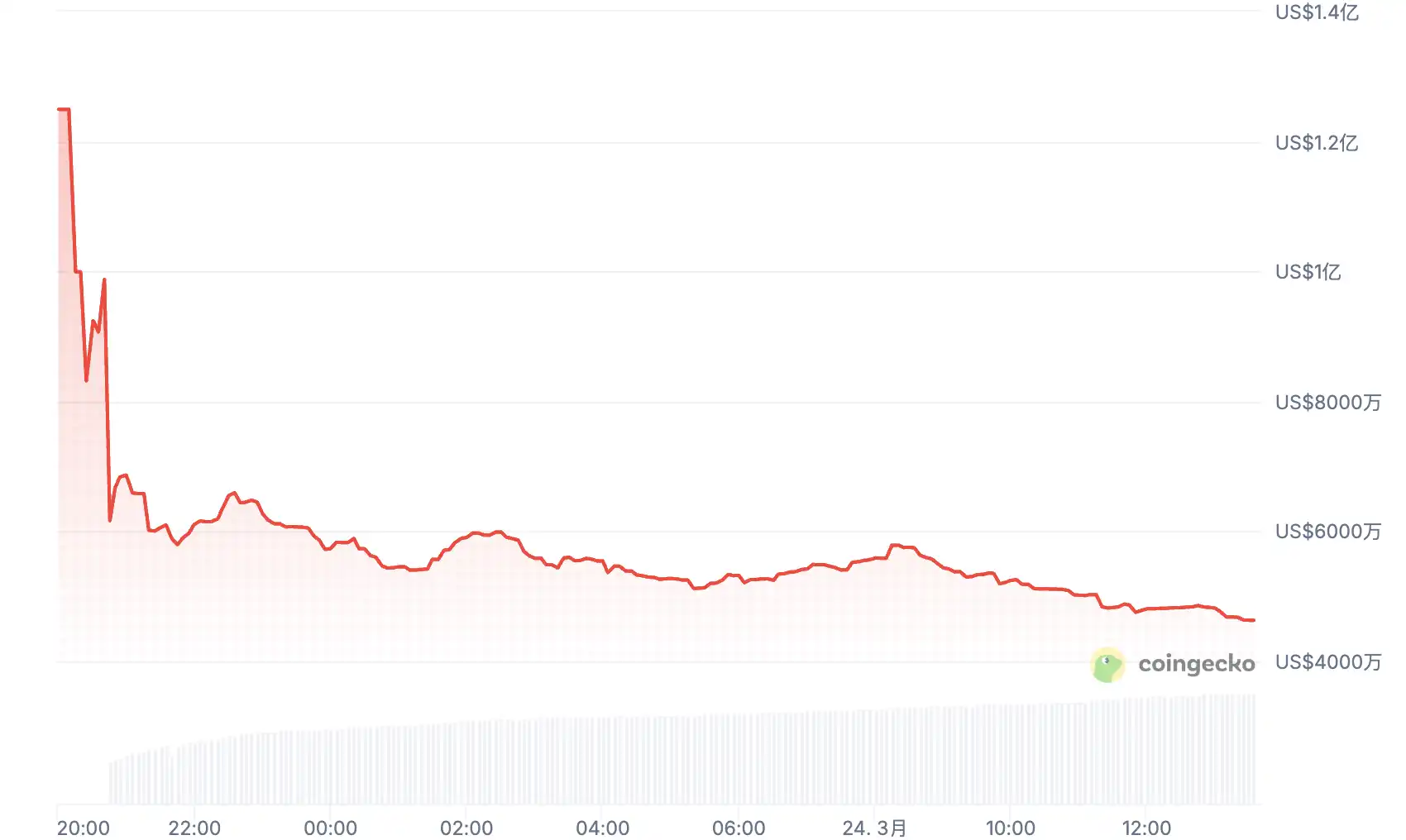
Moreover, the rapid decline of the BP token after listing further magnified the overall losses and exacerbated the negative market sentiment.
All controversies pointed to the lack of transparency in Backpack's rules.

Backpack's sybil判定 criteria were never publicly disclosed. Instead, the risk control mechanisms were continuously upgraded during the process. Just before the TGE, Backpack not only required all accounts participating in the points activity to complete KYC but also conducted a large-scale review under the pretext of "purifying the environment and rewarding real users." Ultimately, over 50 million points were identified as coming from non-genuine behavior and were uniformly reclaimed for redistribution. However, for users, what constituted non-genuine behavior, the basis for judgment, and the boundaries were never clearly explained.

Returning Points and Launching Token Buybacks: Can Trust Be Restored?

Under public pressure, Backpack rushed to "put out the fire."

Backpack team member Claire tweeted in response that the Backpack Chinese team had激烈 discussed with the European and American teams overnight. The Chinese team did not want to see the interests of previously supportive users affected and had in-depth communication with the负责人 in charge of anti-sybil execution.

As an experienced compliance professional, Claire stated that in the logic of the anti-sybil team, "one person, one account" was an absolute bottom line. Under this standard, compared to other regions, more Chinese-speaking users were indeed affected, which was naturally due to different user habits. European and American users' strict adherence to rules and sensitivity to KYC information made multi-account behavior itself beyond their认知范围. In subsequent handling, Backpack founder Armani and the core team planned to immediately open an appeal channel, establish clear rules, and protect user interests to the greatest extent.

Subsequently, Backpack's Chinese account announced the opening of a manual appeal channel, allowing users to submit materials for review. It also announced adherence to the "3-account rule": if the number of accounts operated on the same device was three or fewer and were judged as sybils, upon verification through manual appeal, 50% or more of the points would be returned. Additionally, the Backpack team planned to launch a special program in the coming days to conduct token buybacks on the secondary market for定向 compensation to these eligible users.

However, for those users who had invested wholeheartedly, these remedies might compensate for some losses, but once trust is broken, it is difficult to rebuild easily.

Locking Tokens for a Year in Exchange for Equity? Backpack Bets on the IPO Narrative

From past scripts, most crypto projects often experience high openings followed by declines after token issuance, inevitably fading into obscurity. Against the backdrop of the crypto bear market, Backpack chose to bet on the IPO narrative before officially issuing tokens to boost market confidence.

In February this year, Backpack CEO Armani Ferrante stated that the company followed a core principle in its token economic model: preventing insiders from dumping on retail investors. Before the product achieves "escape velocity," no founder, executive, employee, or venture capitalist should obtain wealth through tokens. For Backpack, the answer to "escape velocity" was clear: the company planned to conduct an IPO in the United States.

This means token value capture will be re-anchored and closely tied to the company's overall valuation. On this note, according to a recent Axios report, informed sources said Backpack is negotiating a new round of financing, discussing raising $50 million in a new round at a pre-money valuation of $1 billion.

Regarding token unlocking, Backpack also showed "sincerity." Aside from 37.5% of the tokens being unlocked gradually according to key milestones before the IPO, Backpack will lock the remaining 37.5% in the company treasury until at least one year after the IPO, with team members holding only company equity.

Additionally, Backpack announced it would allocate 20% of equity, offering users who stake BP tokens for at least one year the opportunity to exchange tokens for company equity at a fixed ratio. Not long ago, Backpack also launched an on-chain IPO new share allocation function, allowing users to directly obtain IPO shares through the platform, and opened a waitlist registration.

However, specific details of the token-to-equity exchange remain undisclosed, including the form of exchange, scope of rights, and timeline. This has also raised community concerns, viewing it as a potential new round of PUA—locking users in before slowly fulfilling promises, using equity exchange to buy more survival time for the project.

Armani Ferrante also revealed that the上市 could happen soon, or not so soon, or might not happen at all. But no matter what, he and the team would go all out.


Related Questions

QWhat was the main controversy surrounding Backpack's TGE and airdrop distribution?

AThe main controversy was the large-scale 'anti-sybil' action where many users, including long-term small traders and high-volume whales, had their points drastically reduced or zeroed out, receiving minimal or no airdrop rewards. This was due to undisclosed sybil detection criteria, causing a severe trust crisis.

QHow did the Backpack team respond to the community backlash and trust crisis?

AThe Backpack team opened an appeal channel for manual review. They announced the '3-account rule', promising to return at least 50% of points to users who operated 3 or fewer accounts on one device after verification. They also planned a token buyback program for secondary market compensation.

QWhat unique strategy is Backpack employing to try to stand out in the crypto bear market?

ABackpack is betting on an IPO narrative. It plans to conduct an IPO in the US, anchoring token value to the company's overall valuation. Team members hold only company equity, and a portion of tokens are locked until after the IPO. They also offered users the opportunity to exchange staked BP tokens for company equity.

QWhy were Chinese community users particularly affected by the 'anti-sybil' measures?

AAccording to a Backpack team member, the sybil detection team's logic had an absolute底线 (bottom line) of 'one person, one account'. Compared to users in other regions, more Chinese-speaking users were affected due to different natural user habits, implying a higher prevalence of multi-account usage in that community.

QWhat concerns did the community have regarding Backpack's plan to offer equity for staked tokens?

AThe community was concerned about the lack of disclosed details for the token-to-equity exchange, including the form of exchange, scope of rights, and timeline. Some worried it was a new form of 'PUA' to lock up user tokens and buy the project more survival time with promises of future equity.

Related Reads

As Consensus Accelerates, What Are Young Investors Betting On?

Title: As Consensus Forms Faster, What Are Young Investors Betting On? In the rapid evolution of tech investment, a new generation of young investors is navigating a landscape where AI, robotics, commercial aerospace, and quantum computing are advancing simultaneously. Traditional investment logic based on financial models is giving way to a need for deep technical understanding and the ability to act before industry consensus forms. An analysis of trends from the "WAIC FUTURE TECH" list of young investment leaders reveals key shifts in focus. The first major trend is the movement of AI from the digital screen into the physical world. Investment is shifting from large language models and chatbots towards embodied AI, robotics, AI hardware, and edge computing. While demonstrations generate excitement, the real challenge lies in achieving scalable, reliable, and cost-effective delivery in complex real-world environments like factories and logistics. Success depends not just on algorithms but on the integration of sensors, actuators, and control systems. Second, the competitive focus for large models is moving beyond raw capability toward building an "intelligence flywheel." The goal is to create self-reinforcing systems where user interaction generates data, improving the model, which in turn enhances the user experience and attracts more engagement. Companies that successfully embed AI into workflows to create these closed-loop systems can build lasting value that isn't easily erased by the next model upgrade. Third, facing a potential bottleneck in high-quality human-generated data, investors are looking at new underlying technologies. Reinforcement learning and self-play, as demonstrated by AlphaGo Zero, offer paths for AI to generate its own experience. Scientific foundation models, which aim to build general AI capabilities for fields like life sciences and materials discovery, represent a non-consensus direction that could unlock new frontiers of knowledge and data. Finally, in deep-tech areas like quantum computing, commercial aerospace, and space-based infrastructure, patient capital is essential. These fields have long, uncertain development and validation cycles involving complex engineering, supply chains, and regulations. Investment here requires a long-term view, focusing on foundational team capabilities and the eventual emergence of market demand, even if commercial returns are distant. Collectively, these trends illustrate how young investors are adapting to a new era. They are learning to make earlier, technically-informed judgments, balance hype with real-world viability, and provide the patient capital needed to build the deep-tech foundations of the future.

marsbit15m ago

As Consensus Accelerates, What Are Young Investors Betting On?

marsbit15m ago

Can Japan Buy Growth with AI? Will the Bond Market Believe It?

Japan's cabinet has introduced the 2026 Basic Policy on Economic and Fiscal Management and Reform, shifting its primary fiscal target. The new framework moves away from the traditional annual primary balance goal and instead prioritizes a stable reduction of the debt-to-GDP ratio. This change is tied to a strategy of increased "responsible proactive fiscal" spending, aiming to boost long-term growth through investments in strategic sectors like AI, semiconductors, energy, and robotics. The government estimates total public and private investment in 62 key technologies could exceed 370 trillion yen by 2040. The market reaction has been mixed and cautious. While equity markets may respond to policy signals, bond markets are focused on fiscal credibility. Concerns center on whether the weakening of the clear primary balance anchor could lead to looser fiscal discipline. If investors doubt that these strategic investments will generate sufficient productivity gains, tax revenue, and nominal growth to outpace rising interest costs, they may demand higher yields on Japanese Government Bonds (JGBs). Recent volatility in the yen and JGB yields, with the 10-year yield briefly reaching 2.9%, reflects this skepticism. The success of this new framework hinges on two factors: whether Japan can achieve a nominal growth rate consistently higher than its long-term interest rates, and whether future budgets demonstrate disciplined control over bond issuance. The government's narrative is that strategic investment is essential to break Japan's cycle of low growth, aging, and labor shortages. However, the bond market will continuously assess the credibility of this plan, pricing the risk that it may represent fiscal expansion rather than a viable growth strategy.

marsbit52m ago

Can Japan Buy Growth with AI? Will the Bond Market Believe It?

marsbit52m ago

Misjudged A-Shares: Resilience, Expectations, and Confidence

China's A-share market recently faced selling pressure, especially in tech sectors, initially triggered by a global tech sell-off that began in South Korea. However, the article argues this is a case of "mistaken injury" and highlights the market's underlying resilience. This resilience stems from three main pillars: **1) Tech Sector Fundamentals:** Unlike Korea's market dominated by a few memory chip stocks, China's tech sector is diversified across computing, communications, electronics, and semiconductors, supported by dual narratives of global AI supply chains and domestic substitution. Core areas like optical modules and fiber optics continue to show strong earnings growth. **2) "National Team" Support:** State-backed institutions and large corporations have made significant market purchases and announced buybacks, providing liquidity and signaling confidence. This is seen as a stabilizing policy signal, often associated with market bottoms. **3) Broader Market Pillars:** Other major sectors are showing endogenous recovery momentum. Consumer stocks benefit from stabilizing CPI and signs of sector recovery (e.g., liquor price hikes). Cyclical sectors like aluminum have high earnings, potential price increases due to tight supply, and low valuations. The financial sector offers stable dividends and low valuations. The conclusion is that the sell-off was driven by external contagion, not a collapse in fundamentals. With strong policy support and recovering momentum across key sectors, the A-share market possesses the toughness to regain stability.

marsbit1h ago

Misjudged A-Shares: Resilience, Expectations, and Confidence

marsbit1h ago

Trading

Spot
活动图片




