Author: RootData
I. Transparency-Driven Cryptocurrency Exchange Rankings
In the February cryptocurrency exchange rankings compiled by RootData, Binance, OKX, Coinbase, Kraken, Gate, Upbit, Kucoin, Crypto.com, HTX, and Bitget ranked in the top 10.
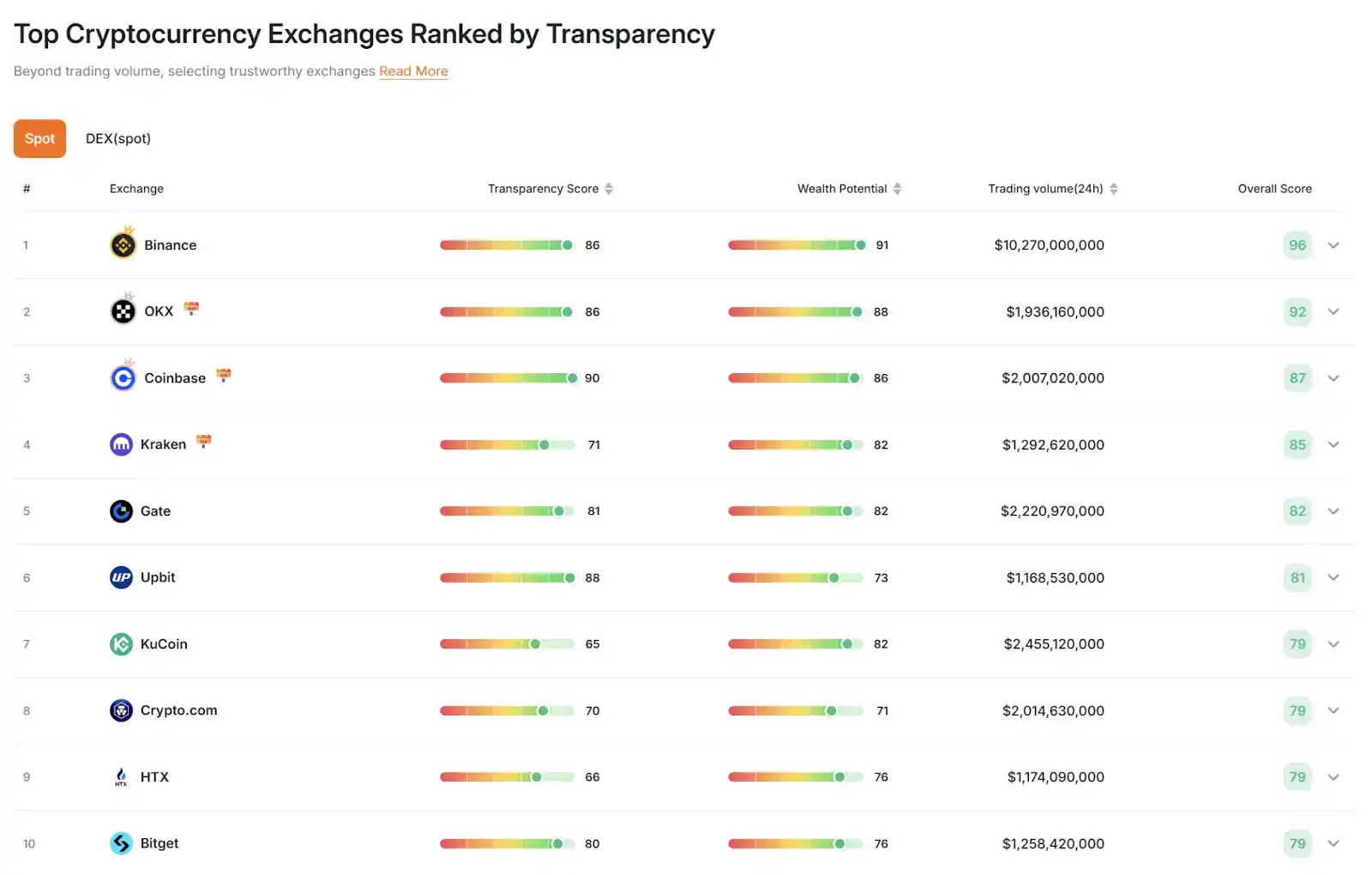
This ranking is based on RootData's extensive data, incorporating multiple indicators such as trading volume, reserve size, listing performance, compliance, and transparency of major exchanges, while avoiding the impact of fraudulent activities like exchange volume manipulation, to objectively reflect the competitiveness and ranking of exchanges in the crypto market.
In this month's ranking, Binance maintained its top position with the highest trading volume and wealth effect. OKX, as one of the few exchanges with increased trading volume this month, rose to second place. Coinbase dropped one spot to third, while Kraken, with its numerous activities, climbed two spots to fourth.
II. Overview of Cryptocurrency Exchange Development in February
1) Multiple Factors Including Weaker Market Sentiment and Spring Festival Holiday Lead to Decline in Trading Volume
In February 2026, the cumulative spot trading volume of cryptocurrency exchanges was $895.2 billion, a slight decrease of 4.7% compared to January. This was the result of multiple factors, including market conditions, the macro environment, and the Spring Festival holiday in Chinese-speaking regions.
From a price perspective, BTC fluctuated within the range of $66,000 to $71,000 throughout February, repeatedly failing to break through resistance and form a trending breakout. ETH and other major altcoins also maintained a volatile pattern, with the market lacking clear directional momentum, directly suppressing trend trading and the willingness of incremental funds to enter the market.
In the absence of one-sided market momentum, spot market activity naturally declined. Although the derivatives market saw局部放量 during periods of heightened short-term volatility, it overall failed to offset the total decline caused by spot market weakness.
At the same time, the impact of the Spring Festival holiday in Chinese-speaking regions on the global trading structure remained significant. A large number of retail investors and some institutional accounts paused or reduced their operations, leading to a阶段性下降 in liquidity during Asian trading hours and a noticeable contraction in成交量 during the Asian session. Given Asia's significant weight in the global crypto market, the holiday effect was放大 at the aggregate level.
On the macro level, global risk assets entered a rebalancing phase in February, with a marginal rise in避险情绪. Some funds flowed into precious metals and bond markets. The decline in risk appetite made marginal demand for crypto asset配置 more conservative. Even though个别 Bitcoin spot ETFs maintained net inflows, the scale of incremental funds was insufficient to generate a trend-level volume surge, ultimately leading to a slight overall decline in crypto market trading volume.
In summary, the decline in spot trading volume in February 2026 was the result of multiple factors共振, but it is not a signal of market衰退. Looking ahead to March, as the Spring Festival effect subsides, potential regulatory benefits (such as the deepening implementation of the EU's MiCA framework) and the clarification of macro data (such as rising expectations for Fed rate cuts), trading activity is expected to反弹.
2) Exchange Listing Frequency Contracts, High-Transparency Projects Favored
Due to the continued downturn in the crypto market and the low activity of employees and investors from many Chinese-speaking region projects during the Spring Festival holiday, the number of new token issuances this month also hit a new low. According to RootData statistics, the cumulative number of newly issued tokens listed on first-tier exchanges this month was 10-15, with a total of 28 new tokens listed (stablecoins and tokenized stocks are not included in the statistics). The number of newly listed tokens per exchange ranged from 2 to 14.

Among them, Binance and OKX each listed only 2 newly issued tokens. Exchanges like Kraken, Gate, and Coinbase listed multiple existing tokens, such as CFG, TAO, HYPE, SKR, etc., but these numbers were significantly reduced compared to previous months. These phenomena collectively resulted in very limited stimulation of user trading sentiment.
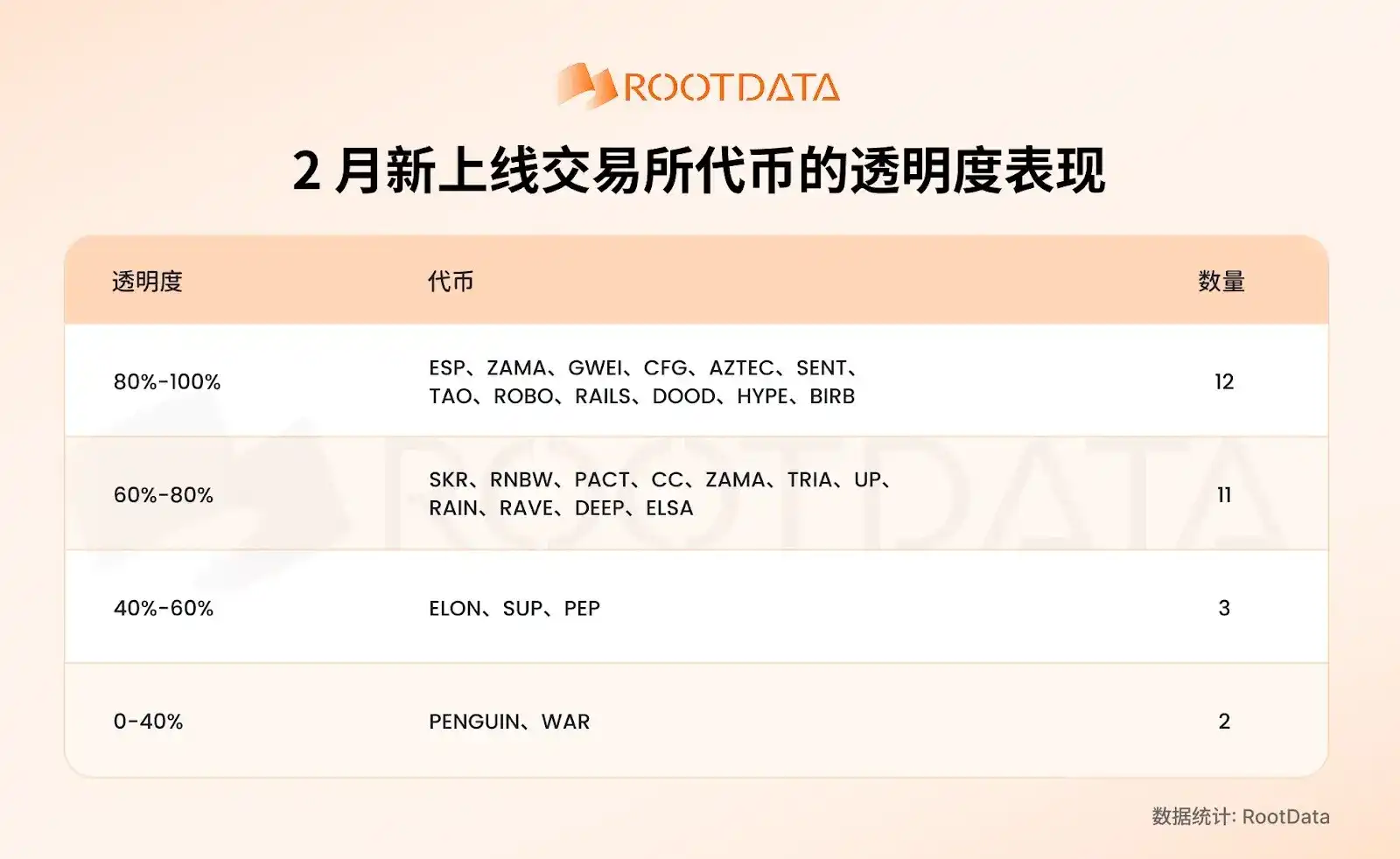
An analysis of these newly listed exchange tokens shows that 82% of the tokens had a transparency score above 60%, 43% had a transparency score above 80%, and only 2 tokens had a transparency score below 40%. This means that high-transparency tokens are more likely to gain the青睐 and trust of exchanges, as high transparency indicates that the project places users and the community in an important position and is more willing to engage in long-term building.
3) Increased M&A Activity Among Asia-Pacific Exchanges, Entry of Traditional Financial Giants
In February, merger and acquisition (M&A) activity in the cryptocurrency exchange sector increased significantly. Exchanges in the Asia-Pacific region, such as Korbit, Coinhako, and Independent Reserve, were acquired by traditional financial giants. This reflects that against the backdrop of gradually明朗 regulation and increasing market maturity, traditional financial institutions in the Asia-Pacific region are accelerating their布局 in the compliant crypto asset sector, seeking to quickly enter the digital asset market by acquiring mature licensed exchanges, connect traditional finance with blockchain infrastructure, and capture growth opportunities in tokenized securities, stablecoins, and institutional-grade digital asset services.
In 2025, cryptocurrency exchanges such as Bullish, Gemini, Kraken, and Hashkey Group相继 IPOed, raising tens of billions of dollars collectively,打通了 the exit path for the exchange赛道. This has also made exchanges an important choice for financial investment by traditional financial giants.
On February 4th, global CFD trading giant IG Group announced the completion of its acquisition of Australian crypto trading platform Independent Reserve, a transaction approved by the Monetary Authority of Singapore. On February 13th, South Korea's Mirae Asset Group announced an investment of 133.5 billion won (approximately $93.82 million USD) through its subsidiary Mirae Asset Consulting to acquire a 92.06% stake in South Korean cryptocurrency exchange Korbit.
On February 17th, Japanese financial group SBI Holdings announced plans to acquire a majority stake in Singapore-based crypto exchange Coinhako to further deepen its布局 in the cryptocurrency field.
III. Case Studies and Analysis of Major Exchanges
1) Binance
In February, Binance's spot trading volume was $319.8 billion, a month-on-month decrease of 19.7%. This decline ranked first among first-tier exchanges. This anomaly suggests that, in addition to weak market conditions, Binance may have been significantly affected by last month's舆论风波.
In January, Binance's irresponsible performance during the "1011 incident" once again drew consistent criticism from many industry media and KOLs, with its risk control mechanisms during extreme market conditions being particularly questioned. This may have prompted the migration of many institutional-level, large-volume clients.
This month, Binance listed only two spot assets, ESP and ZAMA, on its spot market. However, it listed 5 token trading pairs (ROMO, OPN, AZTEC, ESP, TRIA) and 8 tokenized stock trading pairs (including COIN, CRCL) on its futures market, reflecting Binance's strategy to attract more users and trading volume through TradFi products.
On the compliance front, Binance's联合首席执行官 Richard Teng revealed this month that the exchange has applied to Greek regulators for an operating license under the EU's Markets in Crypto-Assets (MiCA) regulation.
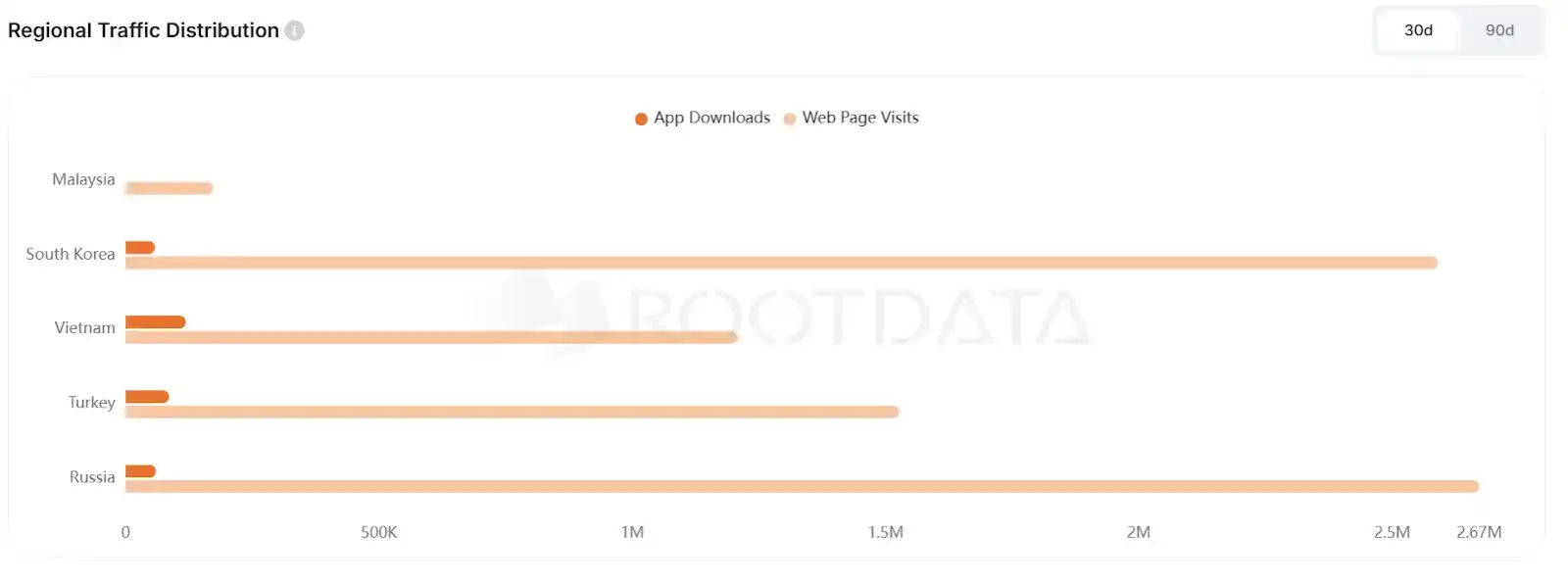
In terms of traffic, Binance performed best this month in emerging markets like Russia and South Korea, with total visit traffic exceeding 5.27 million sessions, significantly领先 other cryptocurrency exchanges.
2) OKX
In February, OKX's spot trading volume was $60.5 billion, a month-on-month increase of 4.3%, making it one of the few cryptocurrency exchanges to see an increase in trading volume.
This month, OKX continued its low-frequency listing strategy, listing only two assets, CC and ZAMA, on the spot market. Additionally, it listed assets like AZTEC, ESP, ROBO, and OPN on the futures market.
On February 26th, OKX officially launched stock perpetual contract functionality in some supported countries/regions, thereby joining the competition in tokenized stocks.至此, major cryptocurrency exchanges now all support tokenized stock trading.
3) Coinbase
In February, Coinbase's spot trading volume was $70.2 billion, a month-on-month increase of 2.3%, also making it one of the exchanges with increased trading volume.
In terms of listings, Coinbase listed new coins such as ROBO, ZAMA, AZTEC, ESP, as well as existing coins like DEEP, UP, and HYPE. The number of 12 newly listed coins was second only to Kraken among first-tier exchanges, and the transparency of all tokens was above 60%, reflecting Coinbase's strategy of attracting more users through active listing policies.
In terms of website traffic, Coinbase performed relatively well this month in emerging markets like Turkey and Russia, but overall traffic remained significantly lower than exchanges like Binance and Gate, primarily because Coinbase mainly focuses on compliant markets like Europe and the US.

This month, Coinbase announced its Q4 and full-year 2025 financial results, recording a net loss of $667 million. Total revenue was $1.78 billion, down 5% quarter-on-quarter and approximately 22% year-on-year. Total trading volume for full-year 2025 increased by 156% year-on-year, and its market share in crypto trading doubled to approximately 6.4%.
4) Gate
In February, Gate's spot trading volume was $70.8 billion, a month-on-month decrease of 11.7%, a decline slightly larger than the overall crypto market decline.
In terms of listings, Gate listed 8 coins on the spot market this month, including PACT, AZTEC, ESP, CRYPTOBURG, RNBW, ELON, BIRB, ZAMA, and ROBO, 14 fewer than the previous month. In terms of website traffic, Gate performed adequately in emerging crypto markets like South Korea, Russia, Vietnam, and Turkey, with total visits reaching 2.46 million sessions. However, traffic in markets like Russia and Vietnam decreased by more than 20% month-on-month.
This month, Gate announced that it had obtained a Payment Institution (PI) license granted by the Malta Financial Services Authority (MFSA), laying the foundation for providing compliant stablecoin and payment services within the EU. Gate also announced the launch of the promoter task and incentive platform "Gate Booster," targeting crypto industry KOLs, content creators, and community builders, connecting quality promotion resources with Gate ecosystem projects through a standardized task mechanism and incentive system.
Other Important Exchange Developments This Month:
- Kraken announced the launch of regulated perpetual futures contracts based on tokenized stocks. These products are available to eligible non-US users in over 110 countries/regions, tracking digital versions of major US stocks, indices, and gold ETFs, built on xStocks' tokenized stock products.
- Kraken announced the launch of its crypto asset staking loan service "Flexline," allowing Kraken Pro traders to obtain liquidity using their existing digital assets as collateral without selling their holdings.
- Gemini announced layoffs of 25% (up to 200 people) and its exit from the European market. Half a month later, its Chief Operating Officer Marshall Beard, Chief Financial Officer Dan Chen, and Chief Legal Officer Tyler Meade had all left the company.
- Crypto.com announced this month that it has received conditional approval from the U.S. Office of the Comptroller of the Currency (OCC), allowing it to apply for a national bank charter in the future. This approval will enable Crypto.com to offer digital asset custody and staking services under a federal regulatory framework.
- KuCoin launched KuCoin Feed 2.0 and KuCoin Live, aiming to connect real-time market discussions with professional-level trading execution features within the KuCoin App.