Robinhood Launches Its Own Chain, No Longer Wants to Be a Tenant on Others' Chains

链捕手Published on 2026-07-02Last updated on 2026-07-02

Abstract

Robinhood has launched its own layer-2 blockchain, Robinhood Chain, built on Arbitrum, marking a strategic shift to control its financial infrastructure rather than relying on external networks. The chain focuses on tokenized real-world assets (RWA) and DeFi, enabling trading of tokenized stocks on integrated DEXs and use in lending and yield farming. Alongside, Robinhood introduced Robinhood Earn for USDG stablecoin lending, expanded European perpetual futures, and launched AI-powered Agentic Accounts in the US. This move reflects a broader trend among financial platforms like Circle and Coinbase to build proprietary chains, moving from being front-end interfaces to owning the underlying settlement layer. For Robinhood, with nearly 28 million funded accounts, this aims to deepen control over asset flows, clearing, and revenue streams across stocks, crypto, and emerging products like prediction markets. The launch comes as Robinhood's crypto trading revenue declines sharply, with prediction markets now potentially surpassing it as a key income source. The company is streamlining operations with recent layoffs while aggressively expanding its integrated financial ecosystem, aiming to become a comprehensive "everything exchange" rather than just a commission-free broker or crypto gateway.

On July 1, Robinhood held a product launch event, announcing a series of new products at once.

The Robinhood Chain Layer 2 public mainnet officially launched. This is a network built on Arbitrum, focusing on tokenized real-world assets and DeFi applications.

Users can trade tokenized stocks on decentralized exchanges like Uniswap, Rialto, Lighter, and 1inch via Robinhood Chain, and use these assets in DeFi scenarios, including as collateral for lending or depositing into liquidity pools to earn yields.
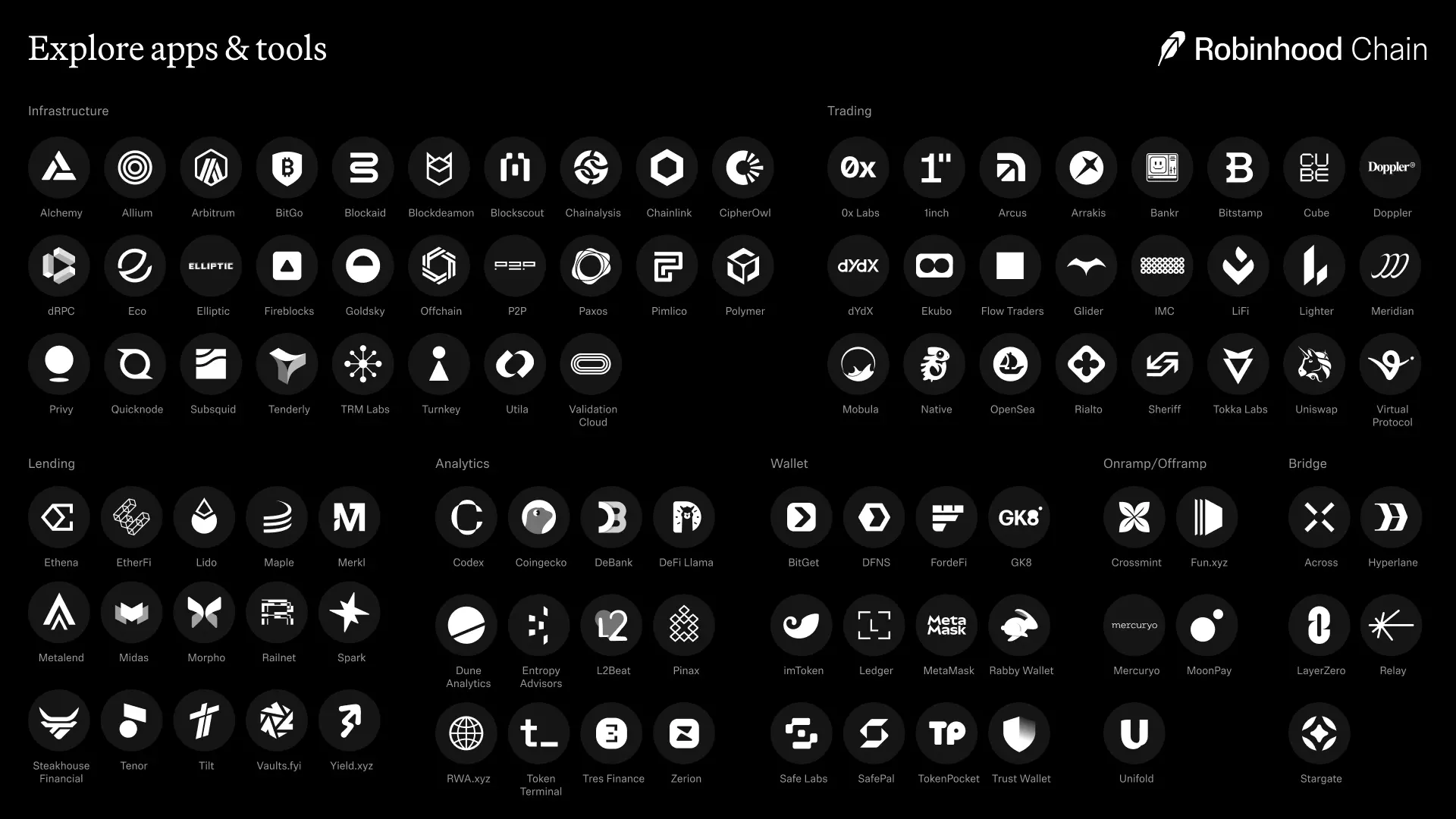
With the mainnet launch, Robinhood's Stock Tokens are now fully accessible. Users can use related products in over 120 countries via the Robinhood Wallet, with availability varying by jurisdiction.

Simultaneously, Robinhood launched Robinhood Earn. This product allows users to lend out the USDG stablecoin via self-custody wallets, with an expected annualized yield of approximately 7%. The underlying lending infrastructure is provided by Morpho, with support from DeFi protocols like Steakhouse, Ethena, Spark, and Maple. The company states that insurance mechanisms have also been introduced to reduce risk exposure.

Additionally, Robinhood announced the expansion of its European perpetual futures products to cover commodities, ETFs, and forex markets, with plans to launch crypto trading in the UK. Following the acquisition of WonderFi, Robinhood's services have also entered the Canadian market.
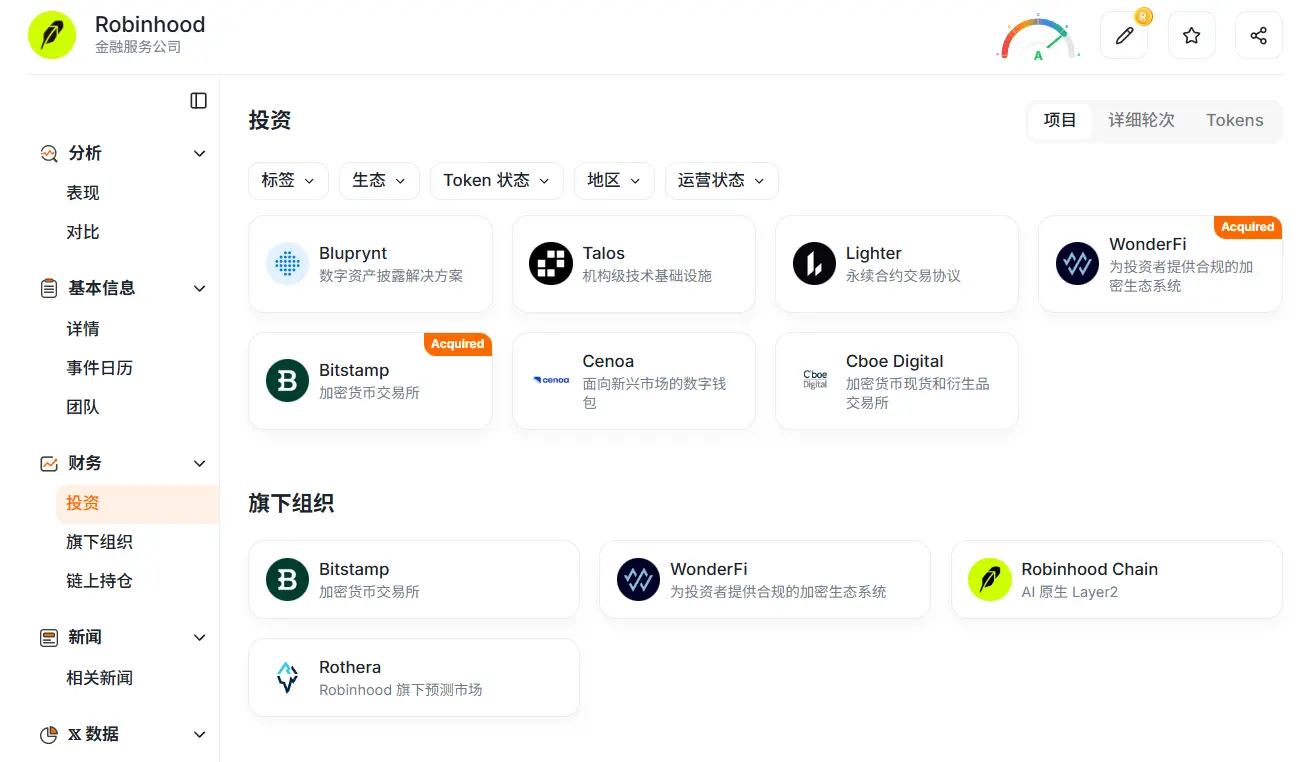
Image Source: RootData

In the US market, Robinhood introduced Agentic Accounts for crypto users. Eligible users can connect AI models to Robinhood's trading infrastructure while retaining control over fund allocation and trading parameters.

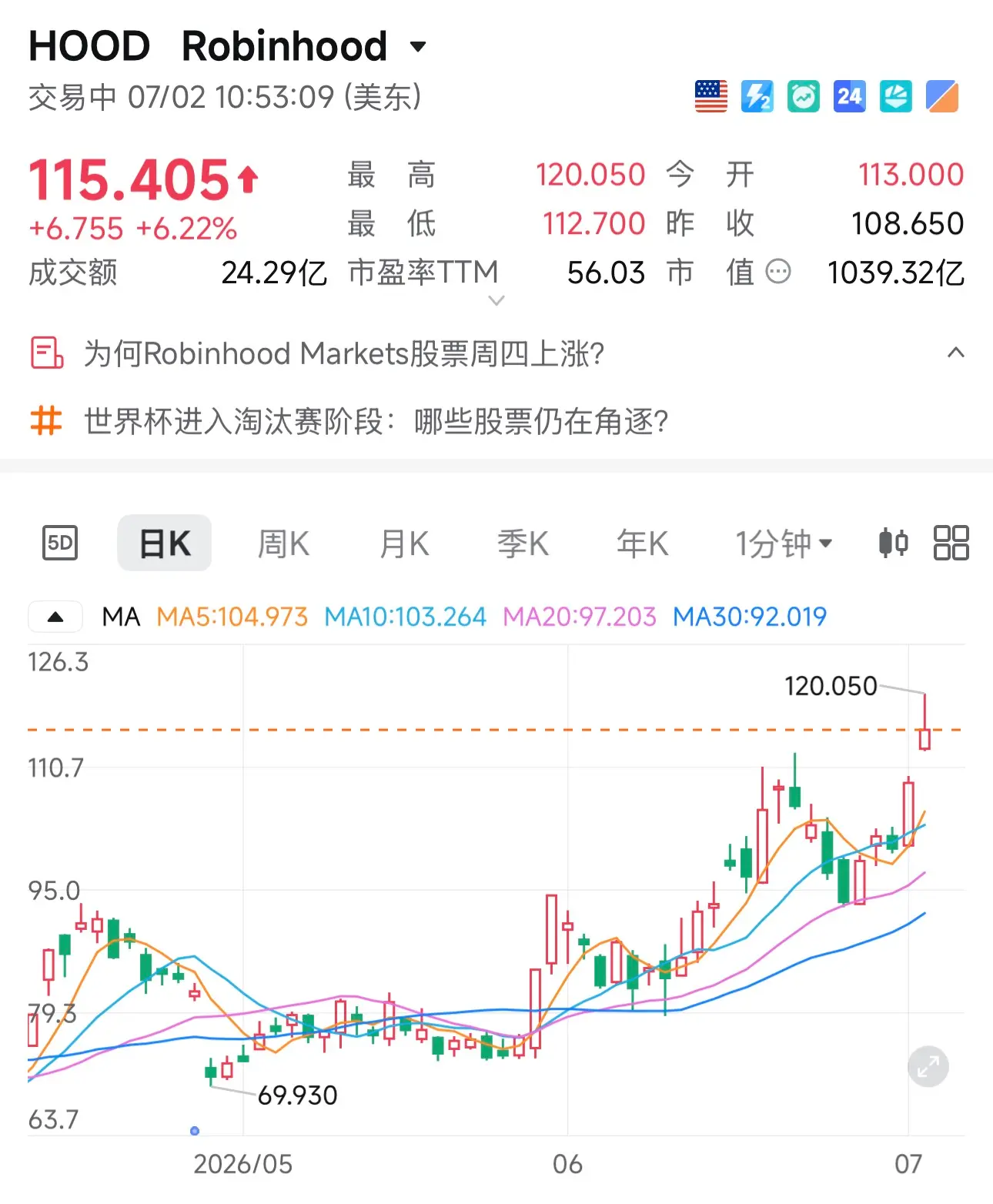
On the day of the event, Robinhood's stock price closed up 8.35% and continued to rise during the US market session tonight.
This is not just a regular crypto product update. Robinhood is gradually placing stocks, cryptocurrencies, tokenized assets, stablecoin yields, perpetual futures, and AI trading tools into the same financial account system. The company's core identity was once a zero-commission brokerage; now, it seems to be moving closer to becoming an "everything exchange."

The significance of Robinhood Chain lies here as well. It's not just about adding another Layer 2; more importantly, Robinhood doesn't want to be just a front-end on others' chains in the long term.

Over the past few years, the common approach for financial companies entering the crypto industry has been to integrate with existing public chains. The platform handles users, interfaces, and product packaging, while underlying settlement, gas fees, liquidity, and DeFi applications occur on external networks.

This model allows for quick launch and leverages existing ecosystems. However, for financial platforms that already have massive user entry points, a long-term issue arises: users are within their own app, but assets and settlement happen on someone else's turf.

For Robinhood, this issue is particularly sensitive. It has nearly 28 million funded accounts, with users already accustomed to trading stocks, options, and crypto. This means Robinhood is no longer just a stock trading app but is evolving into a comprehensive financial entry point covering multiple asset classes and trading forms.

In this context, launching its own chain becomes a natural extension. If Robinhood only directs users to external DeFi, it remains merely a channel provider. If tokenized stocks, USDG lending, AI agent trading, and future RWA products all run on its own chain, it can more deeply control trading, settlement, collateral, yields, and asset flows.

The platform transforms from an interface provider to an owner of financial rails—this is a deeper change.

Following the launch of Robinhood Chain, protocols like Uniswap, 1inch, Lighter, Morpho, Chainlink, BitGo, Ethena, and EtherFi have successively integrated, covering trading, liquidity, lending, oracles, custody, and cross-chain functions.

More notably, the new DEX Arcus, launched by dYdX, chose to deploy on Robinhood Chain rather than dYdX's own chain. This decision sparked controversy within the dYdX community, indicating that institutional chains are competing not just for end-users but also for protocols, liquidity, and product attention.

This is why more financial companies are launching their own chains. Circle's launch of Arc is a stablecoin issuer wanting to tighten its grip on the circulation and settlement rails of USDC. Coinbase's launch of Base is an exchange hoping to keep user, asset, and developer activity within its own ecosystem. Robinhood Chain represents brokers and retail trading platforms starting to compete for the on-chain settlement layer of tokenized assets.

Their asset endowments differ, but they face the same problem. If they don't build their own settlement layer, they risk transitioning from being masters of user and asset entry points to tenants on others' chains.

This wave of chain launches also differs from the previous public chain boom. The last wave focused more on TPS, ecosystem incentives, and fundraising narratives. Now, when financial companies launch chains, the focus shifts to stablecoin gas payments, compliance privacy, RWA issuance, on-chain collateral, AI agent trading, institutional settlement, and internalizing yields.

However, for Robinhood, what's truly noteworthy may not be just Robinhood Chain.

Just last month, Robinhood announced laying off 10% of its staff, about 290 people, expecting to incur approximately $20 million in severance and benefit restructuring costs, plus about $8 million in stock-based compensation expenses. CEO Vlad Tenev stated that while the company's current business condition is very strong, it must avoid excessive institutional hierarchy and needs to keep the team lean and highly focused.

On one hand, reducing organizational costs; on the other, intensively launching new businesses. The signal from Robinhood is clear: it doesn't want to be just a zero-commission broker or just a crypto trading entry point; it aims to keep more trading, issuance, settlement, and yield processes within its own system.

And the backdrop to all this is that due to shrinking institutional trading volume, Robinhood's cryptocurrency transaction revenue is plummeting, nearly halving to $134 million in Q1, with Q2 expected to fall below that figure. Currently, the company's revenue growth is mainly driven by a surge in prediction market revenue.

According to calculations by analyst Dr. Crossroads, as of June 25, Robinhood's Q2 event contract trading volume has reached approximately 12.3 billion contracts. Based on a $0.01 fee per contract, this business is expected to generate at least $123 million in revenue for the quarter, with annualized revenue potentially reaching $500 million, likely marking the first time this business's revenue exceeds its crypto trading revenue.
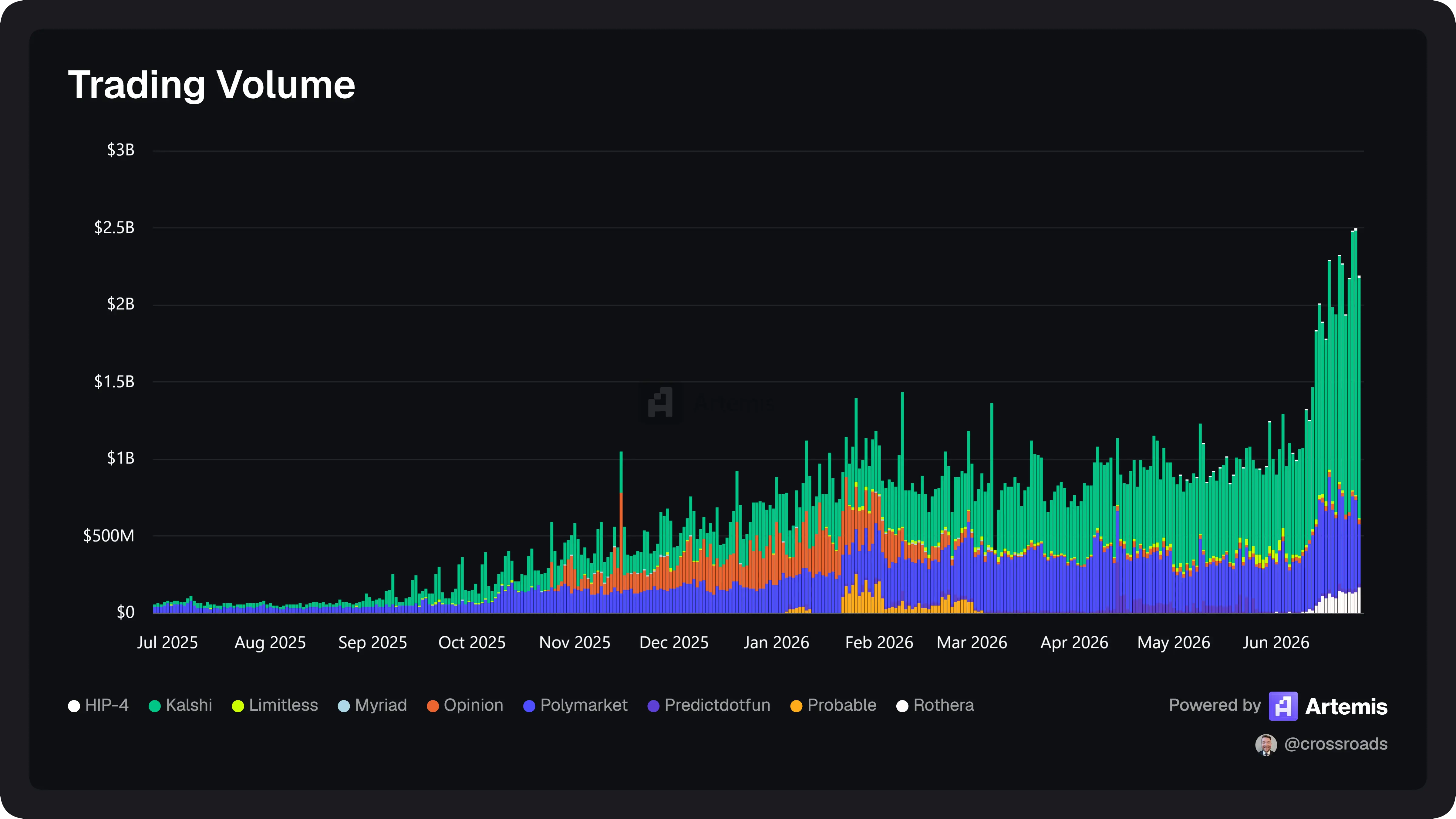
Its newly launched prediction market platform, Rothera, achieved over 900 million contracts in trading volume in its first week, contributing nearly 60% of the company's potential contract trading growth. Simultaneously, the company plans to cut fees from $0.02 to $0.006 per contract, using price advantages to keep trading volume and profits within its own ecosystem.

Ultimately, the product launch is about ambition, while the financial report is about reality. How many developers Robinhood Chain can attract is important, but whether the prediction markets can sustainably fill the revenue gap left by declining crypto spot trading will also impact the market's repricing of this company.

For Robinhood, the real question is no longer just whether it can launch a chain, but whether it can turn stocks, crypto, prediction markets, tokenized assets, stablecoin yields, and AI trading into a sustainable business within a single account system.


Related Questions

QWhat is the Robinhood Chain and why did Robinhood launch it?

ARobinhood Chain is a Layer 2 public mainnet based on Arbitrum, focused on tokenized real-world assets and DeFi applications. Robinhood launched it to move beyond being just a front-end interface on other blockchains, aiming to control the underlying trading, clearing, and financial infrastructure for its diverse products (like tokenized stocks, stablecoin lending, and AI trading). This shift allows Robinhood to become a 'financial rail owner' rather than a 'tenant' on another chain.

QWhat new product allows users to lend USDG stablecoin, and what is its expected yield?

ARobinhood launched 'Robinhood Earn,' a product that allows users to lend the USDG stable币 through self-custody wallets. The expected annualized yield is approximately 7%. The underlying lending infrastructure is provided by Morpho, with support from DeFi protocols like Steakhouse, Ethena, Spark, and Maple, and includes an insurance mechanism to reduce risk exposure.

QHow is Robinhood addressing the decline in its cryptocurrency trading revenue?

ARobinhood's cryptocurrency trading revenue has been declining significantly. The company is addressing this by aggressively expanding into prediction markets (event contracts). Analyst estimates suggest this business could generate over $1.23 billion in quarterly revenue, potentially surpassing crypto trading revenue. Robinhood is also cutting fees in this segment to attract more volume and keep revenue within its ecosystem.

QWhat broader strategic shift does Robinhood's recent announcements represent?

ARobinhood's recent announcements represent a strategic shift from being a zero-commission stock brokerage and crypto trading gateway towards becoming an 'everything exchange' or a comprehensive financial ecosystem. The company is integrating stocks, crypto, tokenized assets, stablecoin yields, perpetual futures, and AI trading tools into a unified account system, while also building its own blockchain infrastructure (Robinhood Chain) to internalize more value and control from transactions, clearing, and asset flows.

QWhat recent operational action did Robinhood take, and what was the stated reason?

ALast month, Robinhood announced a workforce reduction of 10%, affecting approximately 290 employees. CEO Vlad Tenev stated that while the company's business fundamentals are strong, this action was necessary to avoid excessive organizational hierarchy and to maintain a lean, highly focused team. This move comes alongside the company's heavy investment in launching new business lines.

Related Reads

But Bin's Latest Speech: Do Not Miss Out on a Great Era

Dan Bin's Latest Speech: Don't Miss a Great Era On June 29th, Dan Bin, Chairman of Dongfang Harbor (东方港湾), delivered a keynote speech titled "Don't Miss a Great Era" at the "2026—All in the Silicon-based New Epoch" Mid-Year Strategy Summit. Addressing concerns about an AI bubble, Dan Bin argued from an industrial cycle perspective that "the risk of missing an era may be greater than worrying about short-term bubbles." He views humanity as standing at the dawn of the AI era, which could be more disruptive than the electronics, internet, and mobile internet eras. He posits that the AI wave is unlikely to end in just three or four years. Using the internet era's decade-long rhythm as a reference point—with ChatGPT's late 2022 launch as the starting line—a key risk assessment window may only arrive around 2033. Dan Bin emphasized that technological progress is the primary driver of long-term capital market growth, while factors like trade wars or interest rate hikes are secondary. Expanding to a civilizational scale, Dan Bin presented a thought experiment on silicon-based life potentially supplementing or succeeding carbon-based life as a direction for extending Earth's civilization, especially over cosmic timescales spanning billions of years. On geopolitics, he noted that AI is already rewriting warfare rules, as seen in conflicts like Ukraine, and that neither the U.S. nor China can afford to lose the AI race, with each leveraging different strengths. Reflecting on investment lessons, Dan Bin cited Warren Buffett's and Charlie Munger's admitted "regrets" about missing major tech opportunities like Microsoft, underscoring the need for continuous cognitive evolution. His firm, Dongfang Harbor, is deepening its research in foundational AI areas like computing power and storage. Dan Bin concluded by urging investors to maintain a long-term perspective, embrace the epochal shift, and rationally hold onto the opportunities presented by this transformative age. He closed with a poetic reminder: "The tide never turns back... Born in this time is a great fortune in itself. Don't let hesitation trap your steps, nor short-sightedness waste the years—do not miss this magnificent era that belongs to us."

marsbit1h ago

But Bin's Latest Speech: Do Not Miss Out on a Great Era

marsbit1h ago

Latest Speech by Dan Bin: Do Not Miss Out on a Great Era

Dan Bin, Chairman of Dongfang Harbor, delivered a keynote speech titled "Don't Miss a Great Era" at the Glonghui "2026—All in Silicon-Based New纪元" Mid-Year Strategy Summit on June 29th. Addressing concerns about an AI bubble, he argued from an industrial cycle perspective that the risk of missing an entire epoch far outweighs the risk of short-term泡沫. He positioned humanity at the dawn of the AI era, which he views as potentially more disruptive than the electronic, internet, and mobile internet eras. Dan Bin suggested the AI wave is unlikely to end in just three to four years. Drawing a parallel to the internet era's decade-long cycle starting from the 1994 Netscape IPO, he indicated that with ChatGPT's late-2022 launch as a marker, a key risk assessment point might not arrive until around 2033. He emphasized that technological progress is the primary driver of long-term capital market growth, with factors like trade wars and interest rates being secondary. Expanding his perspective to a civilizational scale, Dan Bin presented a thought experiment on silicon-based life potentially replacing carbon-based life as a direction for延续 Earth's civilization, especially given cosmic timescales and interstellar travel challenges. He noted AI's必然 weaponization, citing examples from the Russia-Ukraine war, and stated that neither the U.S. nor China can afford to lose the AI race, with each having distinct competitive advantages. Reflecting on investment lessons, he mentioned Warren Buffett's recent moves into tech like Google and查理·芒格's expressed regret about missing Microsoft's massive growth, underscoring the need for continuous认知迭代. Dan Bin concluded by urging investors to maintain a long-term perspective, focus on core technological trends, and rationally embrace the opportunities of this transformative era, so as not to辜负 this "great时代" defined by波澜壮阔 change.

链捕手1h ago

Latest Speech by Dan Bin: Do Not Miss Out on a Great Era

链捕手1h ago

Trading

Spot
活动图片