Ripple’s Move To Privacy: How A Re-organization Of The XRP Ledger Will Affect The Network

bitcoinistPublished on 2026-06-01Last updated on 2026-06-01

Abstract

Ripple's former CTO David Schwartz discussed how the XRP Ledger (XRPL) could respond to potential state-level attacks. While acknowledging that authoritarian regimes could cause temporary disruptions by targeting the validator network, Schwartz argued that long-term control is unlikely due to the network's decentralized structure, where Ripple-run validators comprise less than 20%. The network's resilience hinges on its ability to replace compromised validators. For sustained threats, Schwartz proposed a theoretical two-layer consensus reorganization. An inner layer of validators would handle daily operations, while an outer layer would manage changes to the validator set. This outer layer could operate more discreetly and infrequently, potentially using anonymizing services like Tor, making it harder to target. The core point is that the XRPL community could adapt its structure to maintain operations even under significant external pressure.

Ripple CTO Emeritus David Schwartz has laid out a rare look at how the XRP Ledger could respond if it ever came under pressure from a state-level actor.

The discussion started with a question about whether an authoritarian regime could use or attack the XRP Ledger by targeting its validator network. Schwartz did not dismiss the risk entirely, and according to him, if the pressure ever became serious enough, the XRP Ledger could be reorganized around a more resilient validator structure.

State-Level Attacks May Only Disrupt XRPL Temporarily

The XRP Ledger has operated without a major outage across more than 70 million closed ledgers, but that reliability record may soon be tested in ways its creators never anticipated, one of which may be authoritarian regimes and state-level interference.

Schwartz acknowledged that the threat to blockchain networks from state actors is real. State-level actors, he said, could cause temporary disruptions to blockchains, including the XRP Ledger, but long-term damage is a different matter entirely. The responses were made to a question on the social media platform X, where an XRP community member asked if an authoritarian regime like Putin’s would co-opt or disrupt the UNL/validator network to weaponize the ledger.

However, according to the Ripple CTO emeritus, long-term control from external forces would be much harder if the broader XRPL community stays active enough to respond. Ripple-run validators account for less than 20% of the total network, which means any concentrated attack on Ripple’s own infrastructure would leave the validator set intact.

The XRPL network’s survival in that type of scenario would depend less on whether one validator is attacked and more on whether the network can keep replacing compromised or pressured operators. The attack would only become truly serious if a hostile actor could make people too afraid to run validators at all.

How Reorganizing The XRP Ledger Will Affect The Network

Schwartz also described a possible longer-term change to XRPL’s consensus structure in the event of an attack by an authoritarian regime. His example was a two-layer consensus algorithm, where the inner layer will handle normal network activity, and the outer layer will only come into play when the network needs to change the Unique Node List (UNL) of the inner layer.

The inner validators would keep the XRP Ledger running day to day. If those validators were attacked or compromised, the effect would be minimal, as they will be easily replaced. The outer validators would serve a lighter and less frequent role, stepping in mainly when changes are needed to the validator set.

Targeting the outer validators would also be harder because they would not need to operate constantly in the same visible way. They could be kept lightweight, appear only when needed, and operate through anonymizing services such as Tor or I2P.

XRP trading at $1.30 on the 1D chart | Source: XRPUSDT on Tradingview.com

Related Questions

QWhat did Ripple CTO Emeritus David Schwartz say about the possibility of an authoritarian regime targeting the XRP Ledger?

AHe acknowledged that state-level actors could cause temporary disruptions to the XRP Ledger, but long-term damage is a different matter. He suggested that if pressure became serious enough, the network could reorganize around a more resilient validator structure.

QWhat is the proposed two-layer consensus structure described by Schwartz to protect against state-level attacks?

AThe proposed structure involves an inner layer of validators that handles normal daily operations, and an outer layer of validators. The outer layer only activates when changes are needed to the Unique Node List (UNL) of the inner layer, making them harder to target as they operate less frequently and can use anonymizing services.

QAccording to the article, what would determine the XRP Ledger's survival in the event of a state-level attack targeting its validators?

ASurvival would depend less on a single validator being attacked and more on the network's ability to keep replacing compromised or pressured validator operators. An attack would only become critical if it made people too afraid to run validators at all.

QWhy would an attack concentrated on Ripple's own validators likely not cripple the XRPL network?

ABecause Ripple-run validators account for less than 20% of the total network. Therefore, attacking them would leave the majority of the validator set intact, and the network could continue operating.

QWhat role would the outer layer of validators play in the proposed reorganization of the XRP Ledger?

AThe outer layer of validators would serve a lighter, less frequent role. They would step in mainly when changes are needed to the validator set (the inner layer's Unique Node List) and could operate in a more hidden manner using anonymizing services.

Related Reads

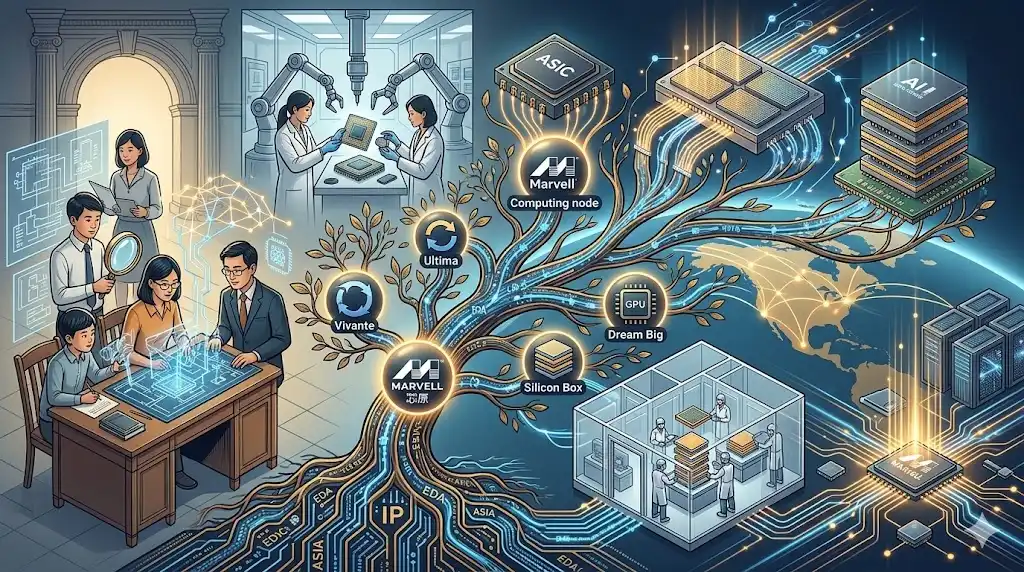
After Marvell's 32% Surge, the Chinese Chip Family Behind It Emerges

The stock price of Marvell Technology surged 32.5% on June 2nd, driven by NVIDIA CEO Jensen Huang highlighting its custom ASICs and optical interconnects as core to AI data center architecture. This event brought attention to the Chinese semiconductor family behind Marvell: the Dai siblings. The story centers on three siblings, all UC Berkeley graduates, whose three-decade entrepreneurial journey aligns with major semiconductor industry shifts. In 1995, youngest sister Dai Wei Li co-founded Marvell with her husband Sehat Sutardja and his brother, focusing on storage controllers. Eldest brother Dai Wei Min founded EDA company Ultima, later sold to Cadence, and later founded VeriSilicon (芯原) in China, becoming a leading semiconductor IP provider. Second brother Dai Wei Jin co-founded EDA firm Silicon Perspective (sold to Cadence) and GPU IP company Vivante, later acquired by VeriSilicon. The combined "Dai-Sutardja" family network extends beyond Marvell. Their ventures and investments form a comprehensive ecosystem for the post-Moore's Law, chiplet era. Key holdings include: Dream Big Semiconductor (AI SuperNICs, acquired by Arm), Alphawave (high-speed SerDes IP, acquired by Qualcomm), and Silicon Box (a chiplet advanced packaging foundry). VeriSilicon itself thrives on the AI ASIC and IP boom in China. Collectively, the family's AI infrastructure-related portfolio is estimated at over $22 billion. Their strategy represents a distinct path: building critical components for open standards and key manufacturing capacity in the chiplet era, rather than pursuing standalone AI chip dominance. While this path may not create the next NVIDIA, it has enabled repeated successful exits and sustained influence within the global semiconductor industry.

marsbit49m ago

After Marvell's 32% Surge, the Chinese Chip Family Behind It Emerges

marsbit49m ago

Microsoft is Afraid of Being Marginalized by AI Giants

Microsoft, once the defining force of the PC era, now faces a familiar challenge in the AI age: the risk of being relegated to a profitable but invisible infrastructure provider. This anxiety was laid bare at Build 2026, where CEO Satya Nadella unveiled a major strategic pivot. The catalyst was a quiet April agreement that dissolved Microsoft's exclusive licensing and cloud-hosting deal with OpenAI, its once-vital partner. This erased Microsoft's key AI moat. With OpenAI and Anthropic defining AI applications and gaining enterprise traction—even within Microsoft's own ranks—Nadella had to answer: without exclusivity, what is Microsoft's role? The answer was a suite of seven in-house AI models, a developer-focused AI workstation (Surface RTX Spark Dev Box), and, most crucially, the Agent 365 platform for enterprise AI governance. The models, notably targeting Anthropic's strengths in coding and enterprise, signal a defensive move. However, the broader strategy is to make the models themselves less decisive. Financially, Microsoft's AI revenue is strong, driven largely by Azure running others' models. Yet its user-facing products like Copilot show weak penetration and engagement. Microsoft earns infrastructure money but lacks direct user mindshare. Nadella's core fear is being "hollowed out." As OpenAI and Anthropic prepare for IPOs and gain financial independence, they may build their own infrastructure, threatening Azure's lucrative AI revenue stream. Microsoft's window is to entrench itself deeper: not as the model creator, but as the indispensable platform for securely deploying, managing, and governing all AI models within the enterprise through Agent 365. Build 2026 revealed Microsoft's bet: in the AI era, the ultimate power lies not in any single model, but in the enterprise "operating system" that controls them. Nadella is determined to ensure Microsoft is the driver of this new era, not just a passenger.

marsbit1h ago

Microsoft is Afraid of Being Marginalized by AI Giants

marsbit1h ago

CPU, Quietly Returning to the Center of the AI Computing Power Stage

Over the past three years, AI computing power narratives have been dominated by GPUs. However, starting in 2026, this story began to shift. While training large models remains GPU-intensive, the rapid growth of inference and AI agent workloads, which require high levels of task orchestration, concurrency, and data flow management, has highlighted a renewed critical role for CPUs. These are tasks GPUs are not designed to handle. Intel's recent launch of the Xeon 6+ processor, built on its Intel 18A process and featuring up to 288 efficiency cores (E-cores), exemplifies this strategic pivot. It is positioned not as a mere companion to GPUs but as the essential "control plane" for AI infrastructure, optimized for high-density, energy-efficient, and high-throughput workloads characteristic of AI agents and inference. This "CPU resurgence" is not about CPUs outperforming GPUs in raw computation. It reflects a systemic bottleneck: as AI scales from training single models to deploying countless intelligent agents, the demand for coordination and data handling surges. Major cloud providers are also developing their own high-density ARM-based server CPUs for similar workloads. However, Intel's success with this strategy faces significant challenges. Competition includes NVIDIA's integrated CPU-GPU solutions, the expanding adoption of cloud vendors' in-house ARM CPUs, and the crucial market test of Intel's 18A manufacturing process against rivals like TSMC's N2. In conclusion, CPUs are indeed reclaiming a central, though redefined, role in AI compute—managing the complex orchestration that enables massive-scale AI deployment. While the trend is clear, which company will ultimately lead this CPU resurgence remains an open question to be decided in the data centers of 2027 and beyond.

marsbit1h ago

CPU, Quietly Returning to the Center of the AI Computing Power Stage

marsbit1h ago

Trading

Spot
Futures

Hot Articles

What is XRP 2.0

XRP 2.0: A New Frontier in the Cryptocurrency Landscape Introduction to XRP 2.0 In the ever-evolving realm of cryptocurrency, new projects continuously emerge, vying for attention and adoption. One such promising initiative is XRP 2.0, a novel cryptocurrency project designed to leverage advanced blockchain technology and robust encryption methodologies. While the name draws parallels with Ripple’s XRP, it’s crucial to note that XRP 2.0 operates independently, focusing on enhancing transaction security, privacy, and scalability. As the digital financial landscape increasingly embraces decentralized solutions, XRP 2.0 aims to contribute meaningfully to web3 and the overall expansion of crypto projects. What is XRP 2.0? At its core, XRP 2.0 is a cryptocurrency project that aims to create a secure and decentralized digital currency ecosystem. Its foundational technology integrates sophisticated blockchain principles with cutting-edge encryption techniques. The overarching goal of XRP 2.0 is to establish itself as a reliable and efficient platform enabling swift transaction execution while prioritizing enhanced privacy protections for its users. The project is promoted as a solution to many limitations faced by existing cryptocurrencies, proposing a system that can handle a higher volume of transactions with improved speed and privacy. This versatility positions XRP 2.0 as a significant contender in a marketplace riddled with various digital currencies. Who is the Creator of XRP 2.0? The identity of the creator behind XRP 2.0 has been flagged as ‘Wilbur.’ However, comprehensive details regarding Wilbur or their associated entity remain elusive. The anonymity of many cryptocurrency creators is not an uncommon phenomenon in the industry, often designed to maintain a degree of privacy and security. Who are the Investors of XRP 2.0? As of now, specific information related to the investment foundations or organizations supporting XRP 2.0 is not publicly available. In the cryptocurrency sector, the backing by reputed investors can significantly influence a project's credibility and success, yet the transparency regarding the financial supporters of XRP 2.0 has not been established. How Does XRP 2.0 Work? XRP 2.0 stands out by employing a combination of blockchain technology and advanced encryption algorithms that ensures secure and decentralized transactions. Its innovative structure includes unique features designed to foster user engagement and broaden functionalities beyond conventional cryptocurrency transactions. Among these features, XRP 2.0 incorporates AI-powered capabilities, such as text-to-image and text-to-speech functionalities. These additions are designed to enhance the interactive experience for users, promoting broader applicability across various sectors. By bridging technological advancements with user-centered design, XRP 2.0 aims to capture the attention of a diverse range of individuals and enterprises looking to integrate cryptocurrency solutions into their operational frameworks. Timeline of XRP 2.0 Understanding XRP 2.0 requires examining the milestones that have defined its journey thus far: July 23, 2023: XRP 2.0 is introduced as a novel cryptocurrency project, aiming to revolutionize secure and decentralized transaction capabilities in the blockchain domain. September 8, 2023: The launching of another project, XRP20, occurs, marking the emergence of an ERC-20 token on the Ethereum blockchain that remains unrelated to XRP 2.0. November 13, 2023: The XRP Ledger undergoes a significant update with the release of rippled server software version 2.0.0. It is essential to note that this development is disconnected from the XRP 2.0 cryptocurrency project. Key Points About XRP 2.0 To distill the essence of XRP 2.0, several critical factors emerge: Unique Features: The inclusion of features like AI-powered text-to-image and text-to-speech further diversifies the potential applications of XRP 2.0. Blockchain Technology: The framework utilizes advanced blockchain mechanisms and encryption protocols, ensuring a secure and decentralized environment for transactions. Scalability and Privacy: XRP 2.0 prioritizes enhanced privacy protections in transaction processes and the scalability necessary to accommodate a growing user base. No Affiliation with Ripple: Importantly, despite its name, XRP 2.0 does not have any allegiance or collaboration with Ripple’s XRP, distinguishing its operational framework and objectives within the cryptocurrency ecosystem. Conclusion XRP 2.0 represents an ambitious venture into the cryptocurrency sphere, aiming to offer a combination of security, privacy, and efficiency in digital transactions. By integrating sophisticated technologies and user-friendly features, the project sets out to broaden the horizons of what cryptocurrency can achieve in today's digital economy. While the anonymity of its creator and lack of disclosed investors might raise questions for some, XRP 2.0's focus on advanced functionalities and decentralisation enhances its appeal amidst an increasingly crowded crypto market. As the cryptocurrency landscape continues to evolve, XRP 2.0 may yet emerge as a pivotal player in the expansion of secure and scalable blockchain solutions.

942 Total ViewsPublished 2024.04.01Updated 2024.12.03

What is XRP 2.0

Discussions

Welcome to the HTX Community. Here, you can stay informed about the latest platform developments and gain access to professional market insights. Users' opinions on the price of XRP (XRP) are presented below.

活动图片