Ripple Makes New AI Bet As XRP Ledger Targets Agentic Payments

bitcoinistPublished on 2026-02-26Last updated on 2026-02-26

Abstract

Ripple has invested in AI infrastructure startup t54 as part of a $5 million seed round, signaling a strategic move into autonomous payments and agent-driven financial systems. The investment aims to integrate the XRP Ledger as a key network for machine-to-machine commerce. t54 is developing a trust layer for the "agentic economy," focusing on verifiable agent identity (KYA), real-time risk assessment, and programmable accountability. The platform spans identity verification, risk management, credit, and settlement, with support for multiple blockchains including XRPL, Solana, and Base. Ripple executives emphasized the need for evolved financial infrastructure as AI agents become active economic participants. Survey data cited by t54 indicates growing consumer willingness to delegate financial tasks to AI, contingent on robust security. At the time of reporting, XRP was trading at $1.4397.

Ripple has backed AI infrastructure startup t54 in a $5 million seed round, a move that ties the company more closely to the emerging market for autonomous payments and agent-driven financial activity. The investment also puts the XRP Ledger in the frame as one of the networks being positioned for machine-to-machine commerce.

Ripple And The XRP Ledger Enter The Agentic Payments Race

t54 announced on February 25 that its seed round was led by Anagram, PL Capital, and Franklin Templeton, with strategic participation from Ripple, alongside Virtuals Ventures, Blockchain Coinvestors, and ABCDE. The company describes itself as a “trust layer for the agentic economy,” focused on a problem that is starting to attract more attention as AI systems move from recommendation to execution: how to verify an agent’s identity, evaluate its risk, and assign accountability when something goes wrong.

That framing was echoed by Ripple President Monica Long, who wrote on X that “as autonomous agents begin managing and transacting with real capital, trust infrastructure becomes a foundational piece of the equation.” She added that Ripple was “proud to be at the forefront of AI innovation,” calling out t54 as a team “building the trust layer for the agentic economy.”

The company’s pitch is that existing financial rails were built around humans, not software agents acting on delegated authority. In the press release, founder Chandler Fang laid that out directly:

“We are building trust infrastructure for the agentic economy. Financial systems were designed around human identity and human decision-making. As agents become autonomous participants, we need agent-native financial primitives—verifiable agent identity (KYA), real-time risk assessment, and programmable accountability—built for how agents operate.”

That thesis is not just about identity in the abstract. t54 says its platform is built across four pillars: identity and verification, risk and fraud, credit, and a broader operating platform that combines controls with settlement. The idea is to give institutions a way to bind agents to verified developers or human operators, monitor their behavior in real time, and decide when they should be allowed to transact, borrow, or execute payment flows.

The company is also making a direct bet on crypto rails as part of that stack. Among the products it listed is an “XRPL x402 Facilitator,” described as infrastructure that lets AI agents pay for services using XRP and RLUSD. It also highlighted an open-source secure layer on x402 and said its ecosystem spans XRPL, Solana, Base, and Virtuals, suggesting it is not building for a single chain, even if Ripple’s involvement gives XRPL special relevance.

That matters because Ripple’s interest here goes beyond venture exposure. Markus Infanger, SVP at RippleX, framed the opportunity as a shift in the nature of economic actors themselves:

“Autonomous systems are becoming participants in economic activity, not just tools. The financial infrastructure that supports them must evolve accordingly. We support t54’s efforts to build the identity and risk capabilities that will be foundational as AI agents operate across payments, treasury, and capital markets.”

Tony Pecore, Franklin Templeton SVP and director of digital asset management, said:

“As institutions embrace tokenization and autonomous systems, the infrastructure layer must evolve to match. t54 is building the trust and verification framework that institutional finance will require as AI agents become participants in financial markets.”

t54 also backed its market argument with survey data. It cited a recent YouGov study showing 42% of US consumers would allow an AI agent to make purchases on their behalf if it secured the lowest price.

At the same time, research from Keyfactor found 86% of cybersecurity professionals believe autonomous systems and AI agents should have unique, dynamic digital identities. Together, those figures capture the tension t54 is trying to monetize: growing willingness to delegate financial actions to software, but only with tighter controls.

For Ripple and XRPL, the bet is clear. If autonomous agents do become active users of payment rails, then Ripple wants XRP Ledger infrastructure to be part of that next layer.

At press time, XRP traded at $1.4397.
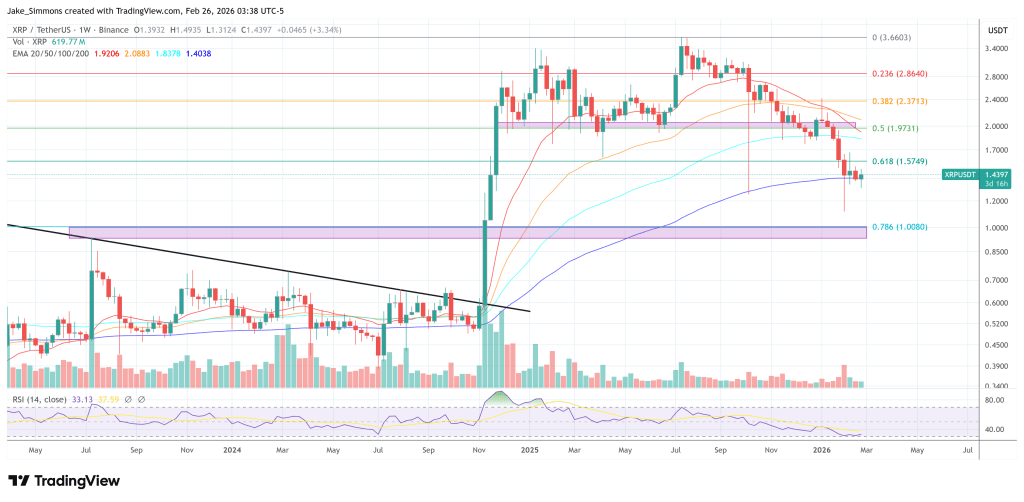
XRP rises back above the 200-week EMA, 1-week chart | Source: XRPUSDT on TradingView.com

Related Questions

QWhat is the main focus of t54, the AI infrastructure startup that Ripple invested in?

At54 is building a trust layer for the agentic economy, focusing on providing verifiable agent identity (KYA), real-time risk assessment, and programmable accountability for autonomous AI agents operating in financial systems.

QWhich financial networks is t54's platform being built to support?

At54's ecosystem spans multiple networks, including XRP Ledger (XRPL), Solana, Base, and Virtuals, indicating it is not building for a single blockchain.

QAccording to Ripple President Monica Long, why is trust infrastructure becoming crucial?

AMonica Long stated that as autonomous agents begin managing and transacting with real capital, trust infrastructure becomes a foundational piece of the equation to ensure security and accountability.

QWhat key statistic from a YouGov study did t54 cite to support its market argument?

At54 cited a YouGov study showing 42% of US consumers would allow an AI agent to make purchases on their behalf if it secured the lowest price.

QHow did Markus Infanger from RippleX describe the shift in economic activity?

AMarkus Infanger described it as autonomous systems becoming participants in economic activity, not just tools, necessitating an evolution in the financial infrastructure that supports them.

Related Reads

Trading

Spot
Futures

Hot Articles

What is XRP 2.0

XRP 2.0: A New Frontier in the Cryptocurrency Landscape Introduction to XRP 2.0 In the ever-evolving realm of cryptocurrency, new projects continuously emerge, vying for attention and adoption. One such promising initiative is XRP 2.0, a novel cryptocurrency project designed to leverage advanced blockchain technology and robust encryption methodologies. While the name draws parallels with Ripple’s XRP, it’s crucial to note that XRP 2.0 operates independently, focusing on enhancing transaction security, privacy, and scalability. As the digital financial landscape increasingly embraces decentralized solutions, XRP 2.0 aims to contribute meaningfully to web3 and the overall expansion of crypto projects. What is XRP 2.0? At its core, XRP 2.0 is a cryptocurrency project that aims to create a secure and decentralized digital currency ecosystem. Its foundational technology integrates sophisticated blockchain principles with cutting-edge encryption techniques. The overarching goal of XRP 2.0 is to establish itself as a reliable and efficient platform enabling swift transaction execution while prioritizing enhanced privacy protections for its users. The project is promoted as a solution to many limitations faced by existing cryptocurrencies, proposing a system that can handle a higher volume of transactions with improved speed and privacy. This versatility positions XRP 2.0 as a significant contender in a marketplace riddled with various digital currencies. Who is the Creator of XRP 2.0? The identity of the creator behind XRP 2.0 has been flagged as ‘Wilbur.’ However, comprehensive details regarding Wilbur or their associated entity remain elusive. The anonymity of many cryptocurrency creators is not an uncommon phenomenon in the industry, often designed to maintain a degree of privacy and security. Who are the Investors of XRP 2.0? As of now, specific information related to the investment foundations or organizations supporting XRP 2.0 is not publicly available. In the cryptocurrency sector, the backing by reputed investors can significantly influence a project's credibility and success, yet the transparency regarding the financial supporters of XRP 2.0 has not been established. How Does XRP 2.0 Work? XRP 2.0 stands out by employing a combination of blockchain technology and advanced encryption algorithms that ensures secure and decentralized transactions. Its innovative structure includes unique features designed to foster user engagement and broaden functionalities beyond conventional cryptocurrency transactions. Among these features, XRP 2.0 incorporates AI-powered capabilities, such as text-to-image and text-to-speech functionalities. These additions are designed to enhance the interactive experience for users, promoting broader applicability across various sectors. By bridging technological advancements with user-centered design, XRP 2.0 aims to capture the attention of a diverse range of individuals and enterprises looking to integrate cryptocurrency solutions into their operational frameworks. Timeline of XRP 2.0 Understanding XRP 2.0 requires examining the milestones that have defined its journey thus far: July 23, 2023: XRP 2.0 is introduced as a novel cryptocurrency project, aiming to revolutionize secure and decentralized transaction capabilities in the blockchain domain. September 8, 2023: The launching of another project, XRP20, occurs, marking the emergence of an ERC-20 token on the Ethereum blockchain that remains unrelated to XRP 2.0. November 13, 2023: The XRP Ledger undergoes a significant update with the release of rippled server software version 2.0.0. It is essential to note that this development is disconnected from the XRP 2.0 cryptocurrency project. Key Points About XRP 2.0 To distill the essence of XRP 2.0, several critical factors emerge: Unique Features: The inclusion of features like AI-powered text-to-image and text-to-speech further diversifies the potential applications of XRP 2.0. Blockchain Technology: The framework utilizes advanced blockchain mechanisms and encryption protocols, ensuring a secure and decentralized environment for transactions. Scalability and Privacy: XRP 2.0 prioritizes enhanced privacy protections in transaction processes and the scalability necessary to accommodate a growing user base. No Affiliation with Ripple: Importantly, despite its name, XRP 2.0 does not have any allegiance or collaboration with Ripple’s XRP, distinguishing its operational framework and objectives within the cryptocurrency ecosystem. Conclusion XRP 2.0 represents an ambitious venture into the cryptocurrency sphere, aiming to offer a combination of security, privacy, and efficiency in digital transactions. By integrating sophisticated technologies and user-friendly features, the project sets out to broaden the horizons of what cryptocurrency can achieve in today's digital economy. While the anonymity of its creator and lack of disclosed investors might raise questions for some, XRP 2.0's focus on advanced functionalities and decentralisation enhances its appeal amidst an increasingly crowded crypto market. As the cryptocurrency landscape continues to evolve, XRP 2.0 may yet emerge as a pivotal player in the expansion of secure and scalable blockchain solutions.

941 Total ViewsPublished 2024.04.01Updated 2024.12.03

What is XRP 2.0

Discussions

Welcome to the HTX Community. Here, you can stay informed about the latest platform developments and gain access to professional market insights. Users' opinions on the price of XRP (XRP) are presented below.

活动图片