Ripple Global Footprint Expands, Quietly Building A Banking Empire – Here’s Why February 26 Is Important

bitcoinistPublished on 2026-02-23Last updated on 2026-02-23

Abstract

Ripple, a leading US payment company, is expanding its global footprint and building a modern digital banking empire through strategic alliances, regulatory approvals, and infrastructure development. Key acquisitions like Metaco and Hidden Road have bolstered its institutional custody, prime brokerage, and treasury infrastructure. A crucial date is February 26, when the SEC is set to announce a decision on a proposed crypto ETF, potentially providing clearer pathways for traditional investors. Meanwhile, investor interest in XRP is surging, with data showing a rapid increase in long positions, indicating growing optimism for a price rebound.

In a significant development that could shape the finance sector, Ripple, a leading American-based payment company, has disclosed its financial ambitions, which signal a growing banking powerhouse. With this move, the firm is extending its global reach in the crypto and financial landscape, reinforcing its modern-day banking infrastructure.

A Bid From Ripple To Reshape Global Banking

Ripple is taking the spotlight after an update about the firm’s latest move that underscores its financial ambitions. The company is progressively growing its global presence and establishing the foundation for what is beginning to seem like a modern digital banking empire.

By forming strategic alliances, gaining regulatory approval, and building infrastructure in important financial areas, the business is putting itself in a position to lead institutional blockchain adoption and cross-border payments. Pumpius, a crypto expert and investor, stated that Ripple is bringing together the full institutional stack in a similar pattern to how banks do it, one regulated component at a time.

The expert has also underlined the firm’s acquisitions in recent years, which tells a story. This is evidenced by the firm’s acquisition of Metaco and Hidden Road. While Metaco gave the firm institutional custody rails, Hidden Road has added prime brokerage-grade execution, financing, and access to real market plumbing. As a result of this, Ripple’s rail plugs into high-volume payment distribution.

While several prices are displayed to the public, some of them are not. However, the trajectory is clear, which is indicated by custody payments, prime brokerage, and treasury infrastructure under one roof. With the inclusion of the OCC Trust bank angle, Ripple is already moving through the United States banking pathway, generating conditional approvals observed among firms in that field.

This is considered the cheat code. Getting involved with the regulated perimeter leads to a barrier to permission, and a company becomes the system that institutions are allowed to use.

As the payment builds a banking stack, February 26 stands as a crucial date in its journey. On the day, the US Securities and Exchange Commission (SEC) is scheduled to announce its decision in a Federal Register proceeding linked to a proposed T Rowe Price crypto Exchange-Traded Fund (ETF). “That is the calendar of when traditional allocators get clearer lanes,” Pumpius added.

Long Positions In XRP Are Heating Up Once Again

With excitement surrounding several updates of Ripple, investors appear to be doubling down on XRP again. Interest in the altcoin has improved over the past few days, as long positions in the leading altcoin are reemerging at a fast rate.

Using data from Binance, the cryptocurrency exchange leader, CW has disclosed a rapid increase in XRP positions from top traders. When investors start to open longs again, it may suggest that they are positioning ahead of a potential bounce.
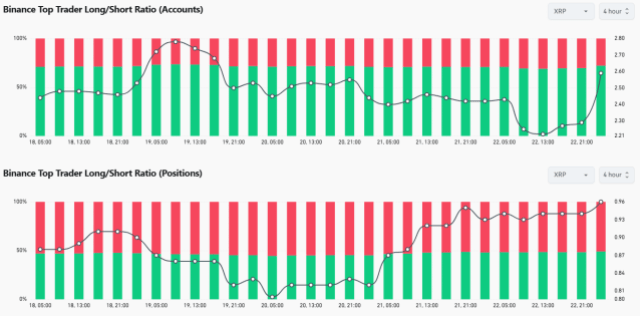
Source: Chart from CW on X

CW noted that these traders were previously positioned heavily on the short side, but the chart shows that they are now becoming neutral. As a result of the renewed conviction, the expert believes that XRP will soon regain the upper hand.

XRP trading at $1.36 on the 1D chart | Source: XRPUSDT on Tradingview.com

Related Questions

QWhat is the significance of February 26th for Ripple, according to the article?

AFebruary 26th is the date the US Securities and Exchange Commission (SEC) is scheduled to announce its decision in a Federal Register proceeding linked to a proposed T Rowe Price crypto Exchange-Traded Fund (ETF), which is seen as a crucial moment for traditional allocators to get clearer regulatory lanes.

QWhich two key companies has Ripple acquired to build its institutional infrastructure?

ARipple has acquired Metaco, which provided institutional custody rails, and Hidden Road, which added prime brokerage-grade execution, financing, and access to real market plumbing.

QHow are top traders on Binance positioning themselves regarding XRP, as reported in the article?

AData from Binance shows a rapid increase in long positions for XRP from top traders, indicating they are positioning ahead of a potential price bounce after previously being heavily positioned on the short side.

QWhat strategy is Ripple using to build a modern digital banking empire, as described by the expert Pumpius?

ARipple is building its empire by forming strategic alliances, gaining regulatory approvals, and building infrastructure in key financial areas, bringing together the full institutional stack one regulated component at a time, similar to how traditional banks operate.

QWhat specific advantage does the article say Ripple gains by operating within the regulated perimeter?

AOperating within the regulated perimeter creates a barrier to permission and allows the company to become the system that institutions are officially allowed to use, which is described as 'the cheat code' for success.

Related Reads

Global Stock Market's Storm Center: South Korea's Stock Market De-leveraging Is Largely Complete

Storm's Eye: South Korean Market De-leveraging Nears Completion The recent sharp correction in South Korean equities, with the KOSPI index dropping 32% from its June high, has been a key trigger for global tech stock volatility. The core driver was not a fundamental shift but a forced de-leveraging process within the market's unique structure, which is now largely complete. Two main leverage channels amplified the sell-off: 1. **Leveraged ETFs:** Their size, proportionally four times larger than in the U.S., peaked near $50 billion. Their mandatory daily rebalancing mechanism created a vicious cycle of "price drop → forced selling → further drop." Approximately 75% of this excess has been unwound, shrinking to $26 billion, with regulatory curbs now blocking new inflows. 2. **Hedge Fund Leverage:** Using swaps to magnify exposure, hedge funds saw their net long positioning fall by over 50% from peak levels. The most intense phase of this institutional de-leveraging is over. In contrast, **retail margin debt** poses minimal systemic risk. At 0.5% of market cap, it is far lower than in the U.S. or China, lacks automatic triggers, and is concentrated in smaller stocks. The conclusion: the high-leverage structures most prone to "chain-reaction selling" have been substantially cleared. The market is transitioning from a liquidity-driven crash to one priced more on fundamentals. The article argues that the AI trend—centered on Korean memory chips—remains intact. This episode represents a painful but necessary clearing of crowded trades, not the end of the AI revolution. For investors, the key question is conviction in the long-term AI direction; if the trend is real, current volatility is a cost of entry, not a terminal risk.

链捕手1h ago

Global Stock Market's Storm Center: South Korea's Stock Market De-leveraging Is Largely Complete

链捕手1h ago

Trading

Spot
活动图片