Ripple expands European footprint with AMINA stablecoin payment partnership

cointelegraphPublished on 2025-12-12Last updated on 2025-12-12

Abstract

Ripple Payments has partnered with Swiss bank AMINA to provide its payment infrastructure, enabling more efficient, faster, and lower-cost transactions using the Ripple USD (RLUSD) stablecoin. This collaboration strengthens Ripple’s presence in Europe, leveraging AMINA’s regulatory standing under Swiss and EU frameworks. The partnership addresses friction faced by crypto-native businesses in traditional banking, particularly in cross-border stablecoin transactions. Ripple aims to bridge fiat and blockchain systems, supporting seamless payments. This move is part of Ripple’s broader strategy to integrate blockchain into traditional finance, following recent expansions in Asia-Pacific and regulatory approvals in Singapore and Abu Dhabi for RLUSD.

The payments subsidiary of blockchain services company Ripple has partnered with Swiss bank Amina to provide it with access to its payment infrastructure.

According to a Friday Ripple Payments announcement, the company will allow Amina to “settle transactions more efficiently without relying on traditional payment infrastructure, making transactions faster, lower cost, and with increased reliability and transparency.” This builds on a previous relationship between the companies, with the bank’s integration of the Ripple USD (RLUSD) stablecoin happening back in July.

The move also reinforces Ripple’s presence in Europe, with Amina being a Swiss Financial Market Supervisory Authority-regulated financial institution. The bank’s Austrian subsidiary also holds a license under the European Union’s Markets in Crypto-Assets Regulation (MiCA) granted by Austria’s Financial Market Authority in October.

Amina chief product officer Myles Harrison said “native web3 businesses often run into friction when working with legacy banking systems,” adding that stablecoins can help solve those issues. “This is particularly the case for cross-border stablecoin transactions which traditional banks are yet to widely adopt.”

Related: Community expects first US spot XRP ETF to launch on Thursday

Banks need crypto services for crypto companies

Harrison explained that the bank’s clients “need payment infrastructure that can handle both fiat and stablecoin rails simultaneously,” which traditional banking networks cannot provide for. Ripple Payments, on the other hand, allowed Amina to offer such services, which led to “reducing cross-border friction and helping our crypto-native clients maintain their competitive edge.”
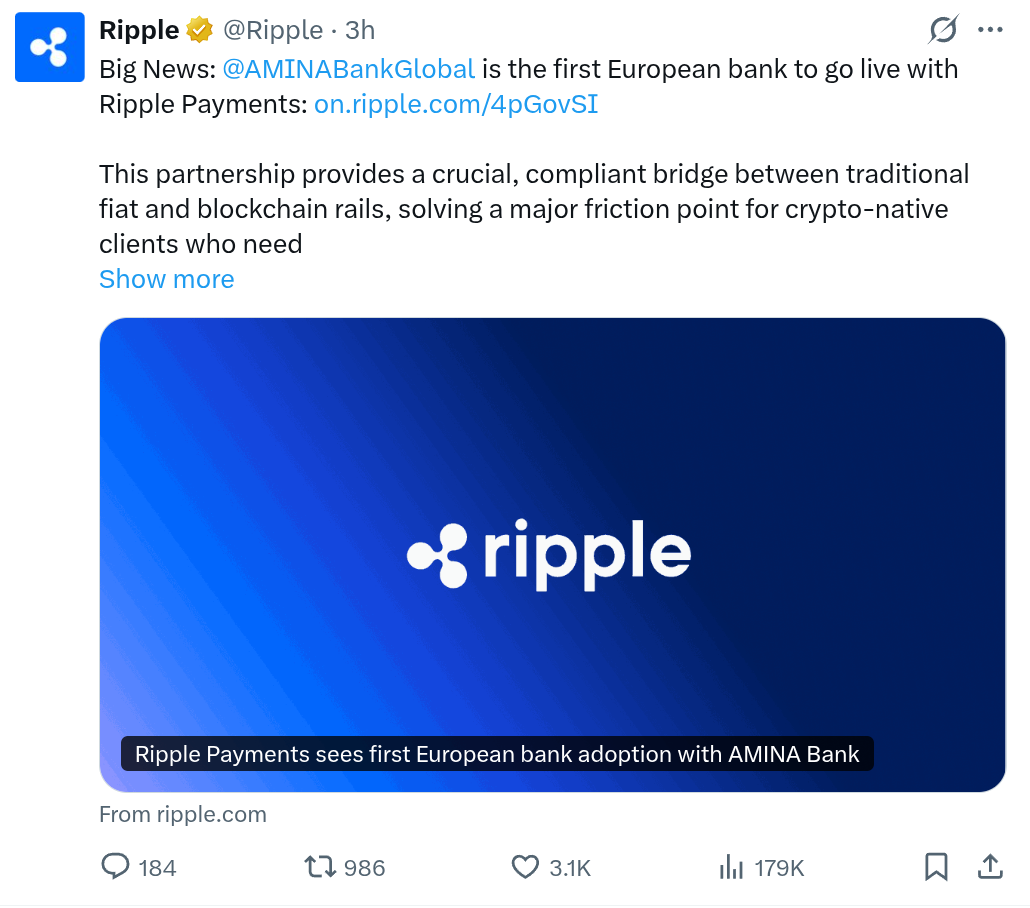
Source: Ripple

Ripple’s managing director for the United Kingdom and Europe Cassie Craddock said that the collaboration lets Amina “serve as the on-ramp for digital asset innovators into traditional financial infrastructure.” He added that Ripple Payments provides a “bridge between fiat and blockchain” that enables seamless stablecoin payments.

Related: Canary Capital filing signals spot XRP ETF set for launch this week

Ripple onboards traditional finance onchain

This is just the latest partnership in which Ripple injected blockchain capabilities into an institution engaged in traditional finance. According to mid-November reports, the company is spending about $4 billion to combine prime trading, treasury tools, payments, and custody to take on traditional finance.

Ripple’s ambitions are also global. Earlier this month, Ripple Labs received approval from Singapore’s central bank to expand its payment activities. This enables the company to offer regulated token services, end-to-end payments and growth across Asia-Pacific.

At the end of November, RLUSD was also cleared for use by institutions in Abu Dhabi after winning recognition as an Accepted Fiat-Referenced Token by the local watchdog.


Related Reads

Casper Network Publishes the Casper Manifest, a Multi-Year Roadmap to Power Regulated Real-World Assets and the Machine Economy

The Casper Association has published "The Casper Manifest," a multi-year technical roadmap for Casper Network. Introduced at the Digital Finance Forum in Bermuda, the roadmap outlines nine coordinated initiatives designed to position the layer-1 blockchain as the infrastructure for regulated real-world asset (RWA) tokenization and the machine-to-machine economy. Key initiatives focus on: 1. **Developer Access:** Adding full Ethereum Virtual Machine (EVM) compatibility alongside its existing WebAssembly (Wasm) execution layer. 2. **User Experience:** Implementing gasless transactions, batch operations, and smart accounts with biometric authentication. 3. **Institutional Compliance & Privacy:** Building compliant security tokens aligned with the ERC-3643 standard and a multi-phase roadmap for confidential transactions with built-in audit tools. 4. **Machine Economy:** Implementing the X402 open payment standard to enable AI agents and machines to make autonomous, programmatic micropayments. 5. **Token Infrastructure:** Creating a Native Token Registry to give all tokens protocol-level status with fixed, predictable costs. 6. **Quantum Safety:** Developing hybrid accounts with both classical and quantum-resistant keys. The first initiative, X402 micropayments, is expected within weeks. Subsequent releases through 2026 and 2027 will include EVM compatibility, compliant security tokens, the Native Token Registry, gasless transactions, and quantum-safe features. The goal is to create a blockchain that is frictionless for users, trusted by institutions, and native for machines.

TheNewsCrypto41m ago

Casper Network Publishes the Casper Manifest, a Multi-Year Roadmap to Power Regulated Real-World Assets and the Machine Economy

TheNewsCrypto41m ago

TechFlow Intelligence: Trump-Linked Companies Transfer $12 Million in Assets Before China Visit, 'The Big Short' Protagonist Warns of Stock Market Bubble Again

The article reports multiple developments across tech, crypto, and finance. In AI, Mozilla used AI for large-scale code review, Google confirmed hackers used AI to find zero-day exploits, and OpenAI deployed GPT-5.5 to find errors in math benchmarks. A court ruled Anthropic's scanning and destroying books for AI training as fair use, while its Claude platform launched on AWS. Google's new video model 'Omni' was leaked. In crypto/Web3, Trump-linked companies transferred $12M in crypto assets before a China visit. BlackRock chose Ethereum for tokenized funds, and a hacker stole $174k via a malicious NFT that tricked an AI. Jack Dorsey's first tweet NFT plummeted from $2.9M to under $5. In chips/hardware, TSMC approved an additional $20B for its Arizona plant. Apple's Tim Cook and Elon Musk will accompany Trump to China, while Nvidia's Jensen Huang is notably absent. For markets, Michael Burry warned of parabolic stock rises and suggested near-total sell-offs, with online discussions comparing current sentiment to the 1999 bubble. Other notes include WTI oil surpassing $100, a 20% price hike for Beijing-Shanghai high-speed rail, and new products like Unitree's $26.9k humanoid robot. The underlying theme suggests AI is becoming infrastructure, creating pressure on old systems while a new order is not yet ready, leaving investors anxious.

marsbit1h ago

TechFlow Intelligence: Trump-Linked Companies Transfer $12 Million in Assets Before China Visit, 'The Big Short' Protagonist Warns of Stock Market Bubble Again

marsbit1h ago

Trading

Spot
Futures
活动图片



