Ripple Calls XRPL Permissioned Domains A ‘Gamechanger’ As Go-Live Nears

bitcoinistPublished on 2026-01-14Last updated on 2026-01-14

Abstract

RippleX announces that the XRP Ledger's "Permissioned Domains" amendment is nearing activation, requiring an 80% validator consensus. Currently at 76.47%, this feature introduces institutional-grade access controls on the public blockchain, enabling regulated entities to use permissioned trading and lending protocols without private infrastructure. It paves the way for a Permissioned DEX, limiting market interactions to approved participants, and supports future applications like on-chain foreign exchange and lending. The community highlights the need for more stablecoins and real-world assets to boost liquidity. XRP price is noted at $2.15.

Ripple’s developer arm RippleX says the XRP Ledger’s “Permissioned Domains” amendment is nearing its activation threshold, positioning the network to roll out institution-friendly access controls that could underpin a permissioned version of XRPL’s native decentralized exchange.

In a series of posts on X late Tuesday, RippleX framed Permissioned Domains as a “gamechanger” enabling layer for “permissioned flows” on a public blockchain, an approach aimed squarely at regulated firms that want on-chain settlement and trading without adopting fully private infrastructure.

Ripple’s Next ‘Gamechanger’ For The XPR Ledger

Via X, RippleX said: “The amendment for Permissioned Domains is nearing the threshold for activation.Ripple supports this feature, as well as the Permissioned DEX which this will ultimately enable. “

Under XRPL’s governance process, amendments become active after maintaining a 80% validator supermajority for a sustained period. According to xrpl.org, the PermissionedDEX is currently open for voting and has reached 50.00% thus far, while the PermissionedDomains amendment stands at 76.47%.

RippleX describes the feature as a “game-changer for XRPL because they bring institutional-grade controls to a public network, without sacrificing the trade-offs of a private chain.”

The company further writes: “While the Permissioned Domains amendment is an enabling feature, it sets the stage for financial institutions to engage in permissioned flows on a fast, scalable, and resilient blockchain network, the XRPL. The Permissioned DEX will enable permissioned trading flows, and the upcoming lending protocol may apply Permissioned Domains for controlled lending and borrowing flows.”

On XRPL’s documentation, permissioned domains are described as controlled environments that “do nothing on their own,” but can be used by higher-level features, such as permissioned DEX functionality and lending protocols,to restrict and manage access for compliance-driven deployments. Permissioned DEXes are the practical endpoint: regulated entities participating in XRPL’s native order books while enforcing who can interact with specific markets.

“Traditionally, any XRPL DEX offer can be matched by anyone. A permissioned DEX changes that,” Ripple wrote, describing permissioned trading as rules-based matching limited to approved participants.

RippleX also points to adjacent roadmap items, including an upcoming lending protocol that could apply the same domain-based controls to borrowing and lending flows, suggesting the design pattern is intended to extend beyond trading into broader onchain finance primitives.

The announcement drew immediate interest from XRP community voices. Popular community member Krippenreiter highlighted “on-chain FX” as a headline application, while Anodos Finance CEO Panos Mekras responded that “the only thing left is to bring the actual assets and liquidity to flow.” Krippenreiter agreed, calling for “more stablecoins, RWAs, and more market making.”

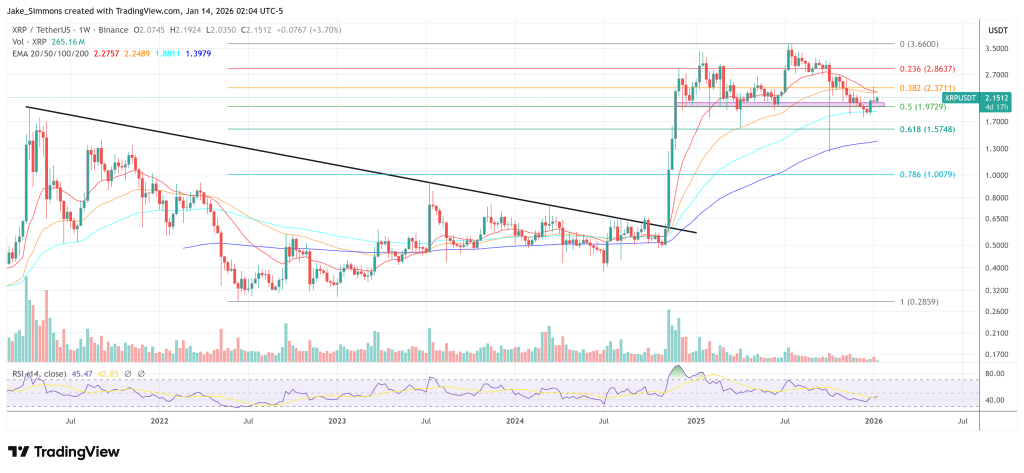
At press time, XRP traded at $2.15.

XRP needs to reclaim the 0.382 Fib, 1-week chart | Source: XRPUSDT on TradingView.com

Related Questions

QWhat is the 'Permissioned Domains' amendment on the XRP Ledger and why is it significant?

AThe 'Permissioned Domains' amendment is an enabling feature that introduces institution-grade access controls to the public XRP Ledger network. It is significant because it allows for 'permissioned flows' on a public blockchain, enabling regulated firms to use on-chain settlement and trading without having to adopt fully private infrastructure, thus combining the benefits of a public network with the controls of a private chain.

QWhat is the governance process for activating an amendment on the XRPL, and what is the current status of the PermissionedDomains vote?

AUnder XRPL's governance process, an amendment becomes active after it maintains an 80% validator supermajority for a sustained period. At the time of the article, the PermissionedDomains amendment had reached 76.47% of the vote.

QHow does a Permissioned DEX differ from the traditional XRPL DEX?

ATraditionally, any offer on the XRPL DEX can be matched by any participant. A Permissioned DEX changes this by enabling rules-based matching that is limited to only approved, vetted participants, which is crucial for compliance-driven deployments by regulated entities.

QBeyond trading, what other potential use cases for Permissioned Domains does RippleX mention?

ARippleX mentions that the upcoming lending protocol could apply the same Permissioned Domains feature to control borrowing and lending flows, suggesting the design pattern is intended to extend into broader on-chain finance primitives beyond just trading.

QWhat was the price of XRP at the time the article was published?

AAt press time, the price of XRP was $2.15.

Related Reads

Bernstein Analysis: Can the $142 Billion Long-Term Order Hold Up the Memory Cycle?

Bernstein revisits long-term agreements (LTAs) in the memory industry, highlighting new contracts with purchase commitments, minimum prices, and financial guarantees signed by Micron and SanDisk. These aim to provide an earnings floor for the coming years. Micron has 16 strategic customer agreements, with 14 representing approximately $100 billion in minimum revenue and about $22 billion in cash deposits/commitments. SanDisk has contracts for around $42 billion in minimum revenue and over $11 billion in guarantees. Combined, these ~$33 billion in guarantees make it more costly for major clients to walk away. However, Bernstein models that the potential revenue needing protection over 3-5 years is around $5.2 trillion. The existing guarantees thus cover only about 0.6% of that scale. While LTAs provide a cushion, they cannot fully shield profits in a severe downturn, as clients may still find it cheaper to breach contracts if spot prices fall deeply below floor prices. LTAs are most suitable for large, credit-worthy customers like U.S. cloud service providers with stable, high-volume AI infrastructure needs. Consumer segments (phones, PCs) and some Chinese clients are less likely to adopt them, leaving an estimated 30-50% of the DRAM/NAND market exposed to spot price volatility. AI demand (e.g., HBM for training, storage for inference) supports higher valuations and makes LTAs more attractive for locking in high-demand customers. Yet, Bernstein stresses that LTAs soften, but do not eliminate, the memory cycle. Their true test will come in the next downturn, revealing whether clients honor contracts and whether guarantees provide sufficient pain to maintain supplier discipline.

marsbit4m ago

Bernstein Analysis: Can the $142 Billion Long-Term Order Hold Up the Memory Cycle?

marsbit4m ago

Dialogue with Jia Hang | Looking Back at Two Decades of Chinese Payment Going Global

**Summary: A Conversation with Jia Hang on Two Decades of China's Payment Globalization** Jia Hang, a veteran with over twenty years in payments, reflects on China's attempts to build a global payment network through three key phases: UnionPay (card networks), Alipay+ (digital wallets), and now, stablecoins. His journey began at UnionPay International, aiming to establish China's card network abroad. While successful in following Chinese tourists ("where Chinese go, UnionPay goes"), it struggled to achieve true global scale. The core lesson: card networks like Visa/Mastercard's unassailable advantage isn't just technical standards, but their deeply entrenched **governance and profit-sharing models** that create powerful network effects. Competing as the "same species" is nearly impossible. At Ant Group, he led Alipay+, a strategy to bypass card networks by interconnecting local e-wallets worldwide. While innovative, it faced a similar ceiling. Mobile QR payments and card swipes were essentially **the same species competing for the same pie**, lacking a disruptive value proposition for users or a sustainable new incentive model to replace the card networks' established flywheel. Today, at Singapore's DCS, Jia focuses on stablecoin-based payments. He argues stablecoins represent a fundamental shift. They are not competing with Visa for consumer payments but challenging the **traditional banking and account system for value movement**. Products like "U Cards" (stablecoin-linked payment cards) are transitional, leveraging existing card networks for acceptance while building new rails. The real potential lies in stablecoins enabling seamless, low-cost global value transfer, potentially reorganizing the financial infrastructure around **accounts rather than cards**. Jia believes stablecoin adoption for local retail payments, cross-border transactions, and as high-yield savings vehicles is becoming irreversible. This could gradually reduce reliance on traditional fiat channels, especially in regions with weak currencies or capital controls. The quest for the "next global payment network" continues, now centered on whether stablecoins can successfully bridge Web2 and Web3, establish new governance, and create compelling user value beyond mere cost reduction.

marsbit27m ago

Dialogue with Jia Hang | Looking Back at Two Decades of Chinese Payment Going Global

marsbit27m ago

Circle's Stock Price Plunges 76%, Hong Kong Dollar Stablecoin Set to Launch Within Two Weeks

Circle's stock price has plunged approximately 76% from its 2023 peak, reflecting a major market revaluation. Despite this, Circle President Heath Tarbert emphasized the company's focus on long-term execution and its dominant position with USDC's $73 billion circulation across 34 blockchains. The competitive landscape is intensifying. A new consortium-backed stablecoin, Open USD, is attempting to challenge incumbents by sharing reserve yields with partners. More significantly, Visa's new stablecoin platform, initially supporting Open USD while also being compatible with USDC, could erode Circle's network effects. In response, Circle is expanding into real-world payments through partnerships like the one with Japan's JCB. Separately, Tether (USDT) faces a two-year compliance window under new U.S. regulations, requiring it to adjust its reserve composition away from assets like Bitcoin and loans towards cash and U.S. Treasuries. Meanwhile, in Hong Kong, Standard Chartered-backed fintech firm Dian Dian is poised to launch a licensed HKD-pegged stablecoin (HKDAP), moving the industry into a phase where the real test is integrating licensed stablecoins into actual payment flows and corporate treasury systems. The sharp decline in Circle's stock underscores a broader shift: the stablecoin market is moving from a winner-takes-all dynamic to a multi-player competitive arena where execution, compliance, and real-world utility are becoming paramount.

marsbit28m ago

Circle's Stock Price Plunges 76%, Hong Kong Dollar Stablecoin Set to Launch Within Two Weeks

marsbit28m ago

Trading

Spot
活动图片