Ripple Advances Zero-Knowledge Proofs For The XRP Ledger

bitcoinistPublished on 2026-01-20Last updated on 2026-01-20

Abstract

RippleX, the development arm of Ripple, is actively prototyping zero-knowledge proof (ZKP) capabilities for the XRP Ledger (XRPL). According to Aanchal Malhotra, Head of Research at RippleX, this initiative aims to introduce "programmable privacy," trust-minimized interoperability, and a scaling model that offloads heavy computation to layer-2 systems while XRPL remains the settlement layer. Malhotra emphasized that integrating ZKPs into XRPL is complex and requires custom development rather than using off-the-shelf solutions. The approach involves a hybrid implementation—some components native for performance, others in a programmability layer for developer choice. Key benefits include selective disclosure for compliance (e.g., proving age without revealing exact data), reducing reliance on trusted intermediaries in cross-chain bridges, and scaling via succinct proof verification on-chain. The goal is to enhance XRPL’s competitiveness without compromising on flexibility or security.

RippleX, the developer arm of Ripple, is prototyping zero-knowledge proof (ZKP) capabilities for the XRP Ledger (XRPL), positioning the technology as a route to “programmable privacy,” trust-minimized interoperability, and a scaling model that pushes heavy computation to layer-2 systems while keeping XRPL as the settlement layer.

In Episode 9 of Ripple’s “Onchain Economy” video series, Aanchal Malhotra, Ph.D., Head of Research at RippleX, framed ZK enablement as a near-term research priority and a long-horizon bet on XRPL’s competitiveness. “I would really like to see an XRP ledger with zero knowledge proof technology enabled. There are so many use cases. There are so many innovative applications that we can build using this technology. So my number one priority right now is to work on enabling zero knowledge proofs on XRP ledger,” Malhotra said.

What Ripple Is Planning With ZK-Proofs

Malhotra also stressed that integrating modern ZK systems into XRPL is not a simple plug-in exercise. “We are getting past the exploration phase of zero knowledge technologies. When the XRP ledger was built, these technologies were not even around. So it takes a while. We cannot just use any off-the-shelf solution. It takes a while for us to figure out the specifics of ZK technology to integrate with XRP ledger,” she said, describing the work as moving from exploratory research into prototyping.

That prototyping effort, according to RippleX’s Head of Research, is taking a hybrid form. Some components of ZK proofs would be implemented “natively for better performance,” while another portion would sit in a “programmability layer” to let developers choose proving systems and build applications tuned to their requirements.

The goal, she indicated, is a design that balances throughput and developer flexibility rather than forcing a single ZK stack across all use cases. “We are at the stage of prototyping zero knowledge proof,” Malhotra said, adding that the approach is intended to support “different applications [and] different proving systems.”

Much of Malhotra’s framing centered on privacy, specifically, a version that can satisfy compliance and business constraints without collapsing into blanket opacity. “In my opinion, zero knowledge proofs is a very very powerful tool. When we talk about privacy, people think about 100% privacy where everything is hidden [...] and those things could be used in nefarious ways,” she said.

“However, what blockchains enable is something called programmable privacy [...] you can do selective disclosure meaning disclose the relevant information to third parties for example auditors for compliance purposes.” In her example, a user could prove they are above a threshold, such as being over 18, without revealing the underlying data like an exact age.

Malhotra also pointed to interoperability as a domain where ZK techniques could reduce reliance on trusted intermediaries. She characterized bridges as “fraught with technical challenges,” with trust being the biggest: today’s designs often depend on third parties, federators, or other centralized structures. “What zero knowledge proofs provide is trustlessness. It provides verifiability. So you do not have to trust a third party. Instead what you trust in is cryptography,” she said.

On scaling, Malhotra described a model where ZK proofs help compress or externalize execution: layer-2 systems perform computation, then submit succinct proofs that can be verified on XRPL. That, in her telling, lets the base layer focus on settlement and proof verification rather than running every workload directly. The practical implication is an architecture where XRPL could support more complex applications without forcing all computation onto the L1.

At press time, XRP traded at $1.976.
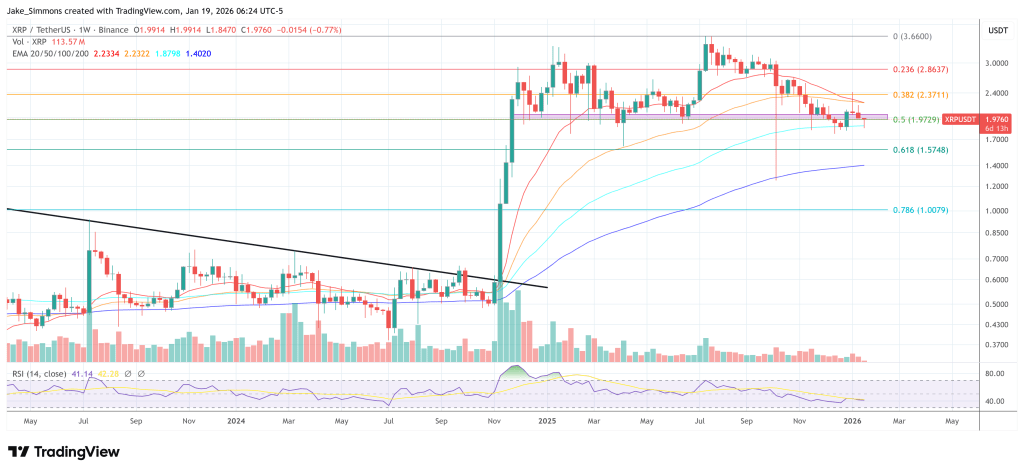
XRP falls into the red support zone, 1-week chart | Source: XRPUSDT on TradingView.com

Related Questions

QWhat is RippleX's main research priority according to Aanchal Malhotra?

AAanchal Malhotra stated that her number one priority is enabling zero-knowledge proof technology on the XRP Ledger to support innovative applications and use cases.

QHow does Ripple plan to implement zero-knowledge proofs on the XRP Ledger?

ARipple is taking a hybrid approach: some ZKP components will be implemented natively for performance, while others will reside in a programmability layer to allow developers to choose proving systems and build customized applications.

QWhat is 'programmable privacy' as described by Malhotra?

AProgrammable privacy refers to selective disclosure capabilities where users can prove specific information (e.g., being over 18) without revealing underlying data (e.g., exact age), enabling compliance with auditors while maintaining privacy.

QHow can zero-knowledge proofs improve interoperability according to the article?

AZK proofs can reduce reliance on trusted intermediaries in bridges by providing verifiability through cryptography instead of third parties, federators, or centralized structures.

QWhat scaling model does Ripple envision using ZK proofs for the XRP Ledger?

ARipple envisions a model where layer-2 systems perform heavy computations and submit succinct proofs for verification on the XRPL base layer, allowing XRPL to focus on settlement and proof verification rather than executing all workloads directly.

Related Reads

VCs on 2025 Crypto Investments: 84% of 118 Tokens Break Issue Price, Only One Type of Company is Quietly Making Money

Crypto investor Ching Tseng categorizes the market into four quadrants based on two axes: crypto-native vs. traditional finance (TradFi)-oriented, and having traction vs. no traction. In 2025, 84.7% of 118 tracked token launches fell below their issuance price, with a median fully diluted valuation drop of 71%. Crypto-native projects without traction are experiencing massive capital destruction, often relying on speculative narratives without sustainable revenue or user retention. Crypto-native teams with traction, often built in prior cycles, generate real revenue but face structural challenges with their tokens lacking direct value capture mechanisms. While some have implemented successful buyback programs, the core issue remains finding growth beyond crypto volatility. TradFi-oriented startups without traction face long, costly enterprise sales cycles but benefit from a robust M&A environment, with crypto acquisitions reaching a record $8.6 billion in 2025. The current winners are TradFi-oriented companies with traction, particularly in the Real World Asset (RWA) tokenization space, which grew from $5.5B to $18.6B in 2025. They are winning through enterprise sales, building alliances, and improving unit economics on established compliance stacks. Their main risk is being bypassed by large incumbent institutions building their own infrastructure. The overarching theme is market maturation, where narrative alone is insufficient for long-term success.

marsbit42m ago

VCs on 2025 Crypto Investments: 84% of 118 Tokens Break Issue Price, Only One Type of Company is Quietly Making Money

marsbit42m ago

Trading

Spot
Futures

Hot Articles

How to Buy XRP

Welcome to HTX.com! We've made purchasing XRP (XRP) simple and convenient. Follow our step-by-step guide to embark on your crypto journey.Step 1: Create Your HTX AccountUse your email or phone number to sign up for a free account on HTX. Experience a hassle-free registration journey and unlock all features.Get My AccountStep 2: Go to Buy Crypto and Choose Your Payment MethodCredit/Debit Card: Use your Visa or Mastercard to buy XRP (XRP) instantly.Balance: Use funds from your HTX account balance to trade seamlessly.Third Parties: We've added popular payment methods such as Google Pay and Apple Pay to enhance convenience.P2P: Trade directly with other users on HTX.Over-the-Counter (OTC): We offer tailor-made services and competitive exchange rates for traders.Step 3: Store Your XRP (XRP)After purchasing your XRP (XRP), store it in your HTX account. Alternatively, you can send it elsewhere via blockchain transfer or use it to trade other cryptocurrencies.Step 4: Trade XRP (XRP)Easily trade XRP (XRP) on HTX's spot market. Simply access your account, select your trading pair, execute your trades, and monitor in real-time. We offer a user-friendly experience for both beginners and seasoned traders.

15.9k Total ViewsPublished 2024.03.29Updated 2025.03.21

How to Buy XRP

What is XRP 2.0

XRP 2.0: A New Frontier in the Cryptocurrency Landscape Introduction to XRP 2.0 In the ever-evolving realm of cryptocurrency, new projects continuously emerge, vying for attention and adoption. One such promising initiative is XRP 2.0, a novel cryptocurrency project designed to leverage advanced blockchain technology and robust encryption methodologies. While the name draws parallels with Ripple’s XRP, it’s crucial to note that XRP 2.0 operates independently, focusing on enhancing transaction security, privacy, and scalability. As the digital financial landscape increasingly embraces decentralized solutions, XRP 2.0 aims to contribute meaningfully to web3 and the overall expansion of crypto projects. What is XRP 2.0? At its core, XRP 2.0 is a cryptocurrency project that aims to create a secure and decentralized digital currency ecosystem. Its foundational technology integrates sophisticated blockchain principles with cutting-edge encryption techniques. The overarching goal of XRP 2.0 is to establish itself as a reliable and efficient platform enabling swift transaction execution while prioritizing enhanced privacy protections for its users. The project is promoted as a solution to many limitations faced by existing cryptocurrencies, proposing a system that can handle a higher volume of transactions with improved speed and privacy. This versatility positions XRP 2.0 as a significant contender in a marketplace riddled with various digital currencies. Who is the Creator of XRP 2.0? The identity of the creator behind XRP 2.0 has been flagged as ‘Wilbur.’ However, comprehensive details regarding Wilbur or their associated entity remain elusive. The anonymity of many cryptocurrency creators is not an uncommon phenomenon in the industry, often designed to maintain a degree of privacy and security. Who are the Investors of XRP 2.0? As of now, specific information related to the investment foundations or organizations supporting XRP 2.0 is not publicly available. In the cryptocurrency sector, the backing by reputed investors can significantly influence a project's credibility and success, yet the transparency regarding the financial supporters of XRP 2.0 has not been established. How Does XRP 2.0 Work? XRP 2.0 stands out by employing a combination of blockchain technology and advanced encryption algorithms that ensures secure and decentralized transactions. Its innovative structure includes unique features designed to foster user engagement and broaden functionalities beyond conventional cryptocurrency transactions. Among these features, XRP 2.0 incorporates AI-powered capabilities, such as text-to-image and text-to-speech functionalities. These additions are designed to enhance the interactive experience for users, promoting broader applicability across various sectors. By bridging technological advancements with user-centered design, XRP 2.0 aims to capture the attention of a diverse range of individuals and enterprises looking to integrate cryptocurrency solutions into their operational frameworks. Timeline of XRP 2.0 Understanding XRP 2.0 requires examining the milestones that have defined its journey thus far: July 23, 2023: XRP 2.0 is introduced as a novel cryptocurrency project, aiming to revolutionize secure and decentralized transaction capabilities in the blockchain domain. September 8, 2023: The launching of another project, XRP20, occurs, marking the emergence of an ERC-20 token on the Ethereum blockchain that remains unrelated to XRP 2.0. November 13, 2023: The XRP Ledger undergoes a significant update with the release of rippled server software version 2.0.0. It is essential to note that this development is disconnected from the XRP 2.0 cryptocurrency project. Key Points About XRP 2.0 To distill the essence of XRP 2.0, several critical factors emerge: Unique Features: The inclusion of features like AI-powered text-to-image and text-to-speech further diversifies the potential applications of XRP 2.0. Blockchain Technology: The framework utilizes advanced blockchain mechanisms and encryption protocols, ensuring a secure and decentralized environment for transactions. Scalability and Privacy: XRP 2.0 prioritizes enhanced privacy protections in transaction processes and the scalability necessary to accommodate a growing user base. No Affiliation with Ripple: Importantly, despite its name, XRP 2.0 does not have any allegiance or collaboration with Ripple’s XRP, distinguishing its operational framework and objectives within the cryptocurrency ecosystem. Conclusion XRP 2.0 represents an ambitious venture into the cryptocurrency sphere, aiming to offer a combination of security, privacy, and efficiency in digital transactions. By integrating sophisticated technologies and user-friendly features, the project sets out to broaden the horizons of what cryptocurrency can achieve in today's digital economy. While the anonymity of its creator and lack of disclosed investors might raise questions for some, XRP 2.0's focus on advanced functionalities and decentralisation enhances its appeal amidst an increasingly crowded crypto market. As the cryptocurrency landscape continues to evolve, XRP 2.0 may yet emerge as a pivotal player in the expansion of secure and scalable blockchain solutions.

941 Total ViewsPublished 2024.04.01Updated 2024.12.03

What is XRP 2.0

Discussions

Welcome to the HTX Community. Here, you can stay informed about the latest platform developments and gain access to professional market insights. Users' opinions on the price of XRP (XRP) are presented below.

活动图片