Revisiting The Dogecoin Rally To $10: Where Is The Meme Coin This Cycle?

bitcoinistPublished on 2026-03-06Last updated on 2026-03-06

Abstract

Market analyst Dima Potts has issued an ambitious Dogecoin (DOGE) price forecast, predicting the meme coin could rally to $10 in the current cycle. He bases this on a recurring pattern observed over the past decade, where DOGE has completed three macro cycles, each ending with a massive price surge. According to Potts, DOGE is currently in its third macro cycle and has already completed four out of five typical bull phases. He suggests the coin is now at a stage where disbelief historically turns into rapid price acceleration, potentially setting up for its largest move yet. Trading around $0.09 at the time of analysis, a surge to $10 would represent an increase of over 11,000%.

Market analyst Dima Potts has released an ambitious Dogecoin (DOGE) price forecast, predicting that the popular dog-themed meme coin could set the stage for a massive rally toward $10. Supporting his bullish outlook, the analyst points out a striking pattern that has quietly repeated across three full macro cycles over the past decade. He stated that each of these cycles ended with an explosive price spike, one that he believes Dogecoin could replicate in the current cycle.

Analyst Predicts Dogecoin Rally From $0.09 To $10

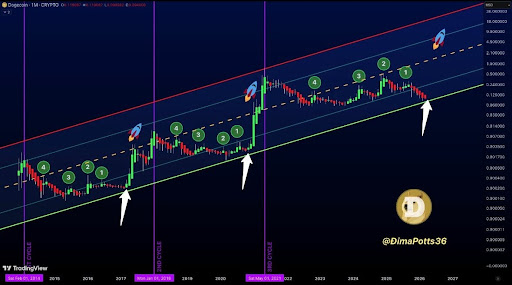
On Wednesday, March 3, Potts issued a bold outlook on X, projecting an unprecedented rise to the double-digit territory for a meme coin that has never reached $1 since its inception. Sharing a monthly TradingView chart, Potts argued that most traders are completely missing Dogecoin’s bigger picture, focusing too much on daily price swings instead of recognizing the broader structural rhythm that has quietly guided the meme coin since its earliest days.

His chart maps out three complete macro cycles unfolding inside a clearly defined rising channel bounded by green and red lines, with an orange midline tracking the long-run trajectory. According to Potts, two of these past cycles concluded with a vertical parabolic surge that completely dwarfed every preceding phase of price action within the same period.
Source: Chart from Dima Potts on X

Notably, the analyst believes Dogecoin’s current setup is identical to past macro cycles, suggesting the meme coin’s largest move may still be ahead. Potts stated that DOGE’s price action has been repeating the same rhythm for a decade. As a result, if the meme coin completely mirrors past cycle patterns, he predicts it could fuel a massive surge to $10, representing a more than 11% increase from current levels at around $0.09.

Where The Meme Coin Fits In Macro Cycle Rhythm

To explain his bullish Dogecoin setup, Potts divides each macro cycle into five distinct bull phases, each one numbered with green circles directly on the chart. He pointed out that the first cycle established “the blueprint,” with five structured expansions building inside the rising channel before culminating in a significant price surge.

Subsequently, the second macro cycle endured a prolonged and brutal bear market, yet when conditions recovered, the same five-phase structure repeated almost perfectly, reinforcing the patient’s reliability. Fast forward to today, the analyst says that Dogecoin is currently in the third macro cycle, highlighted on the chart. Four of five of the recurrent structure phases have already played out, leaving the final stage where the vertical rally typically occurs.

A large white arrow on the chart points to the area Dogecoin currently trades, following a significant downtrend from its 2025 highs. Potts described this level as the point in the cycle where disbelief historically turns into rapid price acceleration. According to him, Dogecoin is now at a stage that has preceded the most aggressive phase of its bull cycle.

DOGE trading at $0.09 on the 1D chart | Source: DOGEUSDT on Tradingview.com

Trending Cryptos

Related Reads

Annual Salary of Millions Competing for Electricians, Meta Rushes to Open Its Own Technical School

The AI boom is facing an unexpected bottleneck: a severe shortage of skilled construction workers and electricians. As tech giants like Meta, OpenAI, and Alphabet race to build massive data centers—such as OpenAI's $16 billion "Stargate" project—they are hitting a critical labor wall. The U.S. needs an estimated 130,000 more electricians, 240,000 construction workers, and 150,000 supervisors by 2030 for AI infrastructure alone, but tens of thousands of electrician jobs go unfilled each year. While AI companies offer high premiums, with electricians earning up to $280,000 annually, worker scarcity still causes massive losses—delays on a single project can cost $14.2 million per month. The complexity of building AI data centers, which require immense power (equivalent to powering hundreds of thousands of homes), sophisticated electrical systems, and advanced liquid cooling solutions, demands highly skilled technicians who are in short supply. To combat this, companies are investing heavily in training. Meta has committed $115 million to a free training school offering tuition, housing, and stipends, targeting 5,000 new workers. OpenAI is partnering with unions to secure skilled labor. These efforts are paying off, with a significant rise in Gen Z interest in trade schools over college. However, the power demands are staggering. AI data centers are driving a rapid surge in electricity consumption, projected to account for up to 12% of U.S. power use by 2028 and raising costs for consumers. Furthermore, the construction boom is project-based, leading to a potential future glut of trained workers once building peaks, which could depress wages industry-wide. The race for AI supremacy now depends as much on skilled hands as on advanced chips.

marsbit1h ago

Annual Salary of Millions Competing for Electricians, Meta Rushes to Open Its Own Technical School

marsbit1h ago

OpenAI No Longer Sells Its Most Expensive Model for Profit

OpenAI is shifting its business strategy away from promoting its most expensive, flagship models for every task. Recent price cuts—80% for GPT-5.6 Luna and 20% for Terra—signal a deeper change: the company now actively advises users that many tasks don't require the most powerful model. Instead, OpenAI recommends a tiered approach: use the high-end GPT-5.6 Sol for complex planning and analysis, then delegate execution to cheaper models like Luna. This mirrors moves by Anthropic, which recently launched Claude Opus 5 at half the price of its top model, Fable 5. Both companies are de-emphasizing flagship models as primary revenue drivers, using them instead for brand prestige and technological showcases. The industry is entering a "mass-market" phase, similar to automotive, where high-volume, cost-effective models handle daily operations and drive scale. OpenAI's price reductions are partly enabled by AI models themselves optimizing underlying code and infrastructure, creating a self-reinforcing cycle of efficiency gains and cost reduction. Competition is shifting from "who is smartest" to "who offers the best value." The goal is no longer selling individual models but fostering widespread API adoption and ecosystem lock-in. By making AI calls cheap and ubiquitous, companies like OpenAI aim to become the indispensable, utility-like infrastructure powering automated workflows—the "water and electricity" of software, quietly embedded everywhere.

marsbit1h ago

OpenAI No Longer Sells Its Most Expensive Model for Profit

marsbit1h ago

Trading

Spot

Hot Articles

Discussions

Welcome to the HTX Community. Here, you can stay informed about the latest platform developments and gain access to professional market insights. Users' opinions on the price of MEME (MEME) are presented below.

活动图片