Resilience Test Week: Markets Seek New Balance Amid Multiple Uncertainties

marsbitPublished on 2026-01-06Last updated on 2026-01-06

Abstract

Resilience Test Week: Markets Seek New Balance Amid Multiple Uncertainties The cryptocurrency market cap stands at $3.11 trillion, with Bitcoin dominance at 58.56%. Stablecoin market cap saw a slight weekly decrease. Major assets like BTC, ETH, and SOL posted gains for the week, with notable performances from MYX and PEPE. US Bitcoin and Ethereum spot ETFs recorded significant net inflows. Key events from the past week include: China's announcement of a new digital yuan framework set for 2026; an arrest related to a Coinbase data breach; Meta's multi-billion dollar acquisition of an AI company; and a security incident in Venezuela that caused a market dip. Macroeconomic data showed lower-than-expected US unemployment claims, while market expectations for a January Fed rate cut remain low. Looking ahead, the market is predicted to trade within a range with potential for gradual upward movement. Key price levels to watch are BTC: $87,000-93,000, ETH: $3,000-3,500, and SOL: $129-150. Upcoming events include US employment data releases and token unlocks for projects like Jito, Movement, and Linea. Caution is advised against chasing highly volatile, low-cap altcoins.

Crypto Market Performance
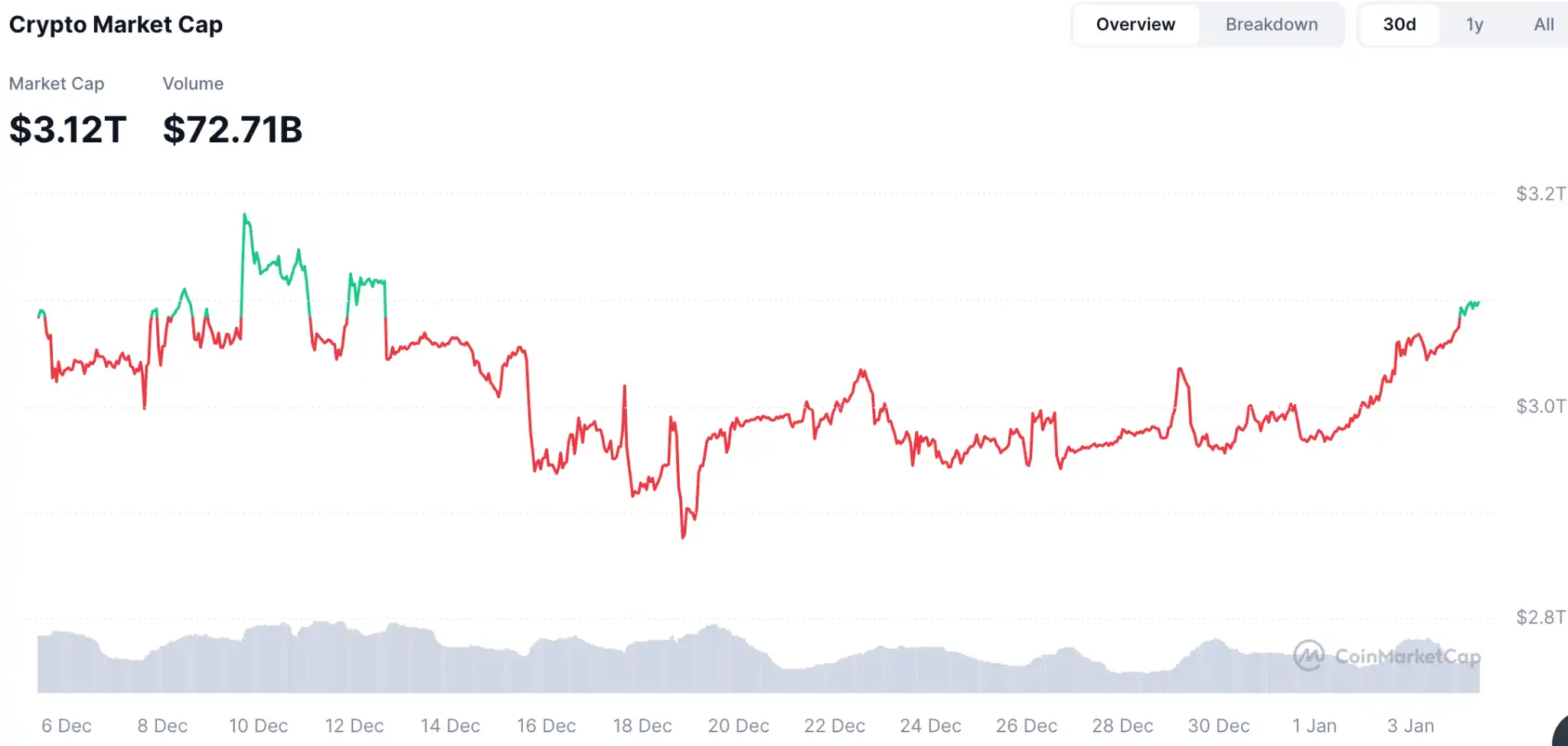
Currently, the total cryptocurrency market capitalization is $3.11 trillion, with BTC accounting for 58.56%, at $1.82 trillion. The stablecoin market cap is $307.5 billion, decreasing by 0.25% in the last 7 days. Stablecoins have seen negative weekly growth for two consecutive weeks, with USDT accounting for 60.8%.

Among the top 200 projects on CoinMarketCap, most have risen while a few have fallen. Specifically: BTC gained 4.2% in 7 days, ETH gained 6.92%, SOL gained 7.93%, MYX gained 84.42%, and PEPE gained 54.1%.

This week, the net inflow for U.S. Bitcoin spot ETFs was $458.7 million; the net inflow for U.S. Ethereum spot ETFs was $1.613 million.

Market Forecast (January 5 - January 9):

The current RSI index is 60.59 (neutral zone), the Fear & Greed Index is 26 (higher than last week, generally in the fear zone), and the Altcoin Season Index is 39 (neutral, higher than last week).

BTC Core Range: $87,000-93,000

ETH Core Range: $3,000-3,500

SOL Core Range: $129-150

This week marks the first week of 2026. The net inflow into U.S. spot ETFs directly boosted the crypto market cap. After gold and silver hit new highs, their prices have corrected. With capital spilling over, crypto has absorbed some liquidity. It is expected that next week's market will fluctuate within a range with an upward trend. Short-term traders can consider "buying low and selling high." Recently, small-cap altcoins have seen significant gains. Given the uncertain market outlook for 2026, it is not advisable to chase highs.

Understanding the Present

Review of the Week's Major Events

  1. On December 29, Lu Lei, Deputy Governor of the People's Bank of China, stated that the PBOC will issue the "Action Plan on Further Strengthening the Digital Yuan Management Service System and Related Financial Infrastructure." A new generation of digital yuan measurement framework, management system, operational mechanism, and ecosystem will be officially launched and implemented on January 1, 2026;
  2. On December 29, Indian police in Hyderabad arrested a former Coinbase customer service employee suspected of involvement in the insider data breach disclosed by Coinbase in May this year. This is the first known arrest in the case, as confirmed by Coinbase CEO Brian Armstrong;
  3. According to a report by LatePost, Meta acquired Butterfly Effect, the company developing the AI application Manus, for billions of dollars. This is Meta's third-largest acquisition to date,仅次于 WhatsApp and ScaleAI. It is reported that before Meta's acquisition, Manus was raising a new round of funding at a $2 billion valuation. "It happened so fast that I even doubted if it was a fake offer," said Liu Yuan, a partner at ZhenFund and an angel investor in Butterfly Effect. The acquisition negotiation was completed in an extremely short time, taking only about ten days;
  4. On December 30, Trust Wallet announced it would proactively compensate affected users. The total stolen assets amounted to approximately $8.5 million;
  5. On December 31, boosted by the Fed's interest rate cuts and a significant surge in AI investment enthusiasm, global stock markets are poised for their largest annual gain in six years in 2025. With only one trading day left in 2025, the MSCI World Stock Index has risen 21% this year;
  6. On January 4, Tom Lee expressed support for BitMine's increase in authorized share capital. BMNR closed up 14.88%;
  7. On January 3, after 14:00 Beijing time, loud explosions were heard in Caracas, the capital of Venezuela, air raid sirens sounded, and power outages occurred in the southern part of the city near a large military base. The crypto market experienced a certain degree of decline, possibly influenced by this event.

Macro Economy

  1. On December 31, U.S. initial jobless claims for the week ending December 27 were 199,000, the lowest since the week of November 29, below the expected 220,000. The previous week's figure was revised from 214,000 to 215,000.
  2. On January 4, according to CME's "FedWatch Tool," the probability of a 25 basis point rate cut by the Fed in January is 16.6%, while the probability of maintaining the current rate is 83.4%.

ETFs
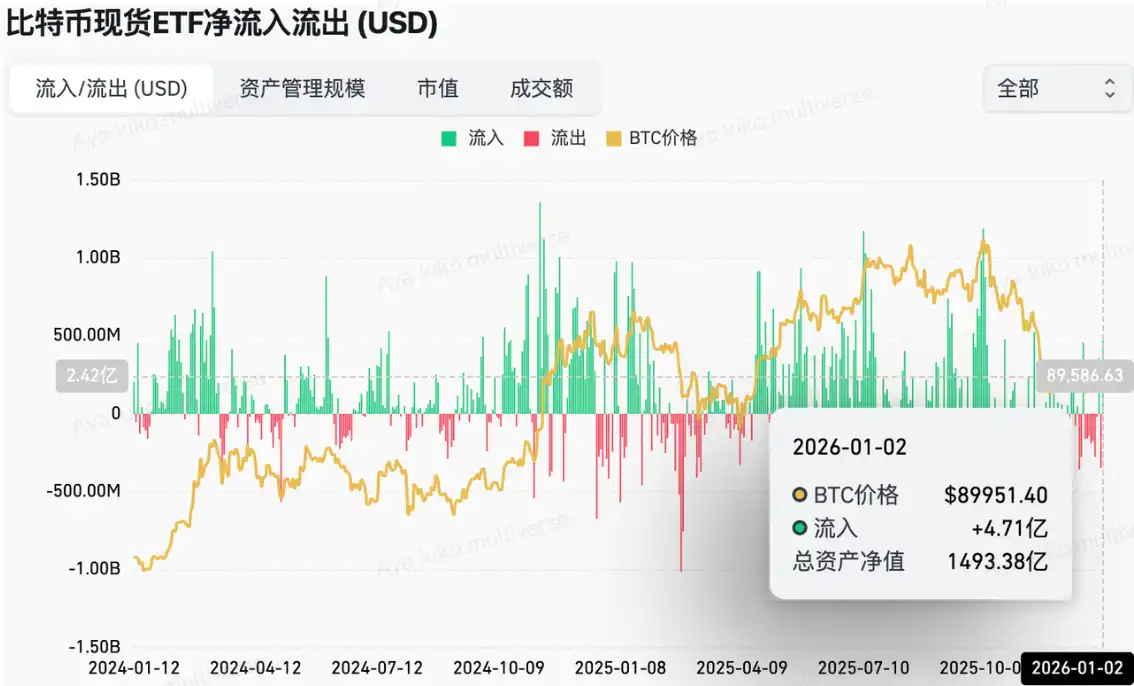
According to statistics, during the period from December 29 to January 2, the net inflow for U.S. Bitcoin spot ETFs was $458.7 million. As of January 2, GBTC (Grayscale) has seen a total outflow of $25.193 billion and currently holds $14.793 billion. IBIT (BlackRock) currently holds $69.313 billion. The total market capitalization of U.S. Bitcoin spot ETFs is $119.546 billion.

The net inflow for U.S. Ethereum spot ETFs was $1.613 million.

Foreseeing the Future

Project Developments

  1. The Daily Gwei, a video program focused on Ethereum, will resume weekly updates on January 5, 2026;
  2. The claim period for the social app Based's Christmas commemorative "Soulbound" NFT ends on January 7, 2026;
  3. Web3 robotics company XMAQUINA will collaborate with Virtuals Protocol for a DEUS community sale on January 8. The auction starts at 20:00 on January 8, with an FDV of $60 million (DEUS price: $0.06). At TGE, 33% will be liquid, and 67% will vest linearly over 12 months. The public sale is open to all non-U.S. contributors. Eligible wallets can receive a 20% DEUS reward, including a Genesis OG reward for those who participated in any previous genesis auction. Contributing 10,000 USDC from the same wallet will yield a 20% DEUS reward.

Important Events

  1. January 7, 21:15: The U.S. will release the December ADP Employment Change (in thousands);
  2. January 8, 21:30: The U.S. will release the Initial Jobless Claims for the week ending January 3 (in thousands);
  3. January 9, 21:30: The U.S. will release the December Unemployment Rate.

Token Unlocks

  1. 1.2 million team-allocated tokens for Hyperliquid will unlock on January 6. Subsequent unlocks will occur on the 6th of each month;
  2. Jito (JTO) will unlock 11.31 million tokens on January 7, worth approximately $5.4 million, accounting for 1.14% of the circulating supply;
  3. Movement (MOVE) will unlock 161 million tokens on January 9, worth approximately $6 million, accounting for 1.62% of the circulating supply;
  4. Linea (LINEA) will unlock 1.44 billion tokens on January 10, worth approximately $10.18 million, accounting for 2% of the circulating supply.

About Us

Hotcoin Research, as the core research arm of Hotcoin Exchange, is dedicated to transforming professional analysis into your practical tool. We analyze market trends through "Weekly Insights" and "In-Depth Research Reports"; with our exclusive column "Hotcoin Selection" (dual screening by AI and experts), we help you identify potential assets and reduce trial costs. Every week, our researchers also engage with you face-to-face through live streams, interpreting hot topics and predicting trends. We believe that warm companionship and professional guidance can help more investors navigate cycles and seize the value opportunities in Web3.

Risk Disclaimer

The cryptocurrency market is highly volatile, and investing carries inherent risks. We strongly advise investors to fully understand these risks and invest within a strict risk management framework to ensure capital safety.

Website:https://lite.hotcoingex.cc/r/Hotcoinresearch

X: x.com/Hotcoin_Academy

Mail:[email protected]

Related Reads

Understanding CPO (Co-Packaged Optics) in One Article: Why Nvidia Is Willing to Spend $3.2 Billion on a Fiber?

NVIDIA and Corning announced a multi-year strategic partnership on May 6, 2026, with NVIDIA committing up to $3.2 billion to support Corning's U.S. expansion. This investment will triple Corning's manufacturing plants and significantly boost its optical fiber and communications production capacity. The core driver behind this massive investment is the fundamental shift from copper to optical interconnect technology within AI data centers. As GPU clusters scale, copper wires face critical limitations: severe signal attenuation over distance, high energy consumption for signal integrity, and excessive heat generation. Optical fiber, transmitting light instead of electrical signals, solves these issues with minimal loss, near-light speed, and lower power needs. The article outlines a three-stage evolution of data center interconnect: 1. **Traditional Copper Interconnects:** The mainstream solution of the 2010s, now being phased out due to scaling bottlenecks. 2. **Pluggable Optical Modules:** The current mainstream, where modules convert electrical signals to light externally. This process still introduces energy loss and latency. 3. **CPO (Co-Packaged Optics):** The next-generation technology where the optical engine is integrated directly with the GPU chip package. This drastically reduces the electrical signal travel distance to mere millimeters, slashing power consumption and latency while boosting data density. NVIDIA CEO Jensen Huang has identified CPO as an essential core technology for AI infrastructure. NVIDIA's investment signifies a strategic shift from being a buyer to actively controlling its supply chain for critical components. With demand for specialized optical fiber far outstripping supply—evidenced by soaring prices—securing long-term manufacturing capacity has become a competitive necessity. While Corning's expansion may pressure some suppliers, a projected global fiber supply gap of 5-15% over the next few years creates a significant opportunity window, particularly for Chinese manufacturers competitive in optical preforms, chips, and modules. Ultimately, NVIDIA's move is not about chasing a trend but an engineering imperative. The transition to light-based interconnects like CPO is driven by the physical limits of copper, marking a definitive step in the ongoing AI computing revolution.

marsbit9m ago

Understanding CPO (Co-Packaged Optics) in One Article: Why Nvidia Is Willing to Spend $3.2 Billion on a Fiber?

marsbit9m ago

KOL's Perspective: Why Is SOL Set to Rise from This Point?

**Summary: Why SOL is Positioned for Growth at This Level** The article argues that SOL is poised for an upward move from its current price point, citing several key factors. Primarily, SOL has just broken out of a 4-month consolidation phase. This breakout signals a return of risk appetite to the broader crypto market, as SOL is seen as a key indicator of overall crypto health. The token's ownership has reportedly shifted from short-term traders and tourists to long-term accumulators, leading to low volume. Any meaningful increase in trading activity could thus trigger significant upward momentum. Fundamental strengths include strong institutional adoption, integration with DeFi and RWAs (Real-World Assets), and the potential benefits from the Clarity Act. Despite its high volatility—having dropped 70% from its all-time high but still up 12x from its bear market low—SOL is highlighted as one of the few tokens from the last cycle to reach new highs. It boasts a robust ecosystem of applications, users, and protocols. Future catalysts include the expected influx of AI developers following the Miami Accelerate conference, which focused on AI on Solana. Furthermore, Solana is positioned as the premier chain for memecoin activity, a trend expected to continue and drive network usage and fees. The article concludes that recent price action reflects a healthy transfer to long-term holders, setting the stage for growth.

marsbit59m ago

KOL's Perspective: Why Is SOL Set to Rise from This Point?

marsbit59m ago

Those Pre-Bitcoin PoW Protocols Have Recently Been Reimplemented

This article details a recent surge in replicating pre-Bitcoin Proof-of-Work (PoW) protocols, specifically focusing on Hal Finney's 2004 RPOW (Reusable Proofs of Work). Within five days in May 2026, multiple independent builders in the Bitcoin/cypherpunk community launched projects inspired by this early electronic cash proposal. The initiative began with Fred Krueger's `rpow2.com`, a centralized but auditable system that replaced RPOW's original IBM 4758 hardware with Ed25519 signatures. Initially a faithful replica, it later adopted Bitcoin-like features (21M supply cap, difficulty adjustment) and a controversial 5.24% founder allocation. This sparked rapid forks, including `rpow4.com` which incorporated full Bitcoin parameters, a prediction market (`rpowmarket.com`), and a DEX (`rpow2swap.com`). Concurrently, Mike In Space created a prototype of Wei Dai's 1998 b-money proposal (`b-money.replit.app`), pushing the historical exploration even further back. The article contrasts these centralized, server-dependent experiments with Bitcoin's core innovation of decentralized, trustless consensus. It also highlights a parallel development: the `HASH` project on Ethereum, which uses smart contract hooks to enable a purely fair-launch, browser-mineable PoW token with 0% allocations to team or VCs. The collective activity is framed as a meme-driven, educational exploration of cypherpunk history rather than a serious financial movement, with all projects heavily disclaiming any investment value.

marsbit1h ago

Those Pre-Bitcoin PoW Protocols Have Recently Been Reimplemented

marsbit1h ago

South Korean Exchanges 'Battle' Regulators, Challenging the Boundaries of Enforcement and Legislation

South Korea's cryptocurrency industry is engaged in a rare, direct confrontation with regulators. The Financial Intelligence Unit (FIU), the primary anti-money laundering (AML) watchdog, has recently imposed heavy penalties on major exchanges like Upbit and Bithumb for alleged violations involving unregistered overseas VASPs and AML procedures. However, exchanges are now actively challenging these actions in court and through industry associations. In a significant shift, the Seoul Administrative Court ruled in favor of Upbit's operator, Dunamu, overturning part of an FIU-ordered business suspension. The court found the FIU's penalty criteria and justification insufficiently clear. Similarly, the court suspended the enforcement of a six-month business suspension against Bithumb pending a final ruling, citing potential irreversible harm to the exchange. Beyond legal battles, the industry is contesting proposed legislative amendments. The Digital Asset eXchange Alliance (DAXA) strongly opposes a draft rule that would mandate Suspicious Transaction Reports (STRs) for all crypto transfers over 10 million KRW (~$6,800). DAXA argues this "poison pill" clause violates legal principles and would overwhelm the STR system, increasing reports from 63,000 to an estimated 5.45 million annually for major exchanges, thereby crippling effective AML monitoring. This conflict highlights a structural tension in South Korea's crypto governance: comprehensive digital asset laws are still developing, while regulators rely heavily on AML enforcement. The industry's move from passive compliance to active legal and legislative challenges signifies a new phase, pressing for clearer rules and more proportionate enforcement. While short-term disputes may intensify, this clash could ultimately lead to a more mature and sustainable regulatory framework for South Korea's vibrant crypto market.

marsbit1h ago

South Korean Exchanges 'Battle' Regulators, Challenging the Boundaries of Enforcement and Legislation

marsbit1h ago

Trading

Spot
Futures
活动图片

