Report Interpretation: J.P. Morgan Details Micron's Pre-Earnings Sentiment, Current Hardware Sector Dynamics

marsbitPublished on 2026-06-22Last updated on 2026-06-22

Abstract

Morgan Stanley analyst Joshua Meyers' report (June 21, 2026) highlights key trends in the hardware and semiconductor sector ahead of Micron's earnings. The core takeaways are: 1. **Micron & Memory:** Memory remains a high-conviction long theme, driven by strong AI demand and rising ASPs. However, investor focus is shifting to the sustainability of Micron's >80% gross margins and the specifics of potential new long-term supply agreements (SCAs). 2. **Hardware Supply Chain:** AI-related demand for servers, networking, and storage remains robust, but company performance is diverging. Celestica (CLS) shows improved margin confidence, Western Digital and Seagate benefit from pricing, Fabrinet (FN) sees predictable AI optics growth, and Teradyne (TER) anticipates a new Google customer. 3. **AI Capex & WFE Forecasts:** JPMorgan increased its Wafer Fab Equipment (WFE) market growth forecasts to 28% in 2026 and 29% in 2027. AI infrastructure financing is evolving, with higher project-level debt reducing constraints on capex expansion. The report signals that while the AI-driven hardware cycle is strong, the market is entering a phase focused on execution verification (e.g., Micron's SCA details, Fabrinet's ramp with Amazon) and valuation sustainability. Key near-term signals include Micron's guidance, Arista Networks' outlook, and the pace of demand normalization post potential tariff-related pull-ins.

Written by: TideResearch

Author: Rita

TideResearch Insights

J.P. Morgan expert Joshua Meyers released a report on June 21, synthesizing findings from a survey of buyer sentiment ahead of Micron's earnings, feedback from pre-earnings checks with hardware companies, updated AI capital expenditure forecasts, and key developments for several major companies. The core message conveyed in the report: The memory sector where Micron operates remains the most consensus-driven long position within the AI segment, but the sustainability of high gross margins and valuation methodologies are sparking discussion. Within the hardware supply chain, AI-related demand for servers, networking, and storage remains robust, but divergence is emerging among individual stocks. Suitable for investors tracking the U.S. stock hardware and semiconductor sectors.

Three Key Takeaways

1 Buyer sentiment remains strong ahead of Micron's earnings, but two issues are simmering.

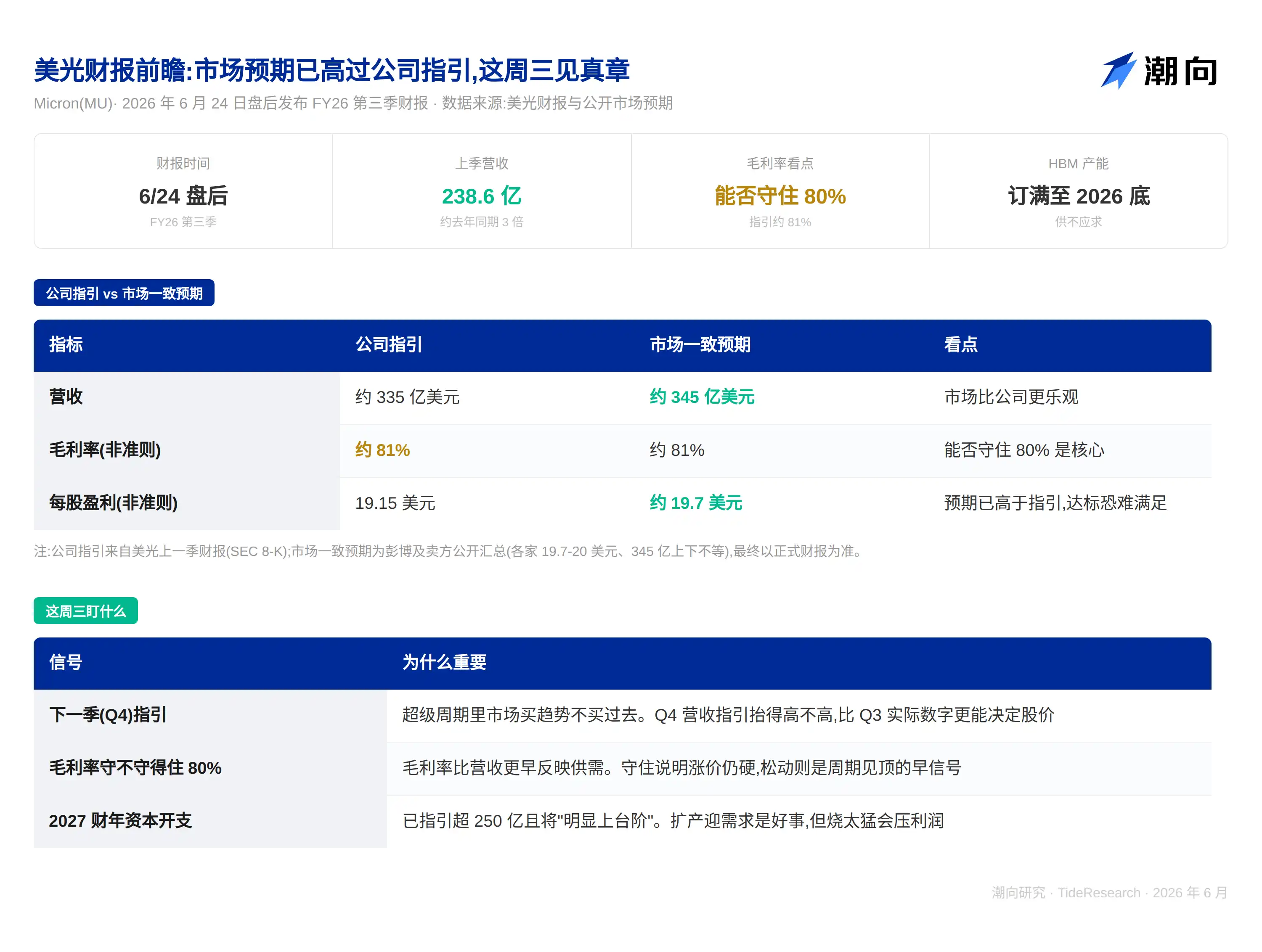
Meyers notes that memory is one of the most consensus-driven long positions in the tech sector and across the broader market. AI demand continues to improve, recently buoyed by unexpected growth in demand for agent CPUs, and the average selling price (ASP) has been ticking up with each industry survey. Demand has indeed been somewhat disrupted, but supply-side responses remain relatively measured. The market generally expects Micron to announce more Supply Commitment Agreements (SCAs) in this earnings report, with roughly 75% of surveyed buyers anticipating new contracts. The market's focus is on: Micron's gross margins have exceeded 80%, sparking debate; how the company views the room for AI applications to further drive ASPs; and the level of detail that can be disclosed regarding the specific terms of the long-term agreements.
2 Pre-earnings checks with the hardware supply chain: AI-related demand robust, clear stock divergence.

Meyers summarizes pre-quarter communications with hardware and networking equipment companies. Celestica's (CLS) margin outlook has improved, showing greater confidence in AI networking projects. Western Digital and Seagate benefit from continued pricing improvements, with no need to concede pricing during product generation transitions in a supply-constrained environment. Fabrinet's (FN) visibility on growth in its AI optical module business has increased, with Amazon-related products starting to contribute revenue this quarter and gradually ramping up. Teradyne's (TER) revenue is expected to decline sequentially in the second half of the year, but Google is likely to become a new VIP compute customer by year-end, representing a significant incremental contributor for the following year.

3 AI capital expenditure forecasts raised again, 2027 WFE market growth seen at 29%.

J.P. Morgan's global semiconductor team has raised its 2026 Wafer Fab Equipment (WFE) market growth forecast from 21% to 28% (equivalent to $155 billion) and its 2027 forecast from 18% to 29% (equivalent to $200 billion). DRAM, TSMC, Intel Foundry, and Samsung Foundry are the primary sources of the increase. The investment and financing model for AI infrastructure is also evolving, with the debt financing proportion at the project level having risen to over 85%. Considering that the market value of projects post-construction significantly exceeds their build cost, the actual loan-to-value (LTV) ratio is only about 60%, indicating that financing constraints on the expansion of AI capital expenditures are weakening.

The Supply Chain Signal Behind Celestica's Improving Margins

Among the pre-quarter communications with the hardware supply chain, Celestica's (CLS) feedback deserves special attention.

Meyers points out that Celestica had previously expressed concerns about Tomahawk (Broadcom switch chip) pricing, but its tone was noticeably more positive during this communication. The company is more confident in its ability to pass on costs through price increases and is also vying for more rack-based AI networking projects, which offer thicker margins. The market expects its FY26 operating margins to continue expanding, possibly by 10 to 20 basis points. The outlook for FY27 is even more optimistic, with the potential for stable margins combined with operating leverage to prompt more positive guidance in the next earnings report.

Regarding AI chip supply, Celestica works with both Broadcom and MediaTek, and its confidence in the supply chain is markedly stronger than that of Arista Networks, as hyperscale customers are receiving higher supply priority. This signal suggests that demand dynamics for AI networking equipment are still consolidating around leading suppliers, with supply chain allocation capabilities becoming a competitive moat.

Short-Term Focus on Earnings Validation, Long-Term Focus on Valuation Anchors

Micron's earnings report is the most immediate catalyst. Market consensus has largely priced in a strong quarter. The real variable lies in the level of detail provided about long-term agreement disclosures. If the coverage ratio of SCAs allows the market to gain clarity on future revenue visibility, Micron's valuation logic could undergo further reshaping.

Another key variable for the hardware sector is the pace of demand. Distributors like CDW report that a significant portion of the current robust demand for servers and networking equipment stems from customers placing advance orders due to concerns about potential further tariff hikes. How long this pull-forward demand can persist is the biggest uncertainty for the hardware sector in the second half of the year.

Three Signals to Track:

The level of detail in Micron's SCA disclosures and its gross margin outlook. Whether Arista Networks can raise its full-year guidance in its next earnings report. Whether Fabrinet's Amazon optical module revenue can ramp up as expected to $250 million per quarter within a year.

Disclaimer

This article is TideResearch's compilation and interpretation of a third-party brokerage research report. The ratings, price targets, earnings forecasts, and related judgments cited herein represent the views of that brokerage's analyst, reflecting solely the position of their affiliated institution. They do not represent TideResearch's views and do not constitute any investment advice.

Please note three points while reading: First, price targets are analysts' expectations for approximately the next 12 months; they are predictions, not promises, and will be adjusted repeatedly based on performance and market conditions. Second, sell-side research reports inherently lean bullish, and some covered companies may have investment banking relationships with the brokerage. Third, the value of a research report lies in its core logic and underlying assumptions, not solely in a specific price target. Focus on the logic, not just the price.

The market carries risks; decisions should be made independently. This article should not be used as the basis for trading any securities.

Data source: J.P. Morgan Research Report (Joshua Meyers et al., June 21, 2026) · Company public disclosures

TideResearch · June 2026

Related Questions

QWhat are the three key conclusions from J.P. Morgan's report regarding Micron and the hardware sector?

A1. Strong bullish sentiment on Micron ahead of earnings, but questions are emerging about the sustainability of high gross margins (over 80%) and the details of potential long-term agreements (SCAs). 2. AI-related demand in the hardware supply chain remains robust, but performance is diverging among individual companies (e.g., Celestica, Western Digital, Seagate, Fabrinet, Teradyne). 3. AI capital expenditure forecasts have been raised again, with the wafer fabrication equipment (WFE) market expected to grow 28% in 2026 and 29% in 2027. The financing model for AI infrastructure is also evolving, easing constraints on capex expansion.

QWhat signals regarding the AI hardware supply chain can be drawn from Celestica's (CLS) improved margin outlook?

ACelestica's improved confidence in passing on costs (like Tomahawk chip pricing) and securing more rack-based AI networking projects (which offer better margins) signals a strengthening position for leading suppliers. Their stronger supply chain confidence compared to Arista Networks also suggests that supply allocation capabilities are becoming a competitive moat, with hyperscale customers getting priority.

QWhat is a key uncertainty for the hardware sector in the second half of the year, according to the report?

AA key uncertainty is the duration of the current strong demand for servers and networking equipment. Distributor feedback (e.g., from CDW) indicates that a significant portion of this demand is due to customers placing orders early to avoid potential tariff-related price increases. How long this front-loaded demand can last is the sector's biggest uncertainty for H2.

QWhat are the three specific signals the report suggests investors should track?

A1. The level of detail disclosed in Micron's earnings regarding its long-term agreements (SCAs) and its gross margin outlook. 2. Whether Arista Networks can raise its full-year guidance in its next earnings report. 3. Whether Fabrinet's revenue from Amazon optical modules can ramp up as expected to $250 million per quarter within a year.

QAccording to the report, what is the primary catalyst for Micron and what could reshape its valuation logic?

AMicron's upcoming earnings report is the most immediate catalyst. The key variable is the detailed disclosure of its long-term supply and capacity agreements (SCAs). If the coverage and terms of these SCAs provide clear visibility into future revenue, it could significantly reshape Micron's valuation logic by offering more predictable, contracted income streams.

Related Reads

The Verdict in Choi Tae-won's Divorce Case: Revealing the Inheritance Undercurrent Behind SK Hynix's Trillion-Won Empire

SK Group Chairman Chey Tae-won's high-profile divorce case, involving a record 1.38 trillion won settlement, has drawn attention to the succession plans for Korea's second-largest conglomerate, especially its crown jewel, SK hynix. Unlike traditional chaebol scripts centered on the eldest son, Chey's three children from his marriage to former President Roh Tae-woo's daughter, Roh Soh-yeong, are carving distinct, non-traditional paths. Eldest daughter Chey Yun-jung (b. 1989) is seen as the most evident successor. With a scientific and consulting background, she holds executive roles at SK bioscience and SK Inc.'s growth support department, focusing on future strategy and biopharma. Her marriage is to an AI infrastructure entrepreneur, not a traditional business alliance. Second daughter Chey Min-jung (b. 1991) took a unique route, voluntarily serving as a South Korean naval officer, including an anti-piracy deployment. She later worked on policy and strategy for SK hynix in Washington D.C. before co-founding an AI-driven healthcare startup. She married a former U.S. Marine Corps officer, connecting her to U.S. defense and policy circles—networks crucial for a global semiconductor giant. The only son, Chey In-geun (b. 1995), who studied physics like his father, worked briefly at SK E&S before joining McKinsey. Despite fitting the traditional "heir" profile as the eldest son, he remains silent and holds no public position or shares in SK, suggesting the old succession playbook is obsolete. As SK hynix's valuation soars, becoming a geopolitical asset in the AI era, the heirs' legitimacy is no longer automatic. They must prove themselves in fields like AI biotech, global policy, and strategic consulting. Their marriages also reflect new elite networks in tech and defense, not old political alliances. Their inheritance is the complex challenge of navigating a globalized, tech-driven world, not just a corporate throne.

marsbit9h ago

The Verdict in Choi Tae-won's Divorce Case: Revealing the Inheritance Undercurrent Behind SK Hynix's Trillion-Won Empire

marsbit9h ago

From OpenSea to OpenRouter: Is Alex Atallah Repeating His 'Exit at the Peak' Playbook?

From OpenSea to OpenRouter: Is Alex Atallah Repeating His "Exit at the Peak" Playbook? According to the Wall Street Journal, payments giant Stripe is in talks to acquire the AI model aggregation platform OpenRouter in a potential deal valuing the company near $100 billion. This would mark founder Alex Atallah's second creation of a company reaching a $100 billion valuation, following his co-founding of NFT marketplace OpenSea. OpenRouter, founded just over three years ago, has grown rapidly by acting as a unified gateway for developers to access over 400 AI models. It currently has about 10 million users and processes over 200 trillion tokens monthly. While the platform's annualized revenue is around $50 million, its valuation has skyrocketed from $1.3 billion in March 2026. The potential acquisition by Stripe, a company OpenRouter's founder once likened it to, represents a major expansion into AI infrastructure for the payments leader. This move echoes Atallah's previous timing with OpenSea, where he departed before the NFT market's significant downturn. For OpenRouter, selling now may be strategic. Despite its scale, its business model—charging a 5-5.5% fee on AI inference calls—faces pressure from competition, open-source models, and potential price wars among model providers, limiting its profitability narrative for an IPO. A key asset for potential acquirers like Stripe is OpenRouter's vast repository of real-world AI usage data, which offers unique insights into model performance and developer preferences that are difficult to replicate. Whether this potential deal signifies a new valuation benchmark for AI infrastructure or another market peak signal remains to be seen.

链捕手10h ago

From OpenSea to OpenRouter: Is Alex Atallah Repeating His 'Exit at the Peak' Playbook?

链捕手10h ago

Trading

Spot
活动图片





