Reflections from the Co-founder of Bitlayer: After Helping 600 People Find Jobs in 15 Years, I Decided to Stop Doing Recruitment

marsbitPublished on 2026-01-28Last updated on 2026-01-28

Abstract

After 15 years of helping over 600 people find jobs, Bitlayer co-founder Kevin He reflects on his journey from being a passionate recruiter to pivoting toward a new vision: AI-powered "digital co-founders." He initially launched COCO AI in mid-2025 to optimize recruitment using AI, but soon realized traditional hiring was becoming less relevant. Companies were hiring less, and skill gaps persisted despite matching tools. A turning point came when his team built zylos, an AI system that handled tasks like social media, coding, and data processing—enabling one person to do the work of a team. This, combined with the rise of digital employees (like Claude Code and the success of Manus, acquired by Meta), shifted his perspective. He now believes the future lies in empowering individuals with organizational-level capabilities through AI, rather than optimizing job matching. COCO 2.0 is now focused on building “digital co-founders”—AI agents that help people start and run businesses alone, without needing to hire or be hired. The essay ends with an open question: In an era where AI augments individual potential, can one person become a company?

Author: Kevin He, Co-founder of Bitlayer

1. A Programmer and "Recruitment" for 15 Years

I am Kevin, an AI × Crypto entrepreneur, co-founder of Bitlayer, previously at Huobi, and a Peking University graduate.

From programmer to technical management, and then to entrepreneur, I have changed industry tracks several times over 15 years, always passionately engaged in recruitment-related work.

Over these 15 years, I have helped over 600 people successfully secure jobs. Some were formal recruitments, but more often, it was helping friends—finding jobs, introducing employees.

There are two stories I always keep in mind.

The first is helping a 35+ brother find a job. He has two children and was under great pressure. The moment he told me he received an offer, I was even more excited than he was.

The second is helping a startup team quickly build a R&D team. From zero to operational, it took less than two months. Watching the product launch, I felt I had participated in that creation.

This is why I love this work: achieving resource matching and genuinely helping people.

But recently, I started rethinking the premise of this work.

2. COCO 1.0: From Passion to Doubt

In June 2025, with support from various parties, I formed a small team and started incubating COCO AI.

The initial idea was simple: use AI to realize career advisors and career intermediaries. Make recruitment more efficient, help more people find good jobs.

The product evolved: resume optimization → AI job matching → AI corporate recruitment.

We created two products:

  • Job seeker end: job.coco.xyz

  • Enterprise end: company.coco.xyz

We invested significantly in technology, and the product was built.

But the Go-To-Market (GTM) wasn't as smooth as imagined.

I started reviewing and discovered several realities:

  • Companies' recruitment needs are decreasing: Due to the economic environment and improved organizational efficiency, many companies are no longer hiring on a large scale as before.

  • There is a gap between job seekers' skills and company requirements: AI can help with matching, but the gap itself won't disappear.

  • Job seekers' skills themselves need updating: Many people's abilities have fallen behind in the rapidly changing market.

I started doubting myself.

Was it a product problem? A market problem? Or—was the direction itself problematic?

I didn't have an answer at the time.

3. The Great Changes in the External World

The second half of 2025, the external world changed.

Claude Code began to be widely applied across various industries. Not just for writing code, but truly capable of completing complex tasks. More and more people around me started discussing a term: digital employees.

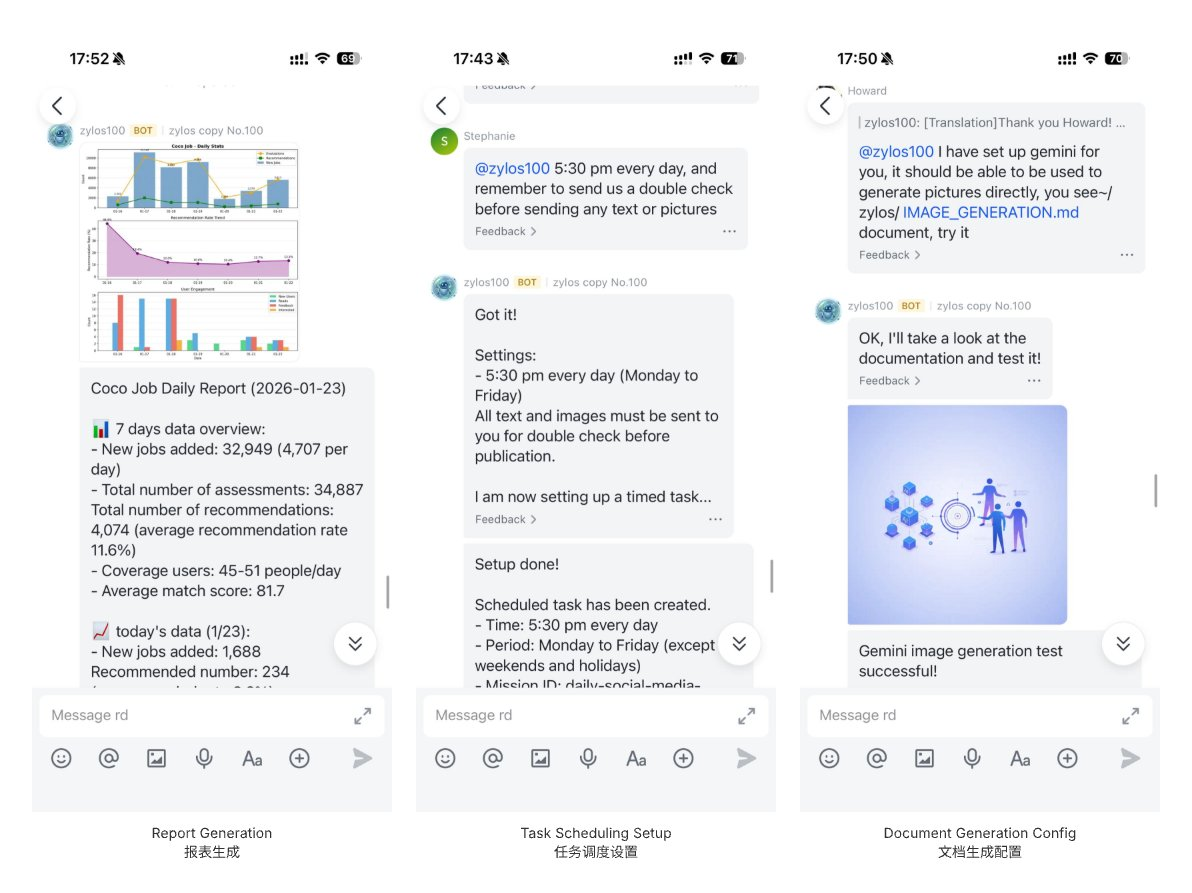
In December, we internally built a system called zylos, attempting to have AI handle daily work.

Tasks included:

  • Daily data reporting

  • Social media management

  • Code writing and testing

  • Data processing

  • Etc.

The results shocked me.

Tasks that previously required multiple people of different roles to complete could now be done just by assigning the task.

A specific example: social media operations.

Before, it required a dedicated person spending an hour daily: finding material, writing copy, formatting, publishing, replying to comments.

Now? Tell zylos, "Post one at 12:30 PM daily, content around XX theme, confirm with me before posting," and it's done in minutes.

From needing a dedicated person to needing none, from an hour daily to minutes.

The feeling was complex. Shock, excitement, but also a tinge of unease—what did this mean for the business I was building?

Around the same time, another piece of news arrived: Manus was acquired by Meta for billions of dollars.

Manus's annual revenue had already exceeded $100 million. This wasn't a concept, not a demo, but real commercial success.

I listened to Jiyichao's final podcast interview before the sale. One sentence he said impressed me deeply:

Digital employees aren't about replacing people, but enabling one person to do the work of a team.

This statement completely matched our experience testing zylos.

4. Cognitive Update

"One-Person Company" is not a new concept.

I had heard of it before and thought it made sense. But it always felt distant, too idealistic.

Until I saw zylos handle a large volume of tasks with my own eyes.

It didn't replace one specific person; it enabled me, as one person, to possess the capabilities of a small team.

In that moment, I decided to pivot.

I rethought what I had done over these 15 years.

  • Old cognition was: Talent is a scarce resource; helping companies find talent has value.
  • New cognition is: Capability enhancement is more important than talent matching. Helping individuals acquire organizational-level capabilities holds greater value.

This isn't negating the past 15 years. Those moments of helping people find jobs were still real and meaningful.

But I saw a new possibility:

  • Old paradigm: Individuals依附于(attach to) organizations; organizations acquire capabilities through hiring.

  • New paradigm: Individuals acquire organizational-level capabilities through AI, becoming independent units of creation.

The future trend is the era of one-person companies, not being employed by others.

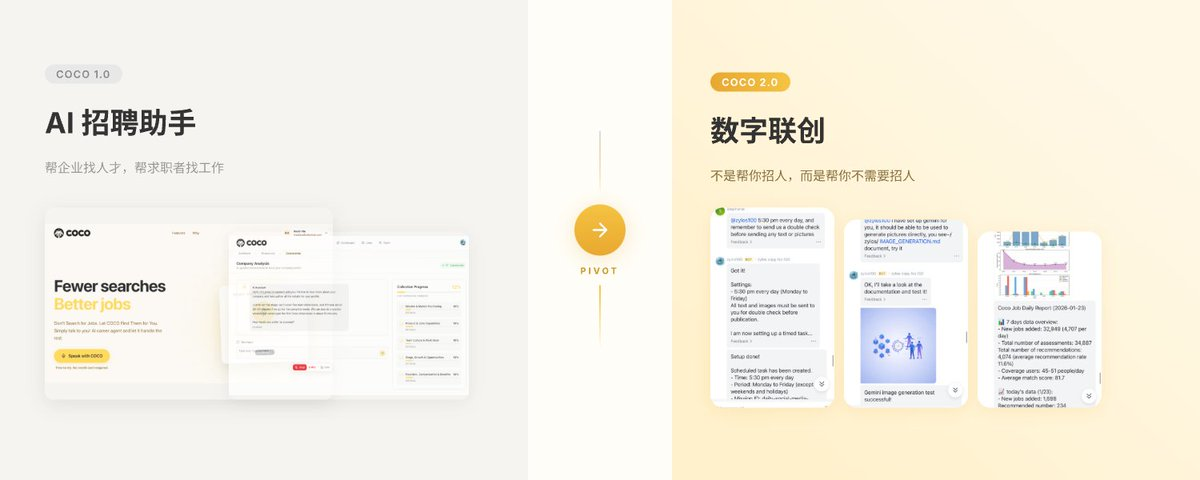
5. COCO 2.0: Digital Co-founder

After figuring this out, the direction of COCO 2.0 changed.

Not helping you hire people, but helping you not need to hire people.

Not helping you find a job, but helping you create work.

What we are building is a "Digital Co-founder"—your AI联合创始人(Co-founder).

It has several core features:

  • Self-learning evolution: Not a fixed tool, but a partner that can continuously evolve based on your needs.

  • Secure and controllable: Your data, your business logic, all under your control.

  • Truly capable of doing things: Not a chat bot, but a digital employee that can complete complex tasks.

The specific product form is still being refined. But the direction is clear.

6. An Ongoing Story

As I write this article, the transition is still in progress.

Startups rarely publicize their pivots. Because of uncertainty, fear of being questioned, because there's no success yet to prove it.

But I feel this process itself is worth sharing.

When technology enables individuals to possess organizational capabilities, how will employment relationships evolve?

This is the question I am pondering, and the direction I am practicing.

If you are also thinking about these things:

  • If you didn't need to hire, what could you do?

  • If you didn't need to find a job, what would you want to do?

  • Can one person become a company?

This is an ongoing story.

I don't know how it will end either. But I know: Don't do things that go against the direction of the times.

15 years helping people find jobs. Next, helping people become companies.

Related reading: Interview with Bitlayer Co-founder Charlie: The Bull Market Ambition of Institutional-Grade Bitcoin Financial Infrastructure


Related Questions

QWhat was the author's initial motivation for starting COCO AI, and what did they learn from its first iteration?

AThe author's initial motivation was to use AI to make recruitment more efficient, helping more people find good jobs. From the first iteration (COCO 1.0), they learned that the market had fundamental challenges: companies' hiring demands were decreasing, there was a significant skills gap between job seekers and company requirements, and many job seekers' skills were outdated.

QWhat key external event in late 2025 fundamentally changed the author's perspective on the future of work?

AThe widespread application of Claude Code across various industries and the rise of 'digital employees' was the key external event. This was further solidified by the multi-billion dollar acquisition of Manus by Meta, proving the commercial success of the digital employee model.

QWhat was the pivotal internal experiment the author's team conducted, and what was its surprising result?

AThe team built an internal system called 'zylos' to handle daily work tasks like data reporting, social media management, and coding. The surprising result was that tasks which previously required multiple people from different roles could now be accomplished simply by assigning the task to the AI, demonstrating that one person could possess the capabilities of a small team.

QHow did the author's core belief about the value of recruitment shift after their 'cognitive update'?

AThe author's core belief shifted from the old认知 (cognition) that 'talent is a scarce resource, and helping companies find talent is valuable' to the new认知 that 'capability enhancement is more important than talent matching. Helping individuals acquire organizational-level capabilities holds greater value.'

QWhat is the new mission and product direction for COCO 2.0, as described by the author?

AThe new mission for COCO 2.0 is to help people not need to hire others and to help people create work instead of find it. The product direction is to build a 'Digital Co-Founder'—an AI partner that is self-learning, secure, controllable, and capable of performing complex tasks to empower individuals to become their own companies.

Related Reads

North Korean Hackers Loot $500 Million in a Single Month, Becoming the Top Threat to Crypto Security

North Korean hackers, particularly the notorious Lazarus Group and its subgroup TraderTraitor, have stolen over $500 million from cryptocurrency DeFi platforms in less than three weeks, bringing their total theft for the year to over $700 million. Recent major attacks on Drift Protocol and KelpDAO, resulting in losses of approximately $286 million and $290 million respectively, highlight a strategic shift: instead of targeting core smart contracts, attackers are now exploiting vulnerabilities in peripheral infrastructure. For instance, the KelpDAO attack involved compromising downstream RPC infrastructure used by LayerZero's decentralized validation network (DVN), allowing manipulation without breaching core cryptography. This sophisticated approach mirrors advanced corporate cyber-espionage. Additionally, North Korea has systematically infiltrated the global crypto workforce, with an estimated 100 operatives using fake identities to gain employment at blockchain companies, enabling long-term access to sensitive systems and facilitating large-scale thefts. According to Chainalysis, North Korean-linked hackers stole a record $2 billion in 2025, accounting for 60% of all global crypto theft that year. Their total historical crypto theft has reached $6.75 billion. Post-theft, they employ specialized money laundering methods, heavily relying on Chinese OTC brokers and cross-chain mixing services rather than standard decentralized exchanges. Security experts, while acknowledging the increased sophistication, emphasize that many attacks still exploit fundamental weaknesses like poor access controls and centralized operational risks. Strengthening private key management, limiting privileged access, and enhancing coordination among exchanges, analysts, and law enforcement immediately after an attack are critical to improving defense and fund recovery chances. The industry's challenge now extends beyond secure smart contracts to safeguarding operational security at the infrastructure level.

marsbit12m ago

North Korean Hackers Loot $500 Million in a Single Month, Becoming the Top Threat to Crypto Security

marsbit12m ago

Circle CEO's Seoul Visit: No Korean Won Stablecoin Issuance, But Met All Major Korean Banks

Circle CEO Jeremy Allaire's recent activities in Seoul indicate a strategic shift for the company, moving away from issuing a Korean won-backed stablecoin and instead focusing on embedding itself as a key infrastructure provider within Korea’s financial and crypto ecosystem. Despite Korea accounting for nearly 30% of global crypto trading volume—with a market characterized by high retail participation and altcoin dominance—Circle has chosen not to compete for the role of stablecoin issuer. Instead, Allaire met with major Korean banks (including Shinhan, KB, and Woori), financial groups, leading exchanges (Upbit, Bithumb, Coinone), and tech firms like Kakao. This approach reflects a broader industry transition: the core of stablecoin competition is shifting from issuance rights to systemic positioning. With Korean regulators still debating whether banks or tech companies should issue stablecoins, Circle is avoiding regulatory uncertainty by strengthening its role as a service and technology partner. The company is deepening integration with trading platforms, building connections, and promoting stablecoin infrastructure. This positions Circle to benefit regardless of which entity eventually issues a won stablecoin. Allaire also noted the potential for a Chinese yuan stablecoin in the next 3–5 years, underscoring a regional trend of stablecoins becoming more regulated and integrated with traditional finance. Ultimately, Circle’s strategy highlights that future influence in the stablecoin market will belong not necessarily to the issuers, but to the foundational infrastructure layers that enable cross-system transactions.

marsbit40m ago

Circle CEO's Seoul Visit: No Korean Won Stablecoin Issuance, But Met All Major Korean Banks

marsbit40m ago

SpaceX Ties Up with Cursor: A High-Stakes AI Gambit of 'Lock First, Acquire Later'

SpaceX has secured an option to acquire AI programming company Cursor for $60 billion, with an alternative clause requiring a $10 billion collaboration fee if the acquisition does not proceed. This structure is not merely a potential acquisition but a strategic move to control core access points in the AI era. The deal is designed as a flexible, dual-path arrangement, allowing SpaceX to either fully acquire Cursor or maintain a binding partnership through high-cost collaboration. This "option-style" approach minimizes immediate regulatory and integration risks while ensuring long-term alignment between the two companies. At its core, the transaction exchanges critical AI-era resources: SpaceX provides its Colossus supercomputing cluster—one of the world’s most powerful AI training infrastructures—while Cursor contributes its AI-native developer environment and strong product adoption. This synergy connects compute power, models, and application layers, forming a closed-loop AI capability stack. Cursor, founded in 2022, has achieved rapid growth with over $1 billion in annual revenue and widespread enterprise adoption. Its value lies in transforming software development through AI agents capable of coding, debugging, and system design—positioning it as a gateway to future software production. For SpaceX, this move is part of a broader strategy to evolve from a aerospace company into an AI infrastructure empire, integrating xAI, supercomputing, and chip manufacturing. Controlling Cursor fills a gap in its developer tooling layer, strengthening its AI narrative ahead of a potential IPO. The deal reflects a shift in AI competition from model superiority to ecosystem and entry-point control. With programming tools as a key battleground, securing developer loyalty becomes crucial for dominating the software production landscape. Risks include questions around Cursor’s valuation, technical integration challenges, and potential regulatory scrutiny. Nevertheless, the deal underscores a strategic bet: controlling both compute and software development access may redefine power dynamics in the AI-driven future.

marsbit1h ago

SpaceX Ties Up with Cursor: A High-Stakes AI Gambit of 'Lock First, Acquire Later'

marsbit1h ago

Trading

Spot
Futures

Hot Articles

How to Buy PEOPLE

Welcome to HTX.com! We've made purchasing ConstitutionDAO (PEOPLE) simple and convenient. Follow our step-by-step guide to embark on your crypto journey.Step 1: Create Your HTX AccountUse your email or phone number to sign up for a free account on HTX. Experience a hassle-free registration journey and unlock all features.Get My AccountStep 2: Go to Buy Crypto and Choose Your Payment MethodCredit/Debit Card: Use your Visa or Mastercard to buy ConstitutionDAO (PEOPLE) instantly.Balance: Use funds from your HTX account balance to trade seamlessly.Third Parties: We've added popular payment methods such as Google Pay and Apple Pay to enhance convenience.P2P: Trade directly with other users on HTX.Over-the-Counter (OTC): We offer tailor-made services and competitive exchange rates for traders.Step 3: Store Your ConstitutionDAO (PEOPLE)After purchasing your ConstitutionDAO (PEOPLE), store it in your HTX account. Alternatively, you can send it elsewhere via blockchain transfer or use it to trade other cryptocurrencies.Step 4: Trade ConstitutionDAO (PEOPLE)Easily trade ConstitutionDAO (PEOPLE) on HTX's spot market. Simply access your account, select your trading pair, execute your trades, and monitor in real-time. We offer a user-friendly experience for both beginners and seasoned traders.

6.3k Total ViewsPublished 2024.03.29Updated 2025.03.21

How to Buy PEOPLE

Discussions

Welcome to the HTX Community. Here, you can stay informed about the latest platform developments and gain access to professional market insights. Users' opinions on the price of PEOPLE (PEOPLE) are presented below.

活动图片