Redemption Wave Meets Credit Withdrawal Wave, US Private Credit Industry Faces 'Run Storm'

marsbitPublished on 2026-03-12Last updated on 2026-03-12

Abstract

US private credit industry faces a liquidity crisis as investor redemptions surge and major banks tighten financing. Cliffwater and Morgan Stanley restricted withdrawals from multi-billion-dollar funds after redemption requests spiked to 14% and 10.9% of assets respectively in Q1, forcing partial payouts to avoid fire sales of illiquid assets. Simultaneously, JPMorgan reduced collateral values for software-sector loans in fund portfolios, curtailing future leverage availability. The squeeze stems from a net asset value (NAV) arbitrage dynamic: while public market software assets plummeted, private credit valuations remained inflated, prompting investors to redeem at above-market prices. This triggered a bank-run-like cycle where remaining investors face diluted values. Apollo plans to boost transparency with monthly NAV reporting. The $1.8 trillion industry, which expanded rapidly during the pandemic using bank leverage, now confronts underlying assets originated at peak valuations. Despite claims of continued software sector growth, pressure mounts as institutions reassess liquidity risks and valuation opacity.

Original Author: Ye Zhen

Original Source: Wall Street News

The US private credit industry is facing a dual squeeze of liquidity contraction and asset revaluation. As investors rush to withdraw funds and major Wall Street financial institutions reduce credit lines, this massive market worth $1.8 trillion is teetering.

According to the Financial Times, private credit giants Cliffwater and Morgan Stanley have recently imposed redemption restrictions on their multi-billion-dollar funds. In the first quarter, these semi-liquid funds faced a surge in withdrawal requests, with the scale of outflows forcing management to trigger "gates" to avoid fire sales of underlying illiquid assets.

While the funding side is under pressure, private credit institutions are also facing tightening from large banks on the financing side. JPMorgan Chase recently notified relevant institutions that it has downgraded the collateral value of some software-related loans in their portfolios. Although this move did not immediately trigger margin calls, it directly reduced the future financing scale available to the relevant funds, marking a comprehensive reassessment of risk exposure in this sector by the traditional banking system.

The core of this two-way squeeze lies in the net asset value (NAV) arbitrage logic. As the value of related assets in public markets plummeted, private credit institutions failed to synchronously mark down their holdings, prompting investors to rush to cash out at the book value, which is higher than the market fair value. This chain reaction, similar to a bank run, not only intensifies the liquidity pressure on funds but also forces the market to re-examine the true pricing of private credit assets.
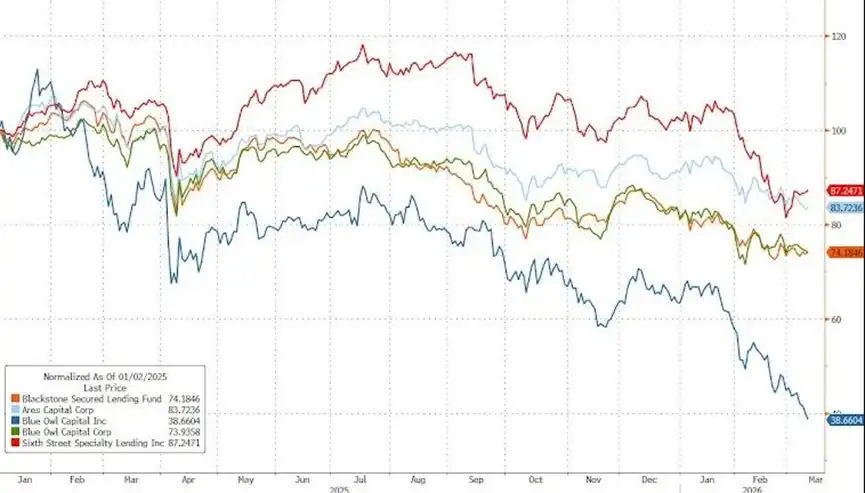
(Private credit company stock prices continue to decline)

Redemption Wave Spreads, Semi-Liquid Funds Face Major Test

According to the Financial Times, Cliffwater restricted redemptions from its $33 billion flagship fund (CCLFX) in the first quarter. The fund received redemption requests accounting for 14% of its total shares, ultimately approving only about half and repurchasing 7% of the shares.

Just hours after Cliffwater took action, Morgan Stanley also notified investors in its $7.6 billion North Haven Private Income Fund that it would limit withdrawals. The fund saw redemption requests jump to 10.9% in the first quarter, ultimately fulfilling only 45.8% of those shares.

This trend has been spreading across the industry in recent months. HPS recently set a 5% redemption cap for its flagship fund targeting high-net-worth clients. Blackstone's Bcred fund fully paid out after redemption requests reached 7.9% of net asset value, while Blue Owl and Ares previously also met high redemption requests, although Blue Owl has imposed a permanent redemption restriction on another fund this year.

Cliffwater raised $16.5 billion last year, expanding at a pace on par with industry giant KKR. However, this model, which relies on independent brokers to manage retail funds, makes it more vulnerable to market sentiment fluctuations.

To address the situation, the report stated that Cliffwater is raising $1 billion by selling loan portfolios and expects to attract $3 billion in new commitments this quarter to offset outflows. The company emphasized in a letter to investors that the fund generated an 8.9% return in 2025 and has a net leverage ratio of only 0.23x, far lower than most similar vehicles.

This capital outflow highlights the risks faced by many new semi-liquid funds, which were originally promoted as a way to invest in private credit but, because their underlying assets are rarely traded, can only offer selling opportunities occasionally.

Overvaluation Triggers Arbitrage, Run Risk Highlighted

The core driver behind investors rushing to withdraw is net asset value arbitrage.

According to a Bloomberg column analysis, software stocks and related debt in public markets have fallen sharply this year, but private credit institutions, which tend to hold loans to maturity, have not synchronously marked down their portfolio valuations.

This lag in pricing creates an arbitrage opportunity. If a fund claims its loan is worth $100, but investors believe its actual market value is only $98, investors will try to redeem and cash out at the $100 book value.

This operation logic triggers dynamics similar to a bank run: if the fund pays out at $100, the asset value of the remaining investors will be further diluted, prompting more people to join the redemption queue. This puts immense pressure on interval funds that promise partial liquidity when facing investors.

To alleviate concerns about opaque valuations, some institutions are trying to increase transparency. John Zito, co-president of the asset management division at Apollo Global Management, said the company is preparing to start reporting the net asset value of its credit funds monthly, with the ultimate goal of achieving daily NAV reporting and introducing third-party valuations.

JPMorgan Takes Proactive Action, Tightens Leveraged Financing

As internal funds drain, the external leverage sources for private institutions are also being tested. According to the Financial Times, JPMorgan proactively downgraded the valuation of some corporate loans in the portfolios of private institutions, primarily concentrated in the software sector, which is considered particularly vulnerable to the impact of artificial intelligence.

JPMorgan has a special clause in its private credit financing business that reserves the right to revalue assets at any time, whereas most other banks typically wait for trigger conditions like interest defaults before taking action. Media analysis indicates this move aims to preemptively compress the available credit lines to these funds, allowing for timely action if necessary, rather than waiting until a crisis erupts.

This tightening action was foreshadowed. JPMorgan CEO Jamie Dimon has repeatedly expressed a cautious stance towards the private credit sector publicly. The bank's executive Troy Rohrbaugh said in February this year that, compared to peers, JPMorgan is becoming more conservative regarding private credit risk. A fund manager also confirmed that JPMorgan has been "significantly tougher" in providing back-end leverage over the past three months.

Industry Expansion Logic Damaged, Subsequent Risks Questioned

The rapid expansion of the private credit industry heavily relies on leveraged financing provided by regulated banks. Since the end of 2020, private institutions have raised hundreds of billions of dollars, quickly gaining the ability to compete directly with banks for large-scale leveraged buyout financing.

However, a large number of underlying assets were formed during the work-from-home boom when software company valuations were high. As corporate cash flow expectations are revised downward, related debts will come due over the next few years, by which time the market environment will be vastly different from when they were issued.

Currently, private credit institutions insist that enterprise software companies are still growing and expect loans to continue performing normally. Although no other banks have explicitly followed JPMorgan's tightening stance, with major banks leading the reassessment of asset values and retail redemption pressure remaining high, the market's scrutiny of the industry's liquidity and valuation transparency is expected to continue intensifying.


Related Questions

QWhat is the core reason behind the surge in redemption requests in the US private credit industry?

AThe core reason is NAV (Net Asset Value) arbitrage. Public market assets like software stocks and related debt have fallen sharply, but private credit funds have not marked down their portfolios accordingly. This creates an arbitrage opportunity where investors redeem at the higher book value to realize a profit, leading to a bank-run-like dynamic.

QWhich two private credit giants recently imposed redemption restrictions on their multi-billion dollar funds?

ACliffwater and Morgan Stanley recently imposed redemption restrictions on their funds. Cliffwater restricted its $33 billion flagship fund (CCLFX), and Morgan Stanley restricted its $7.6 billion North Haven Private Income Fund.

QWhat action did JPMorgan take that signifies a tightening of leverage for private credit funds?

AJPMorgan proactively marked down the value of collateral for some software sector loans within private credit fund portfolios. This action reduces the amount of future financing available to these funds, representing a significant reassessment of risk exposure by the traditional banking system.

QHow did the redemption requests in the first quarter compare to what was ultimately paid out by Cliffwater and Morgan Stanley's funds?

ACliffwater received redemption requests for 14% of its fund's shares but only paid out approximately half, repurchasing 7% of the shares. Morgan Stanley received requests for 10.9% of its fund's shares but only fulfilled 45.8% of those requests.

QWhat long-term factor from the pandemic era is contributing to the current stress in the private credit market?

AA significant amount of the underlying assets were originated during the work-from-home boom when software company valuations were high. As expectations for these companies' cash flows are revised downward, the debt issued during that period is maturing into a much less favorable market environment, creating potential stress.

Related Reads

STAR 50 Soars 10.73%, Why Did A-Shares Stage a "V-Shaped Reversal"?

After a prolonged decline, the Chinese A-share market staged a strong rally on July 21. The STAR 50 index surged 10.73%, its largest single-day gain in nearly a year, leading a broad-based "V-shaped" reversal. The Shanghai Composite Index rose 1.79%, the Shenzhen Component Index gained 4.81%, and the ChiNext Index jumped 7.05%. Total market turnover reached 2.97 trillion yuan, an increase of 256.1 billion yuan from the previous session, with over 3,100 stocks advancing. The semiconductor sector spearheaded the rebound, with related ETFs posting significant gains. Analysts attribute the surge to three converging factors. First, coordinated capital inflows from "national team" institutions, insurance funds, listed company buybacks, and fund house self-purchases have bolstered market liquidity and confidence. Second, supportive policy signals, including commitments from regulators to ensure stable market operations, provided a favorable backdrop. Third, a stabilization and recovery in overseas markets, notably South Korea, created a positive external environment. Institutions suggest the most severe panic selling phase for the tech sector has likely passed, following a significant digestion of crowded positions and leveraged funds. While short-term volatility may persist, the medium to long-term outlook remains underpinned by enduring trends like AI computing demand expansion and semiconductor localization. The market's focus now shifts to the sustainability of supportive fund flows, earnings reports, and upcoming catalysts from the global AI industry chain.

marsbit30m ago

STAR 50 Soars 10.73%, Why Did A-Shares Stage a "V-Shaped Reversal"?

marsbit30m ago

U.S. Tech Momentum Stocks Post Largest Single-Day Gain Ever, But Is the Plunge Over?

US tech momentum stocks staged a sharp rebound on Tuesday (July 21st). Morgan Stanley's TMT Momentum Factor surged over 12%, marking its largest single-day gain on record, exceeding even peaks from the 2000 dot-com bubble. Key momentum indices from Goldman Sachs also posted their strongest daily performances in years. The rally was led by semiconductors, with the Philadelphia Semiconductor Index jumping 4.6%. This rebound followed three consecutive down days and a cumulative 33% plunge in momentum stocks, one of the steepest drawdowns since the dot-com era. Analysts attribute the surge largely to a short squeeze. Heavy selling had pushed high-beta momentum stocks into deeply oversold territory, forcing many short sellers, particularly in Asia, to cover their positions, creating a self-reinforcing buying spiral. However, the rebound's internals appear weak. Trading volume was notably low, and advancing stocks still lagged decliners on the S&P 500, indicating a narrow, concentrated rally rather than broad market participation. Diverging views emerge on the outlook. BTIG warns the bounce has hit key resistance and recommends selling into strength, citing extreme volatility and historical parallels to past market tops. Conversely, Goldman Sachs and UBS believe the momentum unwind is nearing its end, suggesting it may be time to gradually add exposure, as positioning has been significantly reduced. They caution, however, that high volatility warrants a measured approach, potentially using defined-risk strategies. The upcoming earnings season, particularly reports from major tech firms like Alphabet, is seen as a critical test for the rally's sustainability. Simultaneously, bond markets flashed a warning, with yields rising partly due to spiking oil prices. Analysts note that if long-term Treasury yields break decisively higher, it could pose a significant headwind for equities, especially growth stocks.

marsbit37m ago

U.S. Tech Momentum Stocks Post Largest Single-Day Gain Ever, But Is the Plunge Over?

marsbit37m ago

U.S. Tech Momentum Stocks Record Largest Single-Day Gain Ever, but Has the Rout Ended?

U.S. tech momentum stocks staged a dramatic rebound on Tuesday, July 21st. Key momentum indices like the Morgan Stanley TMT Momentum Factor and Goldman Sachs' High Beta Momentum Long Index posted historic or near-historic single-day gains, fueled largely by semiconductor stocks. This sharp rally followed a severe three-day sell-off that saw momentum stocks plunge 33%, marking one of the steepest pullbacks since the dot-com bubble. Analysts attribute the bounce primarily to a short squeeze, as forced covering from over-leveraged traders, particularly in Asia, created a buying spiral. However, the rally's health is questioned due to weak market breadth—overall trading volume was low, and decliners outnumbered advancers in the S&P 500 despite the index's gain—suggesting a narrow, concentrated surge rather than broad recovery. Opinions on the sustainability diverge. BTIG strategists warn the rebound has hit key resistance levels, citing extreme volatility and historic stock dispersion as signs of an ongoing broader correction, and recommend selling into strength. Conversely, Goldman Sachs and UBS view the aggressive momentum unwinding as nearing its end, noting reduced positioning and a lack of new fundamental catalysts. They suggest the sell-off presents a selective opportunity to add exposure, albeit cautiously and gradually using defined-risk strategies. The immediate trajectory hinges on the ongoing earnings season, with market focus on Alphabet's capital expenditure guidance for AI investment clarity. Meanwhile, bond markets present a risk, with rising Treasury yields—potentially heading toward 5.5%—and widening credit spreads for mega-cap tech companies posing a threat to equity valuations. The combination of technical factors, earnings results, and macro conditions leaves the durability of the rebound in doubt.

链捕手40m ago

U.S. Tech Momentum Stocks Record Largest Single-Day Gain Ever, but Has the Rout Ended?

链捕手40m ago

Long-Divided Must Unite, Long-United Must Divide: When L1 Becomes Its Own Rollup, What Is Ethereum's Endgame?

"The Inevitable Cycle: When L1 Becomes Its Own Rollup – What is Ethereum's Endgame?" For years, the Ethereum community grappled with concerns that L2s were fragmenting the ecosystem and eroding L1's value. While L2s provided cheaper execution, they also splintered liquidity and the unified user experience of a single chain. This has prompted a fundamental reassessment of the relationship between L1 and L2. Ethereum's roadmap is evolving. The "Scale" initiative merges L1 and L2 expansion into a holistic framework. L1 itself is advancing with higher gas limits, statelessness, and zkEVM verification, no longer content to be just a low-throughput settlement layer. Consequently, the primary value proposition of L2s is shifting from merely providing cheap blockspace to offering L1 cannot easily provide: application-specific optimizations, privacy features, and flexible governance models. L2s are becoming a spectrum of execution environments with varying degrees of security inheritance from Ethereum. A critical challenge in this multi-chain future is interoperability. The vision is to make Ethereum "feel like one chain again." This relies on advancements in native account abstraction (like EIP-7702) and intent-based architectures (Open Intents Framework), where users declare desired outcomes, and solvers handle the complex cross-chain execution. Furthermore, shortening Ethereum's finality time from minutes to seconds is crucial, as it underpins trust between chains for bridges, stablecoins, and cross-chain applications. Perhaps the most provocative idea is that Ethereum L1 itself could become a form of "its own Rollup." As zkEVM and proof systems mature, high-performance nodes could execute transactions and generate validity proofs. Regular validators would then verify these proofs instead of re-executing all transactions. This blurs the traditional L1/L2 hierarchy, making "Rollup" more of a general execution-verification architecture. Native Rollup aims to integrate L2 validation more directly into the Ethereum protocol, allowing L2s to inherit L1's security more fully and move away from reliance on security councils. In the end, L2s are not destined to replace L1 or be made obsolete by it. The likely future is a unified system where diverse execution environments—each optimized for specific use cases like DeFi, gaming, or privacy—coexist. They will share a common foundation of security, liquidity, and verifiable state, seamlessly connected to restore a cohesive user experience. The next phase for Ethereum is not just about scaling through separation, but about intelligently reintegrating what was separated back into a coherent whole.

链捕手56m ago

Long-Divided Must Unite, Long-United Must Divide: When L1 Becomes Its Own Rollup, What Is Ethereum's Endgame?

链捕手56m ago

Trading

Spot
活动图片




