Redemption Wave Meets Credit Withdrawal Wave, US Private Credit Industry Faces 'Run Storm'

marsbitPublished on 2026-03-12Last updated on 2026-03-12

Abstract

US private credit industry faces a liquidity crisis as investor redemptions surge and major banks tighten financing. Cliffwater and Morgan Stanley restricted withdrawals from multi-billion-dollar funds after redemption requests spiked to 14% and 10.9% of assets respectively in Q1, forcing partial payouts to avoid fire sales of illiquid assets. Simultaneously, JPMorgan reduced collateral values for software-sector loans in fund portfolios, curtailing future leverage availability. The squeeze stems from a net asset value (NAV) arbitrage dynamic: while public market software assets plummeted, private credit valuations remained inflated, prompting investors to redeem at above-market prices. This triggered a bank-run-like cycle where remaining investors face diluted values. Apollo plans to boost transparency with monthly NAV reporting. The $1.8 trillion industry, which expanded rapidly during the pandemic using bank leverage, now confronts underlying assets originated at peak valuations. Despite claims of continued software sector growth, pressure mounts as institutions reassess liquidity risks and valuation opacity.

Original Author: Ye Zhen

Original Source: Wall Street News

The US private credit industry is facing a dual squeeze of liquidity contraction and asset revaluation. As investors rush to withdraw funds and major Wall Street financial institutions reduce credit lines, this massive market worth $1.8 trillion is teetering.

According to the Financial Times, private credit giants Cliffwater and Morgan Stanley have recently imposed redemption restrictions on their multi-billion-dollar funds. In the first quarter, these semi-liquid funds faced a surge in withdrawal requests, with the scale of outflows forcing management to trigger "gates" to avoid fire sales of underlying illiquid assets.

While the funding side is under pressure, private credit institutions are also facing tightening from large banks on the financing side. JPMorgan Chase recently notified relevant institutions that it has downgraded the collateral value of some software-related loans in their portfolios. Although this move did not immediately trigger margin calls, it directly reduced the future financing scale available to the relevant funds, marking a comprehensive reassessment of risk exposure in this sector by the traditional banking system.

The core of this two-way squeeze lies in the net asset value (NAV) arbitrage logic. As the value of related assets in public markets plummeted, private credit institutions failed to synchronously mark down their holdings, prompting investors to rush to cash out at the book value, which is higher than the market fair value. This chain reaction, similar to a bank run, not only intensifies the liquidity pressure on funds but also forces the market to re-examine the true pricing of private credit assets.
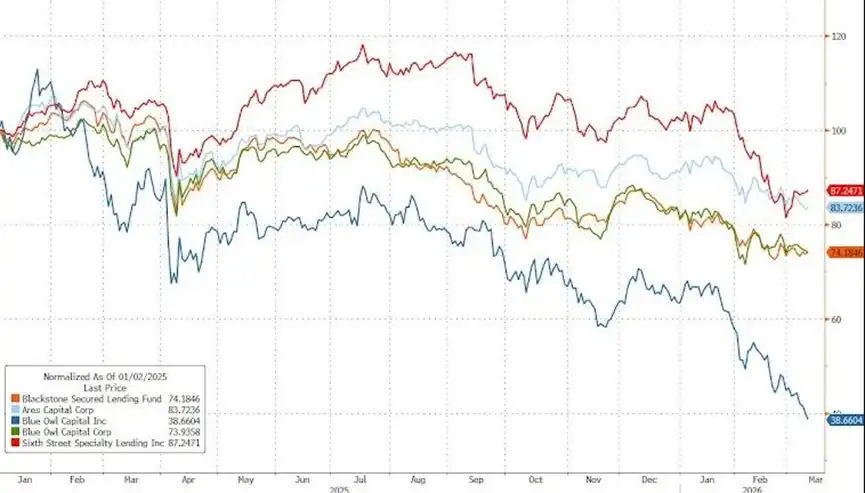
(Private credit company stock prices continue to decline)

Redemption Wave Spreads, Semi-Liquid Funds Face Major Test

According to the Financial Times, Cliffwater restricted redemptions from its $33 billion flagship fund (CCLFX) in the first quarter. The fund received redemption requests accounting for 14% of its total shares, ultimately approving only about half and repurchasing 7% of the shares.

Just hours after Cliffwater took action, Morgan Stanley also notified investors in its $7.6 billion North Haven Private Income Fund that it would limit withdrawals. The fund saw redemption requests jump to 10.9% in the first quarter, ultimately fulfilling only 45.8% of those shares.

This trend has been spreading across the industry in recent months. HPS recently set a 5% redemption cap for its flagship fund targeting high-net-worth clients. Blackstone's Bcred fund fully paid out after redemption requests reached 7.9% of net asset value, while Blue Owl and Ares previously also met high redemption requests, although Blue Owl has imposed a permanent redemption restriction on another fund this year.

Cliffwater raised $16.5 billion last year, expanding at a pace on par with industry giant KKR. However, this model, which relies on independent brokers to manage retail funds, makes it more vulnerable to market sentiment fluctuations.

To address the situation, the report stated that Cliffwater is raising $1 billion by selling loan portfolios and expects to attract $3 billion in new commitments this quarter to offset outflows. The company emphasized in a letter to investors that the fund generated an 8.9% return in 2025 and has a net leverage ratio of only 0.23x, far lower than most similar vehicles.

This capital outflow highlights the risks faced by many new semi-liquid funds, which were originally promoted as a way to invest in private credit but, because their underlying assets are rarely traded, can only offer selling opportunities occasionally.

Overvaluation Triggers Arbitrage, Run Risk Highlighted

The core driver behind investors rushing to withdraw is net asset value arbitrage.

According to a Bloomberg column analysis, software stocks and related debt in public markets have fallen sharply this year, but private credit institutions, which tend to hold loans to maturity, have not synchronously marked down their portfolio valuations.

This lag in pricing creates an arbitrage opportunity. If a fund claims its loan is worth $100, but investors believe its actual market value is only $98, investors will try to redeem and cash out at the $100 book value.

This operation logic triggers dynamics similar to a bank run: if the fund pays out at $100, the asset value of the remaining investors will be further diluted, prompting more people to join the redemption queue. This puts immense pressure on interval funds that promise partial liquidity when facing investors.

To alleviate concerns about opaque valuations, some institutions are trying to increase transparency. John Zito, co-president of the asset management division at Apollo Global Management, said the company is preparing to start reporting the net asset value of its credit funds monthly, with the ultimate goal of achieving daily NAV reporting and introducing third-party valuations.

JPMorgan Takes Proactive Action, Tightens Leveraged Financing

As internal funds drain, the external leverage sources for private institutions are also being tested. According to the Financial Times, JPMorgan proactively downgraded the valuation of some corporate loans in the portfolios of private institutions, primarily concentrated in the software sector, which is considered particularly vulnerable to the impact of artificial intelligence.

JPMorgan has a special clause in its private credit financing business that reserves the right to revalue assets at any time, whereas most other banks typically wait for trigger conditions like interest defaults before taking action. Media analysis indicates this move aims to preemptively compress the available credit lines to these funds, allowing for timely action if necessary, rather than waiting until a crisis erupts.

This tightening action was foreshadowed. JPMorgan CEO Jamie Dimon has repeatedly expressed a cautious stance towards the private credit sector publicly. The bank's executive Troy Rohrbaugh said in February this year that, compared to peers, JPMorgan is becoming more conservative regarding private credit risk. A fund manager also confirmed that JPMorgan has been "significantly tougher" in providing back-end leverage over the past three months.

Industry Expansion Logic Damaged, Subsequent Risks Questioned

The rapid expansion of the private credit industry heavily relies on leveraged financing provided by regulated banks. Since the end of 2020, private institutions have raised hundreds of billions of dollars, quickly gaining the ability to compete directly with banks for large-scale leveraged buyout financing.

However, a large number of underlying assets were formed during the work-from-home boom when software company valuations were high. As corporate cash flow expectations are revised downward, related debts will come due over the next few years, by which time the market environment will be vastly different from when they were issued.

Currently, private credit institutions insist that enterprise software companies are still growing and expect loans to continue performing normally. Although no other banks have explicitly followed JPMorgan's tightening stance, with major banks leading the reassessment of asset values and retail redemption pressure remaining high, the market's scrutiny of the industry's liquidity and valuation transparency is expected to continue intensifying.


Related Questions

QWhat is the core reason behind the surge in redemption requests in the US private credit industry?

AThe core reason is NAV (Net Asset Value) arbitrage. Public market assets like software stocks and related debt have fallen sharply, but private credit funds have not marked down their portfolios accordingly. This creates an arbitrage opportunity where investors redeem at the higher book value to realize a profit, leading to a bank-run-like dynamic.

QWhich two private credit giants recently imposed redemption restrictions on their multi-billion dollar funds?

ACliffwater and Morgan Stanley recently imposed redemption restrictions on their funds. Cliffwater restricted its $33 billion flagship fund (CCLFX), and Morgan Stanley restricted its $7.6 billion North Haven Private Income Fund.

QWhat action did JPMorgan take that signifies a tightening of leverage for private credit funds?

AJPMorgan proactively marked down the value of collateral for some software sector loans within private credit fund portfolios. This action reduces the amount of future financing available to these funds, representing a significant reassessment of risk exposure by the traditional banking system.

QHow did the redemption requests in the first quarter compare to what was ultimately paid out by Cliffwater and Morgan Stanley's funds?

ACliffwater received redemption requests for 14% of its fund's shares but only paid out approximately half, repurchasing 7% of the shares. Morgan Stanley received requests for 10.9% of its fund's shares but only fulfilled 45.8% of those requests.

QWhat long-term factor from the pandemic era is contributing to the current stress in the private credit market?

AA significant amount of the underlying assets were originated during the work-from-home boom when software company valuations were high. As expectations for these companies' cash flows are revised downward, the debt issued during that period is maturing into a much less favorable market environment, creating potential stress.

Related Reads

Despite the sell-off, Goldman Sachs remains bullish on Samsung and SK Hynix. Here's why.

Goldman Sachs maintains "Buy" ratings on Samsung Electronics and SK Hynix despite recent stock declines. Its bullish view centers on three core arguments. Firstly, it expects HBM (High Bandwidth Memory) pricing to re-establish a premium over conventional DRAM by 2027, with a projected blended ASP of around $2.9/Gb. This is driven by tight supply-demand dynamics, increasing manufacturing complexity for newer HBM generations, and the need to restore its historical price premium. Secondly, the volatility of the memory cycle is expected to moderate due to widespread adoption of 3-5 year Long-Term Agreements (LTAs) with key customers. These contracts, covering a significant portion of planned capacity, feature mechanisms like price floors, prepayments, and penalties, reducing supplier risk and improving earnings visibility. Thirdly, inventory levels remain low at key suppliers and major customers, providing a buffer against a sharp downturn. Furthermore, robust demand from enterprise SSDs for AI servers is seen offsetting weakness in consumer segments like smartphones and PCs, preventing NAND markets from slipping into oversupply in the near term. While risks exist—such as potential weaker AI demand or aggressive capacity expansion—Goldman Sachs believes the combination of HBM repricing, LTAs, and low inventory underpins a more stable earnings outlook for the leading Korean memory makers.

marsbit15m ago

Despite the sell-off, Goldman Sachs remains bullish on Samsung and SK Hynix. Here's why.

marsbit15m ago

Korean Cryptocurrency Market Platform Kimpga Integrates with Global Web3 Data Platform RootData, Providing Popularity and Growth Scores for Token Projects

South Korean cryptocurrency market data platform Kimpga (kimpga.com) has announced a data partnership with the global Web3 project data platform RootData. As a result, Kimpga has integrated comprehensive token project information directly into its platform services. The integration introduces a new "RD Score" column within Kimpga's market listings. Clicking the score opens a detailed data window that displays the "RD Popularity Index," the "RD Growth Index," and key fundamental project data such as leading investors, core team members, and project category tags. For example, for Solana (SOL), users can view its indices and identify major backers like Polychain Capital, a16z, and Multicoin Capital directly from the interface, with links to full RootData project pages for deeper research. Jin Jae-yong, a representative of Kimpga, stated that the partnership allows users to quickly assess a project's fundamental strength, including its development team and investor lineup, without leaving the market data screen. This addresses a key challenge for investors who previously had to rely solely on price and premium data. RootData is a widely used global platform providing Web3 project details on funding history, team composition, and investor portfolios for due diligence and investment analysis. Kimpga, which boasts 10 million cumulative users, is a leading Korean crypto market platform providing real-time data and price premiums from over 18 domestic and international exchanges. This collaboration with RootData follows Kimpga's previous partnership with the token rating platform APYWA, further enriching its data offering to support user investment decisions.

marsbit16m ago

Korean Cryptocurrency Market Platform Kimpga Integrates with Global Web3 Data Platform RootData, Providing Popularity and Growth Scores for Token Projects

marsbit16m ago

He Was the Hero of Shanghai's Two Major Industries, Yet Passed Away Quietly in Regret

He was a pivotal figure in the development of two major Shanghai industries—semiconductors and commercial aircraft—yet passed away in quiet regret. Jiang Shangzhou, son of a veteran revolutionary and a Swiss-educated technocrat, became Deputy Director of the Shanghai Economic Commission in 1997. Tasked with identifying strategic industries, he championed integrated circuits (ICs) despite a climate of skepticism. Countering a national plan for just two 8-inch chip production lines, he boldly declared Shanghai would build ten within five years. He masterminded the Zhangjiang microelectronics zone, personally recruited top talent like Morris Chang, and helped establish SMIC. Through innovative financing that circumvented Western embargoes, SMIC grew rapidly, with Shanghai exceeding its target by building 18 lines. Simultaneously, while battling lung cancer, Jiang led the push for China's large commercial aircraft program as head of a state major projects panel. He argued it was a strategic imperative that would drive advancements across multiple industries. His relentless advocacy culminated in the 2006 state approval that paved the way for the C919. Jiang's career was marked by foresight often deemed too超前. Earlier postings in Sanya and Yangpu saw his ideas for tourism and economic reform initially rejected, only to be validated years later. In 2009, he became Chairman of the embattled SMIC. Despite his deteriorating health, he steered the company until his death in 2011, leaving a final insight for the chip industry: China need not master every process but must lead in key areas. He did not live to see the C919 fly or SMIC's full recovery, but his foundational work made Shanghai a national leader in both semiconductors and aerospace. Colleagues remembered him as a visionary whose impact shaped the three decades that followed.

marsbit30m ago

He Was the Hero of Shanghai's Two Major Industries, Yet Passed Away Quietly in Regret

marsbit30m ago

Illustrating the Cloudflare Wallet: The New Player in Stablecoin Payments Using x402

On August 4th, Cloudflare announced the launch of "Wallets," though the initial offering is limited to claiming a user handle. Full functionality for topping up, making payments, and using a Virtual Wallet via API keys is marked "Soon." The announcement clarifies that this handle is not yet a functional wallet. It represents a key piece in Cloudflare's broader payments strategy, alongside the Stripe Projects service (currently in open beta for agent-assisted purchases) and the Monetization Gateway for merchants (on a waitlist). The Wallet is positioned as the payer-side component for managing identity, balances, and authorization rules. While the underlying x402 protocol shows activity (75.41 million transactions, $24.24M volume in 30 days, averaging ~$0.32 per transaction), this data reflects the open network's usage, not specifically Cloudflare Wallet adoption. These metrics indicate suitability for frequent micro-payments like API calls. Cloudflare's documentation uses a $0.01 per-call example to illustrate the x402 flow: a server returns HTTP 402, the agent signs the payment, a facilitator verifies it, and the server delivers the result. Currently, developers must manage private keys and use test networks/USDC for agent payments. The Wallet roadmap aims to separate the user's Account Wallet from an agent's Virtual Wallet, adding controls for spending limits, whitelists, and per-transaction caps. This design resembles a corporate card with approval rules. However, these controls are not yet available for configuration. In summary, Cloudflare Wallet's current launch is a preliminary step. Critical details like supported stablecoins, blockchains, regions, KYC, custody, and fees remain undisclosed. The announcement primarily establishes a payer identity framework, with the full payment and agent autonomy system still under development.

marsbit51m ago

Illustrating the Cloudflare Wallet: The New Player in Stablecoin Payments Using x402

marsbit51m ago

Trading

Spot
活动图片