Real Finance secures $29M to build institutional rails for tokenized assets

cointelegraphPublished on 2025-12-09Last updated on 2025-12-09

Abstract

Real-world asset tokenization network Real Finance has raised $29 million in private funding, led by a $25 million commitment from Nimbus Capital, to build institutional infrastructure for tokenized assets. The funds will support the expansion of its compliance and operational systems as it develops a full-stack RWA platform. The company aims to tokenize $500 million in RWAs, targeting 2% of the current tokenized asset market. The market is currently dominated by US Treasury products, private credit, and alternative funds, with tokenized money market funds growing rapidly. Industry experts, including Plume CEO Chris Yin, project major expansion in 2025, with potential for significant user growth and diversification into assets like private credit, mineral rights, and energy.

Real-world asset (RWA) tokenization network Real Finance has secured $29 million in private funding to build an infrastructure layer for RWAs, aiming to make it easier for institutions to adopt tokenized assets.

The funding round included a $25 million capital commitment from Nimbus Capital, a digital asset investment firm, with additional participation from Magnus Capital and Frekaz Group, the company informed Cointelegraph.

Real Finance stated that the funding will be utilized to expand its compliance and operational infrastructure as it develops a full-stack RWA platform.

In the near term, the company aims to tokenize $500 million worth of RWAs — a target it says would represent about 2% of today’s tokenized asset market.

To date, the tokenization market has been dominated by US Treasury products, private credit and institutional alternative funds, although tokenized public equities and other asset types are also beginning to gain traction, according to industry data.
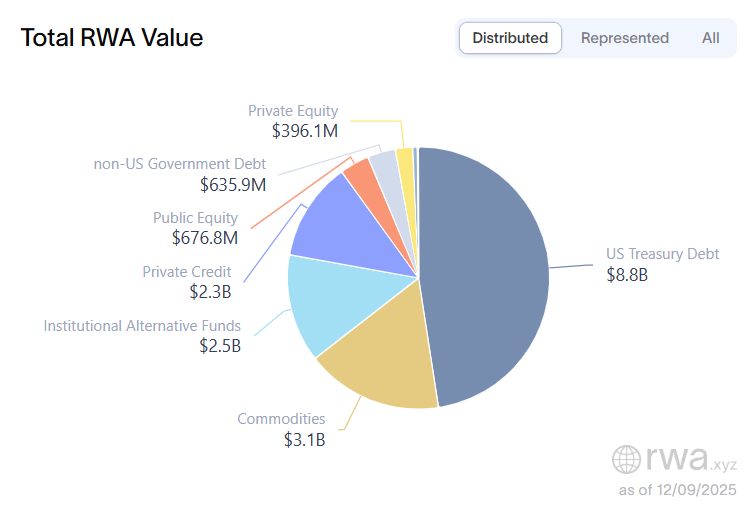
The existing RWA market by asset type. Source: RWA.xyz

Money market funds, which are low-risk investment vehicles that invest in short-term, highly liquid assets, often hold some of the same instruments, such as Treasury bills. Tokenized money market funds have also been expanding quickly, with their market size growing roughly tenfold since 2023, according to data from the Bank for International Settlements.

Goldman Sachs and BNY Mellon are among the largest institutions to enter the tokenized money market fund space, adding further momentum to one of the fastest-growing segments of the RWA sector.

Related: Tokenized money market funds emerge as Wall Street’s answer to stablecoins

Tokenized RWA market poised for major expansion, industry insiders say

With 2025 already a landmark year for tokenized real-world assets due to rising institutional participation, next year could see even stronger growth, according to Chris Yin, co-founder and CEO of Plume, an RWA-focused layer-2 blockchain.

“Currently, we are tracking to over 10x the RWA holders number since the start of the year,” Yin told Cointelegraph, adding that “we think it’s not crazy to imagine another banner year with 25x+ in user growth numbers.”

Beyond US government debt, Yin said the market is seeing rising interest in private credit, mineral rights, energy assets, GPUs and other nontraditional categories.
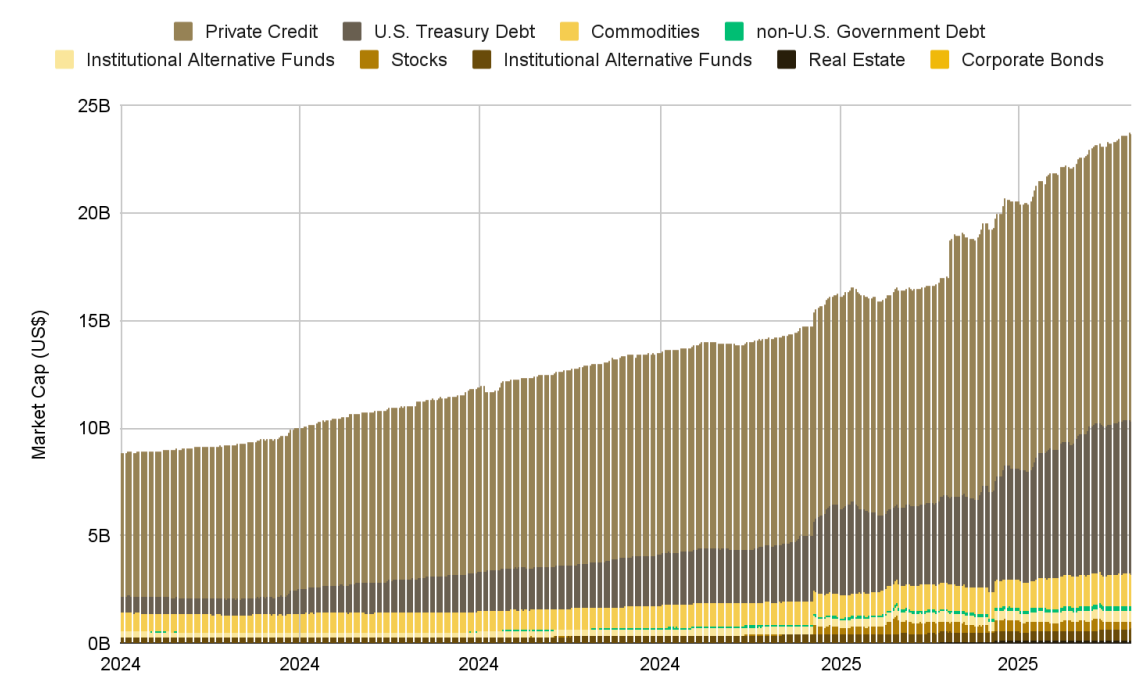
The tokenized RWA market has experienced significant growth since 2024. Source: Binance Research

His outlook aligns with a June report from Binance Research, which noted that clearer regulatory expectations in the United States could draw even more major institutions into tokenization.

Related: SEC ends Biden-era probe into tokenized equity platform Ondo Finance
Related Reads

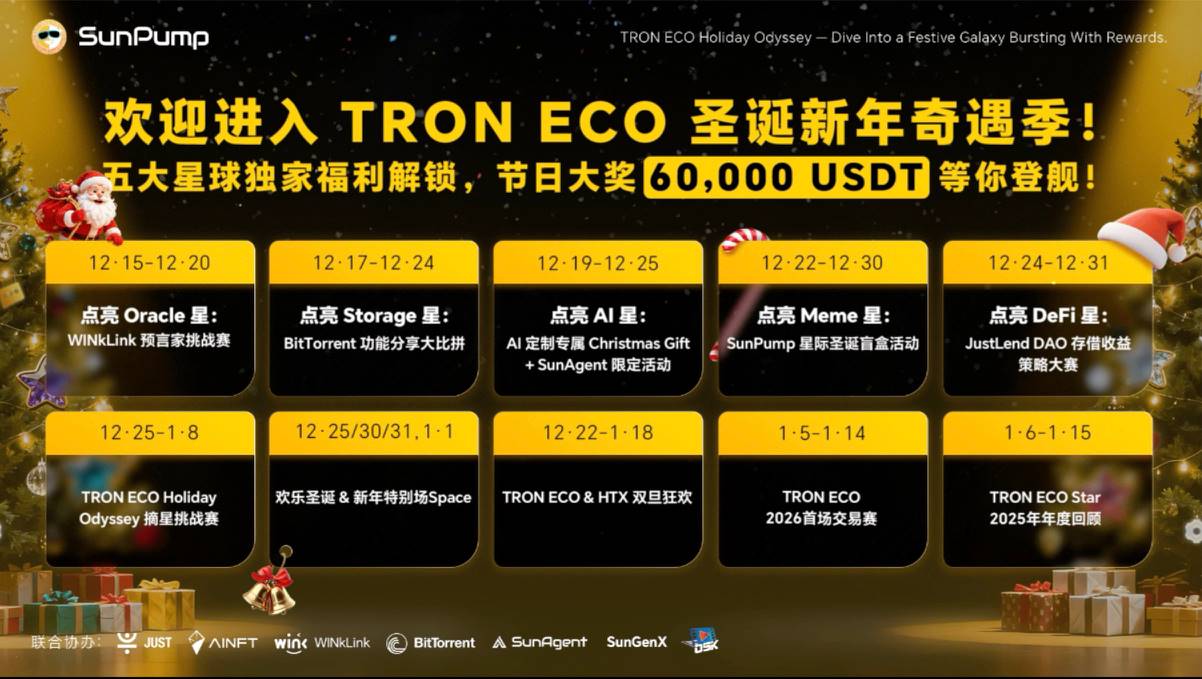
Prize Pool 60,000 USDT: "TRON ECO Holiday Odyssey" Annual Ecological Exploration Gala Set to Begin

TRON ECO launches its "Holiday Odyssey" event, a large-scale year-end celebration from December 10, 2025, to January 18, 2026, featuring a total prize pool of 60,000 USDT. The event centers around five core ecosystem projects—SunPump, JUST, AINFT, BitTorrent, and WINkLink—each representing a "holiday planet" with unique interactive tasks. Participants can complete missions to earn rewards, including limited edition TRON ECO merchandise. Key activities include planet-specific tasks such as price prediction with WINkLink, engagement with BitTorrent’s decentralized storage, AI-themed meme creation via SunGenX, a Christmas blind box event with SunPump, and a DeFi strategy competition with JUST. A major "Star Challenge" from December 25 to January 8 offers a 10,000 USDT prize pool supported by sponsors including OSK, Biconomy, and PepeOnTron. Additional features include holiday-themed Twitter Spaces sessions and a joint campaign with HTX exchange boasting over 40,000 USDT in rewards. The event highlights TRON's growing ecosystem, which recently surpassed 250 million accounts and continues to expand across DeFi, AI, and storage sectors. Recent upgrades in AI infrastructure, tokenomics, and user experience tools like SunAgent aim to strengthen TRON’s position as a leading smart contract platform. "Holiday Odyssey" invites the global community to explore TRON’s ecosystem and participate in its end-of-year festivities.

深潮1m ago

Prize Pool 60,000 USDT: "TRON ECO Holiday Odyssey" Annual Ecological Exploration Gala Set to Begin

深潮1m ago

Eight Years of Turbulence in Web3 Phones: From 'Geek Toy' to Xiaomi's 'Factory Standard'

Web3 Smartphones: An 8-Year Evolution from 'Geek Toy' to Xiaomi's 'Standard Feature' On December 10th, high-performance blockchain Sei announced a partnership with Xiaomi, the world's third-largest smartphone manufacturer. The Sei Foundation will develop a next-gen crypto wallet and DApp discovery platform, which will be pre-installed on Xiaomi's new smartphones for global markets (excluding mainland China and the US). Utilizing MPC technology, the collaboration aims to allow users to log in directly via Google or Xiaomi accounts, eliminating intimidating seed phrases. A pilot stablecoin payment system is also slated for 2026, enabling purchases at Xiaomi's retail stores with tokens like USDC. The journey of Web3 phones began around 2018 with devices like Sirin Labs' Finney and HTC's Exodus 1, which focused on "hardware sovereignty" and extreme security, often featuring physical safeguards or trusted execution environments (TEE). These early attempts, including niche projects like Pundi X's communication-focused BOB phone and Electroneum's low-cost "cloud mining" M1, were commercially unsuccessful due to high costs and poor user experience, remaining confined to tech enthusiasts. Mainstream manufacturers like Samsung cautiously entered the space around 2019, integrating features like the Samsung Blockchain Keystore into flagship models. A notable early example was the "KlaytnPhone" edition of the Galaxy Note 10, which included free KLAY, prefiguring the later "airdrop" model. Luxury brand Vertu and HTC also made attempts, but Web3 functions often remained hidden or mere marketing gimmicks. The market was revitalized in 2023 by the Solana Saga. Initially struggling, it sold out instantly after its included BONK token airdrop exceeded the phone's price, earning it the nickname "dividend phone." This success ushered in a new era of "ecosystem binding" and token incentives. Subsequent models like Solana Chapter 2 (Seeker) refined this model with soul-bound tokens (SBT) to prevent scalping. Competition intensified with the TON ecosystem's $99 Universal Basic Smartphone (UBS), Binance Labs' Coral Phone, and the JamboPhone—a $99 device focused on "learn-to-earn" models in emerging markets. An alternative approach emerged from China Telecom and Conflux's BSIM card, which adds Web3 capabilities to any Android phone via a secure SIM card. The evolution highlights five key shifts: 1) Advanced security is moving from simple TEE to architectures like TEEPIN and MPC; 2) Phones are now gateways to specific ecosystems (e.g., Solana, Aptos, Movement Labs); 3) User growth is driven by airdrops and economic incentives, not just security; 4) The focus has shifted from technical concepts (running a full node) to practical applications like payments; 5) The scale is changing dramatically, as Xiaomi's massive annual shipments could onboard hundreds of millions of users, far surpassing niche manufacturers. The conclusion is clear: the greatest barrier to Web3 adoption is not security but complex user experience. The ultimate goal is for Web3 to become an invisible, seamless feature—like 5G—rather than a marketed label. Solana Mobile proved incentive-driven adoption works, but the partnership between Sei and Xiaomi may demonstrate that experience-driven integration is the sustainable path to bringing Web3 to a billion users.

marsbit34m ago

Eight Years of Turbulence in Web3 Phones: From 'Geek Toy' to Xiaomi's 'Factory Standard'

marsbit34m ago

Trading

Spot
Futures
活动图片