Ransomware Crooks Are Busier Than Ever — But Making Less Money, Researchers Say

bitcoinistPublished on 2026-02-27Last updated on 2026-02-27

Abstract

According to a Chainalysis report, ransomware attacks increased by 50% in 2025, with nearly 8,000 incidents recorded. However, total ransom payments fell by 8% to $820 million. This decline is attributed to stricter regulations, improved law enforcement, and more companies refusing to pay. Attackers have shifted focus to small and medium-sized businesses, which pay faster but yield smaller sums. The cost of launching attacks has also decreased significantly, with access to victim systems on the dark web dropping from $1,427 in 2023 to $439 in early 2026. Despite the drop in ransomware revenue, broader crypto crime remains significant, with $370 million stolen in January 2026 alone, mostly through phishing attacks.

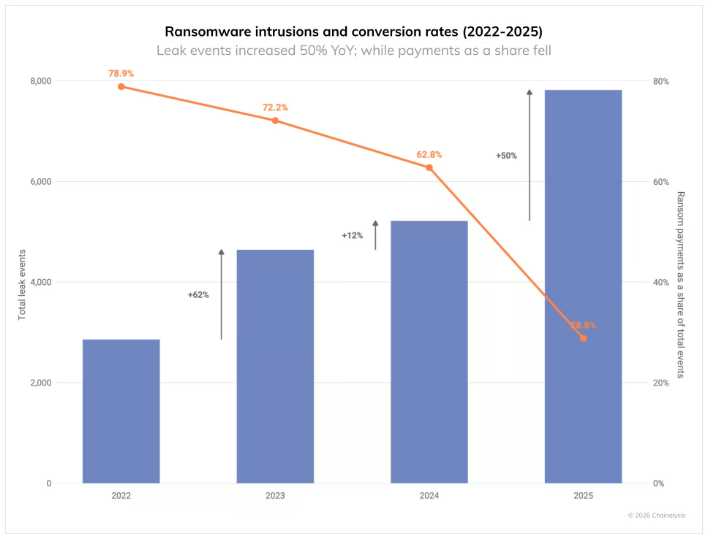
The cybercrime business is booming, at least on paper. According to a new report from blockchain analytics firm Chainalysis, the number of ransomware attacks jumped 50% in 2025, with nearly 8,000 separate incidents recorded throughout the year. Yet for all that hustle, hackers walked away with less cash than the year before.

Smaller Targets, Smaller Payouts

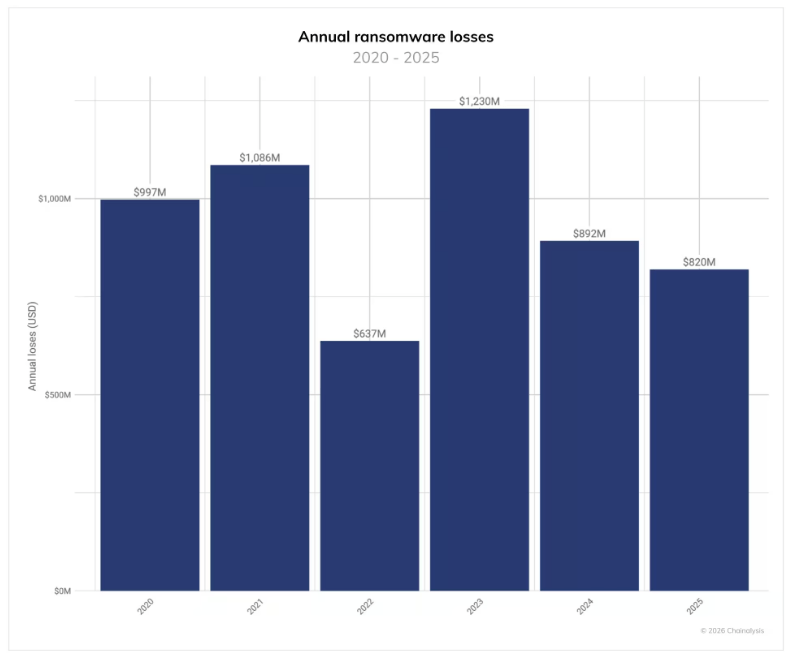
Total ransom payments collected in 2025 came in at $820 million — an 8% drop from 2024. Reports say the decline is tied to several factors: tougher rules from regulators, law enforcement cracking down on the networks criminals use to launder money, and a growing number of companies simply refusing to pay.

With big organizations shutting the door, attackers moved on to easier prey. Small and medium-sized businesses became the new focus. “Smaller victims pay faster,” said Corsin Camichel, founder of eCrime.ch, in the Chainalysis report.

But faster doesn’t mean bigger. Those smaller targets yield smaller sums, and that math is catching up with the criminals running these schemes.
Source: Chainalysis

The gap between how many attacks are being claimed publicly and how much money is actually being collected tells its own story. Attackers are filing more claims than ever, yet the money flowing back to them keeps shrinking.

BTCUSD now trading at $67,800. Chart: TradingView

According to Chainalysis, that gap signals something important — the people running these operations are putting in more work for a worse result.
Source: Chainalysis

Ransomware: The Cost Of Breaking In Has Fallen Sharply

Part of what’s fueling the surge in attack numbers is how cheap it has become to launch one. Reports note that the average price for purchasing access to a victim’s system on the dark web fell from $1,427 in early 2023 to just $439 by early 2026.

Artificial intelligence tools and an oversupply of ready-made attack software have made it easier for more people to get into the ransomware game.

The result is a crowded field of attackers competing for the same pool of victims — and driving down their own profits in the process. It mirrors what happens in any flooded market. More sellers, same number of buyers, prices fall.

2026 Has Already Seen Major Crypto Losses

Even as ransomware payments trended downward last year, the broader picture of crypto-related crime remains grim. According to cybersecurity firm CertiK, $370 million in crypto was stolen in January 2026 alone through various exploits and scams.

Phishing attacks were responsible for the bulk of those losses, accounting for $311 million of the total. Ransomware may be generating less revenue for its operators, but the wider world of crypto theft is far from slowing down.

Featured image from Unsplash, chart from TradingView

Related Questions

QAccording to the Chainalysis report, what was the percentage increase in ransomware attacks in 2025 and the total number of incidents?

AThe number of ransomware attacks jumped 50% in 2025, with nearly 8,000 separate incidents recorded.

QWhat was the total value of ransom payments collected in 2025 and how does it compare to the previous year?

ATotal ransom payments collected in 2025 came in at $820 million, which is an 8% drop from 2024.

QWhat are the three main factors cited for the decline in ransom payments?

AThe decline is tied to tougher rules from regulators, law enforcement cracking down on money laundering networks, and a growing number of companies refusing to pay.

QHow much did the average price for purchasing access to a victim's system on the dark web fall between early 2023 and early 2026?

AThe average price fell from $1,427 in early 2023 to just $439 by early 2026.

QHow much cryptocurrency was reported stolen in January 2026 by CertiK, and what type of attack was responsible for the majority of those losses?

A$370 million in crypto was stolen in January 2026, with phishing attacks accounting for the bulk of those losses at $311 million.

Related Reads

Annual Salary of Millions Competing for Electricians, Meta Rushes to Open Its Own Technical School

The AI boom is facing an unexpected bottleneck: a severe shortage of skilled construction workers and electricians. As tech giants like Meta, OpenAI, and Alphabet race to build massive data centers—such as OpenAI's $16 billion "Stargate" project—they are hitting a critical labor wall. The U.S. needs an estimated 130,000 more electricians, 240,000 construction workers, and 150,000 supervisors by 2030 for AI infrastructure alone, but tens of thousands of electrician jobs go unfilled each year. While AI companies offer high premiums, with electricians earning up to $280,000 annually, worker scarcity still causes massive losses—delays on a single project can cost $14.2 million per month. The complexity of building AI data centers, which require immense power (equivalent to powering hundreds of thousands of homes), sophisticated electrical systems, and advanced liquid cooling solutions, demands highly skilled technicians who are in short supply. To combat this, companies are investing heavily in training. Meta has committed $115 million to a free training school offering tuition, housing, and stipends, targeting 5,000 new workers. OpenAI is partnering with unions to secure skilled labor. These efforts are paying off, with a significant rise in Gen Z interest in trade schools over college. However, the power demands are staggering. AI data centers are driving a rapid surge in electricity consumption, projected to account for up to 12% of U.S. power use by 2028 and raising costs for consumers. Furthermore, the construction boom is project-based, leading to a potential future glut of trained workers once building peaks, which could depress wages industry-wide. The race for AI supremacy now depends as much on skilled hands as on advanced chips.

marsbit1h ago

Annual Salary of Millions Competing for Electricians, Meta Rushes to Open Its Own Technical School

marsbit1h ago

OpenAI No Longer Sells Its Most Expensive Model for Profit

OpenAI is shifting its business strategy away from promoting its most expensive, flagship models for every task. Recent price cuts—80% for GPT-5.6 Luna and 20% for Terra—signal a deeper change: the company now actively advises users that many tasks don't require the most powerful model. Instead, OpenAI recommends a tiered approach: use the high-end GPT-5.6 Sol for complex planning and analysis, then delegate execution to cheaper models like Luna. This mirrors moves by Anthropic, which recently launched Claude Opus 5 at half the price of its top model, Fable 5. Both companies are de-emphasizing flagship models as primary revenue drivers, using them instead for brand prestige and technological showcases. The industry is entering a "mass-market" phase, similar to automotive, where high-volume, cost-effective models handle daily operations and drive scale. OpenAI's price reductions are partly enabled by AI models themselves optimizing underlying code and infrastructure, creating a self-reinforcing cycle of efficiency gains and cost reduction. Competition is shifting from "who is smartest" to "who offers the best value." The goal is no longer selling individual models but fostering widespread API adoption and ecosystem lock-in. By making AI calls cheap and ubiquitous, companies like OpenAI aim to become the indispensable, utility-like infrastructure powering automated workflows—the "water and electricity" of software, quietly embedded everywhere.

marsbit1h ago

OpenAI No Longer Sells Its Most Expensive Model for Profit

marsbit1h ago

Trading

Spot
活动图片





