Ransomware Crooks Are Busier Than Ever — But Making Less Money, Researchers Say

bitcoinistPublished on 2026-02-27Last updated on 2026-02-27

Abstract

According to a Chainalysis report, ransomware attacks increased by 50% in 2025, with nearly 8,000 incidents recorded. However, total ransom payments fell by 8% to $820 million. This decline is attributed to stricter regulations, improved law enforcement, and more companies refusing to pay. Attackers have shifted focus to small and medium-sized businesses, which pay faster but yield smaller sums. The cost of launching attacks has also decreased significantly, with access to victim systems on the dark web dropping from $1,427 in 2023 to $439 in early 2026. Despite the drop in ransomware revenue, broader crypto crime remains significant, with $370 million stolen in January 2026 alone, mostly through phishing attacks.

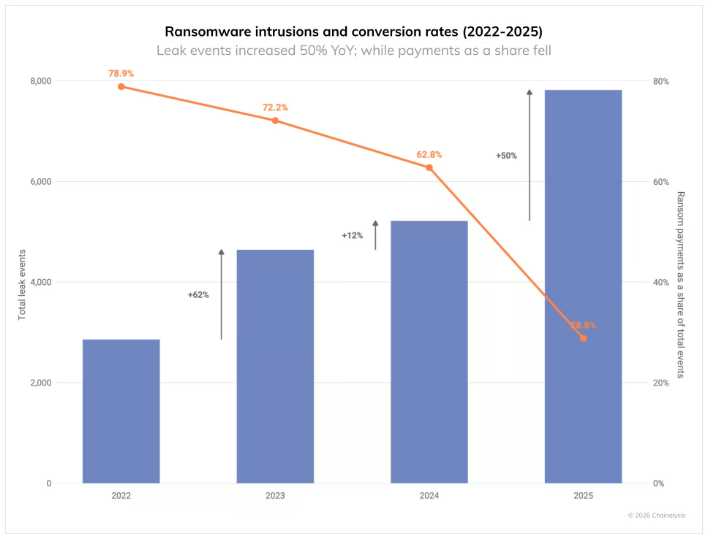
The cybercrime business is booming, at least on paper. According to a new report from blockchain analytics firm Chainalysis, the number of ransomware attacks jumped 50% in 2025, with nearly 8,000 separate incidents recorded throughout the year. Yet for all that hustle, hackers walked away with less cash than the year before.

Smaller Targets, Smaller Payouts

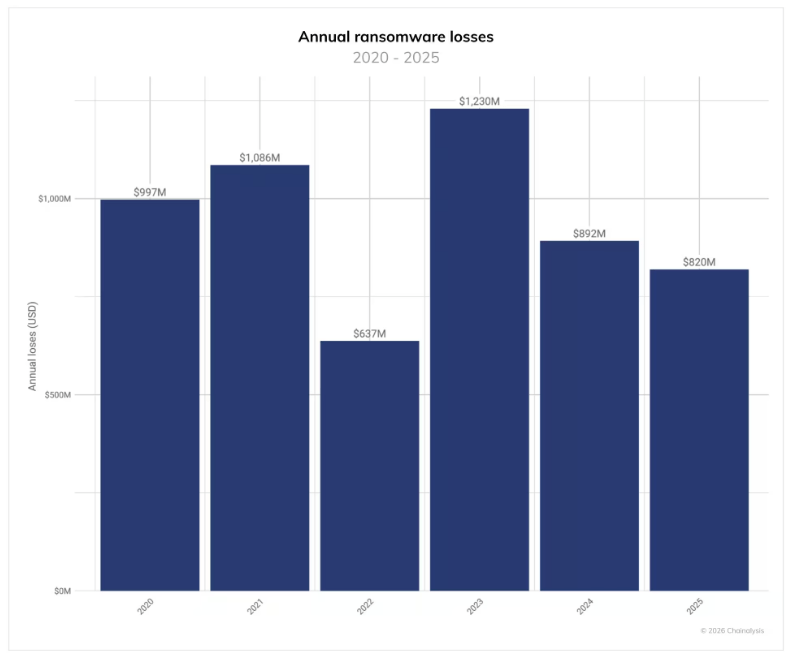
Total ransom payments collected in 2025 came in at $820 million — an 8% drop from 2024. Reports say the decline is tied to several factors: tougher rules from regulators, law enforcement cracking down on the networks criminals use to launder money, and a growing number of companies simply refusing to pay.

With big organizations shutting the door, attackers moved on to easier prey. Small and medium-sized businesses became the new focus. “Smaller victims pay faster,” said Corsin Camichel, founder of eCrime.ch, in the Chainalysis report.

But faster doesn’t mean bigger. Those smaller targets yield smaller sums, and that math is catching up with the criminals running these schemes.
Source: Chainalysis

The gap between how many attacks are being claimed publicly and how much money is actually being collected tells its own story. Attackers are filing more claims than ever, yet the money flowing back to them keeps shrinking.

BTCUSD now trading at $67,800. Chart: TradingView

According to Chainalysis, that gap signals something important — the people running these operations are putting in more work for a worse result.
Source: Chainalysis

Ransomware: The Cost Of Breaking In Has Fallen Sharply

Part of what’s fueling the surge in attack numbers is how cheap it has become to launch one. Reports note that the average price for purchasing access to a victim’s system on the dark web fell from $1,427 in early 2023 to just $439 by early 2026.

Artificial intelligence tools and an oversupply of ready-made attack software have made it easier for more people to get into the ransomware game.

The result is a crowded field of attackers competing for the same pool of victims — and driving down their own profits in the process. It mirrors what happens in any flooded market. More sellers, same number of buyers, prices fall.

2026 Has Already Seen Major Crypto Losses

Even as ransomware payments trended downward last year, the broader picture of crypto-related crime remains grim. According to cybersecurity firm CertiK, $370 million in crypto was stolen in January 2026 alone through various exploits and scams.

Phishing attacks were responsible for the bulk of those losses, accounting for $311 million of the total. Ransomware may be generating less revenue for its operators, but the wider world of crypto theft is far from slowing down.

Featured image from Unsplash, chart from TradingView

Related Questions

QAccording to the Chainalysis report, what was the percentage increase in ransomware attacks in 2025 and the total number of incidents?

AThe number of ransomware attacks jumped 50% in 2025, with nearly 8,000 separate incidents recorded.

QWhat was the total value of ransom payments collected in 2025 and how does it compare to the previous year?

ATotal ransom payments collected in 2025 came in at $820 million, which is an 8% drop from 2024.

QWhat are the three main factors cited for the decline in ransom payments?

AThe decline is tied to tougher rules from regulators, law enforcement cracking down on money laundering networks, and a growing number of companies refusing to pay.

QHow much did the average price for purchasing access to a victim's system on the dark web fall between early 2023 and early 2026?

AThe average price fell from $1,427 in early 2023 to just $439 by early 2026.

QHow much cryptocurrency was reported stolen in January 2026 by CertiK, and what type of attack was responsible for the majority of those losses?

A$370 million in crypto was stolen in January 2026, with phishing attacks accounting for the bulk of those losses at $311 million.

Related Reads

Why Hasn't the U.S. Seen the Rise of 'Huabei' or 'Jiebei'?

The article explores why the U.S. lacks large-scale consumer credit products like China's "Huabei" and "Jiebei," despite having a developed financial sector. Key reasons include: 1. **Structural Barriers**: A fragmented federal and state regulatory system, reinforced by post-2008 reforms like the Dodd-Frank Act, raises compliance costs and protects traditional banks, stifling fintech innovation. 2. **Credit Card Dominance**: Credit cards, used by 70-80% of adults, form a $1.28 trillion debt market with high APRs (avg. 22.3%). This system cross-subsidizes users who pay in full with those carrying balances, creating a predatory yet entrenched ecosystem. 3. **Data Privacy Laws**: Strict regulations (e.g., FCRA, CCPA) prevent tech giants from leveraging behavioral data for credit scoring, unlike in China where such data fuels fintech models. 4. **Capital Market Disincentives**: Wall Street penalizes tech firms entering finance due to lower valuations associated with heavy regulation and risk, as seen in Apple’s failure with Apple Card. 5. **Banking Oligopoly**: Major banks control consumer lending, leveraging lobbying power and consumer habits to maintain high-cost credit, while alternatives like payday loans (400% APR) or "unbanked" services remain niche or exploitative. Ultimately, regulatory, structural, and corporate interests collectively block the emergence of accessible, low-cost digital lending in the U.S.

Odaily星球日报47m ago

Why Hasn't the U.S. Seen the Rise of 'Huabei' or 'Jiebei'?

Odaily星球日报47m ago

More and More 'Model Supermarkets' Are Opening: ByteDance, Alibaba, and Tencent Compete to Integrate

Chinese tech giants like ByteDance, Alibaba, and Tencent are accelerating the rollout of integrated AI model subscription services—dubbed “model supermarkets”—to provide developers with bundled access to multiple leading domestic large language models (LLMs). ByteDance’s Volcengine recently upgraded its "Coding Plan" by adding newer models like GLM-5.1, Minimax M2.7, and Kimi k2.6, allowing subscribers to use various top models under a single monthly fee starting at ¥40. However, user feedback reveals significant issues, including rapid consumption of usage limits (e.g., hitting caps within hours), frequent server errors (like HTTP 429), and slow response times during peak hours. Complaints about misleading deduction rates—where calls to advanced models consume more quota—are also common. The trend is industry-wide: Alibaba, Tencent, and Baidu have all launched similar multi-model coding plans. While these platforms reduce trial costs for developers, they also expose challenges in balancing affordability with service quality and computational stability. Amid this shift, independent AI companies like Zhipu, MiniMax, and Moonlight Face (Kimi) are developing strategies to avoid becoming mere “pipes” in this ecosystem—focusing on vertical applications, autonomous agents, and long-context models to retain competitiveness. Analysts suggest that, while platform aggregation may pressure model firms in the short term, specialized and vertical AI capabilities will remain differentiated in the long run.

marsbit51m ago

More and More 'Model Supermarkets' Are Opening: ByteDance, Alibaba, and Tencent Compete to Integrate

marsbit51m ago

Trading

Spot
Futures
活动图片