Qubic Says Dogecoin Mining Build Is Underway, Revives 51% Attack Fears

bitcoinistPublished on 2026-01-23Last updated on 2026-01-23

Abstract

Qubic has announced the development of a Dogecoin mining integration after a community vote selected DOGE. This move transitions the project from its previous "attention" narrative around Monero into implementation, raising renewed concerns about 51% attacks. Qubic emphasized that integrating ASIC hardware into its useful Proof-of-Work (uPoW) model requires significant engineering and protocol work, but could bring scale by incorporating Dogecoin's large mining economy. The announcement revisits security debates sparked in August 2025 when Qubic claimed a Monero "takeover demonstration" with over 51% hashrate dominance, though subsequent research found its control peaked at 23–34%. Unlike Monero's CPU-based mining, Dogecoin uses Scrypt and has merged mining with Litecoin, making a brute-force 51% attack economically challenging. Research firm 21Shares estimated it would cost billions in hardware and millions daily in electricity. A more plausible risk is Qubic incentivizing existing Scrypt miners to redirect hashpower through its system—a "vampire mining" approach.

Qubic says it is now building a Dogecoin mining integration, a step that moves the project’s post-Monero “attention” narrative into an implementation phase and reopens a familiar set of security questions around majority-hashrate risk.

In an X post shared Thursday, Qubic wrote: “The community didn’t hesitate. The vote was decisive: DOGE won with 301 votes. This isn’t a plug-and-play upgrade. Integrating ASIC hardware into uPoW requires real engineering, deep protocol work, and time to do it right. But the upside is significant. DOGE represents one of the largest and most established mining economies in crypto. Bringing it into Qubic’s useful Proof-of-Work model extends uPoW beyond theory, into scale. [...] Development is underway. This is just the beginning of what is to come.”

Could Dogecoin Suffer A 51% Attack?

The announcement lands with baggage. In August 2025, Qubic ran what it publicly described as a Monero “takeover demonstration,” claiming it had achieved “over 51% hashrate dominance” during parts of the experiment and reporting a brief chain disruption that included a six-block reorganization and orphaned blocks.
That episode became a lightning rod for the broader PoW security debate: how quickly external incentives can concentrate hashpower, and how markets react when “51%” enters the conversation.

Subsequent research challenged the strongest interpretation of those claims. A December 2025 paper reconstructing Qubic-attributed activity on Monero describes the operation as an advertised “selfish mining campaign,” finding Qubic’s hashrate share rising into the 23–34% range in detected intervals, while “sustained 51% control is never observed.”

Dogecoin’s mining economy is structurally unlike Monero’s CPU-oriented RandomX landscape. Dogecoin uses Scrypt and has, since 2014, supported merged mining alongside Litecoin, an architecture that has historically helped bolster its security budget by tapping into a broader Scrypt ASIC miner base.

That hardware reality is central to Qubic’s own messaging. The project said “integrating ASIC hardware into uPoW requires real engineering, deep protocol work, and time to do it right,” explicitly acknowledging that this is not a simple pool launch.

It is also where most of the immediate 51% attack fears run into friction. In an August 2025 research note, published when Qubic first began floating Dogecoin as the “next” network after Monero, 21Shares argued that a brute-force Dogecoin majority would be economically prohibitive, estimating that Qubic would need to match and then exceed roughly 2.78 PH/s, implying about $2.85 billion in hardware plus roughly $2.5 million per day in electricity (before logistics).

The more plausible risk vector, if any, is not Qubic buying its way to majority hashrate, but whether it can engineer incentives and integrations that convince existing Scrypt ASIC operators to route meaningful hashpower through a Qubic-mediated setup, an approach 21Shares characterized as “vampire mining.”

At press time, DOGE traded at $0.12521.
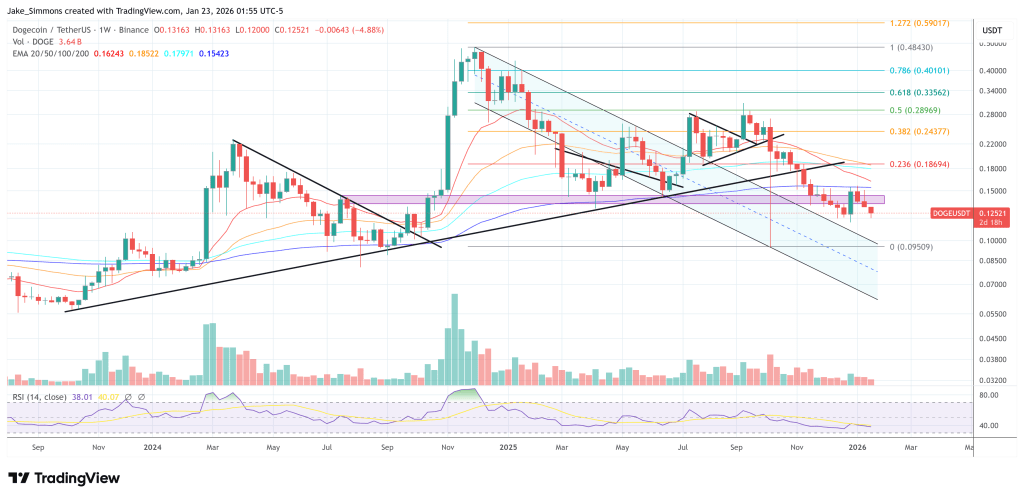
DOGE price, 1-week chart | Source: DOGEUSDT on TradingView.com

Related Questions

QWhat is Qubic currently building and which cryptocurrency does it involve?

AQubic is currently building a Dogecoin mining integration.

QWhat security concern is reignited by Qubic's announcement of Dogecoin mining integration?

AThe announcement reignites fears of a potential 51% attack on the Dogecoin network.

QWhat was the outcome of Qubic's previous 'takeover demonstration' on the Monero network according to subsequent research?

ASubsequent research found that Qubic's hashrate share on Monero reached 23-34% in detected intervals, but sustained 51% control was never observed, challenging the strongest claims of the demonstration.

QWhy does 21Shares argue that a brute-force 51% attack on Dogecoin would be economically prohibitive for Qubic?

A21Shares argued it would be economically prohibitive because Qubic would need to acquire roughly $2.85 billion in hardware and spend about $2.5 million per day on electricity to match the required hashrate.

QWhat is the more plausible risk vector for a Dogecoin 51% attack, as opposed to a brute-force approach?

AThe more plausible risk vector is not a brute-force purchase of hardware, but rather Qubic engineering incentives to convince existing Scrypt ASIC operators to route their hashpower through a Qubic-mediated setup, an approach termed 'vampire mining'.

Related Reads

Will the Fed Definitely Raise Interest Rates in September? How Will Crypto and U.S. Stocks Withstand the Pressure?

The market's expectation for a September Fed rate hike surged dramatically in early August, jumping from under 50% to over 80% within a week. This shift followed a contentious July FOMC meeting, where a 9-3 vote to hold rates revealed growing dissent from hawkish members advocating for an immediate hike to combat persistent inflation. The primary catalyst for this repricing is rising oil prices, driven by renewed geopolitical tensions around the Strait of Hormuz, which threaten global supply. Energy costs directly influence inflation metrics, making the upcoming July CPI report (due August 12th) a critical data point. If it shows inflation reaccelerating, the probability of a September hike will solidify. For Bitcoin and crypto assets, this is typically bearish news. Bitcoin continues to behave as a high-beta, liquidity-sensitive risk asset. A rate hike raises the opportunity cost of holding non-yielding assets and could drive capital toward money markets, pressuring crypto prices in the short term. However, historical patterns suggest that if a hike is perceived as the end of a tightening cycle rather than the start, any negative price impact may be brief. U.S. stocks, particularly crypto-linked equities like Coinbase and growth-oriented tech stocks, are also vulnerable. Higher rates increase discount rates in valuation models, putting pressure on high-multiple companies. This coincides with a pivotal tech earnings season where investor focus has shifted from massive AI capital expenditure to tangible revenue and cash flow generation. Companies with negative cash flow and weak growth narratives could face heightened volatility if borrowing costs rise in September. In summary, a September Fed hike has evolved into a mainstream market scenario. Key factors to watch are oil prices, the July CPI report, and Fed communications, which will determine the final decision and its impact on volatile crypto and equity markets.

marsbit6m ago

Will the Fed Definitely Raise Interest Rates in September? How Will Crypto and U.S. Stocks Withstand the Pressure?

marsbit6m ago

A 'Overlooked' Market Event: Joint US-Japan-South Korea Intervention, Rare US Treasury Involvement, and Bessent's Quiet 'Market Rescue'?

Summary: The United States, Japan, and South Korea executed their largest coordinated foreign exchange intervention in nearly 30 years. The action targeted depreciation pressure on the Japanese yen and South Korean won. This move is seen as a significant effort by the US to stabilize the financial markets of its key allies and prevent the spillover of risks. Key details: * Japan reportedly intervened on July 30 using approximately 8.45 trillion yen (about $52.8 billion). South Korean authorities also intervened that day, selling dollars to support the won. * Notably, the US Treasury Department intervened directly in yen markets for the first time in roughly 30 years. The New York Fed, reportedly acting on behalf of the Treasury, sold euros to buy yen via Goldman Sachs and Morgan Stanley on July 31. Analysts view the use of the euro-yen pair as a way to alleviate yen pressure without adding selling pressure to the US dollar. * Prior to the action, the New York Fed conducted "rate checks" on both USD/JPY and EUR/JPY, a newer signaling tool that falls between verbal and physical intervention. The intervention is interpreted as going beyond traditional currency stabilization. Analysts, such as Michael Hartnett of Bank of America, suggest it resembles a "Price Keeping Operation" for the AI era. The core US objectives are perceived to be: 1. Preventing rapid yen depreciation from triggering a sharp rise in Japanese government bond yields. 2. Containing financial stress from spreading across Asian markets like South Korea and Japan. 3. Reducing the risk of disorderly capital flows impacting the US bond market. This coordinated action underscores the importance of Japan and South Korea as critical partners in the US semiconductor and AI supply chain. Stabilizing their financial markets is seen as vital to mitigating risks to the broader tech industry and the US market itself. The intervention coincides with market pressures, including the KOSDAQ index hitting a low since October 2022. While seen as a move to control volatility, some analysts caution it may not fundamentally reverse existing market trends.

marsbit10m ago

A 'Overlooked' Market Event: Joint US-Japan-South Korea Intervention, Rare US Treasury Involvement, and Bessent's Quiet 'Market Rescue'?

marsbit10m ago

Will the Federal Reserve Definitely Raise Interest Rates in September? How Will Cryptocurrencies and US Stocks Bear the Pressure?

In early August 2024, market expectations for a September Federal Reserve rate hike surged dramatically, from below 50% to over 80%, driven by renewed inflation concerns. This shift followed a contentious July FOMC meeting where a 9-3 vote to hold rates revealed a growing hawkish faction advocating for an immediate hike, citing prolonged above-target inflation. The key catalyst is escalating conflict near the Strait of Hormuz, which has pushed oil prices up approximately 20% in July, threatening to reignite inflation. The next critical data point is the July CPI report on August 12th; a hot reading could solidify hike expectations. For crypto assets, particularly Bitcoin, this represents near-term pressure. Bitcoin continues to exhibit high-beta, risk-on characteristics, making it sensitive to tightening liquidity and higher opportunity costs. However, historical precedent suggests that if a hike is perceived as the cycle's end rather than its start, the negative impact may be brief, with markets quickly pivoting to anticipate future rate cuts. U.S. stocks, especially crypto-linked equities like Coinbase and high-valuation tech stocks, face amplified volatility. Higher rates increase discount rates in valuation models, pressuring growth stocks. This coincides with a pivotal tech earnings season where investor focus has shifted from massive AI capital expenditures to demonstrable revenue and cash flow generation. Companies with negative cash flows and weak growth narratives could see severe pressure if a September hike materializes, as financing costs would rise. Key indicators to watch include oil prices, upcoming inflation data, and Fed commentary at events like the Jackson Hole symposium.

Odaily星球日报10m ago

Will the Federal Reserve Definitely Raise Interest Rates in September? How Will Cryptocurrencies and US Stocks Bear the Pressure?

Odaily星球日报10m ago

Trading

Spot
活动图片





