Qubic Reveals How Its Dogecoin Mining Launch Will Work Starting April 1

bitcoinistPublished on 2026-03-31Last updated on 2026-03-31

Abstract

Qubic has detailed its transition to Dogecoin mining, set to begin on April 1, through a three-phase mainnet rollout. The move shifts Qubic from a mixed model of Monero mining and AI training to a parallel system where external ASIC miners handle Dogecoin via Scrypt algorithm, while Qubic’s own computational resources focus entirely on its AI project, Aigarth. The process uses a bridge called "Doge Connect" to link external miners to Qubic’s network, validate shares, and manage payouts. Monero mining will be phased out gradually over the transition. Miners will be paid in Cubics rather than direct DOGE, as Qubic will sell mined DOGE for stablecoins and buy back Cubics for redistribution—a mechanism expected to yield roughly 10% higher returns than standard Dogecoin mining. The system is designed to support multiple chains in the future, though Dogecoin is the initial focus.

Qubic used a March 30 AMA to lay out the mechanics behind its Dogecoin mining rollout, with core tech lead Joetom outlining a three-phase mainnet transition that begins April 1. The shift matters because it is designed to move Qubic away from its current split between Monero-linked outsourced mining and AI training into a model where both activities run at full scale in parallel.

The presentation centered on what Qubic calls its internal “Doge Connect” architecture, a bridge that links external Scrypt miners to Qubic’s network while redirecting Qubic’s own CPU and GPU resources fully toward its AI initiative, Aigarth. Joetom said the system relies on a dispatcher that connects to pools, translates mining tasks between the Dogecoin and Qubic networks, validates shares, and feeds results back through Qubic’s infrastructure.

“So how does this work? We call it internally Dodge Connect,” he said. “We bridge basically the mining power from outside ... with ASIC miners, we use the Scrypt algorithm and you can connect to any of the Qubic pools. So for you as a miner, nothing changes.”

That bridge is not limited to a single coin, at least in theory. Joetom said the task and messaging system was built generically enough that Qubic could support multiple chains or switch to other mineable assets later. For now, the focus is Dogecoin, with the longer-term goal of running Qubic’s AI research at full capacity while using outsourced mining as a revenue engine.

Qubic Starts Dogecoin Mining Transition

The rollout itself will happen in three stages, with each phase expected to last one to two weeks if testing goes as planned. Phase one begins on mainnet April 1 and is framed as a validation period, covering task distribution, solution handling, pool communications, and public statistics. During that phase, Qubic will reduce its current Monero “marathons” from three days per week to two, beginning a gradual shift away from XMR mining.

Joetom described the process as a controlled crossover rather than a hard cut. “We will reduce this starting with phase one to two days per week,” he said. “So they will basically cross each other and at the end of phase two the Monero stuff will be removed.”

By the final state, he said, the network is meant to reach “100% AI training and 100% outsourced mining.” In practice, that means Qubic’s CPUs and GPUs would be dedicated to Aigarth research, while Dogecoin mining would be handled externally by ASIC miners connected through Qubic pools.

One of the more important economic details from the AMA was the payout model. Rather than distributing DOGE directly, Qubic plans to sell outsourced mining proceeds for stablecoins, use those funds to buy back Cubics, and then redistribute Cubics to miners. Joetom called the mechanism a “buyback” system and said the team expects it to make mining through Qubic more attractive than mining Dogecoin alone.

“We assume that we will see an acceleration for the DOGE revenue,” he said. “Meaning that the Qubic revenue when you mine DOGE via Qubic you will see approximately 10% more revenue than if you would go only for doge.”

The technical path also leans heavily on Qubic’s oracle infrastructure. Shares submitted through the network are validated internally, with oracle machines acting as the source of truth for whether a mined share is accepted. That makes the integration more than a simple mining proxy; it effectively routes Dogecoin-related work through Qubic’s own validation and accounting model.

For miners, the immediate takeaway is operational rather than conceptual. Joetom said older hardware such as Antminer L3 units can still participate, even if newer machines like the L9 offer stronger economics. Public testing is expected to open April 1, with connection details to be shared through Qubic’s Discord and pool operators.

At press time, DOGE traded at $0.09.
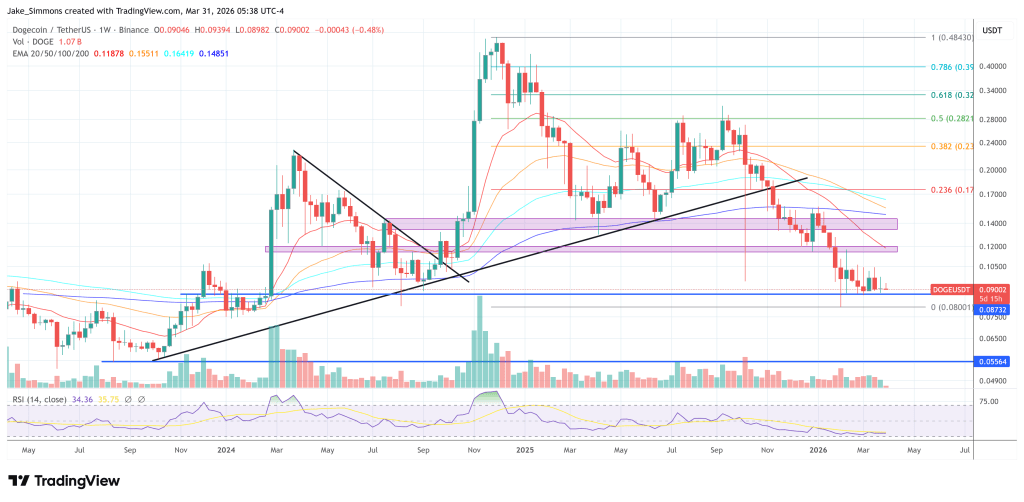
DOGE hovers above key support, 1-month chart | Source: DOGEUSDT on TradingView.com

Related Questions

QWhat is the main purpose of Qubic's Dogecoin mining rollout starting April 1?

AThe main purpose is to transition Qubic away from its current split between Monero-linked outsourced mining and AI training into a model where both activities run at full scale in parallel, dedicating Qubic's CPU and GPU resources fully to its AI initiative Aigarth while using outsourced mining for Dogecoin as a revenue engine.

QHow does Qubic's 'Doge Connect' architecture function?

ADoge Connect is a bridge that links external Scrypt miners to Qubic's network. It uses a dispatcher to connect to pools, translates mining tasks between the Dogecoin and Qubic networks, validates shares, and feeds results back through Qubic's infrastructure, allowing ASIC miners to connect to Qubic pools without changing their operations.

QWhat are the three phases of the mainnet transition and what happens in phase one?

AThe rollout will happen in three phases, each expected to last one to two weeks. Phase one begins on mainnet April 1 and is a validation period covering task distribution, solution handling, pool communications, and public statistics. During this phase, Qubic will reduce its current Monero 'marathons' from three days per week to two.

QHow will Qubic handle payouts for Dogecoin miners using its system?

ARather than distributing DOGE directly, Qubic plans to sell the outsourced mining proceeds for stablecoins, use those funds to buy back Cubics (Qubic's native token), and then redistribute Cubics to the miners. This 'buyback' system is expected to provide approximately 10% more revenue than mining Dogecoin alone.

QWhat role does Qubic's oracle infrastructure play in the new mining system?

AQubic's oracle machines act as the source of truth for validating whether a mined share is accepted. Shares submitted through the network are validated internally, making the integration more than a simple mining proxy by effectively routing Dogecoin-related work through Qubic's own validation and accounting model.

Related Reads

The Macroeconomic Underpinnings of Africa's Payment Market Landscape

The African payments market, characterized by the world's highest mobile money penetration and fastest-growing cryptocurrency adoption, is not a coincidence but a macroeconomic necessity driven by deep structural factors. Two key drivers create this landscape: (1) Africa's heavy reliance on commodity exports, trade, and remittances, generating massive cross-border settlement and remittance demand; and (2) chronically underdeveloped financial infrastructure, exacerbated by international bank de-risking, foreign exchange mismanagement, and persistent inflation. This vacuum has allowed mobile money and crypto to thrive. Mobile money platforms replace banks for domestic payments, while cryptocurrencies serve as a store of value against local currency depreciation and a low-cost medium for cross-border exchange. A crucial division lies along the Sahara Desert. North Africa is integrated into the oil-anchored MENA framework, while Sub-Saharan Africa (SSA), plagued by dollar shortages and fragmented currencies, has become a natural, massive market for mobile money and crypto. Nigeria, Kenya, and South Africa are global leaders in adoption. The SSA economy is deeply dollarized due to currency instability, yet suffers from a severe "dollar shortage" caused by trade deficits and limited export capacity. This creates parallel forex markets and high remittance costs. Cryptocurrencies, particularly stablecoins, fill this gap by providing access to dollar liquidity, cheaper cross-border transfers, and an inflation-resistant store of value, primarily driven by retail users for small-value transactions. While regional initiatives like PAPSS aim to reduce dollar dependence, the fundamental constraints of commodity reliance, trade imbalances, and shallow financial markets persist. Therefore, mobile money and cryptocurrencies are not niche trends but essential financial infrastructure filling a structural void, and they are likely to remain central to Africa's economic landscape for the foreseeable future.

链捕手7m ago

The Macroeconomic Underpinnings of Africa's Payment Market Landscape

链捕手7m ago

Is the Sharp Decline Over? Let the Data Speak

**Has the Sharp Decline Ended? Let Data Speak** Bitcoin's recent significant drop has placed short sellers in a precarious position. Three concurrent pressures—sustained outflows from ETFs, miners offloading coins to exchanges, and short-term holders capitulating—pushed the price near $63k. The asset fell 13% this week and 21% this month, roughly halving from its all-time high. A critical data point is the extremely crowded short positioning, with a short-to-long ratio reaching 8:1, representing nearly $100 billion in short interest overhead. This creates conditions for a potential short squeeze if selling pressure merely pauses, similar to the event in November 2022 which triggered a 24% rally. The selling pressures are real: spot Bitcoin ETFs have seen a record $5.4 billion outflow over 20 days. Short-term holders moved 53k loss-held BTC to exchanges in a day, and miners sent 24k BTC to Binance, a six-month high. Capital is also rotating towards AI and tech stocks like SpaceX, with $400 billion invested in AI infrastructure recently. However, on-chain data shows accumulation by long-term holders, who added 200k BTC in a month, and institutions/miners have absorbed 1.24 million BTC since 2023. This indicates strong buying beneath the surface. Key levels to watch are the $67k-$70k zone (2021 high & 2024 breakout point). A swift recovery above it suggests a leverage washout; failure could test $60k-$55k. The direction also hinges on ETF flow reversal. Currently, the S&P 500 hits new highs driven by AI, while Bitcoin and DeFi (TVL down from $173b to $73.9b) lag. The most probable path is a grinding basing process between $60k-$58k with continued ETF outflows. A less likely but explosive scenario involves a sudden flow reversal, a surge above $70k triggering a short squeeze, and a rally back above $76k. The immediate trigger depends on when the relentless selling pauses. A final cautionary note questions Bitcoin's correlation: if the high-flying U.S. stock market corrects, will Bitcoin once again miss the rally but not the decline?

foresightnews_api22m ago

Is the Sharp Decline Over? Let the Data Speak

foresightnews_api22m ago

Single-Day Plunge of 30%, Arthur Hayes Suddenly Liquidates: Why Did ZEC Get Exploded by Security Issues?

On June 5th, Zcash founder Zooko Wilcox disclosed a critical soundness vulnerability in the project's latest Orchard privacy pool. This flaw, found in the elliptic curve multiplication constraints, could allow an attacker to create unlimited counterfeit ZEC within the shielded pool, with transactions appearing valid. The vulnerability was discovered in late May by security researcher Taylor Hornby, who utilized Anthropic's new Opus 4.8 AI model for a targeted audit. The Zcash ecosystem had already performed an emergency network upgrade to patch the issue. However, the detailed disclosure triggered severe market panic, causing ZEC's price to plummet over 30% in a single day. Notably, prominent investor Arthur Hayes announced he had sold his entire ZEC position following the news. The incident starkly challenges the "technological trust" narrative central to privacy coins. Despite years of top-tier cryptographic audits, the bug persisted until uncovered with advanced AI-assisted research. This highlights the growing gap between theoretical perfection and practical implementation in privacy technology. The event serves as a industry-wide warning: in an AI-driven security landscape, the assumption that "undiscovered equals safe" is obsolete. It underscores the urgent need for continuous, proactive security practices combining AI audits, formal verification, and rapid response mechanisms.

foresightnews_api1h ago

Single-Day Plunge of 30%, Arthur Hayes Suddenly Liquidates: Why Did ZEC Get Exploded by Security Issues?

foresightnews_api1h ago

Trading

Spot
Futures
活动图片