Quant enters crucial supply zone: Will QNT’s 24% weekly rally falter?

ambcryptoPublished on 2026-03-21Last updated on 2026-03-21

Abstract

Quant (QNT) has surged 24.14% in the past week, significantly outperforming Bitcoin, which declined 2.64%. The altcoin is approaching a critical supply zone between $80 and $88, a key resistance area. While QNT has shown strength by rebounding from the long-term demand zone of $55–$60, its weekly chart still reflects a bearish structure, with the RSI below 50 and OBV not trending higher. Key resistance levels to watch are $88, $105, and $135. A daily close above $88 could signal a bullish continuation, while rejection at $80 and a drop below $75 may indicate a bearish reversal. Traders are advised to consider taking profits in the $80–$88 zone or wait for a clear breakout above $88 or breakdown below $75 for directional bias.

At press time, Quant [QNT] rallied 4.91% in 24 hours and was up by 24.14% over the past week. These were impressive numbers for the mid-cap altcoin, especially in comparison to Bitcoin [BTC]. The leading crypto has shed 2.64% over the past week and was oscillating about the $70k level.

In the coming days and weeks, BTC could make another push higher toward $80k. This could provide fuel for altcoins to climb higher, but only a few altcoins have already shown strength.

Quant could be one of them. It has a higher timeframe bearish trend but has reacted positively at the long-term demand zone at $55-$60. In March, QNT rebounded swiftly from $60.92 to $80.72, a 32.5% move in two weeks.

Quant is likely to rally to the Value Area High
Source: QNT/USDT on TradingView

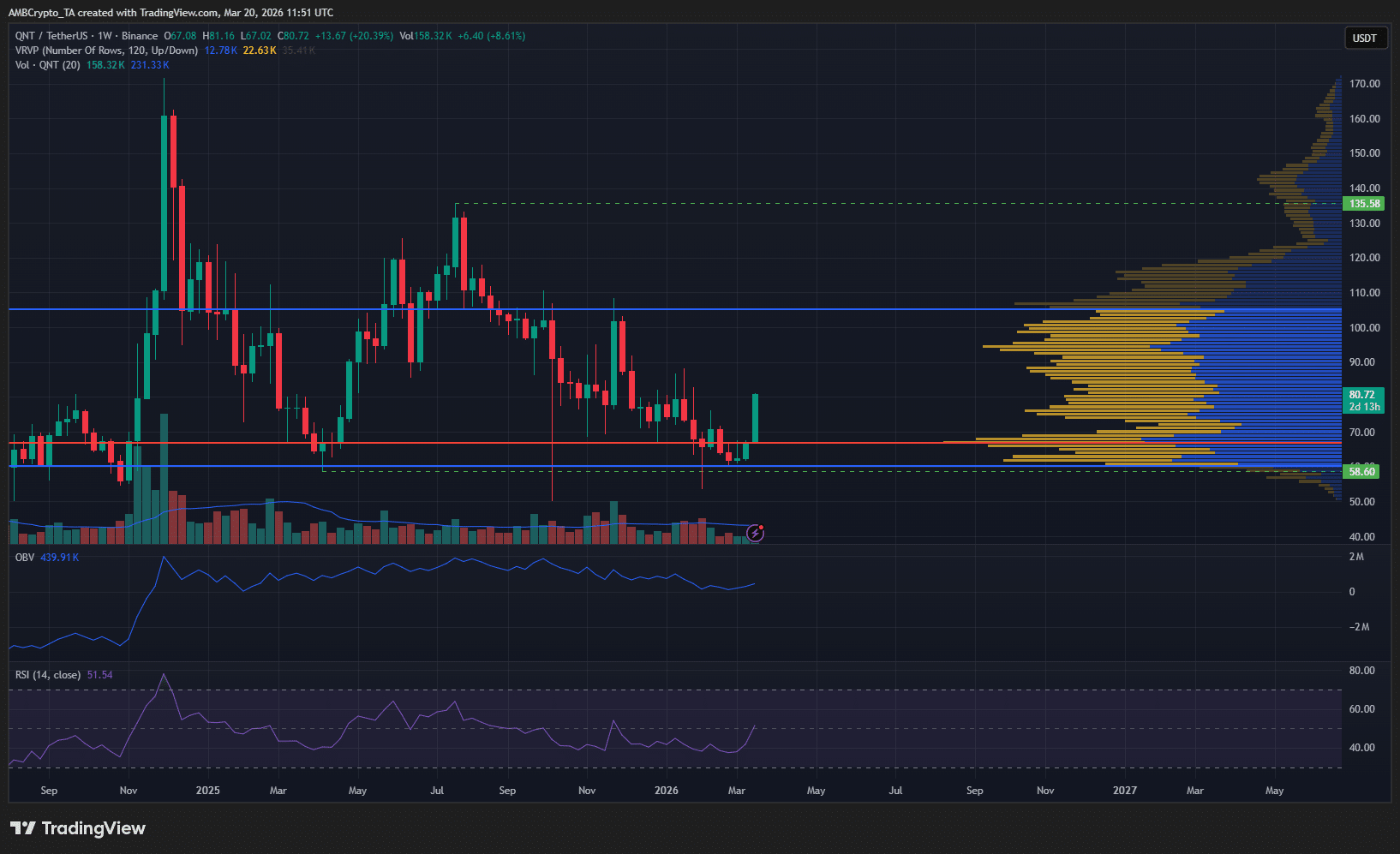
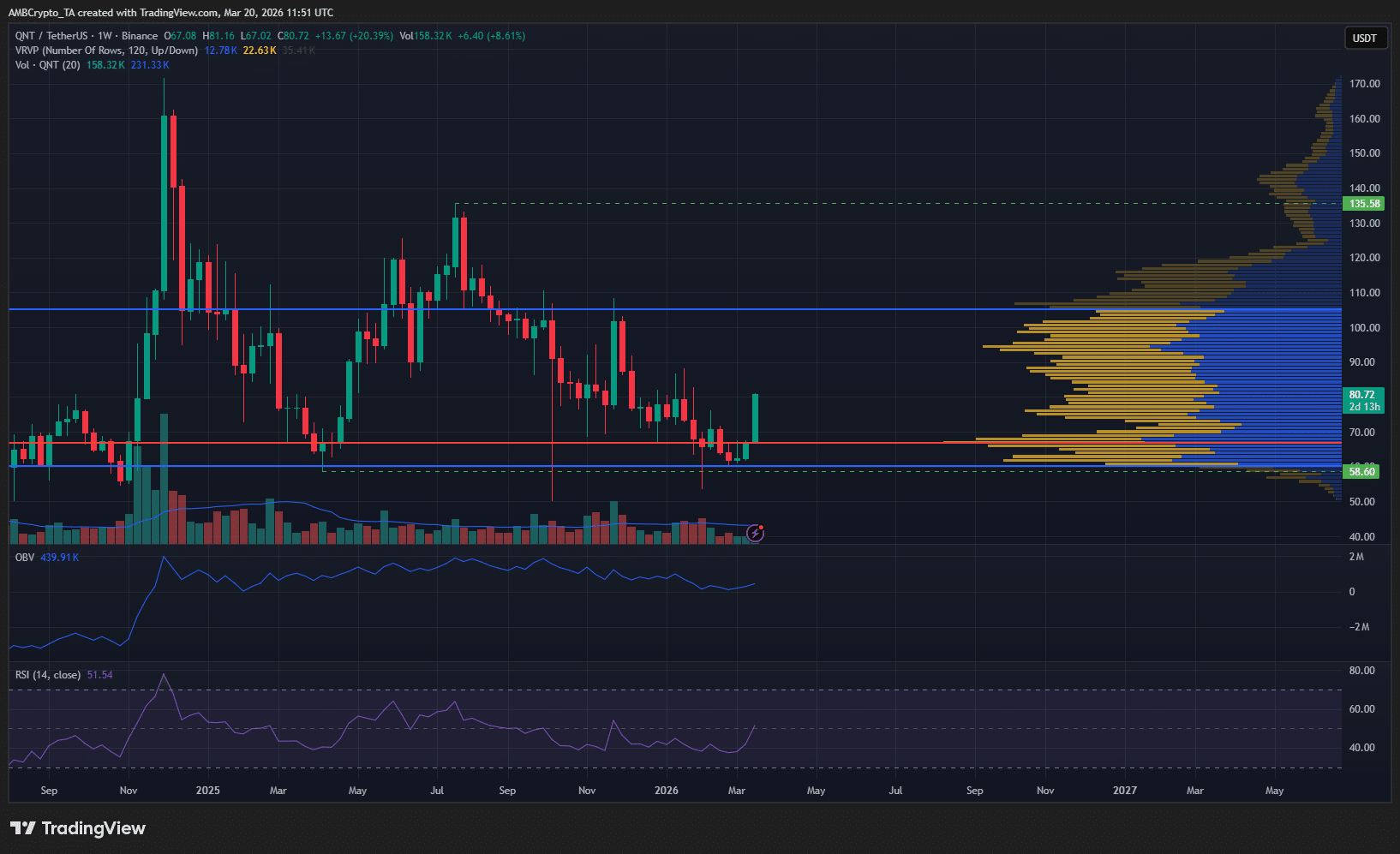
The weekly chart showed a long-term bullish swing structure but a bearish internal structure. Even after the strong gains in March, the local swing high at $88.3 remained unbroken.

The Visible Range’s Value Area was between $60 and $105, with the Point of Control at $67. That means the high-volume node shifted into bullish control, which was encouraging for bulls. However, they still had a long way to go before they could maintain their momentum.

Since April 2025, QNT has been stuck within the $58.60-$135.58 levels. The $88, $105, and $135 levels were the next key resistances to the north for QNT to overcome.

The OBV has not trended higher lately, and the RSI has remained below the neutral 50 level. The structure and technical indicators remained bearishly poised on the weekly timeframe.

QNT is at a make-or-break region
Source: QNT/USDT on TradingView

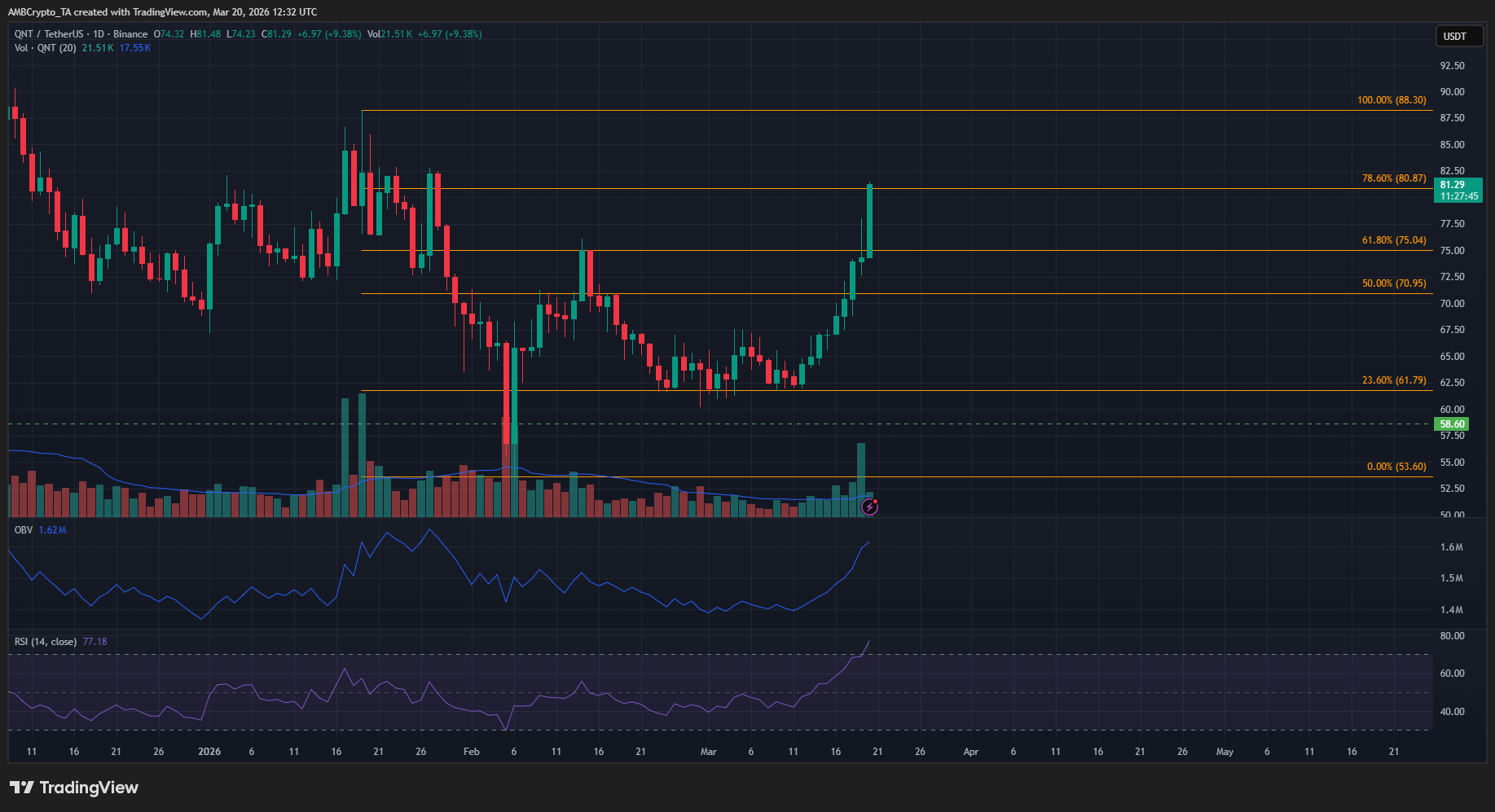
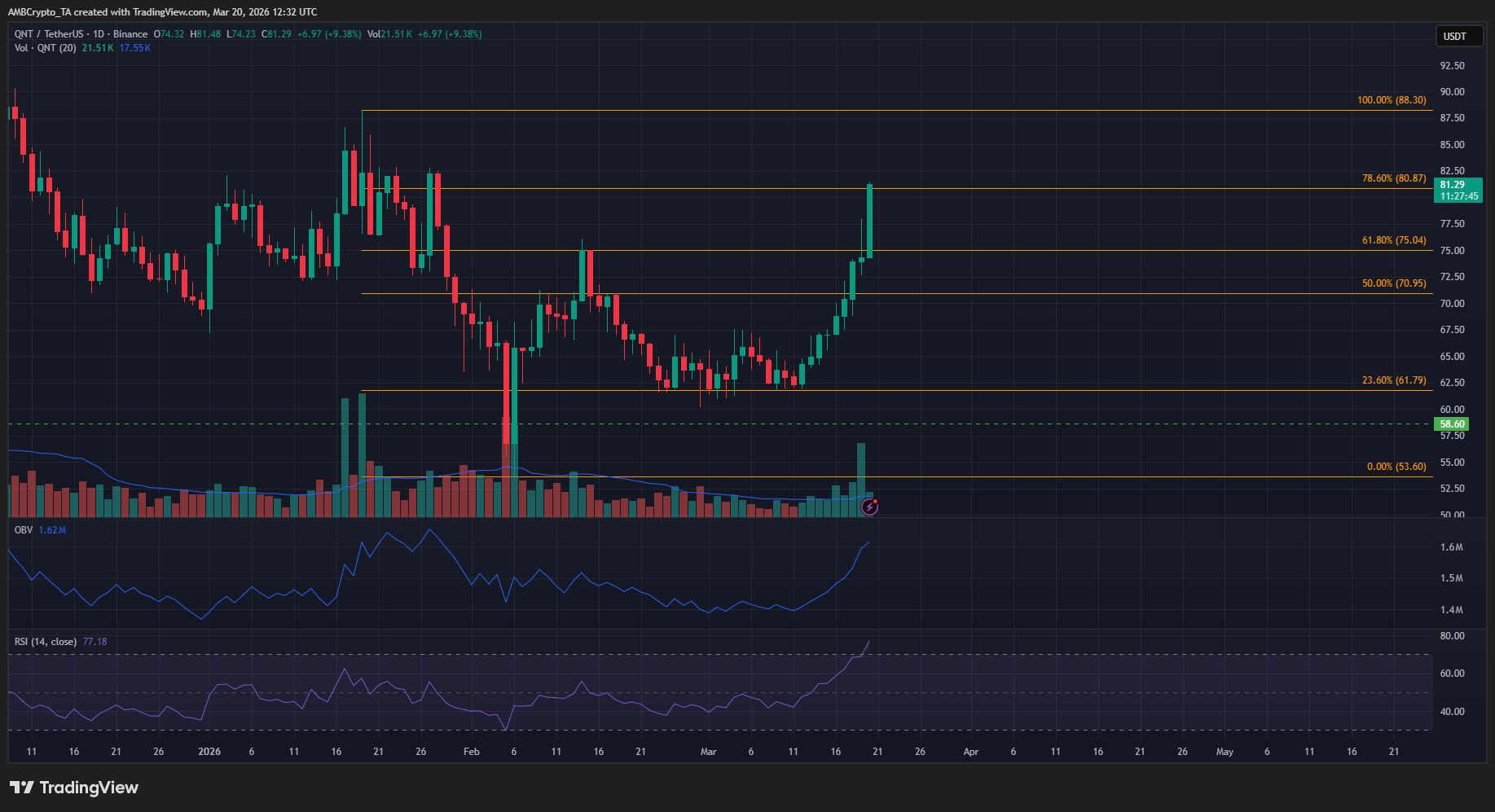
On the 1-day chart, the swing structure was bearish. This drop in January and February was used to plot a set of Fibonacci retracement levels (orange). The $75.04 and $80.87 levels were the levels that demarcated the golden pocket within the retracement.

If the bears were going to take control, they were most likely to do it within this price range. Yet, it has not happened so far.

So swing traders looking to go long should wait, while those looking to sell QNT can do so and book profits. It is unclear where the next leg will go.

A daily session closing above $88 would be a strong sign of a bullish continuation. Meanwhile, rejection from $80 and a subsequent fall below $75 would be indicative of a bearish trend’s renewal.


Final Summary

  • QNT traders already in long positions can look to take profits as the price enters the $80-$88 resistance zone.
  • Swing traders can wait for $75 or $88 to be breached to decide their next directional bias.

Related Questions

QWhat is the current weekly and 24-hour price performance of Quant (QNT) as mentioned in the article?

AAt press time, Quant (QNT) had rallied 4.91% in 24 hours and was up by 24.14% over the past week.

QWhat are the key resistance levels that QNT needs to overcome to the north, according to the weekly chart analysis?

AThe key resistance levels to the north for QNT are $88, $105, and $135.

QWhat is the significance of the Fibonacci retracement's 'golden pocket' levels on the 1-day chart for QNT?

AThe 'golden pocket' levels, $75.04 and $80.87, are the price range where bears are most likely to take control, making it a critical zone for a potential trend reversal.

QWhat would a daily closing price above $88 indicate for QNT's price action?

AA daily session closing above $88 would be a strong sign of a bullish continuation for QNT.

QWhat trading advice is given to swing traders who are currently in long positions on QNT?

ASwing traders already in long positions are advised to look to take profits as the price enters the $80-$88 resistance zone.

Related Reads

The AI Agent Era Accelerates Its Arrival: Questflow Defines a New Paradigm of Financial Intelligence with On-Chain AI Brokerage

The AI Agent era is accelerating, with the CB Insights AI 100 list highlighting global investment confidence. The focus has shifted from whether AI works to its speed of deployment and ability to manage complex workflows, with autonomous AI Agents driving this transformation. At the forefront is Questflow, a Singapore-based startup redefining financial intelligence through its on-chain AI brokerage. Unlike tools that merely provide data dashboards, Questflow deploys AI Agents that proactively scan markets, form judgments, and execute trades via a conversational interface—operating 24/7 without requiring manual confirmation for each decision. This embodies the new AI paradigm of agents capable of executing multi-step workflows autonomously. Questflow's mission is to democratize institutional-grade trading intelligence. Historically reserved for the ultra-wealthy, this capability is now accessible starting from just $1 through Questflow's "AI Clone + Copy Trade" model. The platform charges only a 1% execution fee, aligning its incentives directly with users and eliminating traditional management or performance fees. The timing is opportune, aligning with key trends identified by CB Insights: the scalable deployment of AI Agents, accelerated AI adoption in financial services, and the maturation of on-chain infrastructure. With robust liquidity on platforms like Hyperliquid and Polymarket, alongside advancements in AI reasoning and non-custodial wallet security, Questflow is positioned to merge the roles of broker, fund, and exchange into a single, accessible platform for millions.

链捕手15m ago

The AI Agent Era Accelerates Its Arrival: Questflow Defines a New Paradigm of Financial Intelligence with On-Chain AI Brokerage

链捕手15m ago

Why Pricing Social Interactions is Doomed to Fail?

Titled "Why Putting a Price on Social Interaction Is Doomed to Fail," this article critiques attempts to monetize social networks directly through SocialFi models, arguing their inevitable failure stems from a fundamental misunderstanding of media dynamics. Using Marshall McLuhan's theory of "hot" and "cold" media, the author posits that social networks are inherently "cold" media. Their value isn't contained in individual posts but is co-created through user participation, interpretation, and fragmented, ongoing interaction (e.g., replies, shares). This ambiguity and need for user involvement are core to their function. The article asserts that SocialFi projects like Friend.tech failed because introducing real-time, tradable financial pricing (a definitive "hot" signal) into this "cold" environment doesn't add a layer—it replaces the medium's essence. The unambiguous price signal overshadows and nullifies the nuanced, participatory social signal. Users become traders, not participants, and when speculative profits vanish, the underlying social ecosystem—never genuinely cultivated—collapses entirely. This principle extends beyond crypto. The author argues platforms like Twitter have gradually "heated up" through metrics (likes, retweets counts, algorithmically defined value), shifting users from participants to performers and eroding organic engagement. The solution isn't to abandon capital but to manage its entry point. Successful models like Substack, Patreon, or Bandcamp allow capital to "condense" at specific, isolated nodes (e.g., subscriptions, one-time payments) without permeating and "heating" every social interaction. They preserve the core "cold," participatory medium while enabling monetization at designated boundaries. The NFT boom and bust serves as a stark parallel: the ancient "cold" medium of collecting (valued for story, community, gradual accumulation) was rapidly destroyed by platforms that introduced real-time floor prices, rarity scores, and trading dashboards, transforming collectors into speculators and vaporizing cultural value when prices fell. The core lesson: "Liquidity equals heat." Injecting high liquidity and definitive pricing into a "cold" participatory medium doesn't optimize it; it fundamentally alters and destroys its value-creating mechanism. The future lies not in pricing every social gesture but in finding precise, non-invasive points for capital to condense without overheating the entire ecosystem.

marsbit23m ago

Why Pricing Social Interactions is Doomed to Fail?

marsbit23m ago

Jensen Huang's CMU Speech: In the AI Era, Don't Just Watch, Build

Jensen Huang, CEO of NVIDIA and a first-generation immigrant, delivered the commencement address to Carnegie Mellon University's class of 2026. He shared his personal journey from a humble background to founding NVIDIA, emphasizing resilience, learning from failure, and the responsibility that comes with leadership. Huang framed the present moment as the dawn of the AI revolution, a shift he believes is more profound than previous computing waves. He described AI as fundamentally resetting computing—moving from human-written software to machines that understand, reason, and use tools. This will create a new industry for generating intelligence and transform every sector. While acknowledging AI's potential to automate tasks and displace some jobs, Huang distinguished between the *tasks* of a job and its core *purpose*. He argued AI will augment human capability, not replace humans. The real risk, he stated, is not AI itself, but people being left behind by those who effectively use AI. He presented AI as a generational opportunity for massive infrastructure investment—in chip factories, data centers, energy grids, and advanced manufacturing—that could re-industrialize nations like the U.S. and bridge the digital divide by making computing and intelligent tools accessible to all. Huang called for a balanced approach: advancing AI safely and responsibly, establishing prudent policies, ensuring broad access, and encouraging universal participation. He urged the graduates not to fear the future but to engage with optimism and ambition, reminding them of CMU's motto, "My heart is in the work." His core message was clear: this is their moment to actively build and shape the AI-powered future, not merely observe it.

marsbit1h ago

Jensen Huang's CMU Speech: In the AI Era, Don't Just Watch, Build

marsbit1h ago

Trading

Spot
Futures
活动图片