Pundit Says Current Altcoin Trend “Feels” Like January 2019, Here’s What Happened Back Then

bitcoinistPublished on 2026-01-12Last updated on 2026-01-12

Abstract

A crypto analyst, Chad Steingraber, has drawn parallels between the current altcoin market trend and January 2019, a period marked by extreme negative sentiment that preceded a significant market turnaround. Back then, Bitcoin was trading near $3,000 and Ethereum around $100, but the market eventually rebounded strongly. By mid-2019, Bitcoin surged past $13,000, finishing the year 95% higher, which fueled a broader crypto rally. The total market cap grew over 44%, peaking at $350 billion, with trading volume surging 600%. While some altcoins like Ethereum and Litecoin gained over 40%, others like XRP underperformed. Currently, another analyst, @brain2jene, highlights a Falling Wedge breakout in the altcoin market cap (excluding top 10 coins). The key resistance level is $221.87 billion; a break above this could add $50-$60 billion to the market, targeting the upper trend line. The RSI breakout from a downtrend suggests strong momentum, potentially igniting a broader altcoin rally, with coins like VET, SUI, ICP, and IMO poised for gains. Traders are watching closely to see if history repeats.

Talks of an impending altcoin season are once again gaining traction in the market as major cryptocurrencies saw a fresh rebound at the start of this year. A crypto analyst has likened the current altcoin market trend to that seen in January 2019—a period that marked the early stages of a major market turn. The comparison now has many traders watching closely to see whether the market could be setting up for a similar move.

Current Altcoin Market Echoes Trend From January 2019

Crypto pundit Chad Steingraber said in a recent X post that today’s market feels a lot like January 2019, when investor sentiment was extremely negative. At the time, Bitcoin was trading near $3,000, and Ethereum’s price was around $100, when most believed the market was over. Yet despite the downtrend, the analyst revealed that he had invested heavily in both cryptocurrencies.

Although the market was recovering from a bear market, Steingraber revealed that things began to turn around in April of that year, leading to the strong long-term results that are now widely known. Notably, during that time, the crypto market saw a strong breakout that changed sentiment across the space.

According to CoinGecko’s yearly report for 2019, Bitcoin’s price surged over $13,000 in June and ended the year 95% higher than where it started. This price jump helped drive a broader market rally and marked a key transition from bear market lows earlier in the year. Altcoins also reacted to this surge in market momentum, as traders and investors sought growth beyond Bitcoin and diversified into lower-cap cryptocurrencies.

While some altcoins, including Ethereum, Litecoin, and Bitcoin Cash, climbed by more than 40% in 2019, other large-cap tokens, such as XRP, performed poorly, finishing the year significantly weaker despite earlier strength in 2018. Excluding individual altcoin gains, the total cryptocurrency market capitalization grew by more than 44% in 2019, peaking at $350 billion in late June. The market also experienced a surge in trading volume of over 600%, along with renewed enthusiasm among investors who had stayed on the sidelines during the prior downturn.

Altcoin Market Eyes Breakout As Analyst Flags 221B Level

In a separate post, crypto analyst @brain2jene shared a chart tracking the total altcoin market capitalization, excluding the top 10 coins. He explained that a Falling Wedge breakout has already set the stage for the market’s next move. The analyst noted that the wedge pattern has been forming for weeks and emphasized that altcoins typically begin to move once the price breaks above the wedge lines shown on the chart.
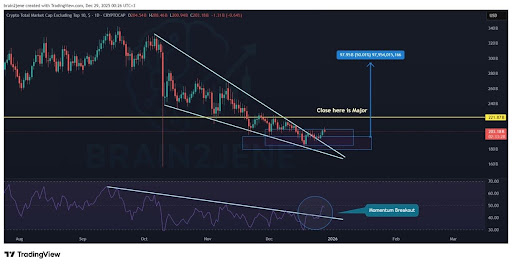
Source: Chart from @brain2jene on X

The chart also shows a clear pullback after the price hit the 221.87B resistance, which @brain2jene identified as the key level to watch. He explained that a clean break above 221.87B is critical and could add another $50-$60 billion to the market, with the target zone near the upper trend line.

Related Reading: Altcoin Season Index Crashes To Low 17 As Bitcoin Price Struggles, What This Means

Supporting this outlook, momentum appears strong, as the RSI on the chart has broken out of a downtrend. The analyst noted that this could signal the start of a broader altcoin rally, potentially boosting the price of coins like VeChain (VET), SUI, Internet Computer (ICP), and IMO.

Overall market cap excluding BTC at $1.25 trillion on the 1D chart | Source: TOTAL2 on Tradingview.com

Related Questions

QWhat does crypto pundit Chad Steingraber compare the current altcoin market trend to, and why?

AChad Steingraber compares the current altcoin market trend to January 2019 because the current market sentiment feels similar, with extreme negativity among investors at that time, yet it marked the early stages of a major market turnaround.

QWhat were the prices of Bitcoin and Ethereum in January 2019, as mentioned in the article?

AIn January 2019, Bitcoin was trading near $3,000 and Ethereum's price was around $100.

QAccording to CoinGecko's 2019 report, how much did Bitcoin's price surge by June 2019, and what was its yearly gain?

ABitcoin's price surged over $13,000 by June 2019 and ended the year 95% higher than where it started.

QWhat key resistance level does analyst @brain2jene identify for the altcoin market capitalization, and what could a break above it lead to?

AAnalyst @brain2jene identifies the 221.87B level as key resistance, and a clean break above it could add another $50-$60 billion to the market, targeting the upper trend line.

QWhich altcoins does the analyst suggest could potentially be boosted by a broader altcoin rally based on the chart analysis?

AThe analyst suggests that coins like VeChain (VET), SUI, Internet Computer (ICP), and IMO could potentially be boosted by a broader altcoin rally.

Related Reads

Annual Salary of Millions Competing for Electricians, Meta Rushes to Open Its Own Technical School

The AI boom is facing an unexpected bottleneck: a severe shortage of skilled construction workers and electricians. As tech giants like Meta, OpenAI, and Alphabet race to build massive data centers—such as OpenAI's $16 billion "Stargate" project—they are hitting a critical labor wall. The U.S. needs an estimated 130,000 more electricians, 240,000 construction workers, and 150,000 supervisors by 2030 for AI infrastructure alone, but tens of thousands of electrician jobs go unfilled each year. While AI companies offer high premiums, with electricians earning up to $280,000 annually, worker scarcity still causes massive losses—delays on a single project can cost $14.2 million per month. The complexity of building AI data centers, which require immense power (equivalent to powering hundreds of thousands of homes), sophisticated electrical systems, and advanced liquid cooling solutions, demands highly skilled technicians who are in short supply. To combat this, companies are investing heavily in training. Meta has committed $115 million to a free training school offering tuition, housing, and stipends, targeting 5,000 new workers. OpenAI is partnering with unions to secure skilled labor. These efforts are paying off, with a significant rise in Gen Z interest in trade schools over college. However, the power demands are staggering. AI data centers are driving a rapid surge in electricity consumption, projected to account for up to 12% of U.S. power use by 2028 and raising costs for consumers. Furthermore, the construction boom is project-based, leading to a potential future glut of trained workers once building peaks, which could depress wages industry-wide. The race for AI supremacy now depends as much on skilled hands as on advanced chips.

marsbit29m ago

Annual Salary of Millions Competing for Electricians, Meta Rushes to Open Its Own Technical School

marsbit29m ago

OpenAI No Longer Sells Its Most Expensive Model for Profit

OpenAI is shifting its business strategy away from promoting its most expensive, flagship models for every task. Recent price cuts—80% for GPT-5.6 Luna and 20% for Terra—signal a deeper change: the company now actively advises users that many tasks don't require the most powerful model. Instead, OpenAI recommends a tiered approach: use the high-end GPT-5.6 Sol for complex planning and analysis, then delegate execution to cheaper models like Luna. This mirrors moves by Anthropic, which recently launched Claude Opus 5 at half the price of its top model, Fable 5. Both companies are de-emphasizing flagship models as primary revenue drivers, using them instead for brand prestige and technological showcases. The industry is entering a "mass-market" phase, similar to automotive, where high-volume, cost-effective models handle daily operations and drive scale. OpenAI's price reductions are partly enabled by AI models themselves optimizing underlying code and infrastructure, creating a self-reinforcing cycle of efficiency gains and cost reduction. Competition is shifting from "who is smartest" to "who offers the best value." The goal is no longer selling individual models but fostering widespread API adoption and ecosystem lock-in. By making AI calls cheap and ubiquitous, companies like OpenAI aim to become the indispensable, utility-like infrastructure powering automated workflows—the "water and electricity" of software, quietly embedded everywhere.

marsbit29m ago

OpenAI No Longer Sells Its Most Expensive Model for Profit

marsbit29m ago

Will the Fed Definitely Raise Interest Rates in September? How Will Crypto and U.S. Stocks Withstand the Pressure?

The market's expectation for a September Fed rate hike surged dramatically in early August, jumping from under 50% to over 80% within a week. This shift followed a contentious July FOMC meeting, where a 9-3 vote to hold rates revealed growing dissent from hawkish members advocating for an immediate hike to combat persistent inflation. The primary catalyst for this repricing is rising oil prices, driven by renewed geopolitical tensions around the Strait of Hormuz, which threaten global supply. Energy costs directly influence inflation metrics, making the upcoming July CPI report (due August 12th) a critical data point. If it shows inflation reaccelerating, the probability of a September hike will solidify. For Bitcoin and crypto assets, this is typically bearish news. Bitcoin continues to behave as a high-beta, liquidity-sensitive risk asset. A rate hike raises the opportunity cost of holding non-yielding assets and could drive capital toward money markets, pressuring crypto prices in the short term. However, historical patterns suggest that if a hike is perceived as the end of a tightening cycle rather than the start, any negative price impact may be brief. U.S. stocks, particularly crypto-linked equities like Coinbase and growth-oriented tech stocks, are also vulnerable. Higher rates increase discount rates in valuation models, putting pressure on high-multiple companies. This coincides with a pivotal tech earnings season where investor focus has shifted from massive AI capital expenditure to tangible revenue and cash flow generation. Companies with negative cash flow and weak growth narratives could face heightened volatility if borrowing costs rise in September. In summary, a September Fed hike has evolved into a mainstream market scenario. Key factors to watch are oil prices, the July CPI report, and Fed communications, which will determine the final decision and its impact on volatile crypto and equity markets.

marsbit40m ago

Will the Fed Definitely Raise Interest Rates in September? How Will Crypto and U.S. Stocks Withstand the Pressure?

marsbit40m ago

Trading

Spot
活动图片





