Privacy and RWA Tokens Dominate MEXC December Trading as Meme Trading Cools

TheNewsCryptoPublished on 2026-01-15Last updated on 2026-01-15

Abstract

MEXC, a leading cryptocurrency exchange, reported a significant shift in trading activity during December, with infrastructure projects capturing 50% of top-performing positions. Privacy computing and real-world asset (RWA) tokenization led capital allocation among 110 new listings, reflecting a move toward utility-driven investments. Meme tokens declined to just 10% of top spots. Notable performers included privacy tokens like ZKP, NIGHT, and RLS, each achieving gains nearing 2,000%, while DeFi and Web3 entertainment also showed strength. The month featured strong institutional participation, with projects backed by established teams like Charles Hoskinson’s NIGHT and Bitfinex-incubated STABLE. MEXC’s user-focused initiatives, including Launchpad and Airdrop+, saw substantial growth in engagement.

MEXC, the fastest-growing global cryptocurrency exchange, redefining a user-first approach to digital assets through true zero-fee trading, reported a significant shift in December trading activity as infrastructure projects captured 50% of top-performing positions, with privacy computing and real-world asset (RWA) tokenization leading capital allocation across the platform’s 110 new token listings.

December trading patterns reflected concentrated capital flow toward utility-driven narratives. Infrastructure projects accounted for half of the top 10 tokens by spot trading volume, including NIGHT, RLS, ZKP, STABLE, and US. DeFi and Web3 Entertainment each represented 20% of top performers, while meme tokens declined to 10% of positions.
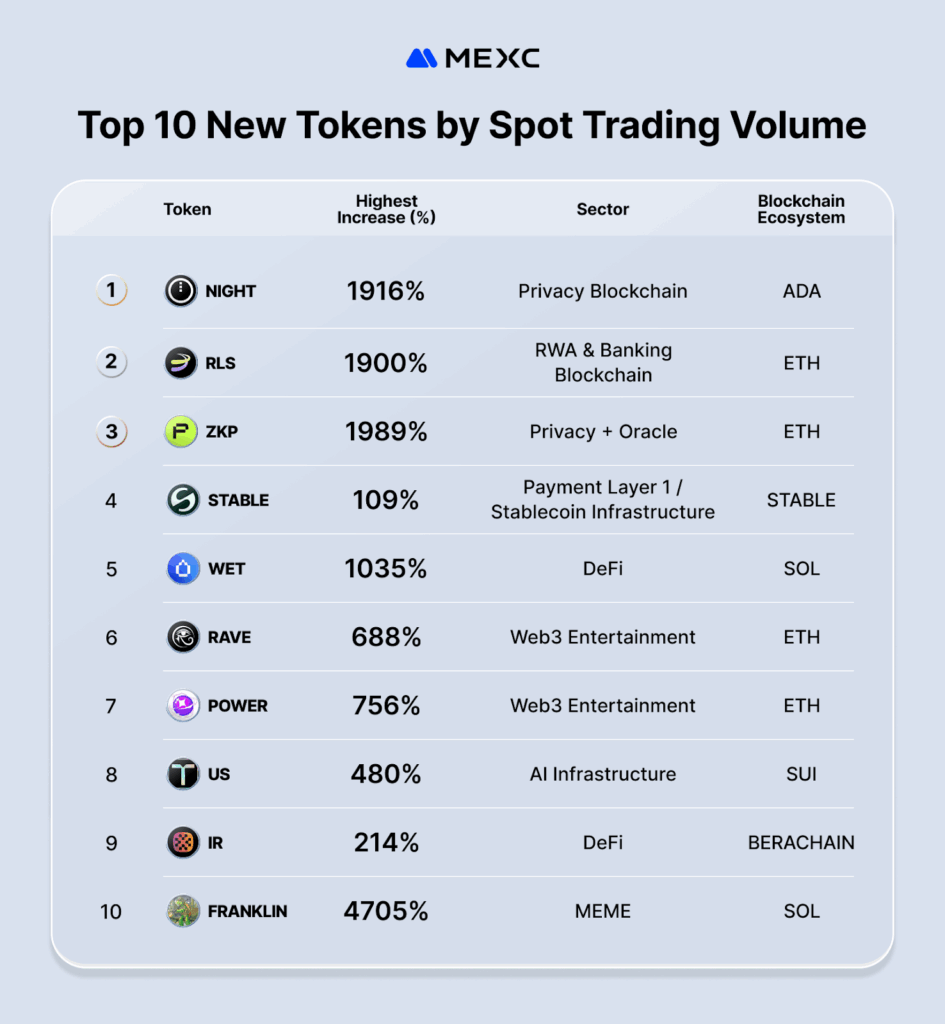
Notable institutional participation characterized the month’s listings. NIGHT, led by Ethereum and Cardano co-founder Charles Hoskinson, focuses on zero-knowledge proof technology for privacy infrastructure. STABLE, incubated by Bitfinex and Tether, utilizes USDT as gas for compliant payment solutions. The presence of established teams and technical foundations distinguished December’s top performers from previous months.

Privacy-focused and real-world asset projects delivered substantial returns. ZKP, NIGHT, and RLS each achieved gains approaching 2,000%, while the DeFAI sector showed strength with SEEK and THQ posting approximately 900% gains across Ethereum and BASE ecosystems.
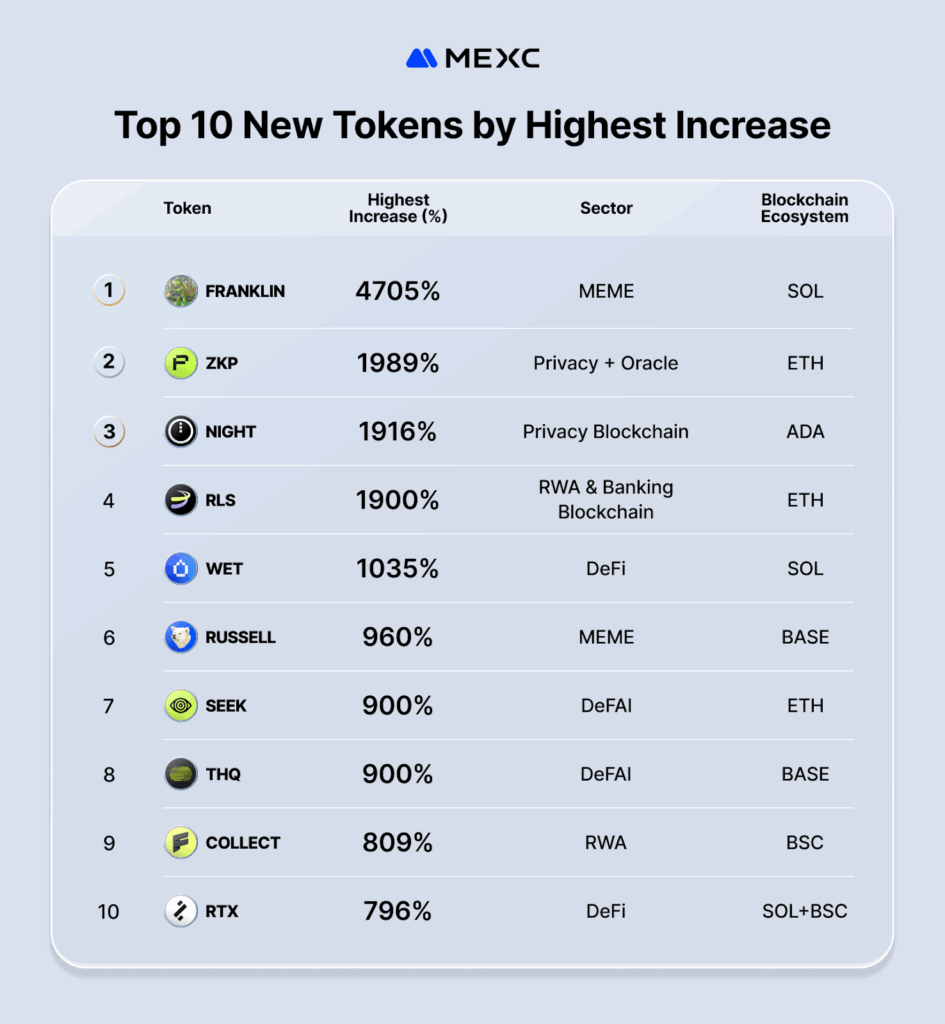
Top-performing assets spanned multiple blockchain ecosystems. Ethereum led with four positions across RWA, privacy, and entertainment sectors. Solana secured two positions, while emerging chains including Berachain, SUI, and StableChain demonstrated strong performance, reflecting broad ecosystem representation.

MEXC’s user-first approach translated into measurable participation growth across key initiatives. The Launchpad’s “Quality First” strategy delivered approximately 70% peak returns on Lighter (LIT), validating the platform’s asset selection framework for early-stage access.

Airdrop+ maintained high-frequency momentum with 30 events across DePIN, Privacy Computing, and RWA sectors. Participation surged 142% month-over-month with an 80% win rate, combining probability with meaningful upside.

The platform’s Spin & Win format integrated gamification directly into trading activity, allowing users to earn rewards through standard execution—reinforcing MEXC’s commitment to aligning user success with platform growth.

MEXC’s December performance reflects evolving market dynamics as capital allocation increasingly prioritizes utility-driven projects with institutional backing and technical fundamentals.

About MEXC

Founded in 2018, MEXC is committed to being “Your Easiest Way to Crypto”. Serving over 40 million users across 170+ countries, MEXC is known for its broad selection of trending tokens, frequent airdrop opportunities, and low trading fees. Our user-friendly platform is designed to support both new traders and experienced investors, offering secure and efficient access to digital assets. MEXC prioritizes simplicity and innovation, making crypto trading more accessible and rewarding.

MEXC Official Website| X | Telegram |How to Sign Up on MEXC

For media inquiries, please contact MEXC PR team:

  • media@mexc.com
  • Source

Disclaimer: TheNewsCrypto does not endorse any content on this page. The content depicted in this Press Release does not represent any investment advice. TheNewsCrypto recommends our readers to make decisions based on their own research. TheNewsCrypto is not accountable for any damage or loss related to content, products, or services stated in this Press Release.


TagsMEXCPrivacyRWA

Related Questions

QWhat were the two dominant themes in MEXC's December trading activity, according to the article?

APrivacy computing and real-world asset (RWA) tokenization were the two dominant themes.

QWhat percentage of the top 10 tokens by spot trading volume were infrastructure projects?

AInfrastructure projects accounted for 50% of the top 10 tokens by spot trading volume.

QWhich two specific tokens, backed by notable institutions, were highlighted for their focus on privacy and compliant payments?

ANIGHT, led by Charles Hoskinson, focused on privacy infrastructure, and STABLE, incubated by Bitfinex and Tether, focused on compliant payment solutions.

QWhat was the approximate percentage gain achieved by top privacy and RWA tokens like ZKP, NIGHT, and RLS?

ATokens like ZKP, NIGHT, and RLS each achieved gains approaching 2,000%.

QHow did user participation in the Airdrop+ events change from the previous month, and what was the win rate?

AParticipation in Airdrop+ events surged 142% month-over-month with an 80% win rate.

Related Reads

Can Japan Buy Growth with AI? Will the Bond Market Believe It?

Japan's cabinet has introduced the 2026 Basic Policy on Economic and Fiscal Management and Reform, shifting its primary fiscal target. The new framework moves away from the traditional annual primary balance goal and instead prioritizes a stable reduction of the debt-to-GDP ratio. This change is tied to a strategy of increased "responsible proactive fiscal" spending, aiming to boost long-term growth through investments in strategic sectors like AI, semiconductors, energy, and robotics. The government estimates total public and private investment in 62 key technologies could exceed 370 trillion yen by 2040. The market reaction has been mixed and cautious. While equity markets may respond to policy signals, bond markets are focused on fiscal credibility. Concerns center on whether the weakening of the clear primary balance anchor could lead to looser fiscal discipline. If investors doubt that these strategic investments will generate sufficient productivity gains, tax revenue, and nominal growth to outpace rising interest costs, they may demand higher yields on Japanese Government Bonds (JGBs). Recent volatility in the yen and JGB yields, with the 10-year yield briefly reaching 2.9%, reflects this skepticism. The success of this new framework hinges on two factors: whether Japan can achieve a nominal growth rate consistently higher than its long-term interest rates, and whether future budgets demonstrate disciplined control over bond issuance. The government's narrative is that strategic investment is essential to break Japan's cycle of low growth, aging, and labor shortages. However, the bond market will continuously assess the credibility of this plan, pricing the risk that it may represent fiscal expansion rather than a viable growth strategy.

marsbit29m ago

Can Japan Buy Growth with AI? Will the Bond Market Believe It?

marsbit29m ago

Misjudged A-Shares: Resilience, Expectations, and Confidence

China's A-share market recently faced selling pressure, especially in tech sectors, initially triggered by a global tech sell-off that began in South Korea. However, the article argues this is a case of "mistaken injury" and highlights the market's underlying resilience. This resilience stems from three main pillars: **1) Tech Sector Fundamentals:** Unlike Korea's market dominated by a few memory chip stocks, China's tech sector is diversified across computing, communications, electronics, and semiconductors, supported by dual narratives of global AI supply chains and domestic substitution. Core areas like optical modules and fiber optics continue to show strong earnings growth. **2) "National Team" Support:** State-backed institutions and large corporations have made significant market purchases and announced buybacks, providing liquidity and signaling confidence. This is seen as a stabilizing policy signal, often associated with market bottoms. **3) Broader Market Pillars:** Other major sectors are showing endogenous recovery momentum. Consumer stocks benefit from stabilizing CPI and signs of sector recovery (e.g., liquor price hikes). Cyclical sectors like aluminum have high earnings, potential price increases due to tight supply, and low valuations. The financial sector offers stable dividends and low valuations. The conclusion is that the sell-off was driven by external contagion, not a collapse in fundamentals. With strong policy support and recovering momentum across key sectors, the A-share market possesses the toughness to regain stability.

marsbit1h ago

Misjudged A-Shares: Resilience, Expectations, and Confidence

marsbit1h ago

Trading

Spot
活动图片




