Polymarket bets surge on Lighter airdrop as Hyperliquid lists LIT

cointelegraphPublished on 2025-12-23Last updated on 2025-12-23

Abstract

Lighter, a perpetual decentralized exchange (perp DEX) and rival to Hyperliquid, is generating significant airdrop speculation. A core contributor announced the platform is finalizing its token generation event (TGE), including removing Sybil and wash-trading points from its Season 2 rewards program. Hype intensified when Hyperliquid listed the yet-to-launch LIT token. Lighter opened an airdrop allocation form, allowing users to direct tokens to additional wallets, with submissions accepted until Friday. The transfer of 250 million LIT tokens (25% of supply) further fueled expectations. On prediction market Polymarket, the odds of an airdrop occurring by December 31st have surged to 86%, with $9.5 million in betting volume. Lighter recently raised $68 million in a round led by Founders Fund and Ribbit Capital.

Lighter, a perpetual decentralized exchange (perp DEX) and a major rival to Hyperliquid, is fueling airdrop speculation as Polymarket traders bet on a token launch before year’s end.

Sebas, also known as Babastianj, a core contributor to the Lighter DEX, announced on the project’s Discord channel Monday that the platform is finalizing key processes ahead of the highly anticipated token generation event (TGE).

“We’re in the final stretch of Season 2 and are running data science to remove Sybil, self-trading, and wash-trading points,” he said, adding that all slashed and removed points are planned to be redistributed to the community.

The announcement has fueled growing optimism over Lighter’s airdrop, further amplified with Hyperliquid’s listing of the yet-to-launch Lighter token against USDC (USDC) on Monday.

Lighter’s airdrop allocation form open until Friday

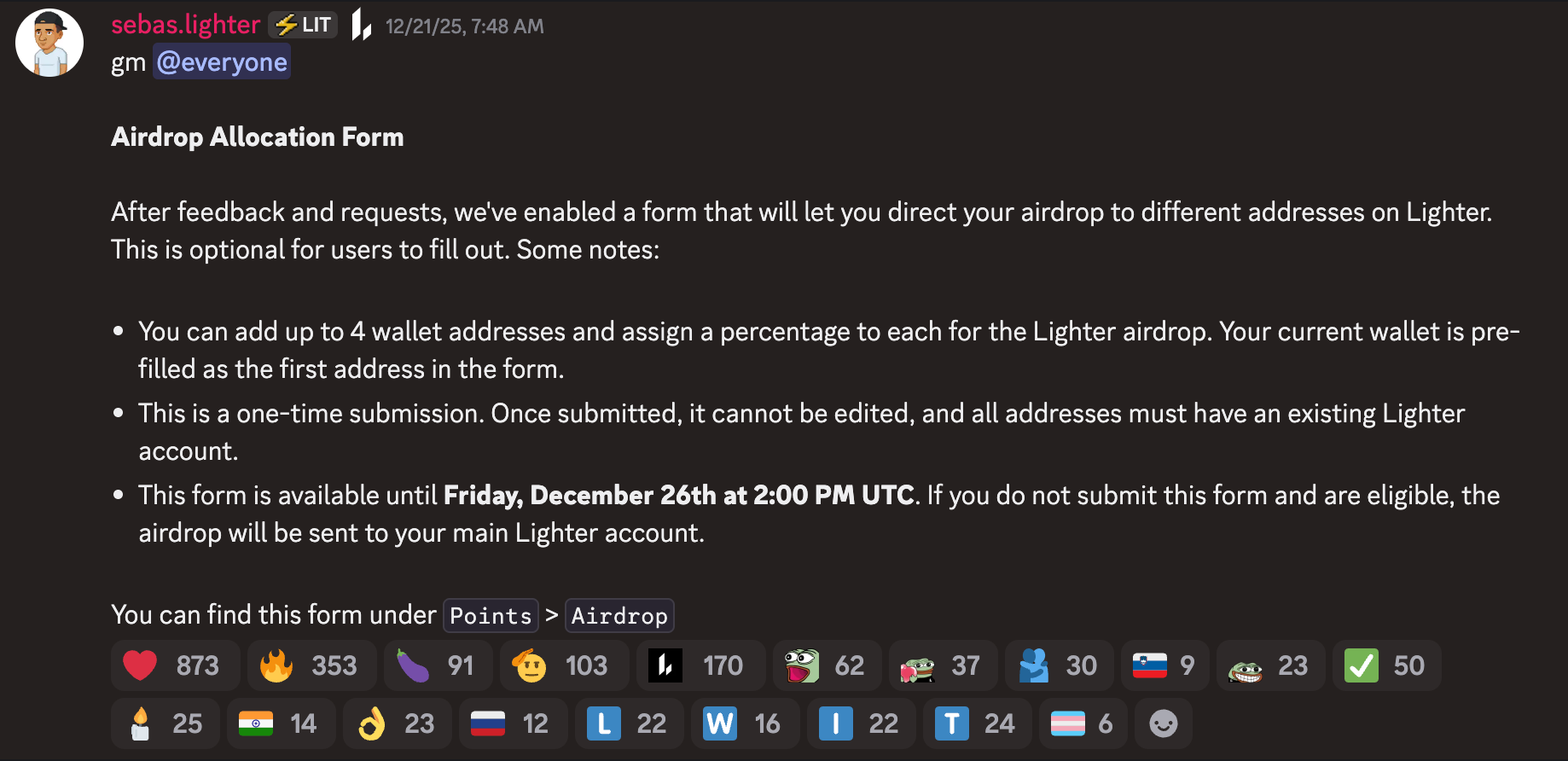
Lighter launched an airdrop allocation form on Sunday, allowing users to direct their tokens to up to four additional wallets.

The optional form lets users allocate different token amounts to each wallet, with submissions accepted through Friday.

“If you do not submit this form and are eligible, the airdrop will be sent to your main Lighter account,” Sebas said on Discord.
Source: Discord

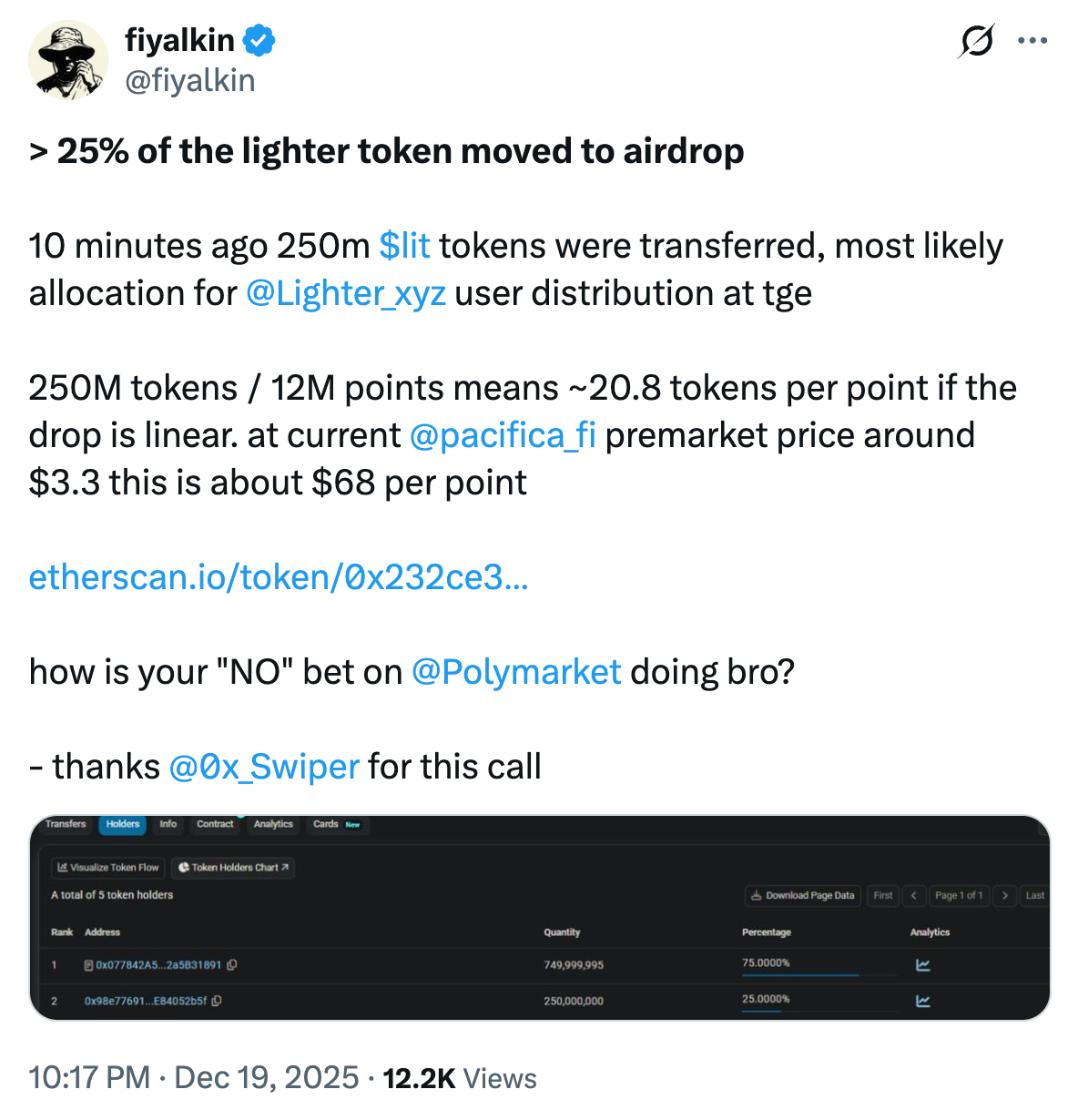
Lighter transferred 250 million LIT tokens — representing 25% of the total supply — on Friday, sparking community speculation that the move signaled an upcoming user airdrop ahead of the TGE, expected by Dec. 31.
Source: Fiyalkin

According to Lighter, its Season 1 points program ended with the final private beta distribution on Sept. 30, while Season 2 points are distributed every Friday.

Related: Hyperliquid says ex-employee responsible for HYPE token shorting

The points are earned by running organic trading strategies via user interface and application programming interface.

Polymarket odds on Lighter airdrop at 86%

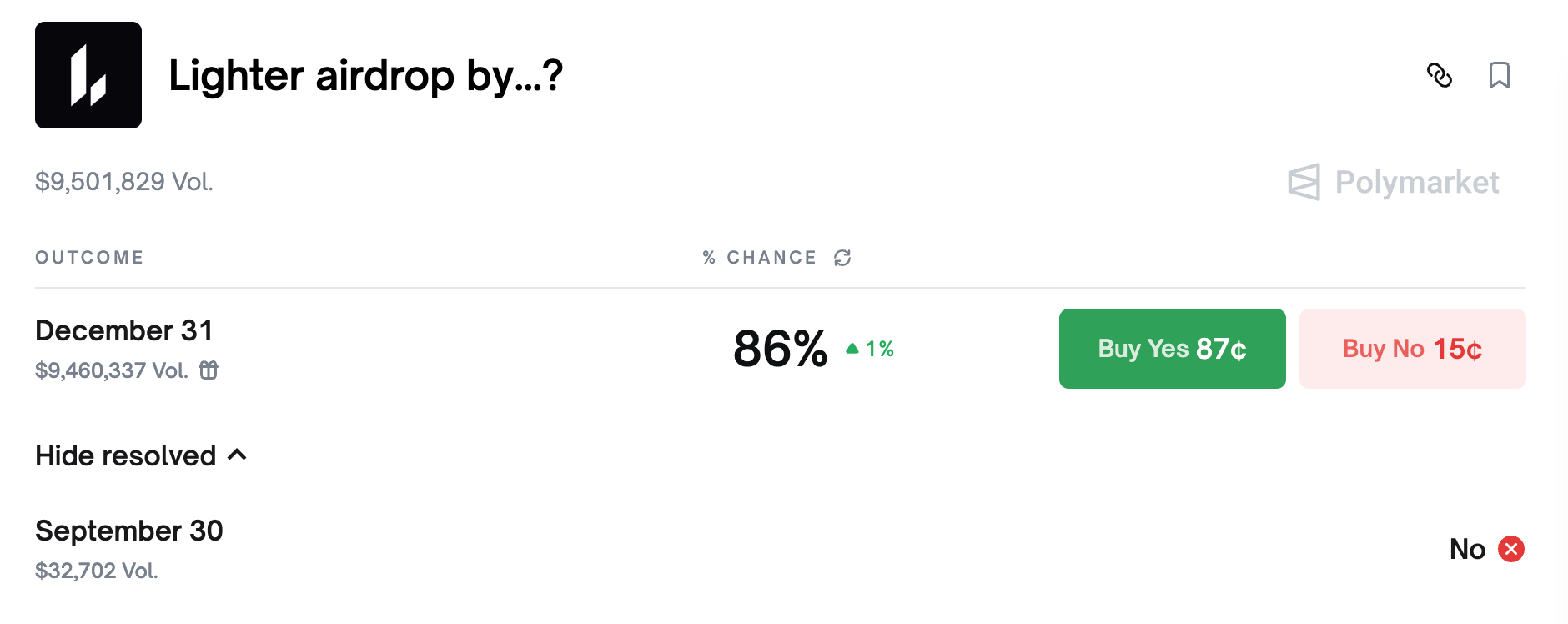
Amid rising community anticipation, the odds that Lighter’s airdrop will occur before the end of the year have been climbing on the prediction market Polymarket, with $9.5 million in volume backing bets that it will take place by Dec. 31.

At least 86% of traders have positioned their predictions on a “yes” scenario.

Onchain analyst Andrew 10 GWEI previously suggested that the airdrop would happen by the end of December, using an alleged insider bet proof on Polymarket.
Source: Polymarket

The news follows Lighter’s $68 million fundraising round announced in November, led by Peter Thiel’s Founders Fund and fintech investor Ribbit Capital, shortly after the platform launched its public mainnet in October.

Related: Coinbase opens Solana DEX access as CeFi and DeFi converge

Founded in 2022 by tech entrepreneur Vladimir Novakovski, Lighter has emerged as a key competitor in the perpetual decentralized exchange market, ranking as the second-largest perp DEX after Hyperliquid at the time of publication, according to DefiLlama data.

In mid-December, major US cryptocurrency exchange Coinbase added Lighter to its listing roadmap, signaling a potential future listing of the token, which has yet to be generated.

Related Questions

QWhat is the current probability on Polymarket that Lighter's airdrop will occur before the end of the year?

AThe current probability on Polymarket is 86%, with $9.5 million in volume backing bets that the airdrop will take place by December 31st.

QWhat action did Hyperliquid take that amplified the speculation around Lighter's token?

AHyperliquid listed the yet-to-launch Lighter token (LIT) against USDC on Monday, which amplified the growing optimism over the airdrop.

QWhat is the purpose of the airdrop allocation form that Lighter launched, and until when is it open?

AThe optional airdrop allocation form allows eligible users to direct their tokens to up to four additional wallets, with different amounts for each. Submissions are accepted through Friday.

QWhat percentage of the total LIT token supply was transferred recently, and what did this action spark in the community?

ALighter transferred 250 million LIT tokens, representing 25% of the total supply. This sparked community speculation that it signaled an upcoming user airdrop ahead of the Token Generation Event (TGE).

QWho led Lighter's recent $68 million fundraising round?

AThe $68 million fundraising round was led by Peter Thiel's Founders Fund and fintech investor Ribbit Capital.

Related Reads

Global Stock Market's Storm Center: South Korea's Stock Market De-leveraging Is Largely Complete

Storm's Eye: South Korean Market De-leveraging Nears Completion The recent sharp correction in South Korean equities, with the KOSPI index dropping 32% from its June high, has been a key trigger for global tech stock volatility. The core driver was not a fundamental shift but a forced de-leveraging process within the market's unique structure, which is now largely complete. Two main leverage channels amplified the sell-off: 1. **Leveraged ETFs:** Their size, proportionally four times larger than in the U.S., peaked near $50 billion. Their mandatory daily rebalancing mechanism created a vicious cycle of "price drop → forced selling → further drop." Approximately 75% of this excess has been unwound, shrinking to $26 billion, with regulatory curbs now blocking new inflows. 2. **Hedge Fund Leverage:** Using swaps to magnify exposure, hedge funds saw their net long positioning fall by over 50% from peak levels. The most intense phase of this institutional de-leveraging is over. In contrast, **retail margin debt** poses minimal systemic risk. At 0.5% of market cap, it is far lower than in the U.S. or China, lacks automatic triggers, and is concentrated in smaller stocks. The conclusion: the high-leverage structures most prone to "chain-reaction selling" have been substantially cleared. The market is transitioning from a liquidity-driven crash to one priced more on fundamentals. The article argues that the AI trend—centered on Korean memory chips—remains intact. This episode represents a painful but necessary clearing of crowded trades, not the end of the AI revolution. For investors, the key question is conviction in the long-term AI direction; if the trend is real, current volatility is a cost of entry, not a terminal risk.

链捕手58m ago

Global Stock Market's Storm Center: South Korea's Stock Market De-leveraging Is Largely Complete

链捕手58m ago

The Eternal Fragments of Money: Third-Party Payment Has No First Principle

"The Enduring Fragments of Money: Third-Party Payments Lack a First Principle" Stripe is reportedly attempting to acquire PayPal, marking a significant shift reminiscent of PayPal's merger with the original X.com 30 years ago. The article analyzes Stripe's strategic challenges and the broader payments industry landscape. Despite its initial success with a developer-friendly API model, Stripe missed its optimal IPO window during the pandemic and has since seen its valuation decline. Its attempts to expand through acquisitions and new ventures, particularly in stablecoins (like its OUSD project) and Agent-focused payments (ACP/MPP protocols), have faced headwinds. The author argues that the payment industry remains highly fragmented and is ultimately an adjunct to the traditional banking system. This structure limits the potential for any single player, including Stripe, to achieve complete dominance. While stablecoins and the future rise of autonomous Agent economies present potential growth avenues, they are not yet mainstream and still require integration with the existing financial system. For now, Agent-based transactions are largely used for speculative "volume boosting" rather than substantive business applications. Stripe's current move to acquire PayPal is seen as an attempt to bolster its weak consumer-facing (C-side) business after its stablecoin-focused strategies faltered. Meanwhile, PayPal is described as structurally outdated, unable to revive itself through new products like Venmo or PYUSD. The future of payments may lie not in payments themselves but in value-added services like more efficient settlement networks. The author suggests that companies like Stripe and Circle, which are building their own blockchains (Tempo, Arc) and stablecoins, are positioning themselves to eventually profit from high-efficiency settlement systems. These new networks could potentially bypass some traditional banking layers. In conclusion, the article posits that third-party payment is a perpetually fragmented battlefield where scale alone cannot ensure victory. Players must find new models, focusing on efficiency to compete with the entrenched banking system. Stripe's acquisition of PayPal represents a bet on this uncertain future.

链捕手1h ago

The Eternal Fragments of Money: Third-Party Payment Has No First Principle

链捕手1h ago

Trading

Spot
活动图片





