Polymarket acquires Brahma to fix ‘liquidity imbalance’: Report

ambcryptoPublished on 2026-03-19Last updated on 2026-03-19

Abstract

Polymarket has acquired crypto infrastructure firm Brahma to address liquidity imbalances and improve its on-chain trading systems. While popular markets like elections attract significant activity, niche markets suffer from low participation and unreliable pricing. The acquisition aims to distribute liquidity more evenly and enhance platform efficiency. Despite rapid growth and a valuation of $18–20 billion, driven by the 2024 election cycle, Polymarket faces inconsistent trading activity and a recent drop in market share. Competitor Kalshi, a regulated non-crypto platform, briefly captured 66% market share during the election. Polymarket continues to focus on crypto, with plans for a native token, contrasting with Kalshi’s traditional approach.

In a surprising shift, Polymarket has moved beyond simply hosting bets on future events and is now working to build the full infrastructure behind those wagers.

According to reports, Polymarket has acquired Brahma, a company specializing in crypto and DeFi infrastructure. This means Polymarket wants better technology to make its platform faster, smoother, and more on-chain.

Polymarket has grown rapidly, now valued at an estimated $18–20 billion, boosted by heavy activity during the 2024 elections. Yet with that growth come new challenges.

What is Polymarket trying to revamp with Brahma?

One of the core problems is liquidity imbalance. This means popular wagers, like elections or major sports events, attract a lot of money and activity.

Whereas, smaller or niche wagers struggle because not enough people are betting on them. That makes prices less reliable and the markets less useful.

Citing examples, Fortune added,

Larger event contracts, like those in sports or politics, easily bring lots of money into the pool. But smaller wagers focused on niche areas such as, for instance, the outcome of a bowling match in Spain, struggle to amass a sizable amount of liquidity.

Therefore, by acquiring Brahma, Polymarket is trying to fix this by improving how liquidity is distributed across markets. The plan also focuses on making trading more efficient and strengthening its blockchain-based system.

Remarking on this initiative, Shayne Coplan, founder and CEO of Polymarket, told Fortune,

Building reliable infrastructure across blockchain networks and traditional financial rails is hard—there are no shortcuts.

That said, Brahma, founded in 2021, has already processed over $1 billion in transactions, and by bringing its team in-house, Polymarket is effectively shutting down Brahma’s external operations to focus entirely on its growth.

Polymarket’s metrics paint a confusing picture

However, the platform’s internal data suggests that growth is not entirely balanced. While more capital is flowing into the system, as seen in the steady rise in Open Interest, actual trading activity remains inconsistent.
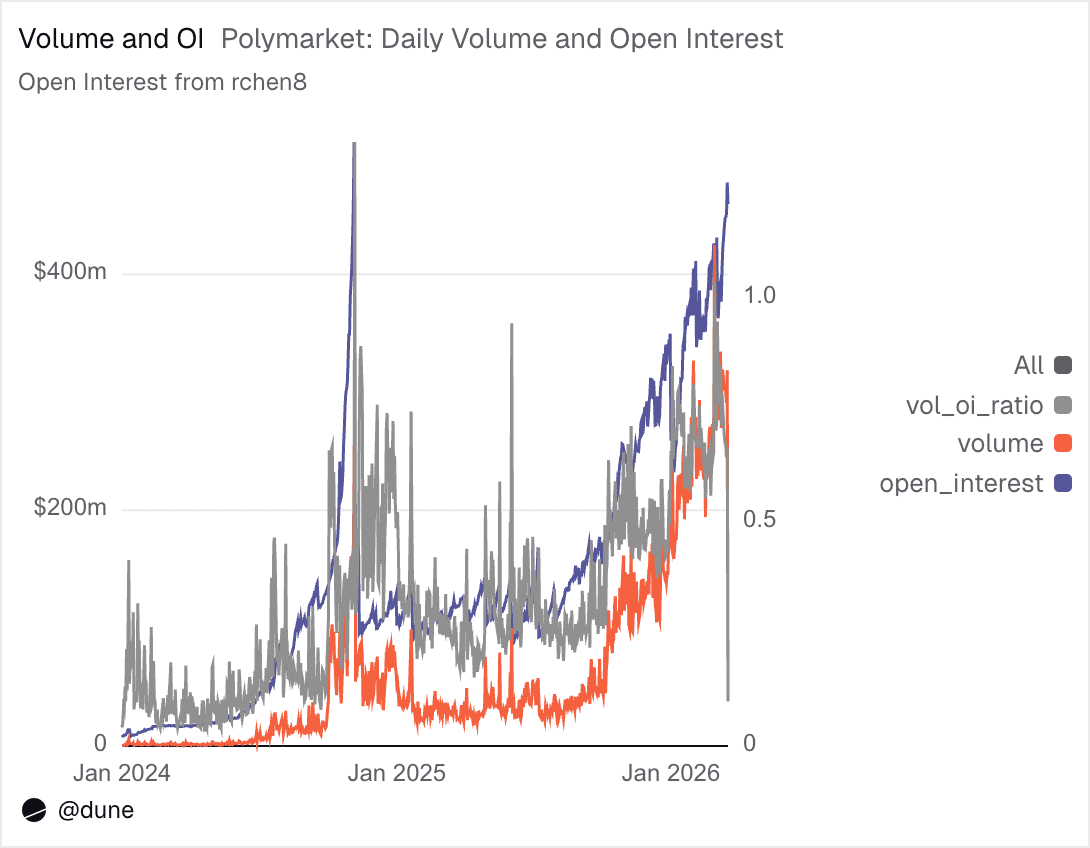
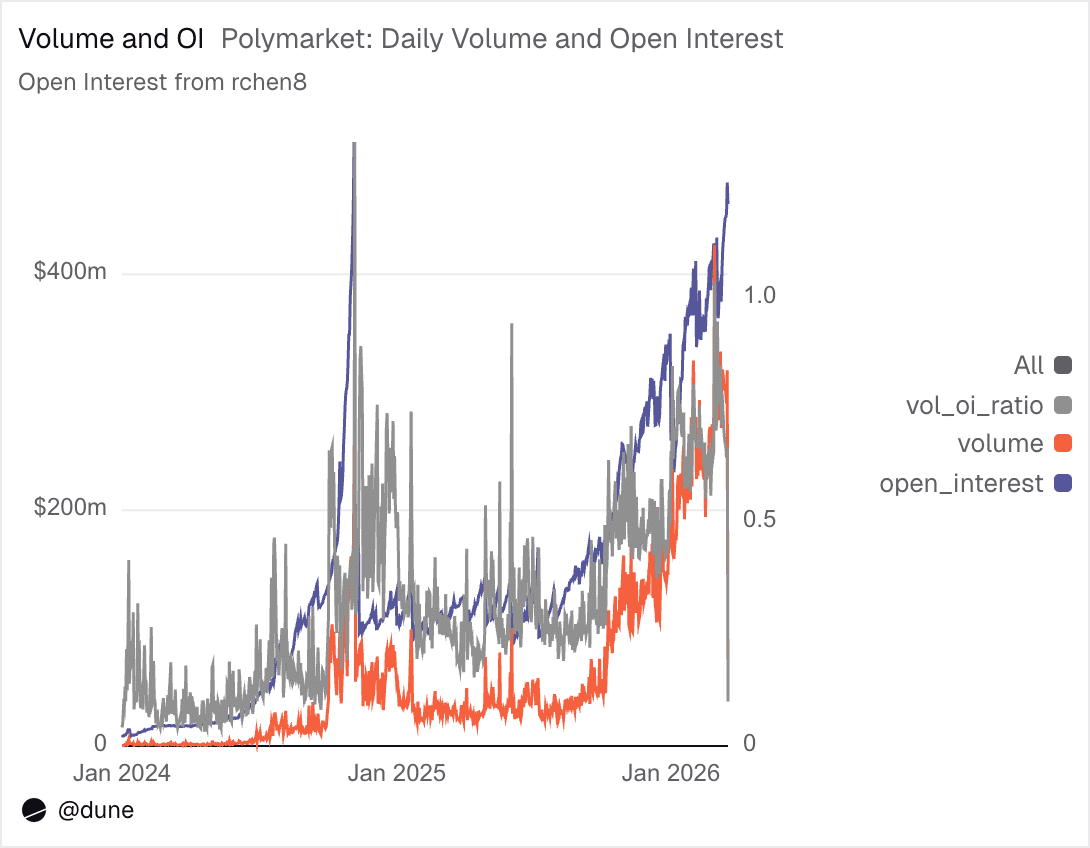
Source: Dune

This gap shows that users place long-term bets but trade inconsistently, resulting in low liquidity and one-sided markets.

Even though the platform became very popular during the 2024 election cycle, its dominance didn’t last. Its market share dropped sharply from over 61% to around 32% as the hype faded. However, at press time, Polymarket’s stock price stood at $141.60, marking a more than 20% increase year-to-date.

Is Polymarket losing ground against Kalshi?

In fact, during the 2024 election, its U.S.-based competitor Kalshi took advantage of the slowdown, briefly capturing about 66% market share and handling nearly $1 billion in weekly trading volume.

This competition reflects two very different paths. Kalshi follows a fully regulated approach with no blockchain, DeFi, or token layer.

Polymarket, in contrast, is doubling down on crypto. Besides Brahma, the platform’s CEO is also hinting at a potential POLY token. With a possible 2026 launch, it acts as a strong incentive for users, something regulated platforms like Kalshi are struggling to offer.


Final Summary

  • The Brahma acquisition shows that fixing liquidity and market efficiency is now more important than just attracting users.
  • Competition from regulated players like Kalshi adds pressure, especially as they gain ground during periods of low hype.


Related Questions

QWhat is the primary reason Polymarket acquired Brahma, according to the report?

APolymarket acquired Brahma to fix the 'liquidity imbalance' on its platform by improving how liquidity is distributed across markets, making trading more efficient, and strengthening its blockchain-based system.

QWhat specific problem does the 'liquidity imbalance' cause for smaller wagers on Polymarket?

ASmaller or niche wagers struggle to attract enough betting activity, which makes their prices less reliable and the markets less useful due to low liquidity.

QHow did Polymarket's market share change after the hype of the 2024 election cycle faded?

APolymarket's market share dropped sharply from over 61% to around 32% after the hype of the 2024 election cycle faded.

QWhich competitor briefly captured about 66% market share during Polymarket's slowdown, and what is its key operational difference?

AKalshi, Polymarket's U.S.-based competitor, briefly captured about 66% market share. Its key difference is that it follows a fully regulated approach with no blockchain, DeFi, or token layer.

QWhat potential incentive is Polymarket's CEO hinting at to attract users, and how does it contrast with regulated platforms?

APolymarket's CEO is hinting at a potential POLY token, which acts as a strong incentive for users. This is something regulated platforms like Kalshi struggle to offer.

Related Reads

Bitcoin Boom in Full Swing: Saylor's Latest Statement Fuels Buying Speculation

MicroStrategy's Executive Chairman Michael Saylor has fueled speculation about a new Bitcoin purchase by posting "Bitcoin Drive engaged" on August 2, accompanied by the company's customary purchase tracker. This aligns with his pattern of hinting at treasury changes ahead of weekly reports. The accompanying report showed MicroStrategy's Bitcoin holdings at 843,775 BTC, with an average cost of $75,653 per coin and an unrealized loss of -$10.58B. A similar signal preceded the company's July 27 announcement, strengthening expectations for a treasury update on Monday. However, MicroStrategy's real-time ledger reflects two recent Bitcoin sales totaling 3,588 BTC, reducing holdings from 847,363 BTC to the current 843,775 BTC. The company stated these sales funded preferred stock dividends and replenished its U.S. dollar reserve. Recent reports indicate the company made no Bitcoin purchases the week ending July 26 while increasing its dollar reserve to approximately $3.75B. The company faces financial headwinds after reporting an $8.33B operating loss for Q2 2026, including an $8.32B unrealized loss on its digital assets. Management may sell up to $1.25B more in Bitcoin to meet cash obligations. The expected Monday update will reveal if the "Bitcoin Drive" signal marks a return to accumulation as MicroStrategy balances its massive Bitcoin stash against growing cash commitments.

cryptonews.ru2h ago

Bitcoin Boom in Full Swing: Saylor's Latest Statement Fuels Buying Speculation

cryptonews.ru2h ago

Trading

Spot
活动图片




