Polygon deploys Madhugiri hard fork, aims for 33% throughput boost

cointelegraphPublished on 2025-12-09Last updated on 2025-12-09

Abstract

Polygon has deployed the Madhugiri hard fork, targeting a 33% increase in network throughput and reducing block consensus time to one second. The upgrade includes support for three Fusaka Ethereum Improvement Proposals (EIP-7823, EIP-7825, EIP-7883), which improve efficiency and security by limiting gas consumption for heavy mathematical operations. It also introduces a new transaction type for Ethereum-Polygon bridge traffic and adds flexibility for future upgrades. This enhancement aims to better support high-frequency use cases like stablecoins and real-world asset (RWA) tokenization. The hard fork follows the recent Heimdall 2.0 upgrade, which significantly reduced finality times, despite a brief disruption in September due to a bug that was later resolved.

Blockchain network Polygon has rolled out its latest protocol upgrade, known as the Madhugiri hard fork, which aims to achieve a 33% increase in network throughput and reduce block consensus time to one second.

Polygon core developer Krishang Shah said on X that the update includes support for three Fusaka Ethereum Improvement Proposals, specifically EIP-7823, EIP-7825 and EIP-7883. These EIPs make heavy mathematical operations more efficient and secure by limiting the amount of gas they consume.

They also prevent single transactions from consuming excessive computing power, helping the network run more smoothly and predictably.

The upgrade introduces a new transaction type for Ethereum to Polygon bridge traffic and adds a built-in flexibility feature for future upgrades. Polygon previously said that the update makes throughput increases as easy as “flipping a few switches.”

“We are also decreasing the consensus time to 1 second, so blocks can now be announced in 1 second if ready, instead of waiting the full 2 seconds,” Shah wrote.
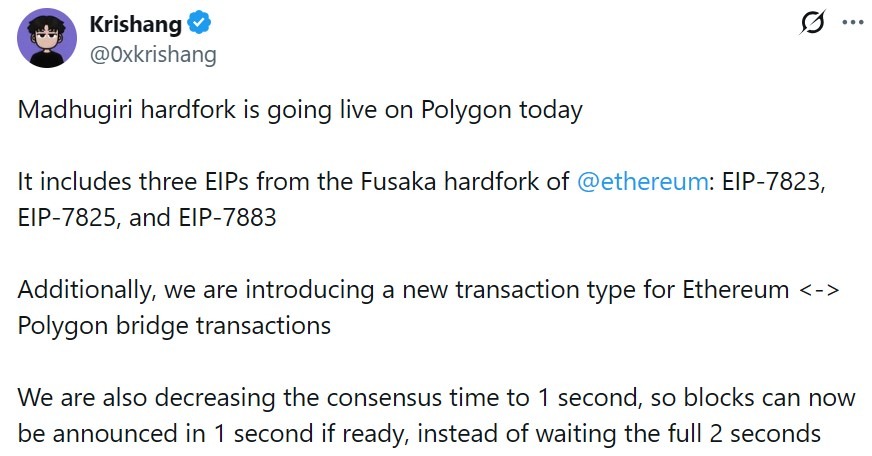
Source: Krishang Shah

New update reinforces Polygon for stablecoins and RWAs

With Madhugiri now live, Polygon aims to reinforce its infrastructure while materially improving its performance. These are prerequisites for high-frequency and high-trust use cases, such as real-world asset (RWA) tokenization and stablecoins.

Aishwary Gupta, the global head of payments and RWAs at Polygon Labs, previously forecasted a “stablecoin supercycle.”

Gupta said there will be a surge of “at least 100,000 stablecoins” in the next five years. However, he said this would not only be about minting tokens and must have a corresponding utility like yield.

Gupta also advocated for more transparency and accountability in the RWA sector. He previously argued that RWA numbers are meaningless if the assets cannot be audited, settled or traded.

“When transparency and accountability are established, RWAs will reach even greater heights, unlocking trillions in institutional capital,” he wrote.

Related: Polygon co-founder mulls resurrecting MATIC a year after POL rebrand

Hard fork follows major Heimdall upgrade

The upgrade comes on the heels of rapid prior improvements. On July 10, Polygon deployed Heimdall 2.0, dubbed by Polygon Foundation CEO Sandeep Nailwal as the network’s “most technically complex” hard fork since its launch.

The update reduced transaction finality times from one to two minutes to roughly five seconds.

However, on Sept. 10, the network experienced a significant disruption when a bug caused finality delays of 10 to 15 minutes, affecting validator sync, remote procedure call services and third-party tooling. Despite this, the team assured the community that blocks were still running.

On Sept. 11, the Polygon Foundation announced that the consensus and finality functions had been restored through a hard fork. With the update, nodes were no longer stuck, while checkpoints and milestones were finalized as expected.

Magazine: Ethereum’s Fusaka fork explained for dummies: What the hell is PeerDAS?

Related Reads

Polymarket's "2028 Presidential Election" Volume King Is... LeBron James???

An article from Odaily Planet Daily, authored by Azuma, discusses a peculiar phenomenon observed on the prediction market platform Polymarket regarding the "2028 US Presidential Election" event. Despite having a real-time probability of less than 1%, unlikely candidates such as NBA star LeBron James (with $48.41 million in trading volume), celebrity Kim Kardashian ($33.84 million), and even ineligible figures like Elon Musk ($23.14 million) and New York City Mayor Zohran Mamdani ($18.39 million) account for approximately 70% of the total trading volume. In contrast, high-probability candidates like Vice President JD Vance ($10.58 million), California Governor Gavin Newsom ($15.71 million), and Secretary of State Marco Rubio ($9.32 million) have significantly lower trading activity. The article explains that this counterintuitive trend is not driven by irrational speculation but by rational strategies. Polymarket offers a 4% annualized holding reward for certain markets, including the 2028 election, to maintain long-term pricing accuracy. This yield exceeds the current 5-year US Treasury rate (3.98%), attracting large investors ("whales") to hold "NO" shares on low-probability candidates for risk-free returns. Additionally, some users utilize a platform feature that allows converting a set of "NO" shares into corresponding "YES" shares for better liquidity or pricing efficiency, rather than directly buying "YES" shares for their preferred candidates. Thus, the seemingly absurd trading activity is strategically motivated.

marsbit1h ago

Polymarket's "2028 Presidential Election" Volume King Is... LeBron James???

marsbit1h ago

Dialogue with ViaBTC CEO Yang Haipo: Is the Essence of Blockchain a Libertarian Experiment?

"ViaBTC CEO Yang Haipo: Blockchain as a Hardcore Libertarian Experiment" In a deep-dive interview, ViaBTC CEO Yang Haipo reframes the essence of blockchain, arguing it is not merely a new technology or infrastructure but a hardcore libertarian experiment. This experiment, born from the 2008 financial crisis and decades of cypherpunk ideology, tests a fundamental question: to what extent can freedom and self-organization exist without centralized trust? The discussion highlights the experiment's verified outcomes. On one hand, it has proven its core value of censorship resistance, providing critical financial lifelines for entities like WikiLeaks and individuals in hyperinflationary or sanctioned countries via tools like stablecoins. However, Yang points out a key paradox: the most successful product, USDT, is itself a centralized compromise, showing users prioritize a less-controlled pipeline over pure decentralization. On the other hand, the experiment has exposed the severe costs of this freedom—a "dark forest" without safeguards. Events like the collapses of LUNA, Celsius, and FTX, resulting in massive wealth destruction and prison sentences for founders, underscore the system's fragility and the inherent risks of an unregulated environment. Yang observes that despite decentralized protocols, human nature inevitably recreates centralized power structures, speculative frenzies, and narrative-driven cycles (from ICOs to Meme coins), where emotion and belonging often trump technological substance. Looking forward, he believes blockchain's future is significant but niche. Its real value lies in serving specific, real-world needs for financial sovereignty and bypassing traditional controls, not as a universal infrastructure replacing all centralized systems. For the average participant, Yang's crucial advice is to cultivate independent judgment. True freedom is not holding a crypto wallet, but possessing a mind resilient to groupthink and narrative hype in a high-risk, often irrational market.

marsbit1h ago

Dialogue with ViaBTC CEO Yang Haipo: Is the Essence of Blockchain a Libertarian Experiment?

marsbit1h ago

Trading

Spot
Futures
活动图片