Polygon deploys Madhugiri hard fork, aims for 33% throughput boost

cointelegraphPublished on 2025-12-09Last updated on 2025-12-09

Abstract

Polygon has deployed the Madhugiri hard fork, targeting a 33% increase in network throughput and reducing block consensus time to one second. The upgrade includes support for three Fusaka Ethereum Improvement Proposals (EIP-7823, EIP-7825, EIP-7883), which improve efficiency and security by limiting gas consumption for heavy mathematical operations. It also introduces a new transaction type for Ethereum-Polygon bridge traffic and adds flexibility for future upgrades. This enhancement aims to better support high-frequency use cases like stablecoins and real-world asset (RWA) tokenization. The hard fork follows the recent Heimdall 2.0 upgrade, which significantly reduced finality times, despite a brief disruption in September due to a bug that was later resolved.

Blockchain network Polygon has rolled out its latest protocol upgrade, known as the Madhugiri hard fork, which aims to achieve a 33% increase in network throughput and reduce block consensus time to one second.

Polygon core developer Krishang Shah said on X that the update includes support for three Fusaka Ethereum Improvement Proposals, specifically EIP-7823, EIP-7825 and EIP-7883. These EIPs make heavy mathematical operations more efficient and secure by limiting the amount of gas they consume.

They also prevent single transactions from consuming excessive computing power, helping the network run more smoothly and predictably.

The upgrade introduces a new transaction type for Ethereum to Polygon bridge traffic and adds a built-in flexibility feature for future upgrades. Polygon previously said that the update makes throughput increases as easy as “flipping a few switches.”

“We are also decreasing the consensus time to 1 second, so blocks can now be announced in 1 second if ready, instead of waiting the full 2 seconds,” Shah wrote.
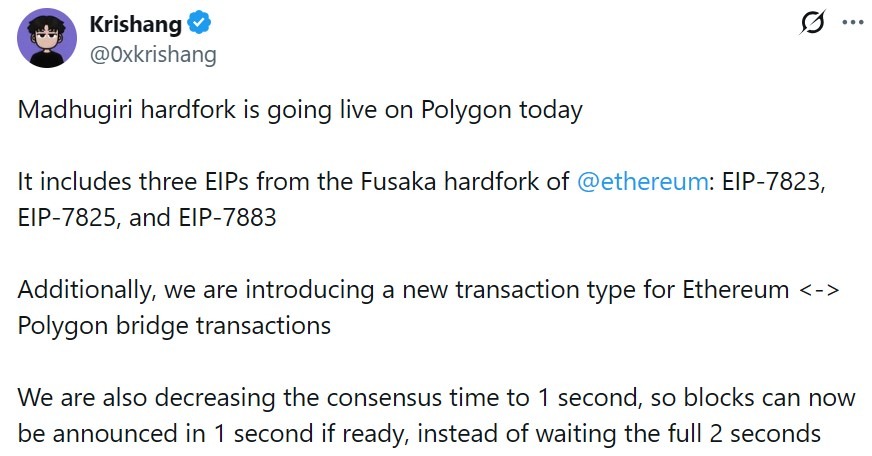
Source: Krishang Shah

New update reinforces Polygon for stablecoins and RWAs

With Madhugiri now live, Polygon aims to reinforce its infrastructure while materially improving its performance. These are prerequisites for high-frequency and high-trust use cases, such as real-world asset (RWA) tokenization and stablecoins.

Aishwary Gupta, the global head of payments and RWAs at Polygon Labs, previously forecasted a “stablecoin supercycle.”

Gupta said there will be a surge of “at least 100,000 stablecoins” in the next five years. However, he said this would not only be about minting tokens and must have a corresponding utility like yield.

Gupta also advocated for more transparency and accountability in the RWA sector. He previously argued that RWA numbers are meaningless if the assets cannot be audited, settled or traded.

“When transparency and accountability are established, RWAs will reach even greater heights, unlocking trillions in institutional capital,” he wrote.

Related: Polygon co-founder mulls resurrecting MATIC a year after POL rebrand

Hard fork follows major Heimdall upgrade

The upgrade comes on the heels of rapid prior improvements. On July 10, Polygon deployed Heimdall 2.0, dubbed by Polygon Foundation CEO Sandeep Nailwal as the network’s “most technically complex” hard fork since its launch.

The update reduced transaction finality times from one to two minutes to roughly five seconds.

However, on Sept. 10, the network experienced a significant disruption when a bug caused finality delays of 10 to 15 minutes, affecting validator sync, remote procedure call services and third-party tooling. Despite this, the team assured the community that blocks were still running.

On Sept. 11, the Polygon Foundation announced that the consensus and finality functions had been restored through a hard fork. With the update, nodes were no longer stuck, while checkpoints and milestones were finalized as expected.

Magazine: Ethereum’s Fusaka fork explained for dummies: What the hell is PeerDAS?
Related Reads

Robinhood CEO named three benefits of tokenized stocks for American investors

Robinhood CEO Vlad Tenev advocates for the U.S. to allow trading of tokenized stocks domestically. He argues this model could modernize the financial system through three key benefits: **faster, near real-time settlements** reducing counterparty risk and broker capital requirements; **24/7 trading** enabling reaction to market events anytime; and **greater asset portability**, allowing tokens to be moved between platforms and held in self-custody wallets, increasing competition among services. Tenev emphasized tokenization is about rebuilding asset ownership infrastructure for freer movement, similar to information online. He highlighted potential integration with DeFi, where tokenized stocks could be used for lending or as collateral. Currently, Robinhood's stock tokens are not direct ownership of the underlying securities but are backed by them and provide access to economic value like dividends; their structure may evolve with future regulations. Tenev identified outdated securities laws and market infrastructure, developed over a century, as the main U.S. obstacle, urging regulators to adapt rules for blockchain while preserving investor protections. He warned it would be strange if the rest of the world could build the future of ownership around U.S. assets while Americans are left behind, suggesting tokenization could later expand to private company shares and other illiquid assets.

cryptonews.ru7m ago

Robinhood CEO named three benefits of tokenized stocks for American investors

cryptonews.ru7m ago

Web3 Wallets in a 'Turbulent Autumn': In the AI Era, How to Understand the Evolution of 'Spear and Shield' in Crypto Security?

The recent spate of incidents involving Coldcard, Trezor, and SafePal highlights a critical evolution in cryptocurrency wallet security, moving the focus beyond simple private key protection to a holistic, multi-layered attack surface. These events—spanning a random number generator flaw, supply chain data leaks, and plugin permission issues—underscore that vulnerabilities now exist across the entire wallet lifecycle: from secure element and code generation to logistics, user data, and daily interactions with dApps. This broadening threat landscape is accelerating with the advent of AI. Attackers are leveraging AI to automate and scale previously labor-intensive tasks like vulnerability discovery, sophisticated social engineering, and targeted phishing campaigns. This effectively lowers the cost of attacks, eroding the security margin once provided by the high effort required to find and exploit flaws. In response, defense strategies must also evolve by integrating AI. The future of wallet security lies not just in static rules and blacklists, but in proactive, AI-powered risk assessment. This includes pre-transaction simulation, behavioral analysis to detect anomalies (like sudden large approvals), and contextual awareness of dApps and counterparties. The goal is to transform wallets from passive signing tools into active guardians that can understand intent, predict outcomes, and clearly communicate risks to users—all while preserving user sovereignty and control through minimal permissions and human confirmation for critical actions. Ultimately, self-custody does not guarantee inherent safety; it returns absolute control to the user. Protecting that control requires a dynamic, evolving security posture where AI becomes a essential tool on both sides of an ongoing "spear and shield" arms race in the Web3 ecosystem.

marsbit17m ago

Web3 Wallets in a 'Turbulent Autumn': In the AI Era, How to Understand the Evolution of 'Spear and Shield' in Crypto Security?

marsbit17m ago

Trading

Spot
活动图片